
Aristotelian Philosophy at Paris
MARSILIUS of Inghen, GILES of Rome, and ALBERT of Saxony.
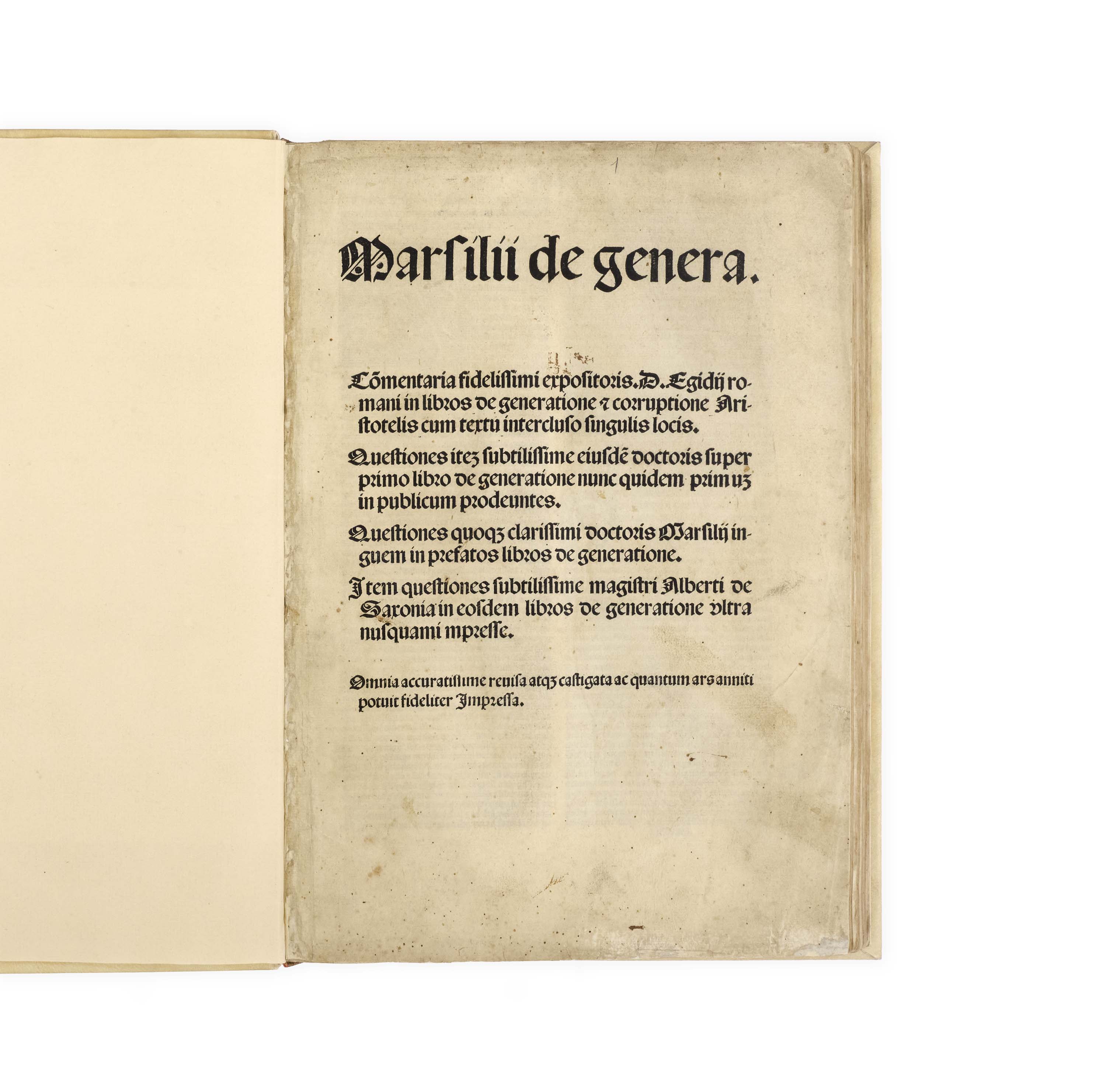
Marsilii de genera[tione et corruptione]. Commentaria fidelissimi expositoris D. Egidii Romani in libris de generatione & corruptione Aristotelis cum textu intercluso singulis locis … Omnia accuratissime revisa atque castigata ac quantum ars anniti potuit fideliter impressa. [(Colophon:) Venice, [Boneto Locatello for] the heirs and partners of Ottaviano Scoto, 19 June 1520.]
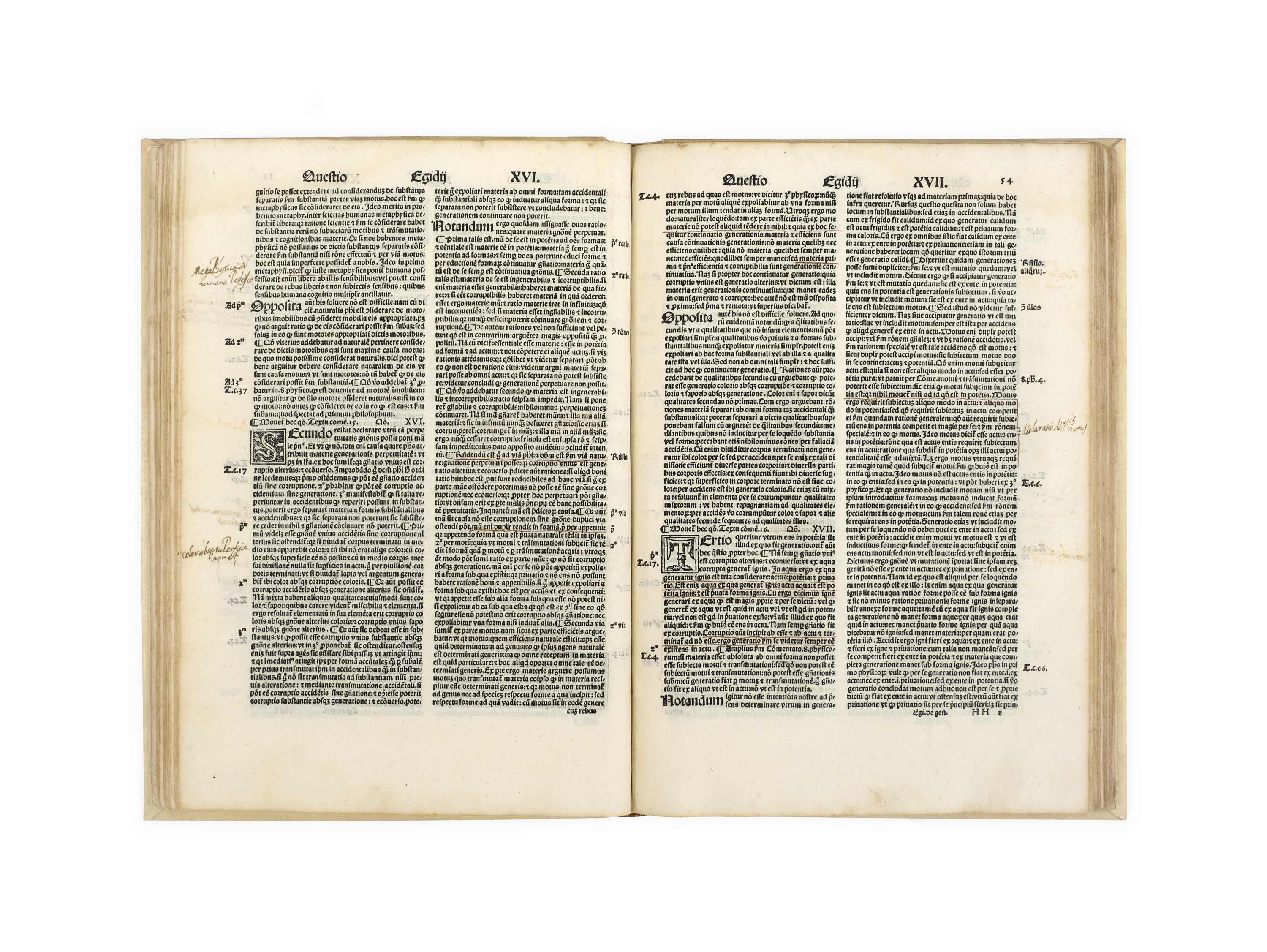
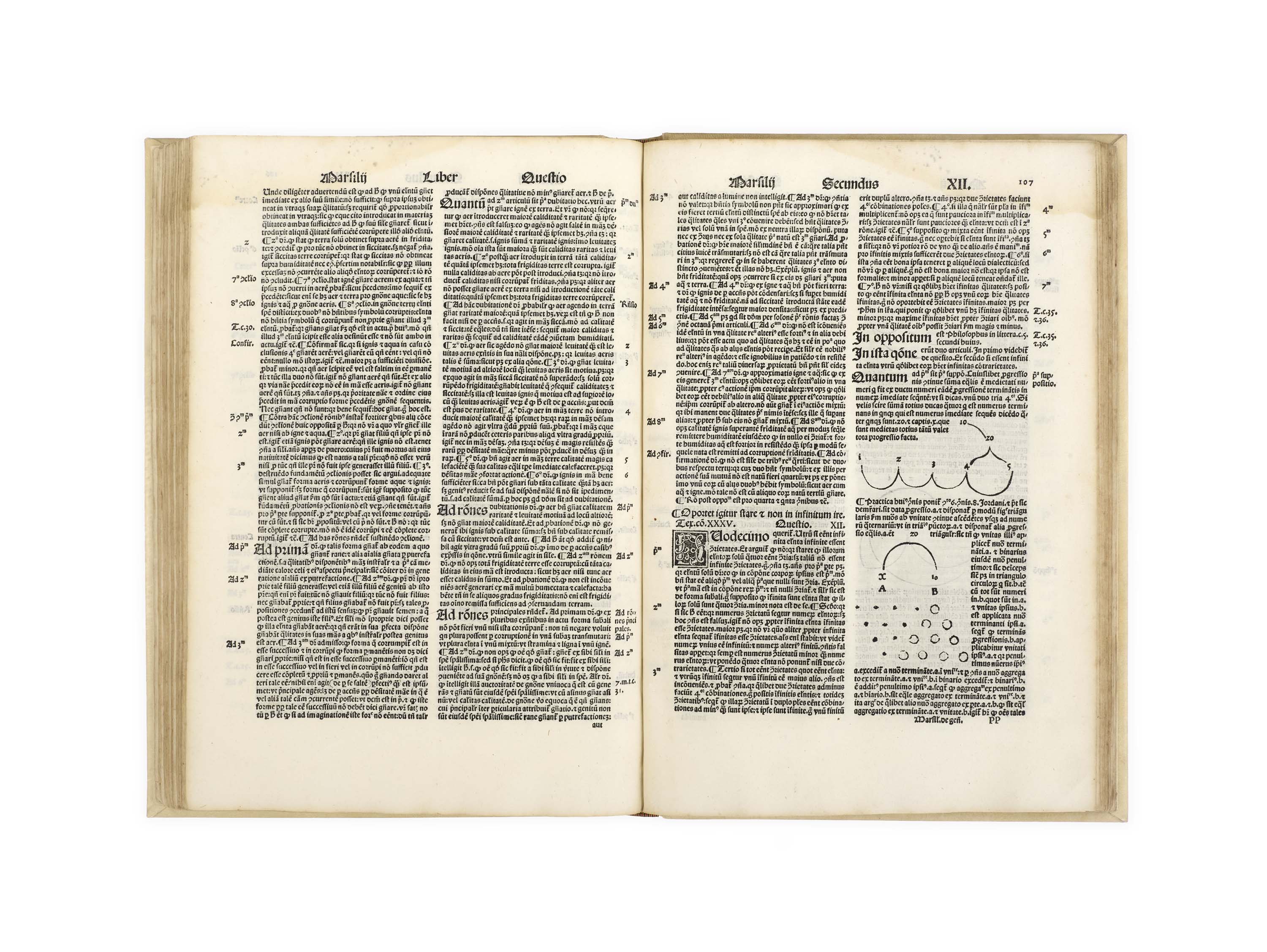
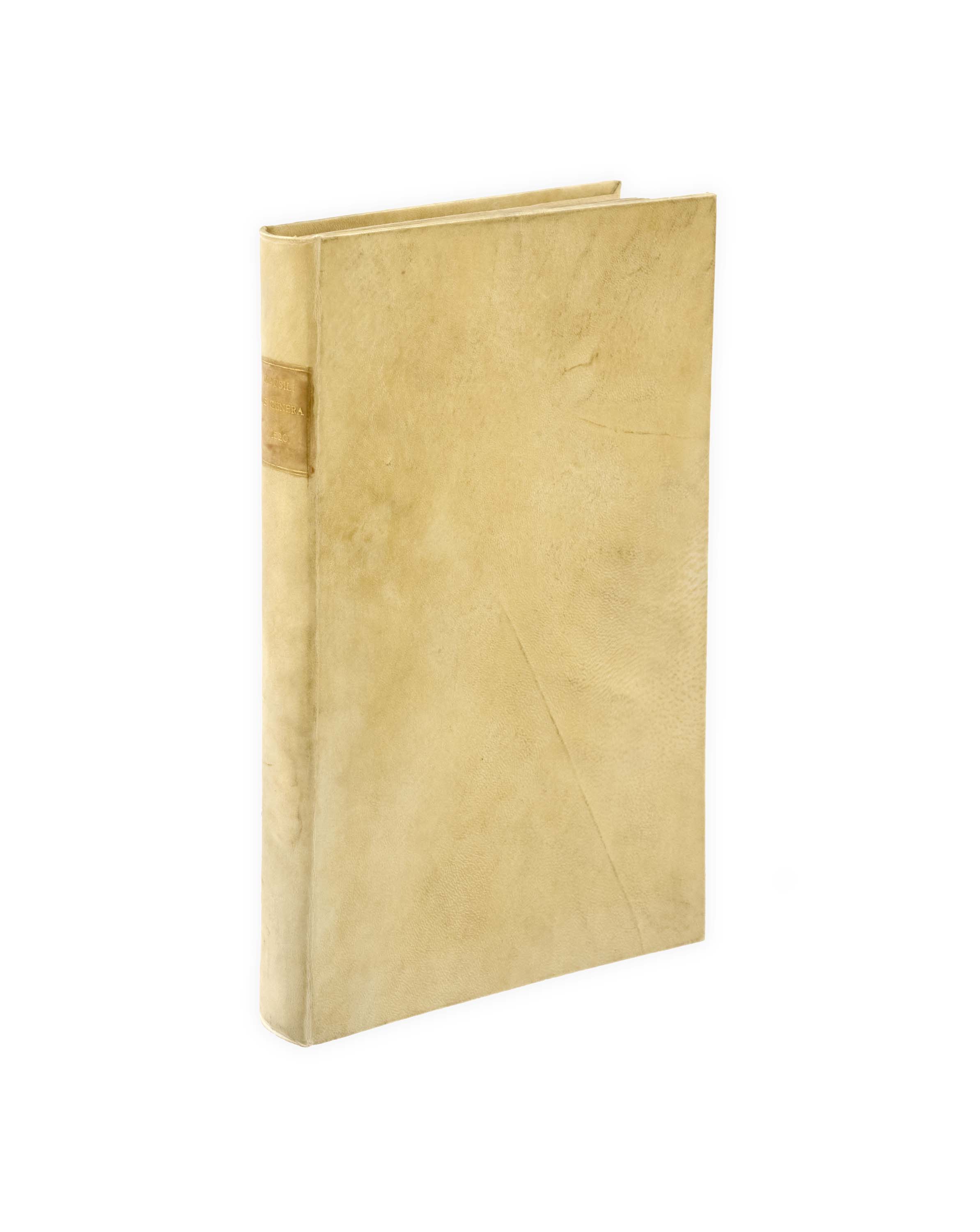
Folio, ff. 144; gothic type, text in double columns, woodcut initials and diagrams, woodcut Scoto device beneath colophon; title-page slightly soiled with neat repairs at edges, occasional light marginal staining, slight creasing, small chips to outer margins of PP8 and TT4, nonetheless a good copy; bound in modern vellum over boards, spine lettered directly in gilt; a few seventeenth-century annotations in Latin to c. 15 pp. and occasional underlining in ink.
Added to your basket:
Marsilii de genera[tione et corruptione]. Commentaria fidelissimi expositoris D. Egidii Romani in libris de generatione & corruptione Aristotelis cum textu intercluso singulis locis … Omnia accuratissime revisa atque castigata ac quantum ars anniti potuit fideliter impressa.
A trio of late thirteenth- and fourteenth-century commentaries on Aristotle’s books on generation and corruption, composed at the University of Paris by Giles of Rome, Marsilius of Inghen, and Albert of Saxony, demonstrating the international nature of medieval scholarship.
Aristotle’s De generatione et corruptione was one of his ‘natural books’, forming a fundamental part of the study of natural philosophy at universities from the mid-thirteenth century onwards. The commentary of Giles of Rome dates to around 1274, and formed the basis for subsequent commentaries. Marsilius of Inghen and Albert of Saxony were both scholars in the line of the Buridan school of Aristotelian thought, continuing the nominalist methods of the Parisian teacher Jean Buridan; Albert was his contemporary and Marsilius just a generation later.
Giles of Rome (c. 1243/7–1316) is listed second on the title-page, yet his commentary appears first in the volume. An Augustinian hermit, he studied at his Order’s Paris convent before moving back to Italy and eventually becoming Prior General. While better known for his treatise on papal authority, he composed several Aristotelian commentaries.
Marsilius of Inghen (1330–1396) studied and taught at Paris before moving to Heidelberg as one of the founders of the university there. He wrote numerous Aristotelian commentaries and was influenced by Albert of Saxony and William of Ockham. ‘Both Leonardo da Vinci and Galileo Galilei referred to Marsilius’s commentary on De Generatione et Corruptione’ (Stanford Encyclopedia of Philosophy).
Albert of Saxony (c. 1320–1390) also studied at Paris and became rector there before helping found the University of Vienna. He too wrote notable and influential commentaries on all of Aristotle’s works of natural philosophy. And although not mentioned on the title-page, this edition contains a short work by Nicoletto Vernia (1420–1499), teacher of natural philosophy at Padua, on the subject of natural philosophy (ff. 119–120); Vernia was responsible for the first edition of these commentaries (Padua, 1480), connecting them with the teaching of Aristotle at Padua.
The end of the index is dated 13 April 1385, which is copied from a manuscript exemplar and appears in other printed editions.
Uncommon outside Italy: we have located three copies in the US (Fordham and two in Chicago) and three in the UK (BL, Bodley, Wellcome).
EDIT16 CNCE 33097; USTC 541111.