A Renaissance Tristan and Isolde
MAUGIN, Jean.
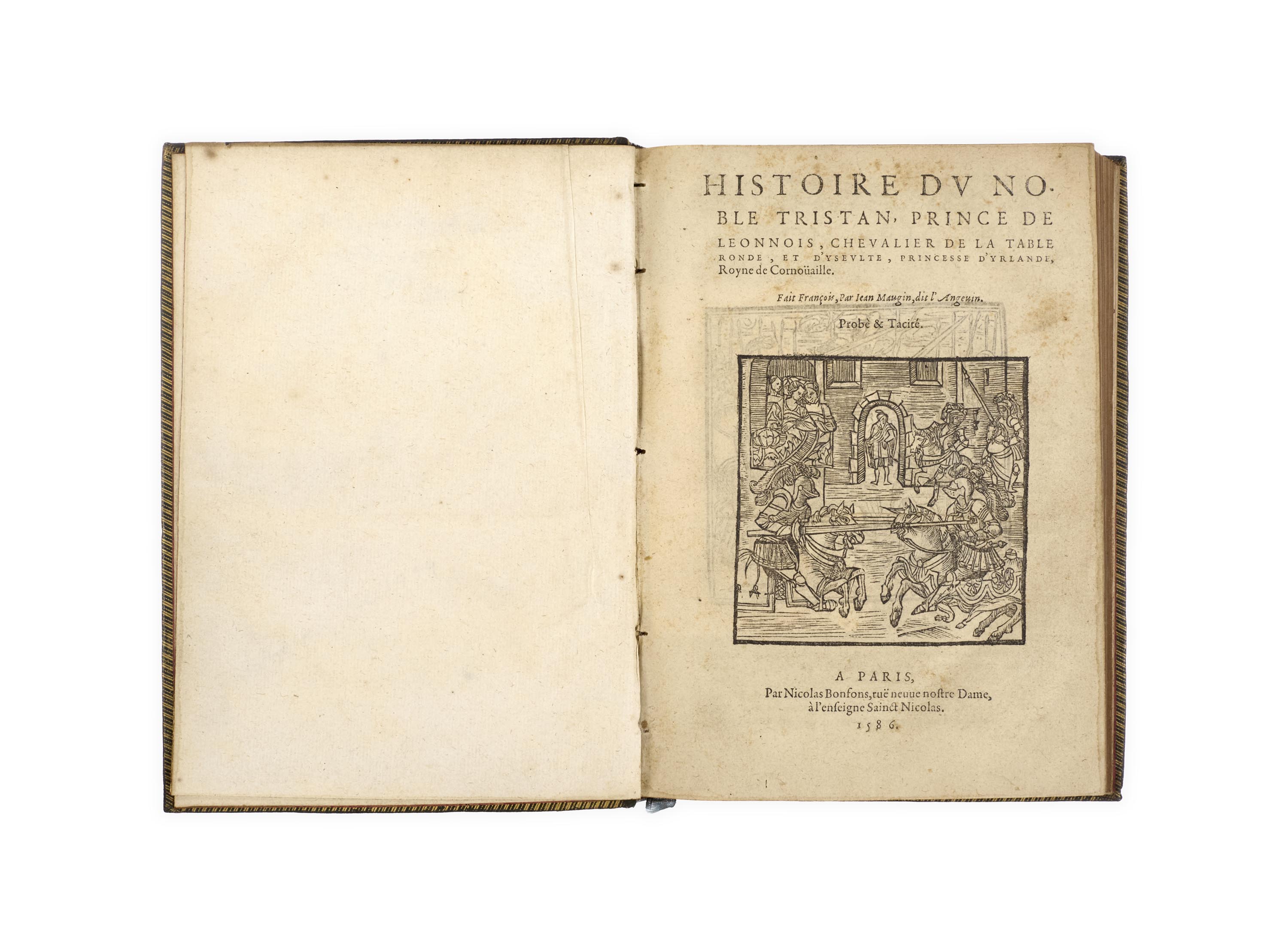
Histoire du noble Tristan, prince de Leonnois, chevalier de la Table Ronde, et d’Yseulte, princesse d’Yrlande, Royne de Cornoüaille. Fait François, per Jean Maugin, dit l’Angevin. Paris, Nicolas Bonfons, 1586.
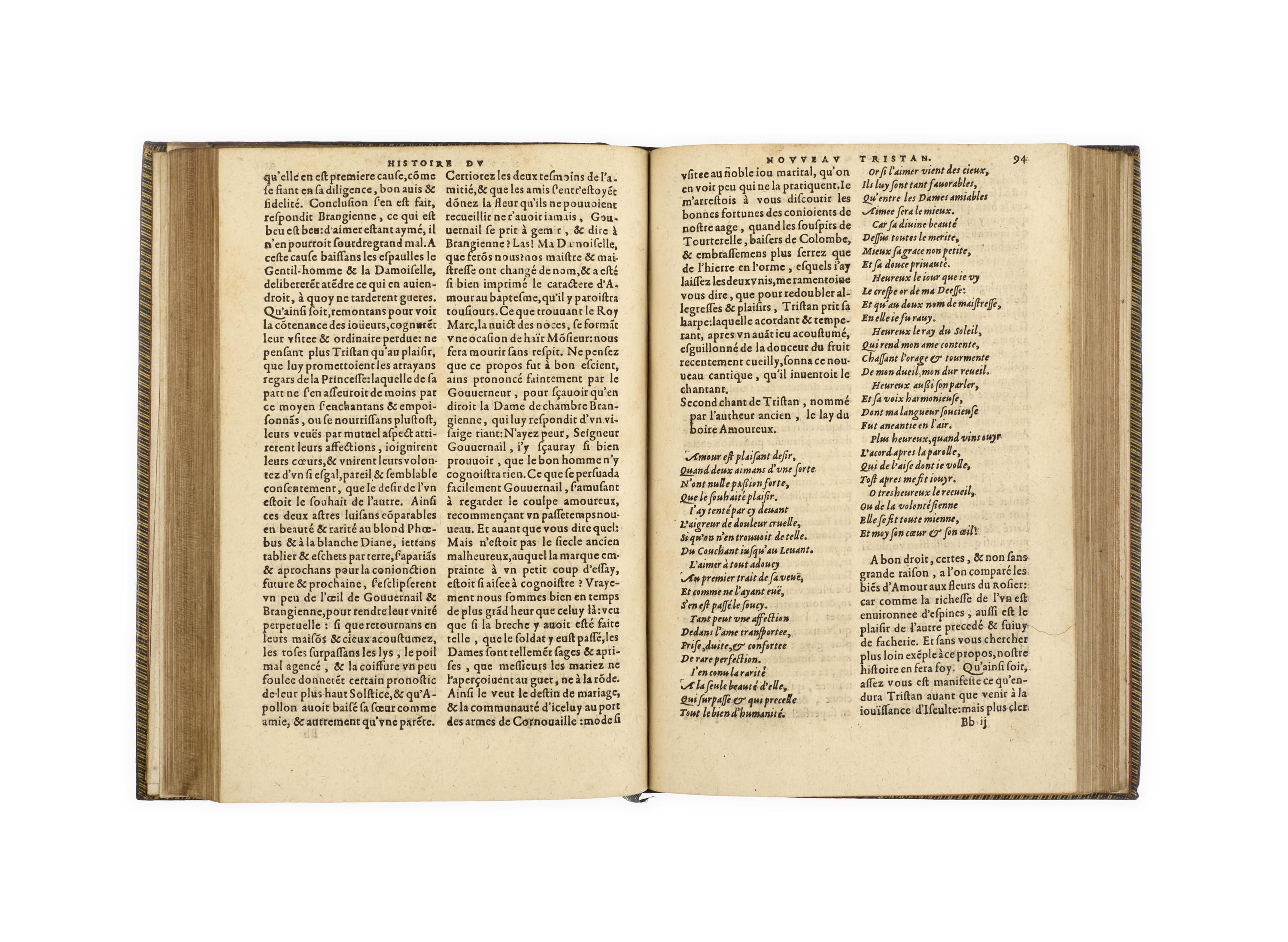
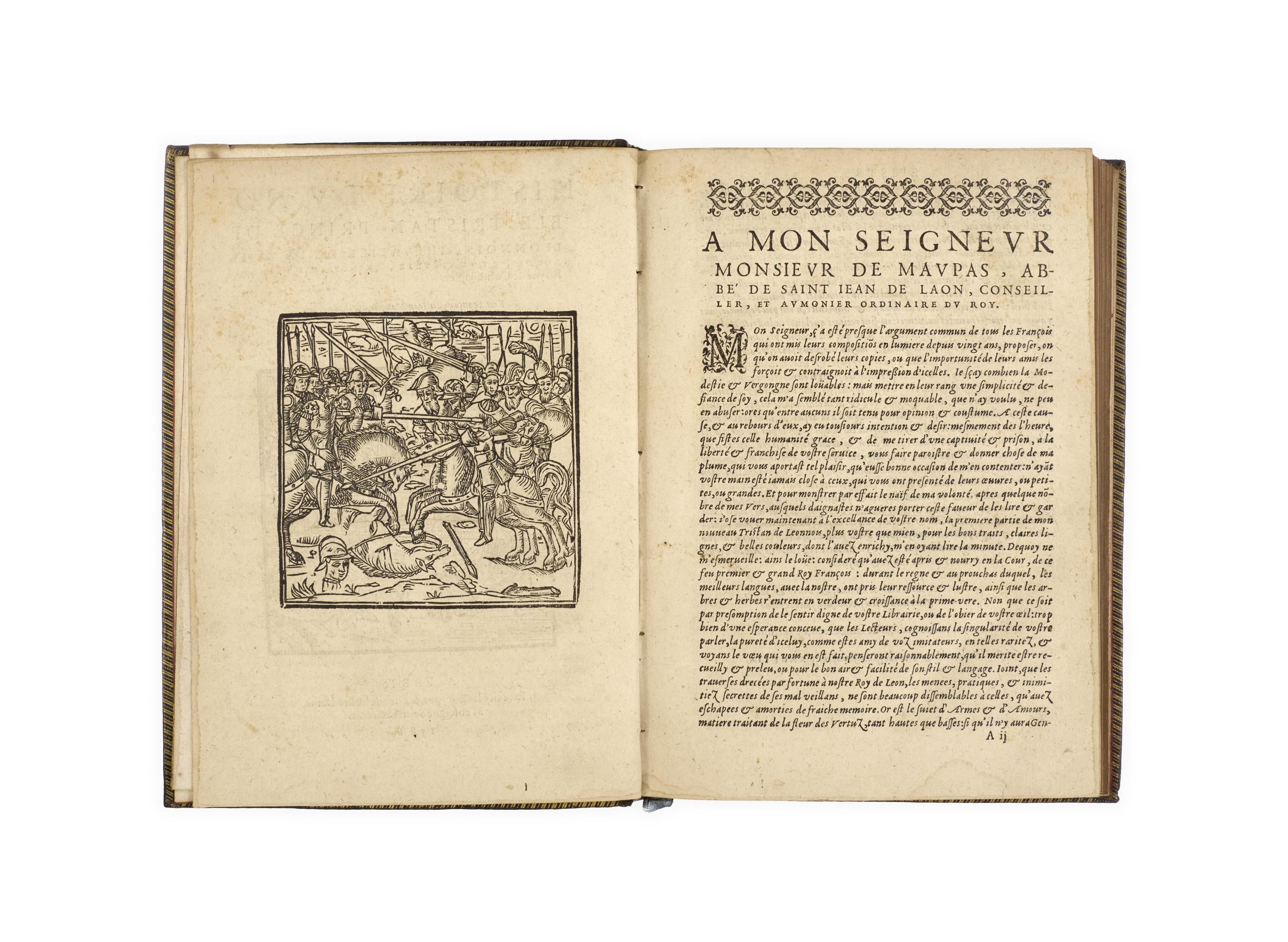
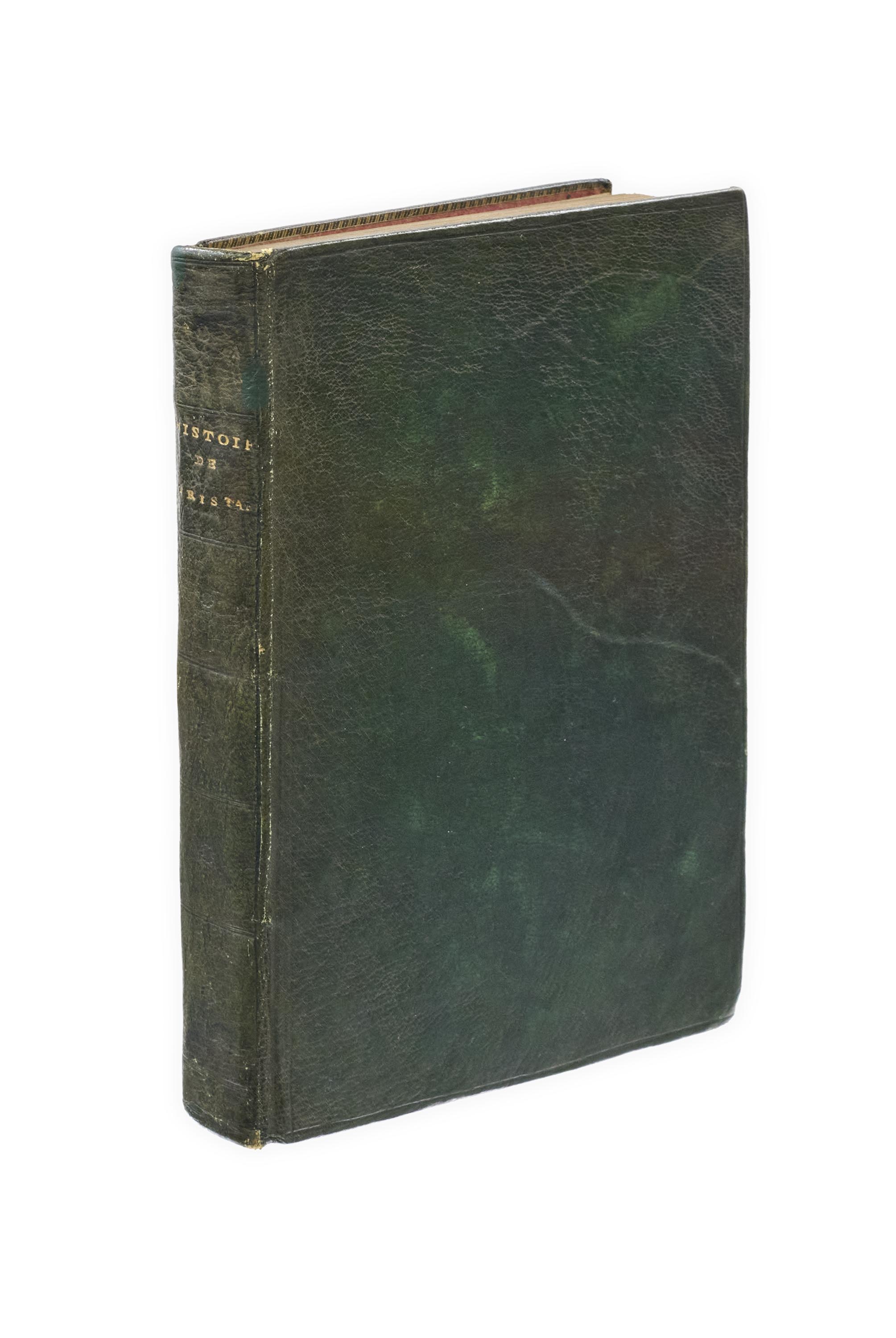
4to, ff. [ii], 94, 93–184; woodcut illustrations (of a joust and a battle scene) to both sides of title-page, woodcut initials, typographical headpieces; cut a little close at head, title lightly foxed, stain to B3 with some text overwritten on verso, a few light stains, but a very good copy; bound in late eighteenth-century French green morocco, single blind fillet frame, flat spine lettered directly in gilt and with blind fillet bands and fleurons, gilt dentelles, pink pastepaper endleaves, edges gilt; binding a little rubbed, small repair to head of spine.
Added to your basket:
Histoire du noble Tristan, prince de Leonnois, chevalier de la Table Ronde, et d’Yseulte, princesse d’Yrlande, Royne de Cornoüaille. Fait François, per Jean Maugin, dit l’Angevin.
A scarce edition of the New Tristan, reworking the tale of Tristan and Isolde for the Renaissance reader; bound in eighteenth-century French green morocco.
Jean Maugin (fl. 1540s–1550s) was a prolific translator of works ancient and modern, from Tacitus to Machiavelli, though predominantly romances. His translation and reworking of the thirteenth-century prose romance of Tristan and Isolde into French was first printed in 1554, intended to be the first of three or four parts, though only this first was produced, containing about a third of the original text. The appeal of Arthurian romances had started to wane by the mid-sixteenth century, so Maugin sought to revivify this tale by stripping it of its medieval baggage and clothing it in ‘nouvelle eloquence’; he must have succeeded, as this was the fourth edition produced within thirty years, indicating more commercial success than was granted to most of his books.
In his Nouveau Tristan, Maugin was ‘specializing in chivalric hyperbole and more particularly in emotional effusions: his account, for instance, of the drinking of the love potion is a model of determined hyperbole: Tristan and Iseut feel themselves to be two suns, two stars – comparable to Phoebus and Diana’ (Taylor, p. 233). The text is divided into 77 chapters (rather than the original 59), to separate out the action in a more comprehensible way, and Maugin also explains away historical infelicities, such as the presence of Joseph of Arimathea. More notably, he also gives names to all the previously anonymous minor characters. The influence of more recent literature on his prose is also apparent, in particular the popular Amadis de Gaule.
The woodcut on the title-page, depicting a jousting scene, previously appeared in Jean Bonfons’ edition of Bertrand du Guescelin produced in the 1550s, and the other woodcut appeared on the title-page of a Bonfons edition of Champier’s life of the Chevalier de Bayard (undated, c. 1580s). Nicolas Bonfons (active 1572–1618) continued his father Jean’s production of chivalric literature and vernacular devotion.
We have located five copies in the US (UC Berkeley, LoC, Chicago, Dartmouth and Cleveland), and three in the UK (British Library, Bodley, and NLW).
USTC 29266. See Taylor, ‘French romance in the late Middle Ages’ in The New Cambridge Companion to Medieval Romance (2023), pp. 228–242.