Annotated Sermons Bound by the Unicorn Binder
MEFFRET, Johann.
Sermones Meffreth alias Ortulus regine de tempore. Pars hyemalis. [Basel, Nicolaus Kesler, not after 1485.]
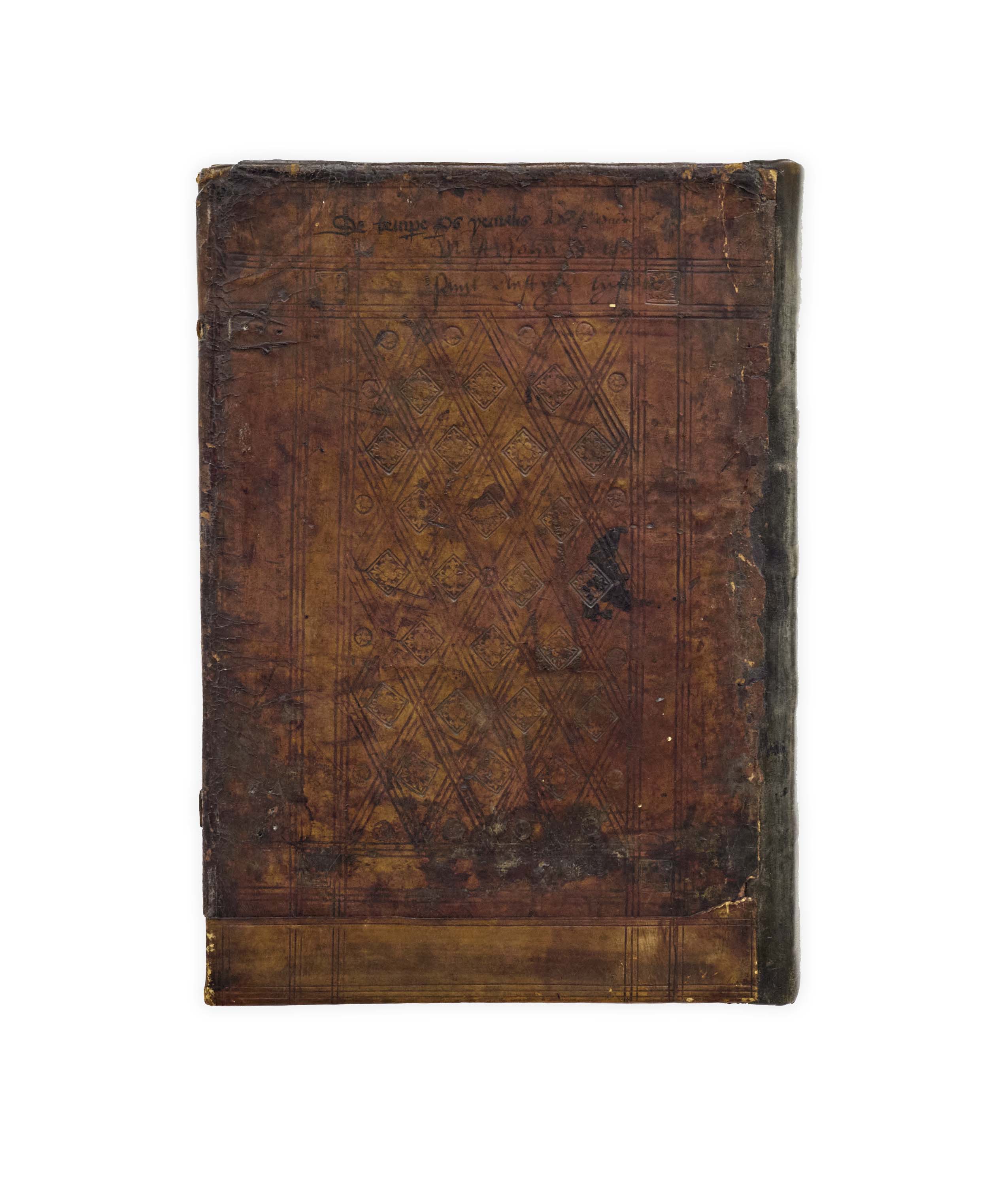
Folio, part I only (of III); ff. [231] (of 232, without final blank); a12 b10 c–r8 ſ8 s–v8 w–z8 ⁊8 ꝯ8 ꝝ10; gothic letter, text in two columns, capital spaces; title-page stained and worn (reinforced at head to verso), old marginal repair to e6, some (mostly marginal) dust- and dampstaining, ꝝ1 creased and chipped at margins with repairs to verso, else a good, wide-margined copy retaining some deckle edges; contemporary English blind-tooled calf by the Unicorn Binder relaid over late nineteenth-century calf, borders and central lattice composed of triple blind fillets, compartments of lattice filled with a lozenge stamp of a flower with fleurs-de-lys and a small round floral stamp, corners of frame with square dragon stamp (Oldham tools 63, 59, and 73 respectively; Pearson 48P for the flower stamp, 48W for the dragon), traces of two pairs of clasps; panels defective at edges, rebacked; early annotations in Latin in several English hands with manicules to c. 112 pp. (see below), early pen trials in English, early English inscription ‘Liber m[agist]ri Redshawe’ to title-page, early English manuscript title to head of lower cover ‘De temp[or]e P[ar]s yemalis […]’ and in an earlier hand ‘M[agistri] A[rtis] Joh[a]n[nis] […] | Saint Austyn Hist[–]'.
A volume of sermons with early English annotations, in a binding featuring tools attributed to an early Cambridge workshop known as the Unicorn Binder.
G.D. Hobson named the workshop from a unicorn stamp found on some of its bindings; a slightly earlier Cambridge workshop, the Demon Binder, employed a very similar dragon stamp. More than one hundred bindings from the late fifteenth century survive from the Unicorn Binder’s workshop, which may have belonged to Walter Hatley, a Cambridge stationer, whose known dates correlate with the bindings. The bindings are found on books with imprints from across Europe, dating from 1478 onwards.
The association with Cambridge could indicate that the early owner, Master Redshawe, may have been John Redshaw, who was a sizar at Christ’s College Cambridge in 1546. The two inscriptions on the lower board suggest that the binding may have been re-used at a very early date.
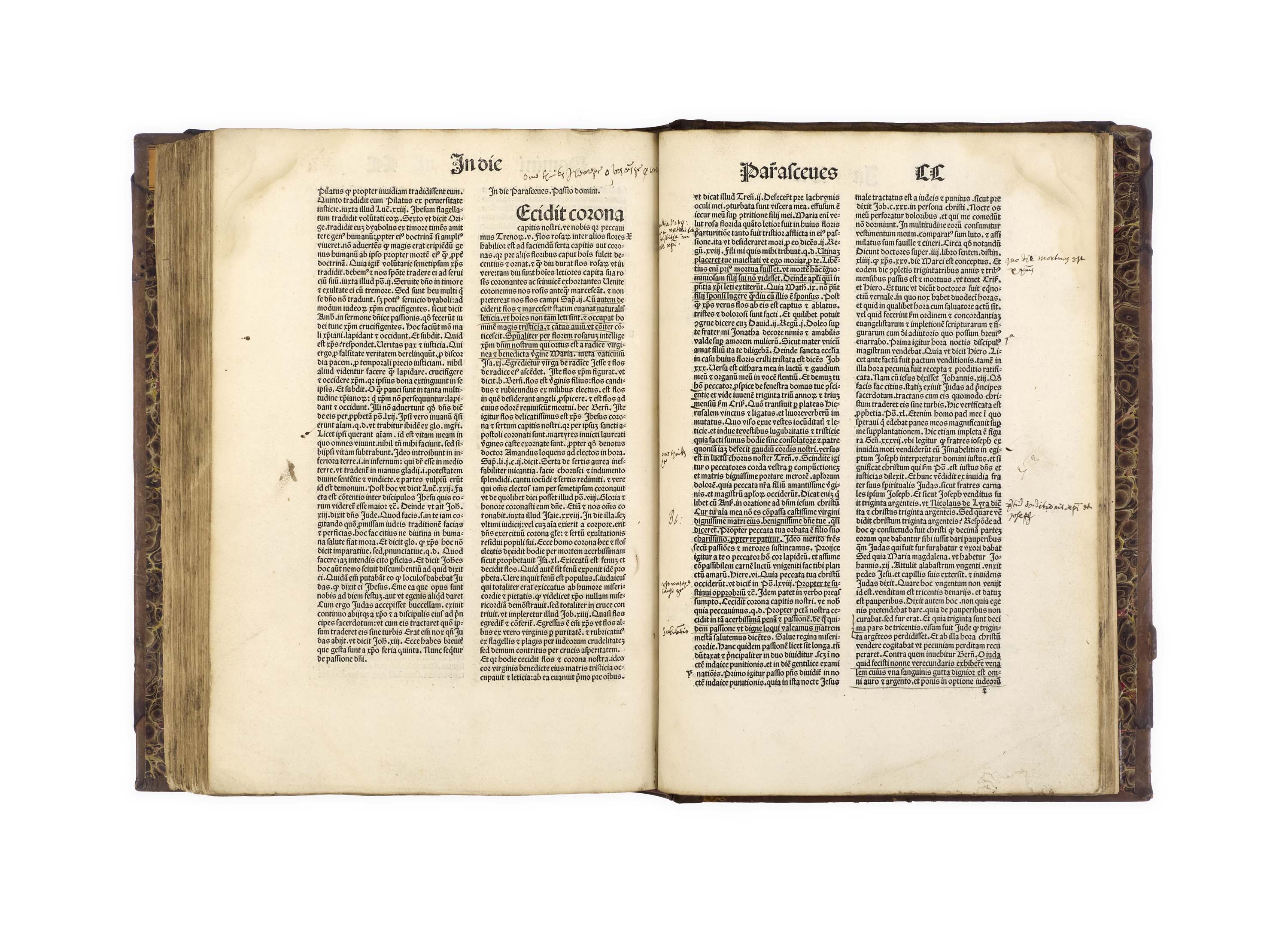
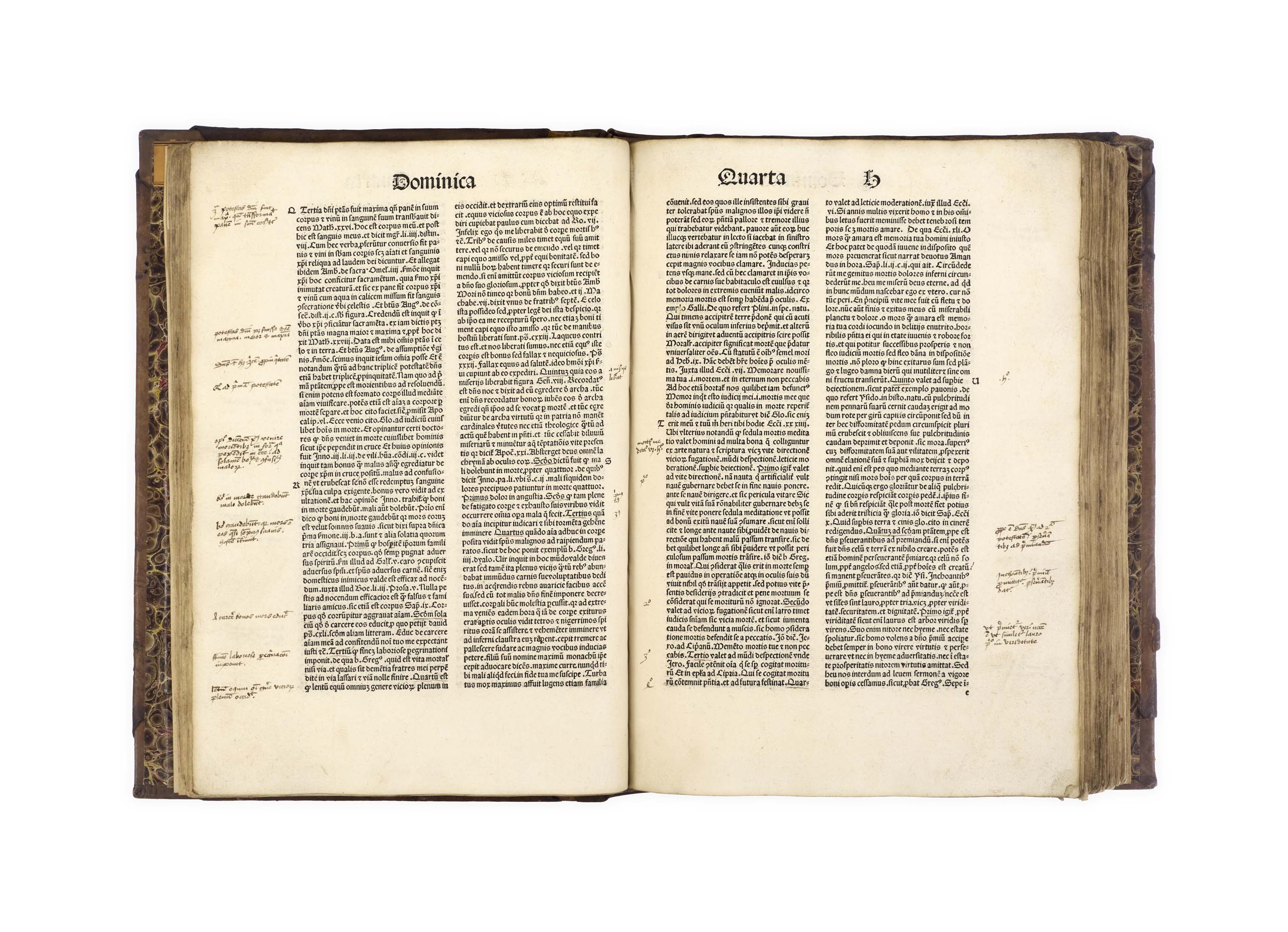
The text contains the winter section of this popular collection of sermons attributed to Johann Meffret of Meissen; the other two sections not included were for summer and for the feast days of particular saints, and surviving copies often contain just one or two sections. The text has been provided with capital letters in the right-hand headline (from A to DD) and also in the margins; these reference numbers are then used in the table to enable the easy location of specific passages. It is likely that this is the second printing of these sermons, closely following Kesler’s other undated edition, assigned to not after 1483 (ISTC im00440000); both these editions are dated from manuscript notes of acquisition.
This copy contains sections that have been annotated in several hands, one early and small, another later (seventeenth century?) and a little messier, often just noting ‘Exemplum’ next to a passage. At the head of a2 the name of God (Yahweh) is written in Hebrew characters, but the other annotations are almost all in Latin, featuring marginal notes, underlining, manicules, and trefoils (the latter usually accompanying underlining, for example on a6v). The notes do not merely repeat phrases from the text, but also pull out themes or expand on the text; in some passages there are what seem to be commas or apostrophes, perhaps marking out places to take a breath (for example on d8). One page has a few words of English, a jotting rather than an annotation on the text (b8r).
ISTC records a single copy of part I in the UK as part of a made-up set at Cambridge University Library; other parts are found also at the British Library (parts II–III), Lambeth Palace Library (part II), and Ipswich School (part III).
HC 10999*; BMC iii 764; GW M22648; Goff M441; BSB-Ink S-304; ISTC im00441000 (all for all three parts). See Hobson, Bindings in Cambridge Libraries (1929), pp. 40–46; Pearson, Cambridge Bookbinding 1450–1770 (2023), pp. 30–32, 209–210 & 275.