Women’s Rights and Copyright
From the Library of William Michael Rossetti
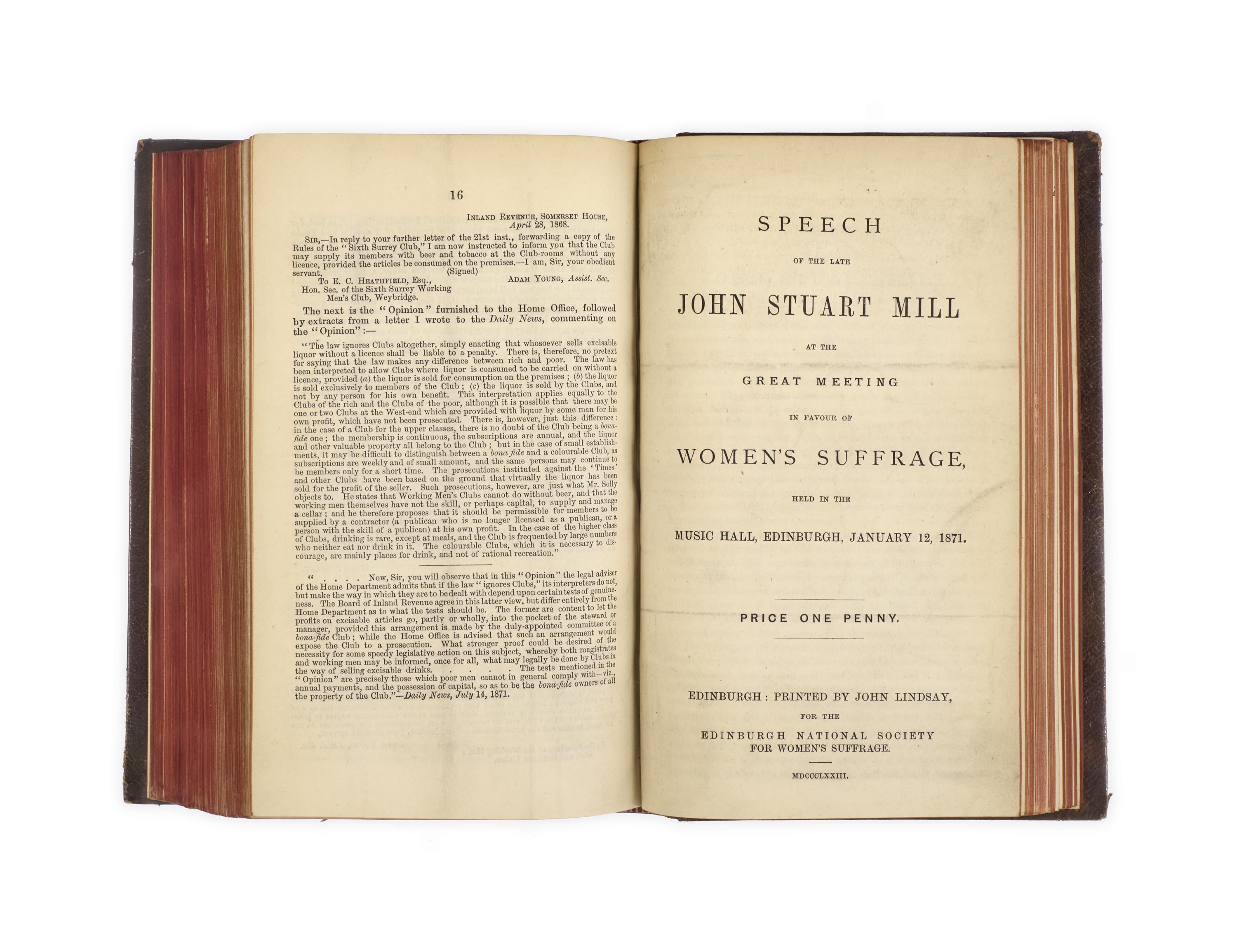
MILL, John Stuart.
Speech … at the great Meeting in favour of Woman’s Suffrage, held in the Music Hall, Edinburgh, January 12, 1871 … Edinburgh, John Lindsay, 1873.
[bound with:]
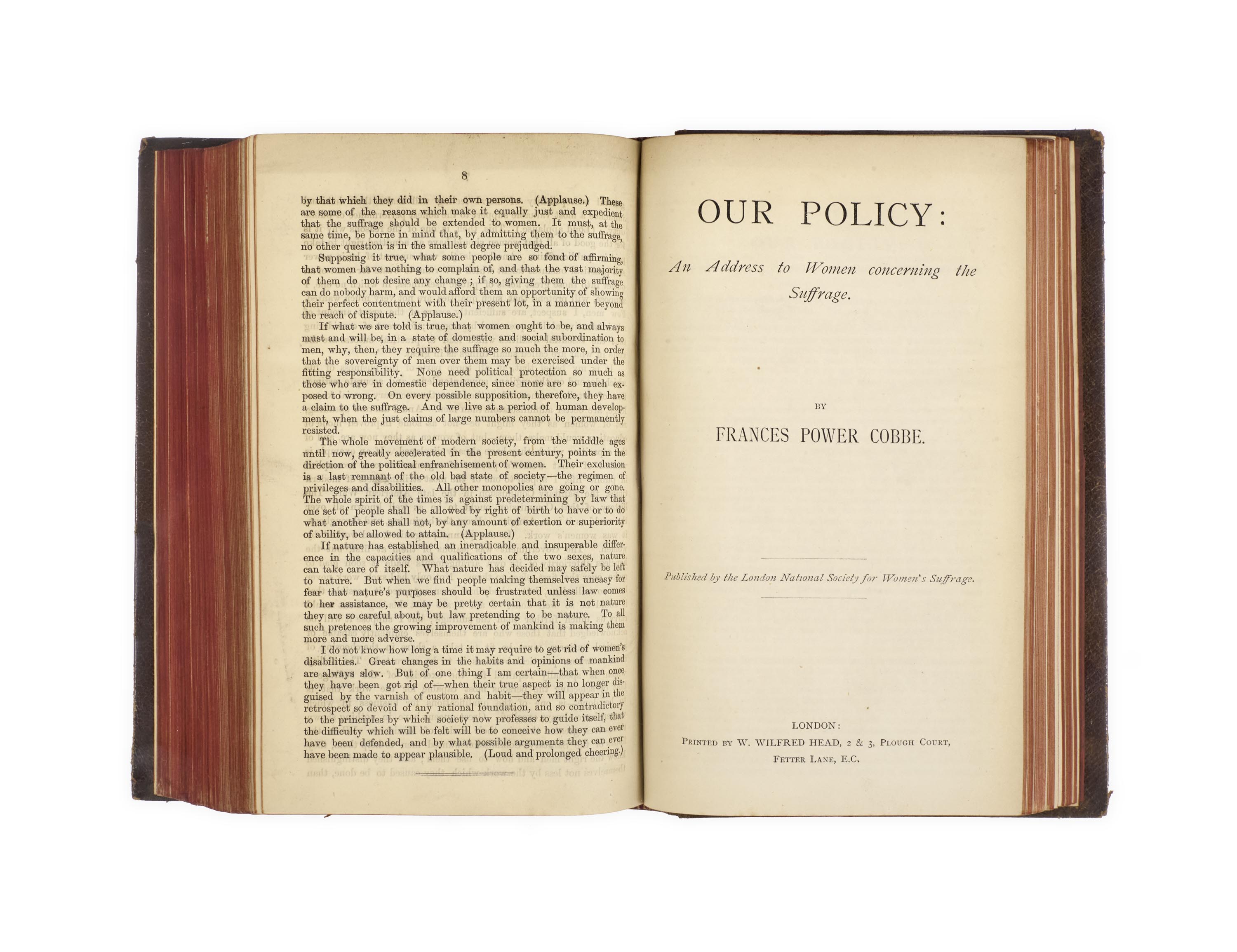
COBBE, Frances Power. Our Policy: an Address to Women concerning the Suffrage … London, W. Wilfred Head, [1870?].[and:]
MAINE, Sir Henry Sumner. The Early History of Property of married Women … A Lecture … Manchester, A. Ireland and Co., [1873].[and:]
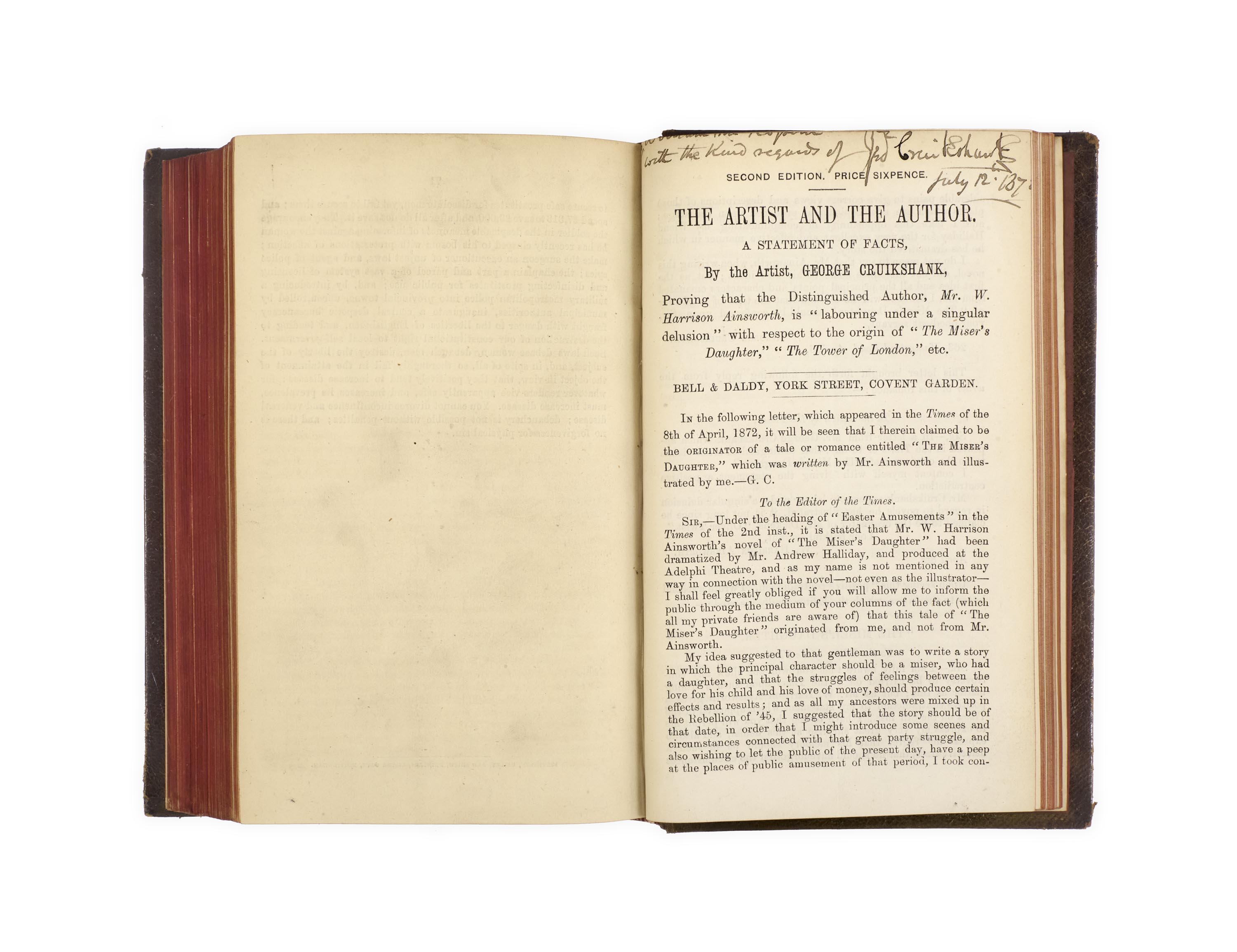
CRUIKSHANK, George. The Artist and the Author. A statement of Facts … [second edition]. London, Bell and Daldy, [1872].[and:]
[COPYRIGHT.] Memoranda on international and colonial Copyright. March 1872. London, Spottiswoode & Co., 1872.[and:]
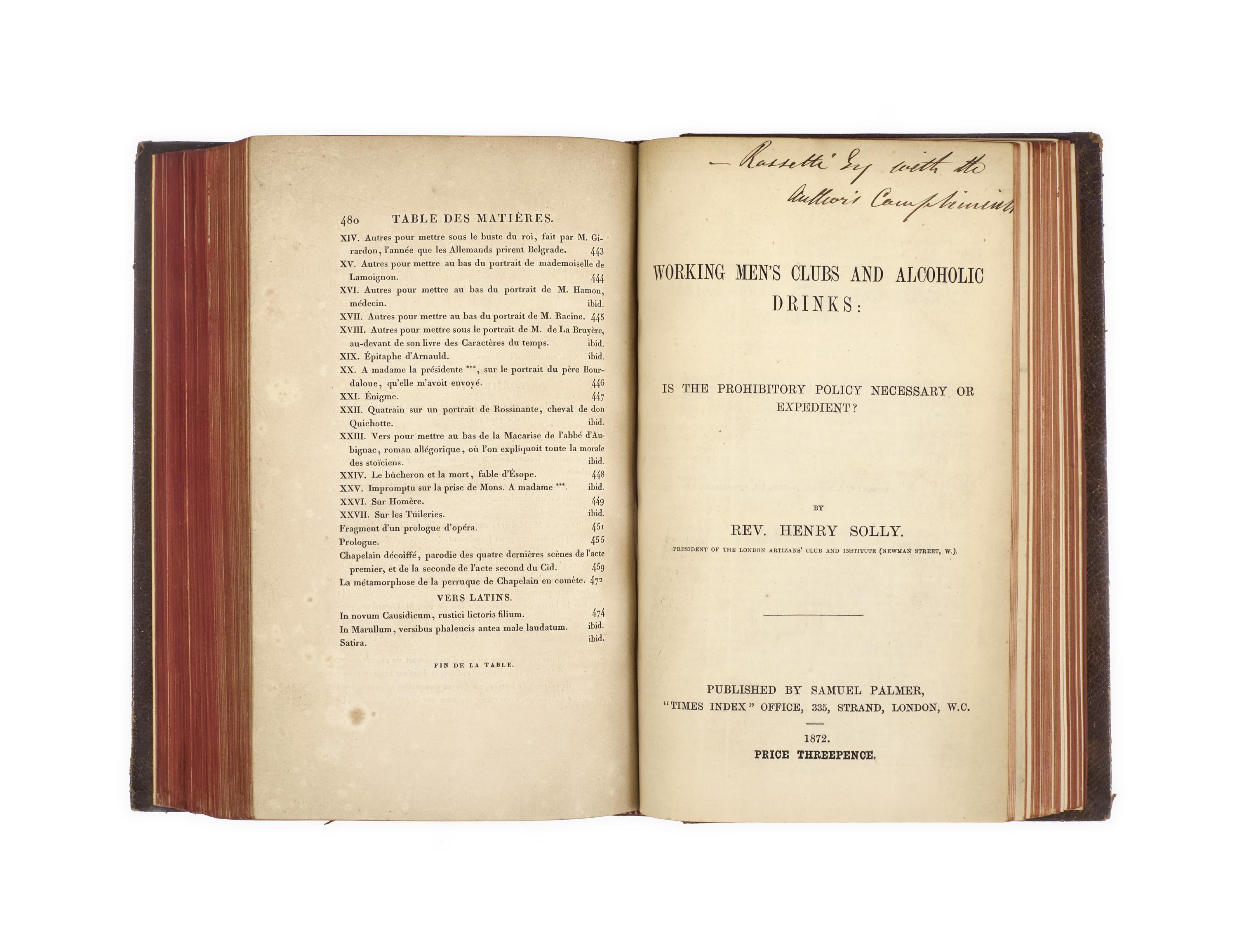
SOLLY, Henry. Working Men’s Clubs and alcoholic Drinks: is the prohibitory Policy necessary or expedient? … London, Samuel Palmer, 1872.[and three others.]
Nine works, 8vo, Mill: pp. 8; Cobbe: p. 8; Maine: pp. 21, [3, blank]; Cruikshank: pp. 16, with a drop-head title (authorial presentation inscription to head partly cropped); Copyright: pp. 16; Solly: pp. 16 (presentation inscription to title-page); bound with Boileau, Oeuvres politiques (Paris, 1825), and two other works in late nineteenth-century green morocco, spine worn and dry; from the library of William Michael Rossetti, with his ownership inscription and manuscript index to front endpaper.
Added to your basket:
Speech … at the great Meeting in favour of Woman’s Suffrage, held in the Music Hall, Edinburgh, January 12, 1871 …
An unusual tract volume on suffrage and women’s rights, from the library of William Michael Rossetti, also including a presentation copy of Cruikshank’s attack on his erstwhile collaborator William Harrison Ainsworth.
Cruikshank claimed here to be the ‘originator’ of a number of Ainsworth’s novels; his reputation suffered greatly by the publication. Earlier, in 1867, William Michael Rossetti and his brother Dante Gabriel had both signed an application for a civil-list pension for Cruikshank.
William Michael Rossetti was a firm supporter of women’s rights, attending and speaking at meetings in the 1870s and ’80s, supporting the formation of the Somerville Club, and celebrating the passing of the Married Women Property Bill. He even advocated militant action; and was later consulted by the National Society for Women’s Suffrage for names of possible sympathisers (see Thirlwell). As well as the works by Mill, Cobbe and Maine here, there is a pamphlet by Charles Bell Taylor, The Contagious Diseases Act (Women,) from a sanitary point of view (1870), on the subject of syphilis, prostitution, and the misogyny and classism of the Contagious Diseases Act.
The final two items listed above are a rare summary of copyright law (Reading and V&A only in Library Hub; OCLC adds Princeton only in the US); and a presentation copy of a very rare pamphlet in favour of licensed bars at Working Men’s Clubs (BL and LSE only in Library Hub and OCLC). A radical clergyman, Solly (1813–1903) had founded the Working Men’s Club and Institute Union in 1862; he was an ardent teetotaller but modified his position over time.