
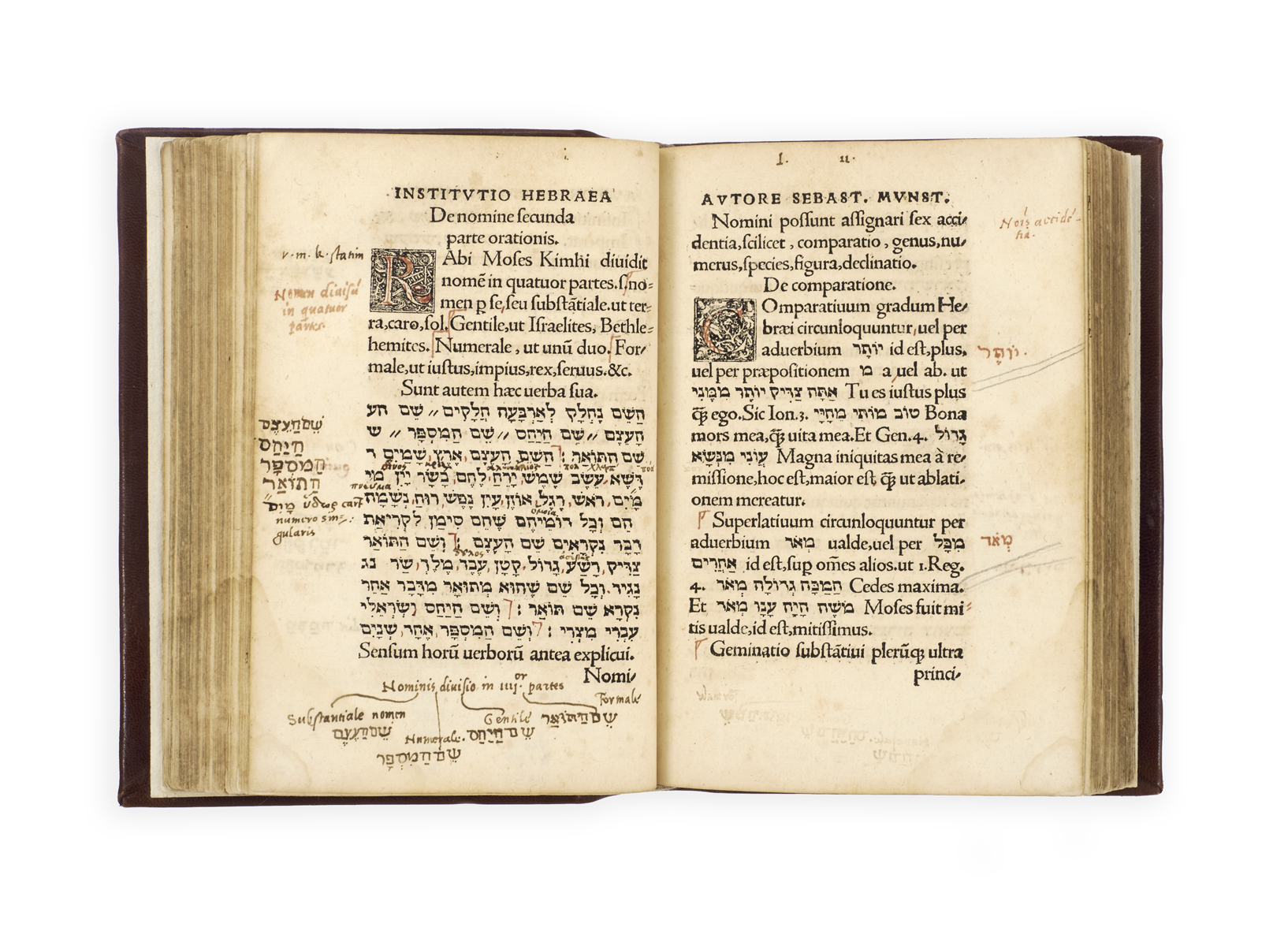
Annotated Hebrew Grammar
MÜNSTER, Sebastian.
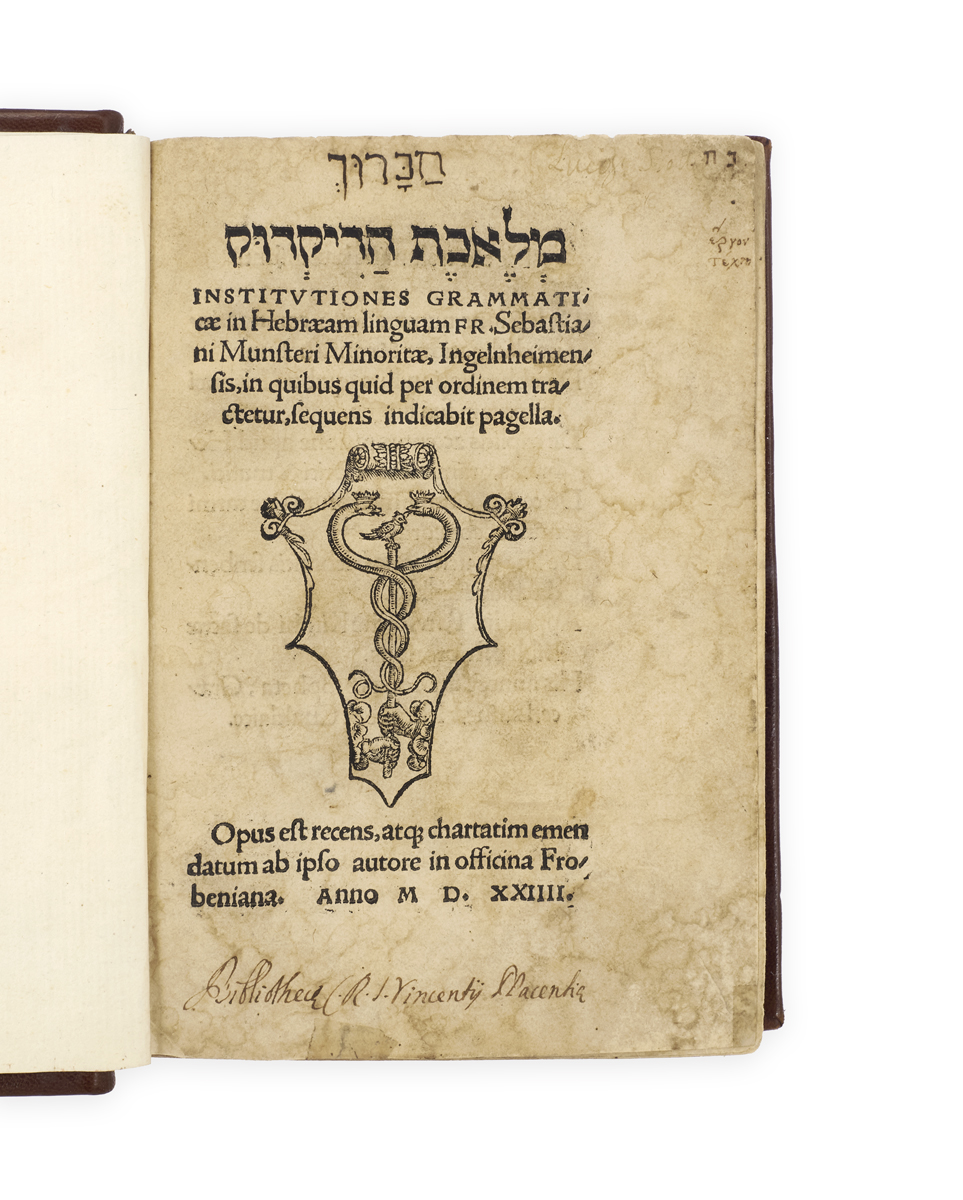
[Melechet ha-Dikduk]. מלאכת הדיקדוק Institutiones grammaticae in Hebraeam linguam FR Sebastiani Munsteri Minoritae, Ingelnheimensis, in quibus quid per ordinem tractetur, sequens indicabit pagella.
[Basel,] Johann Froben, 1524.
[with:]
יונוה נביא בארבעה לשונות [Yonah nevi be-arba’ah leshonot]. Ionas propheta in quatuor orbis principalioribus linguis, Graeca, Latina, Hebraea atque Chaldaica, pulchre sibi correspondentibus columnellis. [Basel,] Johann Froben, 1524.[bound with:]
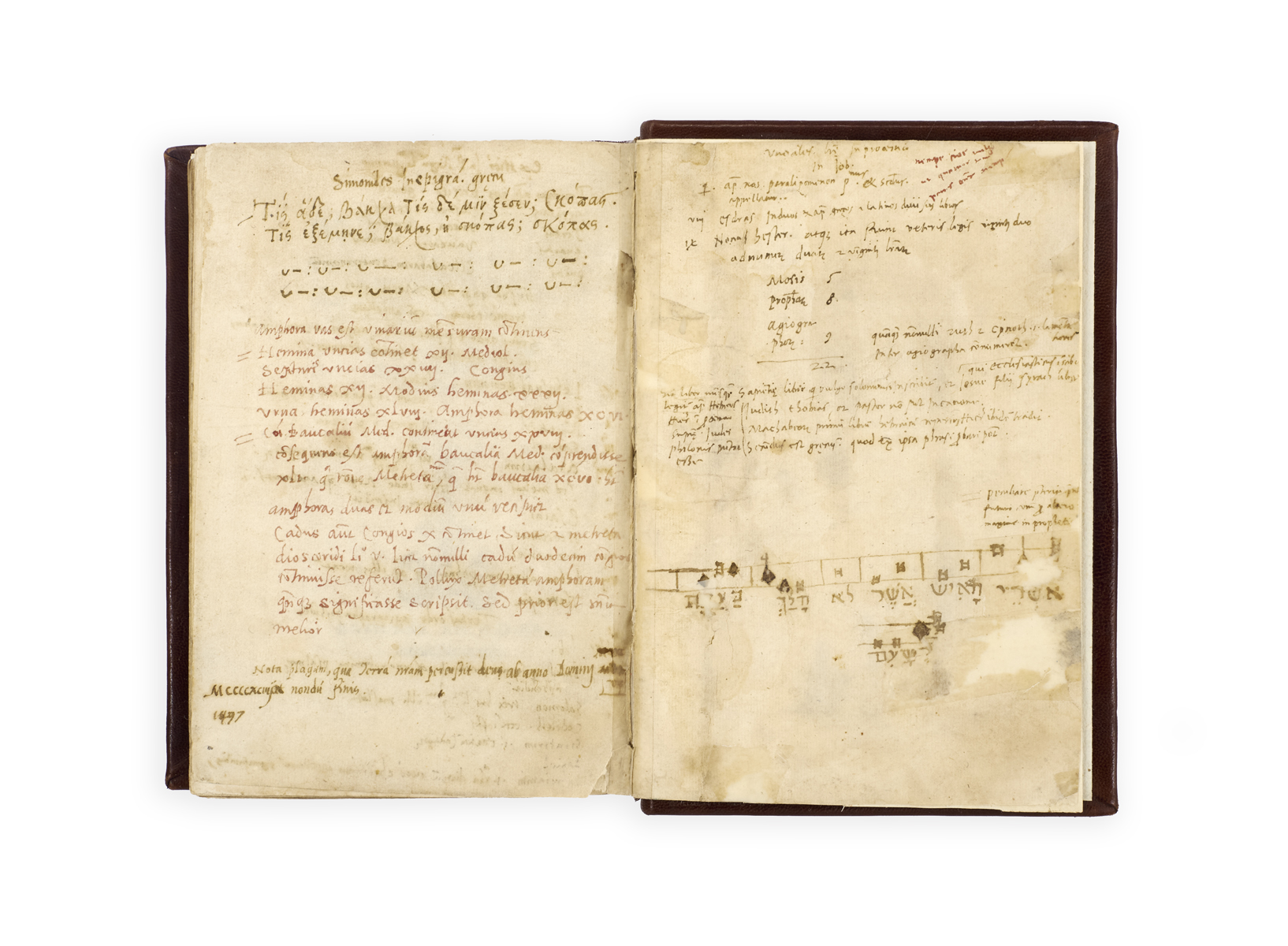
LEVITA, Elia; Sebastian MÜNSTER, translator. ספר ההרכבה [Sefer ha-Harkavah]. Composita verborum & nominum Hebraicorum. Opus vere insigne atq[ue] utile: Hebraicae Gra[m]maticae studiosis in primis necessariu[m], Romae Elia Levita autore aeditum, & nuper per Sebastianum Munsteru[m] Latinitate donatum. Basel, [Johann Froben], November 1525.Two works, in one vol., 8vo: Münster: two parts: ff. [128]; [16]; a–s8; in Hebrew and Latin, read left to right, r1v–s7r printed in two columns with parallel Greek, Latin, Hebrew, and Aramaic text, woodcut printer’s device to title-page and verso of last leaf, woodcut musical notation to p2 and p3, decorated woodcut initials and headpieces (several hand-coloured in red); title somewhat stained with short repaired tear to lower margin, occasional marginal dampstaining, a few scattered spots, old repaired paperflaw to lower corner of f2, a few neat repairs to gutters; contemporary annotations in red and brown inks to c. 189 pp., with manicules, underlining, and markings to a further c. 49 pp.; contemporary motto ‘εργον τεχνη’, ?near-contemporary Hebrew inscription, seventeenth-century ownership inscription ‘Luigi ?Scotto’ (faded), and early eighteenth-century ownership inscription ‘Bibliothece C.R.S. Vincentij Placentie’ [i.e. Clericorum regularium S. Vincenzo Piacenza] to title-page; Levita: ff. [84]; in Hebrew and Latin, read right to left, preface in parallel Hebrew and Latin on facing pages; woodcut printer’s device to title-page and verso of last leaf, printed manicules throughout; very short repaired tear to outer margin of title-page, light marginal dampstaining; contemporary annotations in dark brown ink to c. 17 pp. in a single hand, markings and underlining to a further 4 pp; bound together in blind-tooled panelled modern calf, spine blind tooled in compartments; rear endpapers preserved from an earlier binding and copiously annotated in Latin, Hebrew, and Greek.
Added to your basket:
[Melechet ha-Dikduk]. מלאכת הדיקדוק Institutiones grammaticae in Hebraeam linguam FR Sebastiani Munsteri Minoritae, Ingelnheimensis, in quibus quid per ordinem tractetur, sequens indicabit pagella.
First edition of Sebastian Münster’s important Hebrew grammar for students, bound with the first Latin edition of his translation of Elia Levita’s Composita verborum, both critical to the Christian scholarly reception of Hebrew grammatical works and here enhanced by extensive contemporary annotations in Hebrew, Latin, and Greek.
‘Of greatest importance in the sixteenth century were the works of Sebastian Münster (Epitome Hebraica grammaticae, 1520; Institutiones Grammaticae, 1524), who, following Elijah Levita, perfected the science of Hebrew grammar as regards both its material and its methods of presentation’ (Jewish Encyclopedia). Johann Froben, the printer, and Beatus Rhenanus, the cosmographer, mathematician, and professor of Hebrew at Heidelberg, prompted Münster (1488–1552) to produce his first introduction to Hebrew grammar, in which he includes a list of common Hebrew abbreviations, notes on cantillation, an appendix on the Book of Jonah and a section on ‘the vernacular written in Hebrew characters’, or Yiddish, with a brief Yiddish-Hebrew-Latin glossary. With the encouragement of Simon Grynaeus, Münster was the first to translate into Latin the Hebrew works of the Neustadt-born lexicographer and grammarian Elia Levita (1469–1549), author of the popular Yiddish epic Bovo-Bukh; his Sefer ha-harkavah, which alphabetically addresses compound and foreign terms in the Hebrew Bible, was written in 1517 and appears here in Latin for the first time.
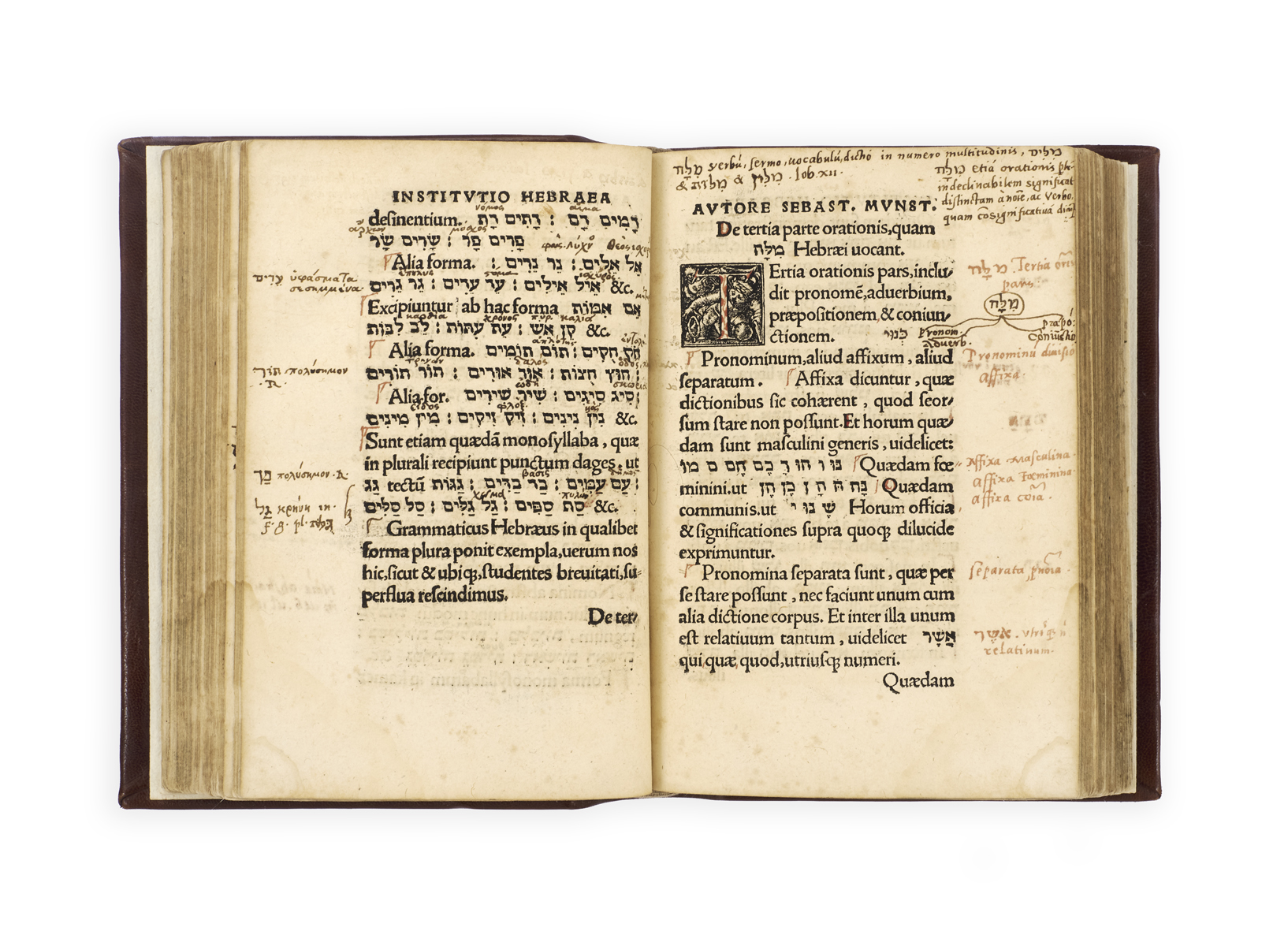
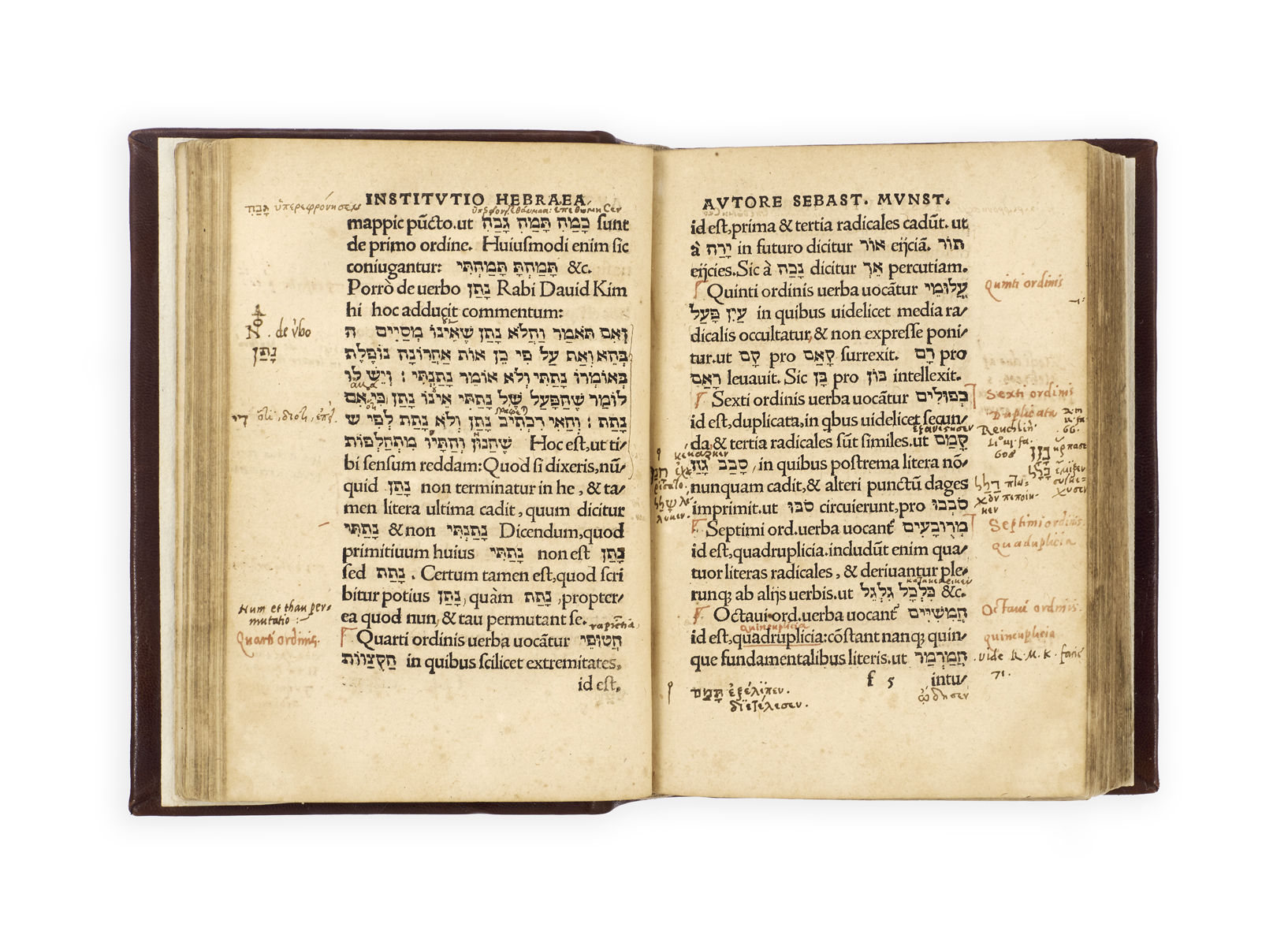
Our copy has been extensively annotated in a single hand, particularly the Institutiones grammaticae. Most heavily annotated are the sections on vocalisation, conjugation and declination, and word order, in which our reader imitates the printed Hebrew text and produces several elaborate tree diagrams on hiphil and hithpael verbal stem formations and parts of speech, frequently citing the grammatical works of Levita, Reuchlin, Abraham de Balmes, and David and Moses Kimhi. The rear endpapers contain, in the same hand, Latin descriptions of different varieties of Greek vases, copied in red ink from Joannes Cruceus’s 1558 annotations to Justinian’s Pandects, and an epigram by Simonides. In another early hand we find the opening line of Psalm 1 in Hebrew (Ashrei ha’ish), with musical notation; and a list of the books of the Prophets and of the Torah (the latter in Latin and in transliteration).
Institutiones grammaticae: BM STC German, p. 633; USTC 661237; VD 16 M 6685; Adams M 1931; Graesse IV, col. 623. Composita verborum: USTC 661383; VD 16 E 1000; Adams E 110. See Contemporaries of Erasmus II, pp. 329 and 143; Weil, Élie Lévita humaniste et massorète (1469–1549), (1963), pp. 227–8.