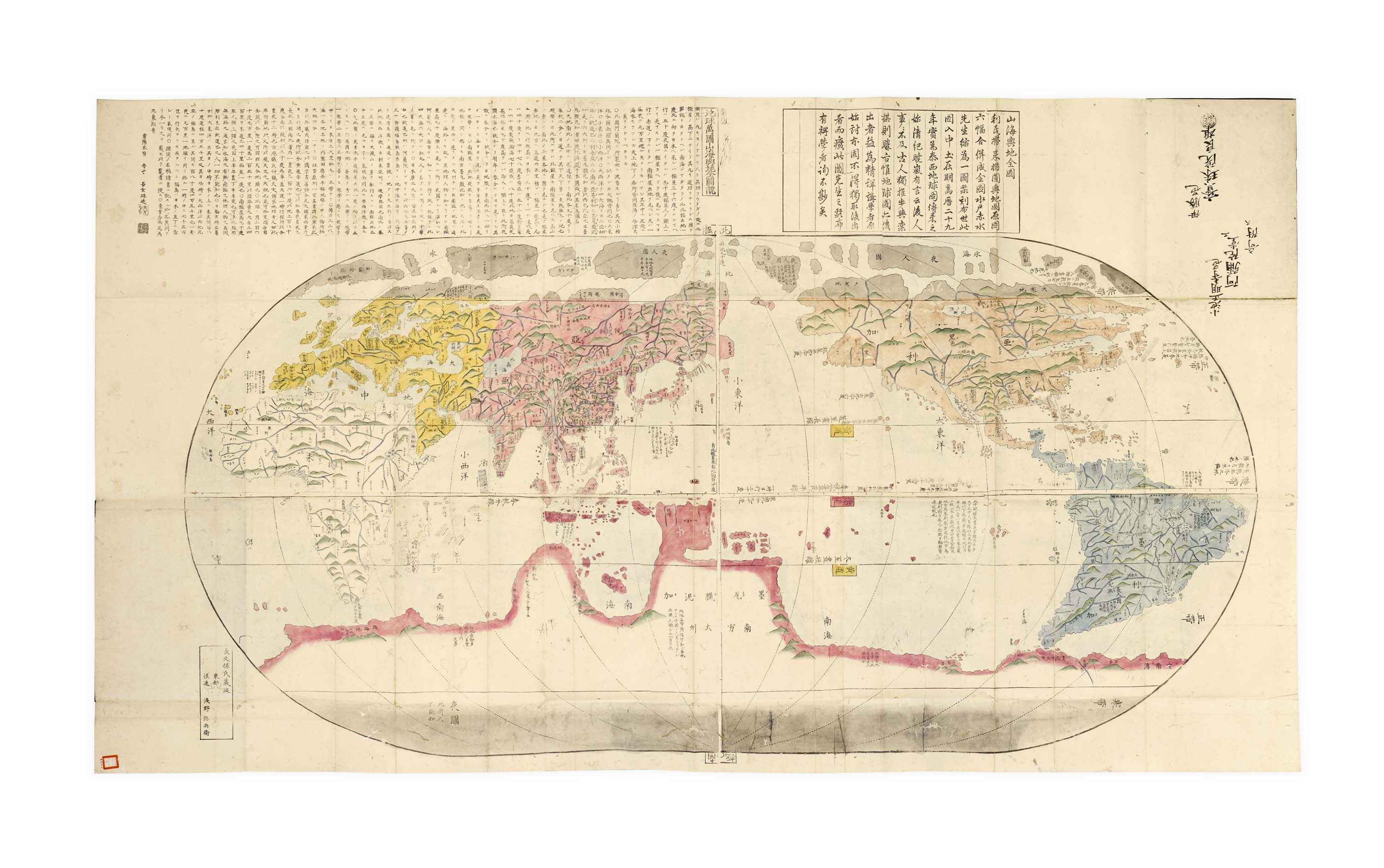
[NAGAKUBO] Sekisui [長久保] 赤水.
地球萬國山海輿地全圖說 [Chikyū bankoku sankai yochi zenzusetsu; ‘Complete illustrated Description of the myriad Nations, Mountains, Seas, and Territories of the Earth’]. Tōto [Tokyo] and Naniwa [Osaka], Yahei Asano, [late eighteenth–early nineteenth century].
Large folding map (1666 x 920 mm), woodcut on paper; text printed in Japanese, hand-coloured in yellow, orange, red, blue, and grey; some worming neatly repaired, a few short tears along folds; else a good copy in later dark blue paper wrappers, blank title label to front cover; early brush-and-ink inscription relating to a temple to upper right corner, twentieth-century bookseller’s ticket of Motoyama Bunko to bottom left corner of map and front cover.
Added to your basket:
地球萬國山海輿地全圖說 [Chikyū bankoku sankai yochi zenzusetsu; ‘Complete illustrated Description of the myriad Nations, Mountains, Seas, and Territories of the Earth’].
An early hand-coloured impression of this pioneering world map by the ‘founder of Japanese geography’.
Sekisui Nagakubo (1717–1801) is credited with producing the first Japanese map employing lines of latitude and longitude. It is for the present work, the Chikyū bankoku sankai yochi zenzusetsu, that he is now best known, a woodcut world map produced in 1785 based upon Matteo Ricci’s pioneering map of 1602 but with significant improvements in the representation of Japan and the Kuril Islands, for example. Later editions appeared well into the nineteenth century.
Our map follows the colouring recommended by Ricci for each continent: Africa in white, Europe in yellow, North America in orange, South America in blue, Asia in pink, and the edge of a vast Antarctica in red. The texts at the upper margin include a discussion of the contribution of the Dutch to world mapping. On the map itself we read of Brazil: ‘The inhabitants of this country do not build houses. They dig the earth and live in caverns. They like to eat human flesh, however they only eat men and not women. Their clothes are made from birds’ feathers’. A caption to Antarctica reads ‘night country with no information on the inhabitants’.