
The Devil’s Own Apostle
[NAS, Johannes.]
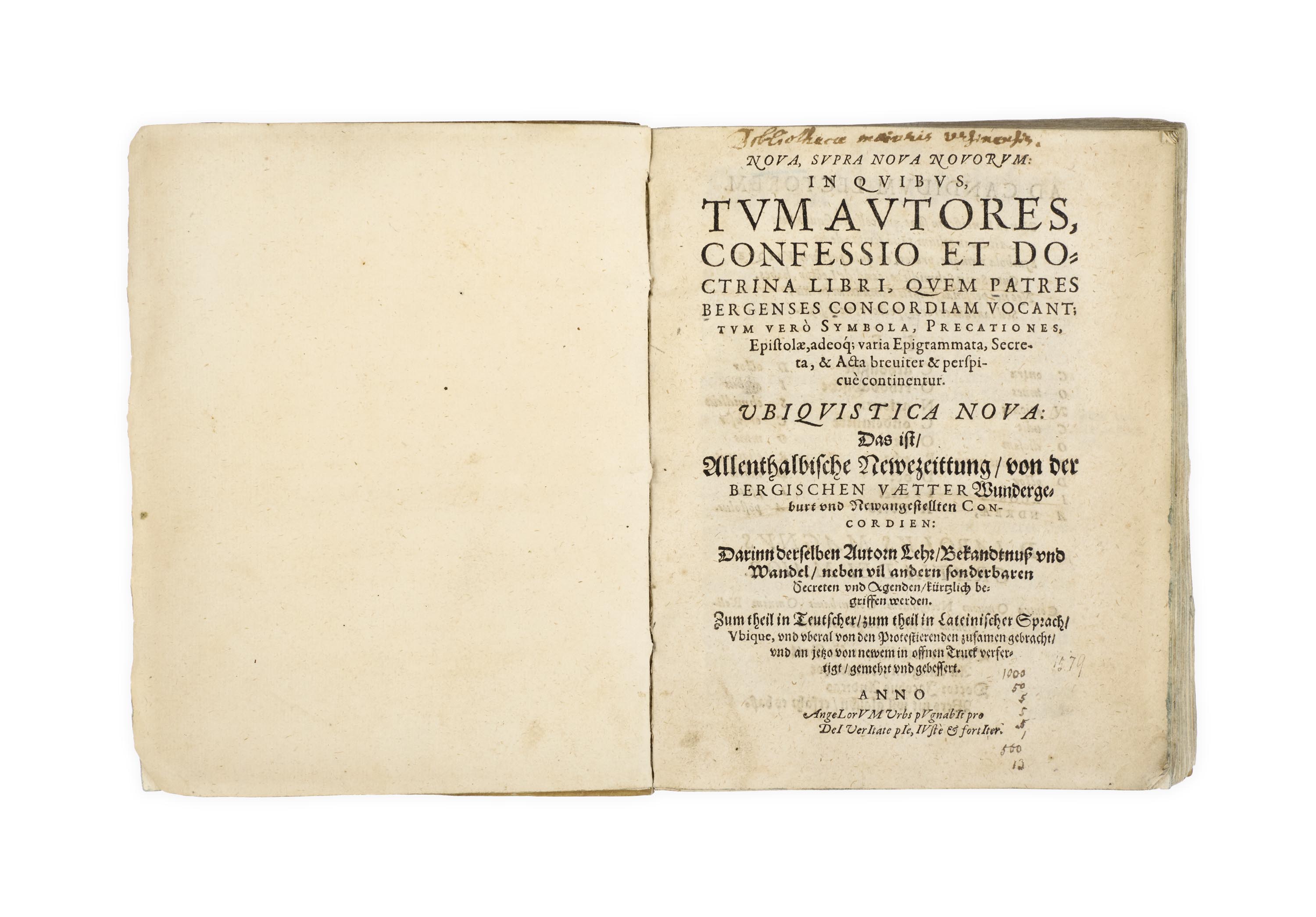
Nova, supra nova novorum: in quibus tum autores, confessio et doctrina libri, quem patres Bergenses Concordiam vocant; tum vero symbola, precationes, epistolae, adeoq[ue] varia epigrammata, secreta, et acta breviter et perspicue continentur ... [Ingolstadt, Wolfgang Eder, December 1581].
Small 4to, ff. [84]; text in German and Latin, chronogram to title, imprint to A4ʳ, woodcuts to A4ᵛ (repeated to K3ᵛ), G2ʳ, and H3ʳ, woodcut initials and tailpieces; loss to upper corner of A4 affecting some text, repair to corner of L3, some cockling, some light damp-staining at the end; overall a good copy in contemporary limp vellum, title in manuscript to spine; cockled and marked, losses to lower cover; early ownership inscription at head of title ‘Bibliothecae maioris Ursinensis’, numerals at foot of title adding up the chronogram.
Added to your basket:
Nova, supra nova novorum: in quibus tum autores, confessio et doctrina libri, quem patres Bergenses Concordiam vocant; tum vero symbola, precationes, epistolae, adeoq[ue] varia epigrammata, secreta, et acta breviter et perspicue continentur ...
Second, much expanded and illustrated edition of this remarkable attack on the Lutheran Formula and Book of Concord by the Franciscan theologian and bishop of Brixen, Johannes Nas (1534–1590), illustrated with woodcuts depicting their ‘monstrous birth’, and representing them as beasts of the Apocalypse. The first edition appeared in June of the same year, with only twenty-eight leaves and no woodcuts.
The Formula of Concord, the authoritative Lutheran statement of faith (also known as the Bergen Book after Bergen Abbey where it was partly compiled), was published in 1577, and was followed three years later by the Book of Concord, a definitive collection of the chief confessional documents of Lutheranism.
Here Nas makes his position clear from the off with an acrostic to the verso of the title-page spelling out Discordia and attacking Jakob Andreae, one of the chief compilers of the Formula and Book: ‘Doctor Iacobus Schmidlein Confusor Omnis Religionis, Diaboli Ipsius Apostolus’ (Dr Jacob Schmidlein, the confuser of all religion, the devil’s own apostle).
The remarkable woodcut depicting the ‘monstrous birth’ of the Bergen Book, shows the Lutheran theologian Johannes Brenz rising from his grave and attempting to cover the nose-, ear-, and hairless baby with goat’s horns emerging between the legs of a figure resembling the Whore of Babylon. The six spectators include Andreae and Martin Chemnitz.
Only three holding institutions traced in the UK (BL, Bodleian, Cambridge MMLL). USTC 678545; VD16 N 125.