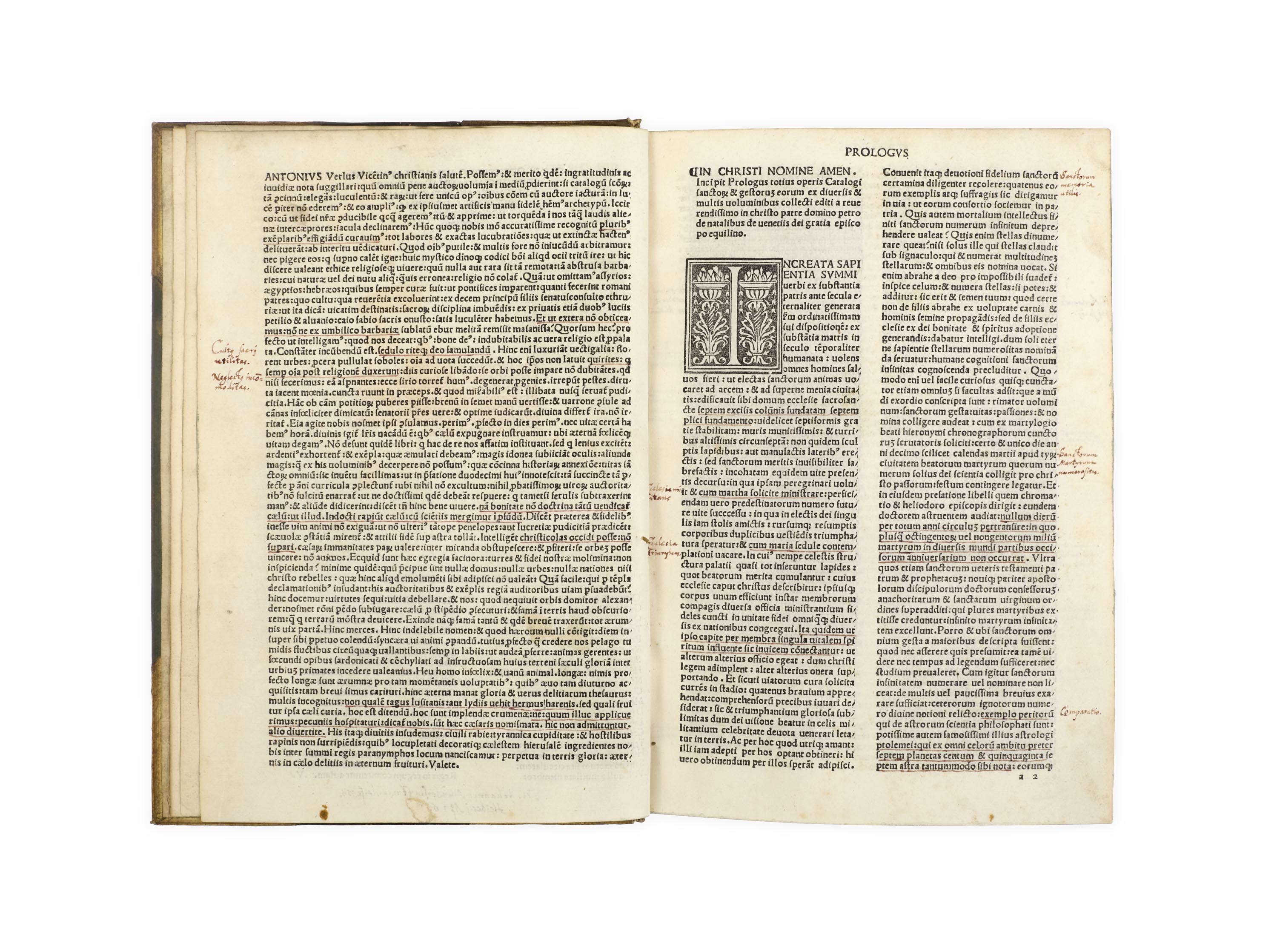
A Regensburg Pastor’s Catalogue of Saints
NATALI, Pietro de’; Antonio VERLO, editor.
Catalogus sanctorum et gestorum eorum. Vicenza, Henricus de Sancto Ursio, Zenus, 12 December 1493.
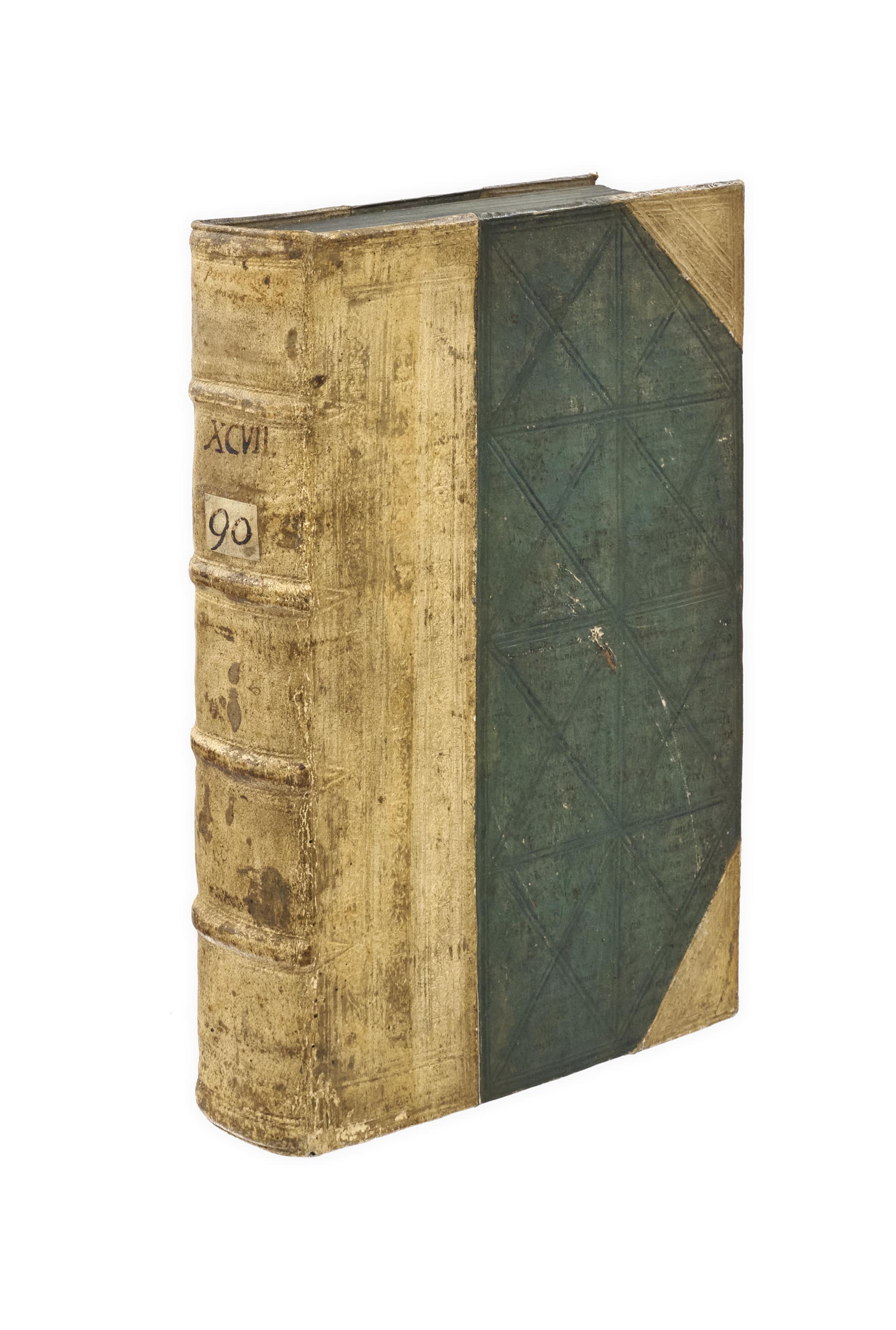
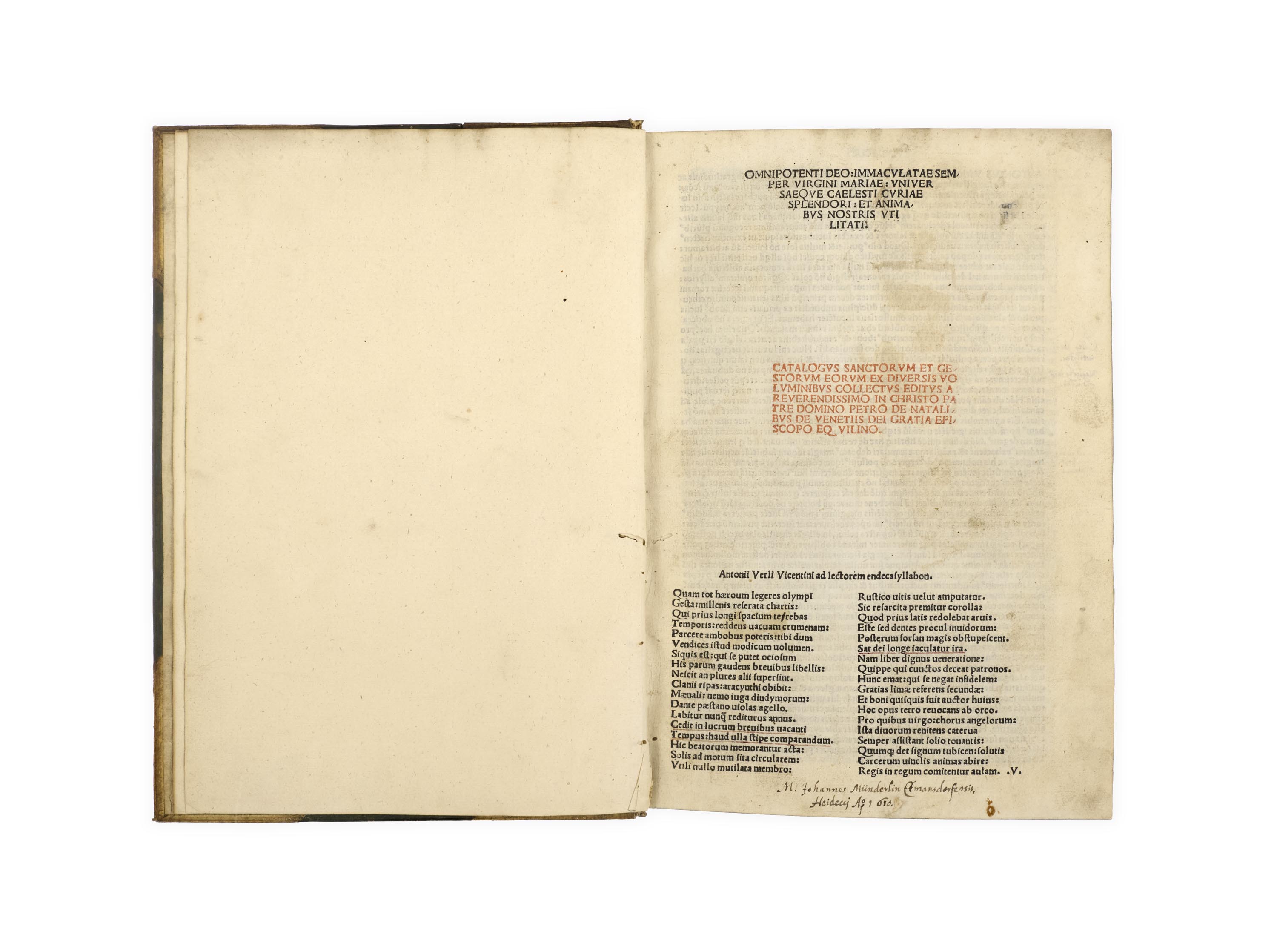
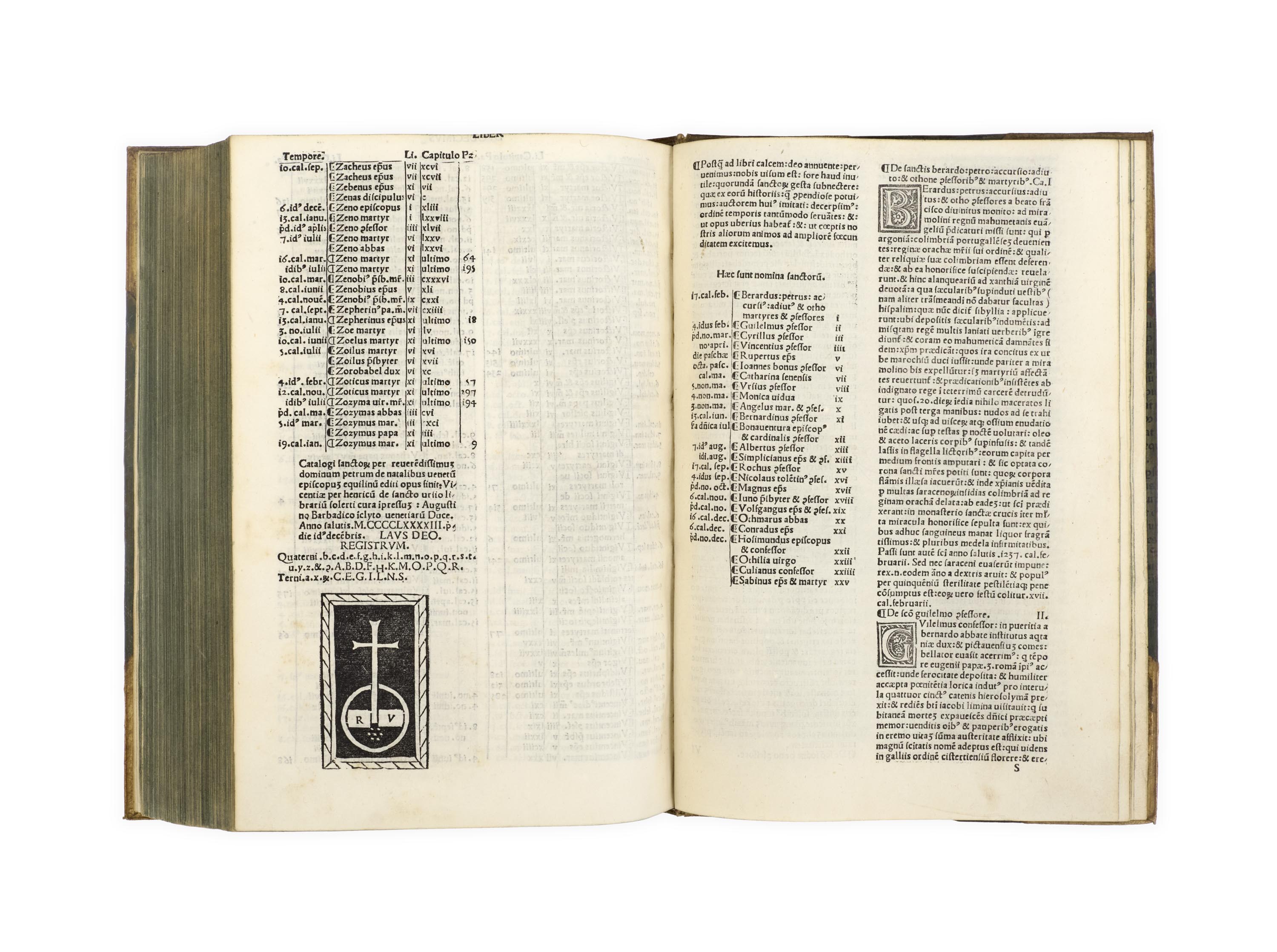
Folio, ff. [331] (of 332, without final blank); a6 b–v8 x6 y–z8 &8 [con]8 [rum]6 A-B8 C6 D–N8/6 O–R8 S6; first leaf blank; roman type in double column, woodcut initials, title printed in red; cut a little close at head with a few headlines shaved or trimmed, opening of text slightly soiled, small tear to foot of n3, some wormholes to inner margin of front and rear flyleaves and first two leaves of text, small repair to outer margin of final leaf, a very good copy; bound in early seventeenth-century south German (probably Regensburg) half pigskin over pasteboard, pigskin with three vertical bands of a roll-tool, pigskin corners with a diagonal line of a candelabra roll-tool, sides of binder’s waste (see below) painted green with blind ruling, spine with ink lettering and shelfmarks, one on a paper label; binding a little rubbed with a few small wormholes (particularly to inside of boards); inscription of Johann Münderlin of Ettmannsdorf dated Heideck, 1610 to foot of a2, annotations, underlining and numbering of passages to c. 39 pp. in red, dark red and black ink, some (if not all) by Münderlin, twentieth-century bookplate with motto ‘Bene vixit qui bene latuit'.
First edition of a comprehensive encyclopaedia of 1,589 saints, providing brief biographies and feast days, showing signs of use by a Lutheran pastor in Regensburg more than a century later.
Pietro de’ Natali (c. 1330–1406) was a Venetian bishop and humanist scholar, writer of poetry and acquaintance of Petrarca. This catalogue of saints, however, was his most significant achievement, written between 11 June 1369 and 27 May 1372, remaining in use and then in print for two hundred years. Divided into twelve books to represent the Apostles, the first eleven books are arranged according to the feast days of the liturgical year.
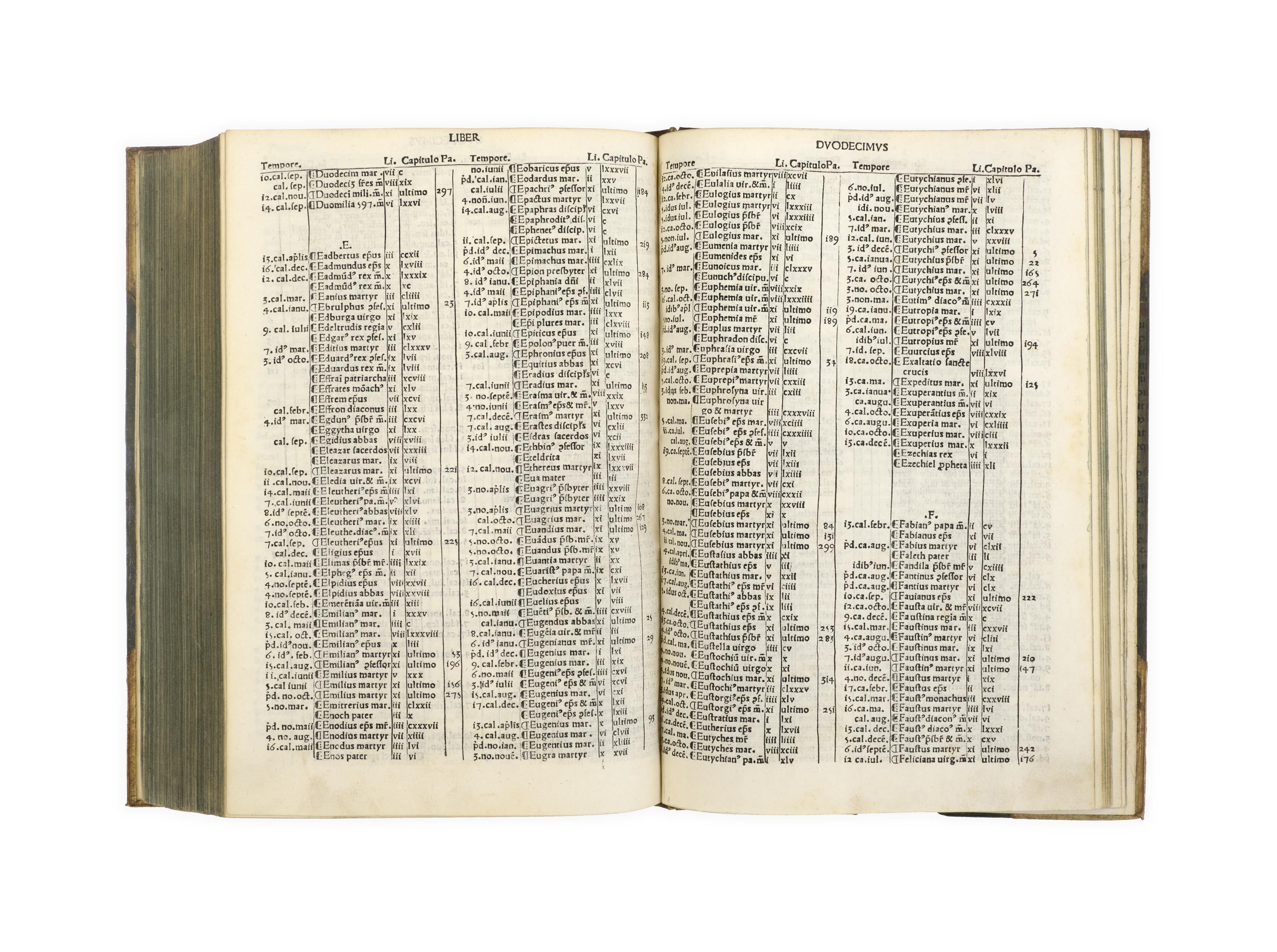
This first edition has been supplied with various introductions, tables and indexes to enable efficient use of the volume. After the prologue is a ‘Divisio totius operis per revolutionis anni’, dividing up the text according to the liturgical year, and each of the first eleven books is prefaced by a table of contents. The eleventh book concludes with a list of 333 saints not included in the main text as not much information is known about them, beyond their feast day and perhaps their location or the manner of their death. At the end of the volume, book twelve comprises a comprehensive alphabetical index of all the saints, noting their feast day, and indicating the book, chapter and, for the list at the end of book eleven, the paragraph number where the entry can be found.
The final quire, which appears after the colophon, contains twenty-four more recent (or previously omitted) saintly biographies, including Catherine and Bernardino of Siena, Bonaventure of Bagnoregio, Osmund, bishop of Salisbury in the late eleventh century, as well as a local saint for Vicenza, St Ursus or Orso (note the name of the printer, Henricus de Sancto Ursio). The editor, Antonio Verlo, was a patrician and a poet from Vicenza; he compiled this list to bring Natali’s text up to date and correct any omissions.
The annotations involve underlinings and marginal notations, in Latin and German (and one in Greek), predominantly highlighting words or phrases from the text. In the prologue, the names of the sources have been underlined and marked ‘Historiographi sacri’. A passage in the life of St Joseph talks of his previous wife and children and the sources of that information; the annotator notes that some of the text is false. Of particular interest to the annotator are the saints Thomas the Apostle, Nicholas, and the Three Magi, the sections on Advent and the Epiphany, as well the introductory section on the arrangement of the book.
The binder’s waste is from a rubricated copy of a large legal text with surrounding commentary, printed by Peter Schoeffer in two sizes of a rounded gothic type; the main text is in Schoeffer’s type 5:118G, and the commentary in his type 6:92G.
Provenance:
Johannes Münderlin (c. 1580–1628), from Ettmannsdorf in the Upper Palatinate (Bavaria), was a Lutheran preacher. At the time he inscribed this book, he was a deacon in Heideck (‘Heidecii’) and he later became an archdeacon in Regensburg. In 1621, he performed the baptism of Johannes Kepler’s daughter Cordula in Regensburg.
HC 11676*; BMC VII 1047; GW M25858; Goff N6; BSB-Ink N-4; Bod-inc N-001; ISTC in00006000.