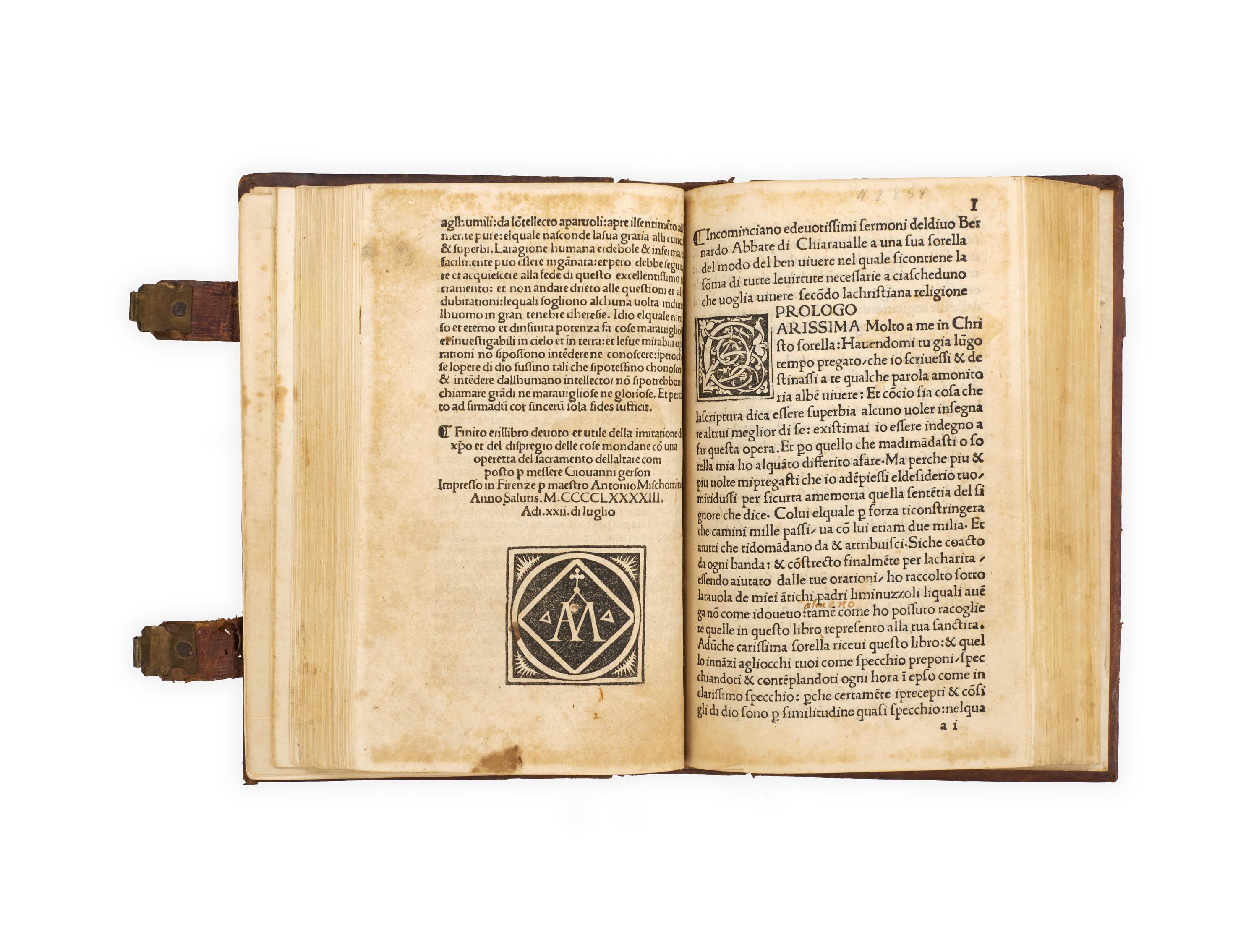

Devotional Duo
[THOMAS à Kempis.]
Ioanni Gerson vulgare devota operetta della imitatione di Iesu Christo … Florence, Antonio Miscomini, 22 July 1493.
[bound with:]
BERNARD of Clairvaux, attributed. [Sermoni vulgari devotissimi di Sa[n]cto Bernardo Abbate di Chiaravalle necessarii al ben vivere ridocti in lingua Toscana.] Florence, Lorenzo Morgiani and Johannes Petri for Piero Pacini, 27 January 1495.Two works in one vol., 8vo; Imitatio: ff. [78]; woodcut of Christ to title-page, woodcut printer’s device to colophon; small chips to lower edge of title-page, dampstain at head of first few leaves, inner margins strengthened throughout, occasional foxing and browning, calligraphy in form of bird at foot of title; Sermoni: ff. CXX, bound without the first four leaves of preliminaries; woodcut initials, three woodcut devices to colophon; occasional foxing especially to last leaf, small wormholes to last leaf; bound in early nineteenth-century calf, in the style of a sixteenth-century binding with covers decorated in blind to a panel design, three raised bands to spine roll-tooled in gilt, two brass clasps and catches; some wear to extremities, a few wormholes.
Added to your basket:
Ioanni Gerson vulgare devota operetta della imitatione di Iesu Christo …
Uncommon editions of two classic Latin devotional texts rendered into Italian.
One of the most influential works of Christian literature after the Bible, the Imitatio Christi was long attributed to Jean Gerson but is now generally ascribed to the German-Dutch ascetical writer Thomas à Kempis (c. 1380–1471). ‘The purpose of this famous manual of spiritual devotion is to instruct the Christian how to seek perfection by following Christ as his model. The book is divided into four parts. The first two contain general counsel for the spiritual life, the third deals with the interior dispositions of the soul, and the fourth with the sacrament of the Holy Communion’ (Oxford Dictionary of the Christian Church).
The Imitatio circulated in manuscript from 1418 with the Latin editio princeps being printed at Augsburg by Günther Zainer in 1473. Editions in various vernaculars swiftly followed: in Catalan (1482), German (1486), Spanish (c. 1488), and French (1488). An Italian translation was first published in Venice by Johannes Rubeus in 1488, with another version appearing in 1491 in a Florentine edition by Antonio Miscomini. Ours appears to be the first Miscomini edition with a woodcut to the title, depicting the crucified and risen Christ with the cross in his left hand and blood falling from his right hand into a cup.
The second work is an Italian translation of the Modus bene vivendi in Christianam religionem attributed to Bernard of Clairvaux, a popular and frequently printed guide to living a good Christian life often produced in editions aimed at female religious communities. An Italian translation was first published by Bernardinus Benalius at Venice c. 1494; the rendering here differs very slightly but is by the same translator. Our copy is missing the preliminaries i.e. the translator’s preface to his daughter Laura (a nun), with an opening woodcut, and the table of contents.
Imitatio: BMC VI 642; Bod-Inc T-114; Goff I52; ISTC ii00052000. ISTC records three copies in the UK (BL, Bodleian (imperfect), St John’s College Cambridge) and five copies in the US. Sermoni: BMC VI 683; Goff B418; Bod-Inc B-206; ISTC ib00418000. ISTC notes three copies in the UK (BL, Bodleian (imperfect), Cardiff (imperfect)) and eleven copies in the US.