Syriac Gospels
[NEW TESTAMENT, in Syriac.]
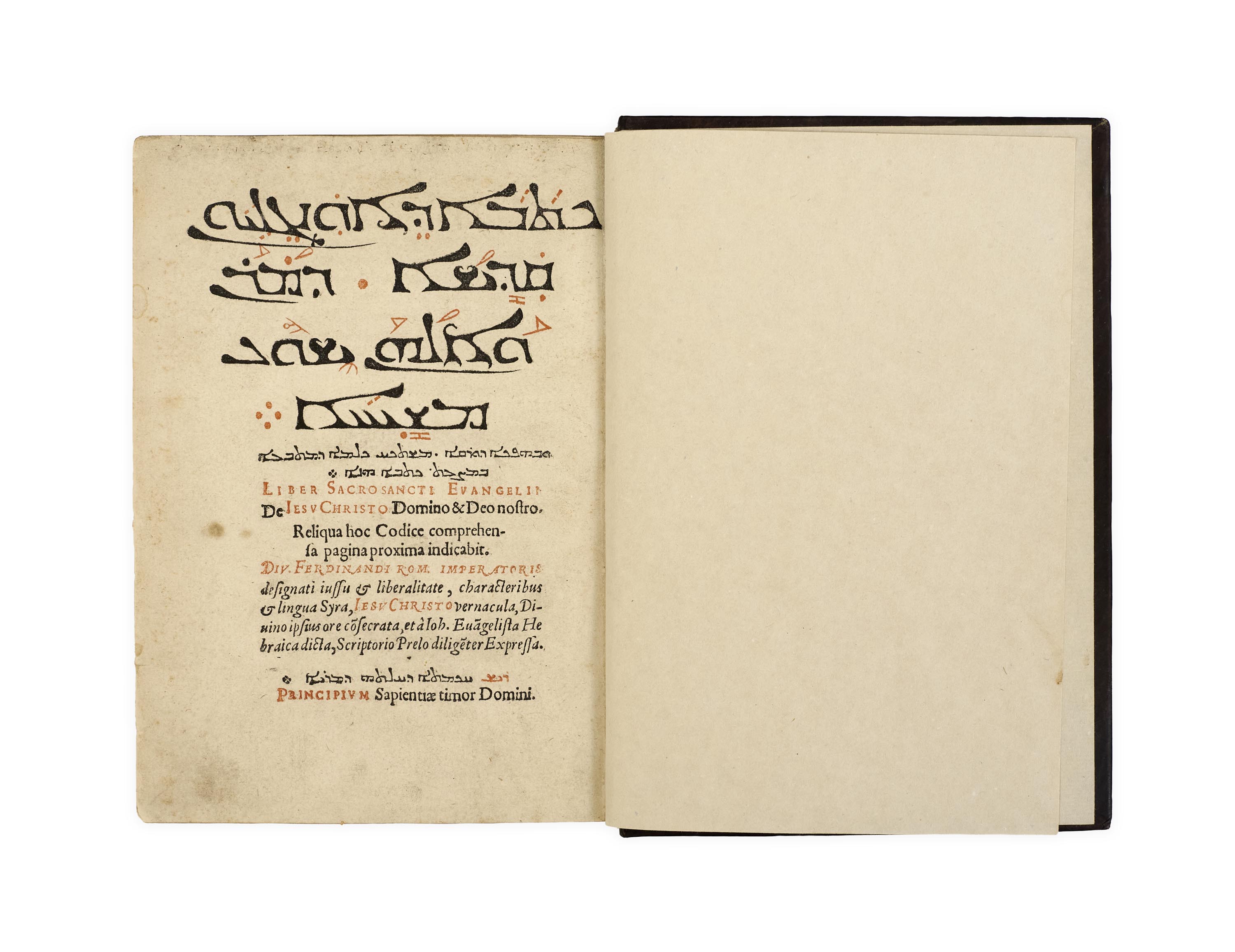
[Ktābā d-Ewangeliyon qaddīšā d-Māran w-Alāhan Yešu‘ Mšīhā] … Liber Sacrosancti Evangelii de Iesu Christo Domino et Deo nostro. Reliqua hoc codice comprehensa pagina proxima indicabit. [Vienna, Michael Zimmermann, 1555].
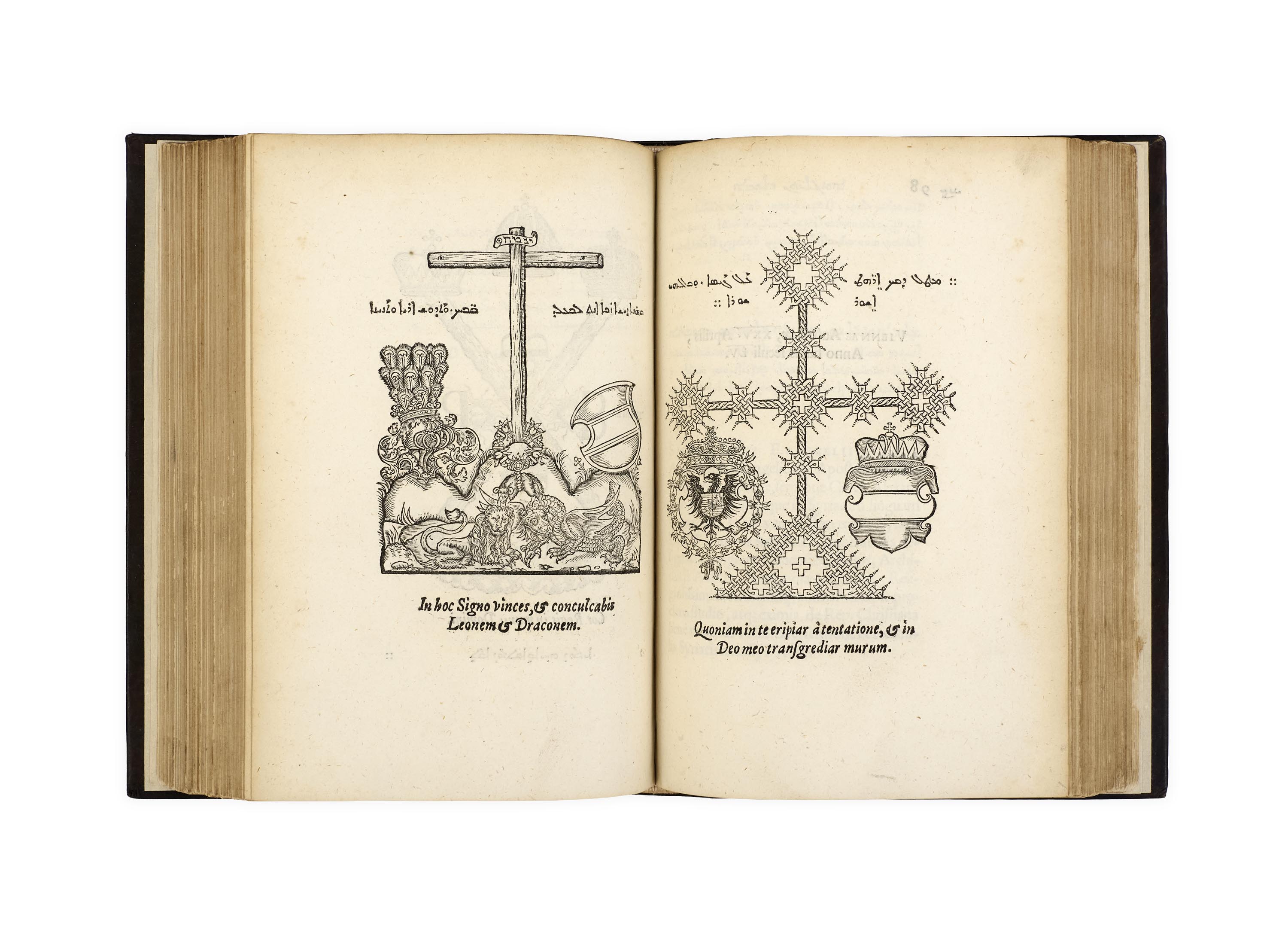
4to, ff. [27], 129, [11], lxxx, [2], 38, [2], 11, [28]; title printed in red and black, a few other headings printed in red; with 15 full-page emblematic woodcut illustrations; without the preliminary leaves for parts III and IV, as usual (see below), but with the preliminary leaves for part II (usually missing); tiny marginal repair to one leaf (n2, not affecting text); a very good copy in recent old-style calf, gilt edges.
Added to your basket:
[Ktābā d-Ewangeliyon qaddīšā d-Māran w-Alāhan Yešu‘ Mšīhā] … Liber Sacrosancti Evangelii de Iesu Christo Domino et Deo nostro. Reliqua hoc codice comprehensa pagina proxima indicabit.
First edition, first issue, of the Syriac New Testament in the Peshitta version, ‘une des plus belles impressions orientales’ (Le livre et le Liban).
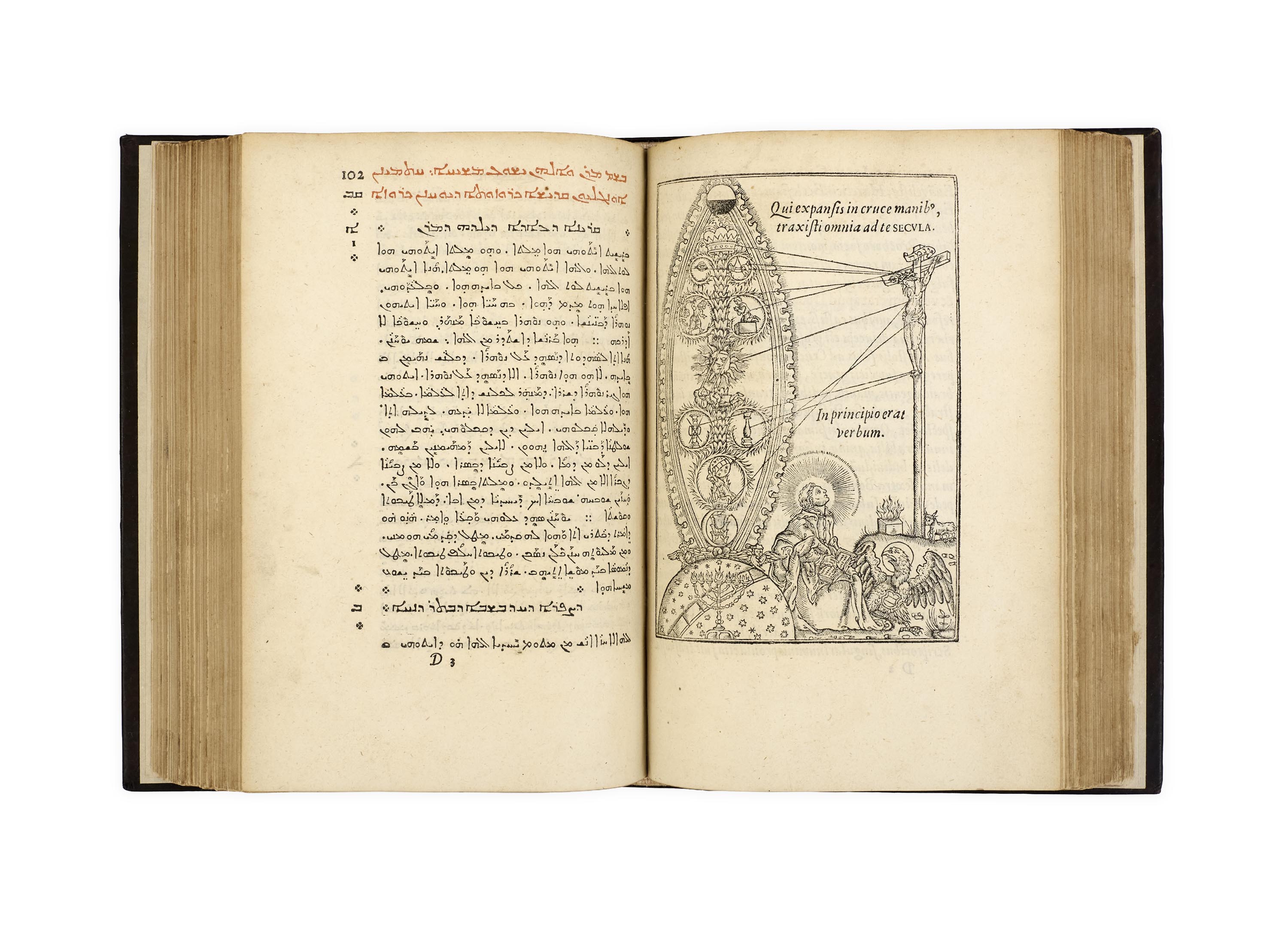
‘A number of motives combined to produce this publication. The Syrian Orthodox priest Moses of Mardin was in Europe trying to find a sponsor for printing the Syriac gospels. Widmanstetter, who was a scholar of Hebrew and Arabic, took up Syriac, supposing that it was the language of Jesus (a common misconception, but one he may have picked up from Teseo [Ambrogio]), and that in some way the publication of the Syriac Bible might be a divinely-favoured action that would renew Christendom. Such an idea would have consequences for the fight against the Turks, and perhaps that was part of the reason that King Ferdinand [I] paid for the publication … But whatever its ideological background, the book was a great scholarly and typographical achievement. The text was edited by Moses, and his handwriting is evidently the model for the pleasing serto and estrangela types … Unfortunately, this type was never used again’ (J. F. Coakley, ‘Printing in Syriac, 1539–1985’ in Middle Eastern languages and the print revolution, Gutenberg Museum Mainz, 2002, pp. 93–115, p. 96). Guillaume Postel, who had already completed, in Venice, the text of the Gospels in Syriac and was in Vienna from the end of 1553 to May 1554, oversaw the preparation of these types and gave valuable assistance to Widmanstetter (see Kuntz, Guillaume Postel, prophet of the restitution of all things. His life and thought, pp. 115–116).
‘The compact size of the book is made possible by the admirable small type used for the text – only the second Syriac type ever made – which has the vowel-signs and diacritical points cast onto the letters. (Few Syriac types had this degree of sophistication until the nineteenth century.) Syriac also had a fascination for practitioners of “Christian kabbalah”. In the illustration [on f. 101v] the Jewish sefirot, or divine emanations, are connected with the wounds of Christ’ (Middle Eastern languages and the print revolution, p. 468).
Of the two variants of this work, classified by Darlow & Moule ‘A’ and ‘B’, the present copy conforms to variant A. In variant B the verso of the title bears an armorial device and the colophon ‘Viennae Austriae excudebat Michaël Zymmerman. Anno MDLXII’. ‘The edition consisted of 1,000 copies, of which 500 were retained for use in Europe, while 300 were intended for the Patriarch of Antioch and the Maronite Patriarch, and 200 were entrusted to Moses to carry back with him to Mesopotamia. Moses, however, after offering his stock of copies to Andreas Masius (Maes), a Flemish scholar, who had learnt Syriac from him when they were both sojourners in Rome, eventually sold the books elsewhere … It has been suggested that variant A represents the class of copies which got into circulation at an early date – whether presentation copies … or those dispersed by Moses’s sale of his stock – and that variant B represent the bulk of the edition which was reserved and not actually published until 1562. Nearly all copies [of both variants] lack the preliminary leaves in parts 2, 3 and 4, including the dedication addressed to the three sons of Ferdinand I. These three pieces are numbered III, V, and VII in the table of contents. No. III is found in a few copies [it is present here], but Nos. V and VII are always missing’ (Darlow & Moule).
Adams B1800; Darlow & Moule 8947; Le livre et le Liban 55; Smitskamp, Philologia orientalis 91; VD16 B4584. See also Le livre et le Liban pp. 122–134.