Nuns Six Feet Under
[NUNS.]
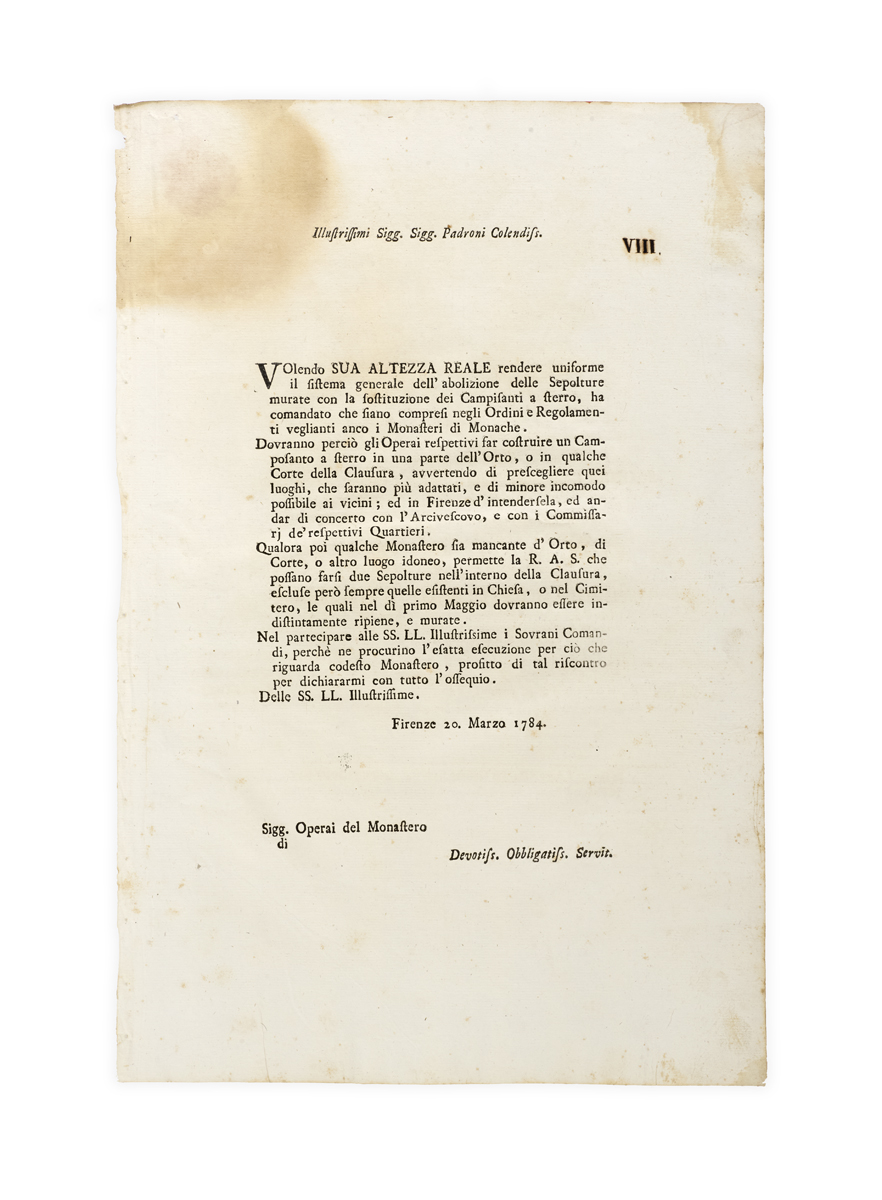
[Incipit:] Illustrissimi Sigg. Sigg. Padroni Colendiss. Volendo Sua Altezza Reale rendere uniforme il sistema generale dell’abolizione delle sepolture murate ... Florence, 20 March 1784.
Half-sheet letterpress broadside (400 x 270 mm); dampstaining to upper corners not affecting text, evidence of overcast stitching to left margin, else very good; upper right corner numbered ‘VIII’ in brown ink.
Added to your basket:
[Incipit:] Illustrissimi Sigg. Sigg. Padroni Colendiss. Volendo Sua Altezza Reale rendere uniforme il sistema generale dell’abolizione delle sepolture murate ...
Extremely rare broadside confirming the acquiescence of a Florentine convent with an edict issued by Peter Leopold of Habsburg Lorraine, Grand Duke of Tuscany (later Holy Roman Emperor), abolishing the communal burial of nuns in vaulted underground chambers and requiring that they be buried in graves.
Monks were already, by this point, required to be buried in graves, and the present edict standardises burial practices by extending the rule to nuns. Sepolture murate, or walled burials, commonly used in Tuscan convents from the seventeenth century onward, were brick chambers designed for prolonged use and for housing the bodies of several members of the same convent over time. The deceased would be buried in a seated position, often holding a rosary.
Peter Leopold (1747–1792) was the younger brother of Holy Roman Emperor Joseph II, who in Habsburg Lombardy was carrying out burial reforms of his own. ‘Leopold II had the greatest effect on ecclesiastical legislation. Inspired by a rigid jurisdictionalism, he abolished the right of asylum, suppressed convents and religious societies that did not serve a public purpose, reorganised ecclesiastical property at his discretion, suppressed the tribunals of the nunciature and the Inquisition, subjected the acts of religious authorities to sovereign sanction, and even regulated the teaching of the secular and regular clergy’ (DBI, trans.).
In order to carry out Peter Leopold’s proposed reform, the broadside states that the workers of each convent must build a graveyard in the garden or in a courtyard, or alternatively in some other place that causes ‘the least possible inconvenience to the neighbours’ (trans.), in which case the approval of the Archbishop of Florence and the relevant neighbourhood is required. Blank spaces have been left for the name of the monastery and of the relevant correspondent, and the proposed works were to be carried out within a month and a half.
This edict was later included in vol. XII of Bandi, e ordini del granducato di Toscana (1786), of which OCLC finds a single copy in the UK (BL), and four in the US (Harvard Law, Illinois, NYPL, Newberry).
On sepolture murate, see Ciampoltrini and Spataro, I Segni della devozione. Testimonianze da ‘sepolture murate’ tra Lucca e la Valdera (XVII–XVIII secolo).