Marrying for Money
OSTROVSKY, Aleksandr Nikolaevich.
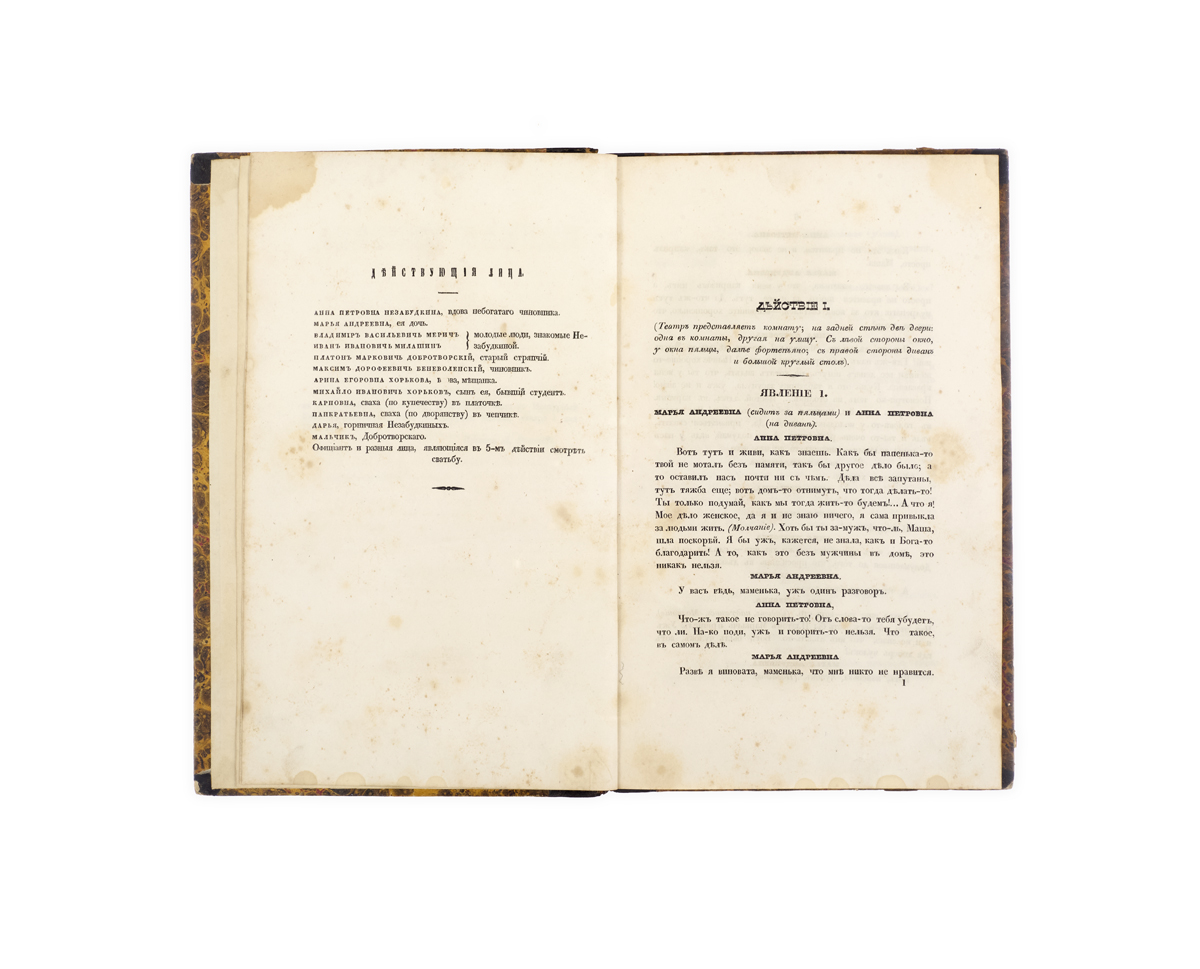
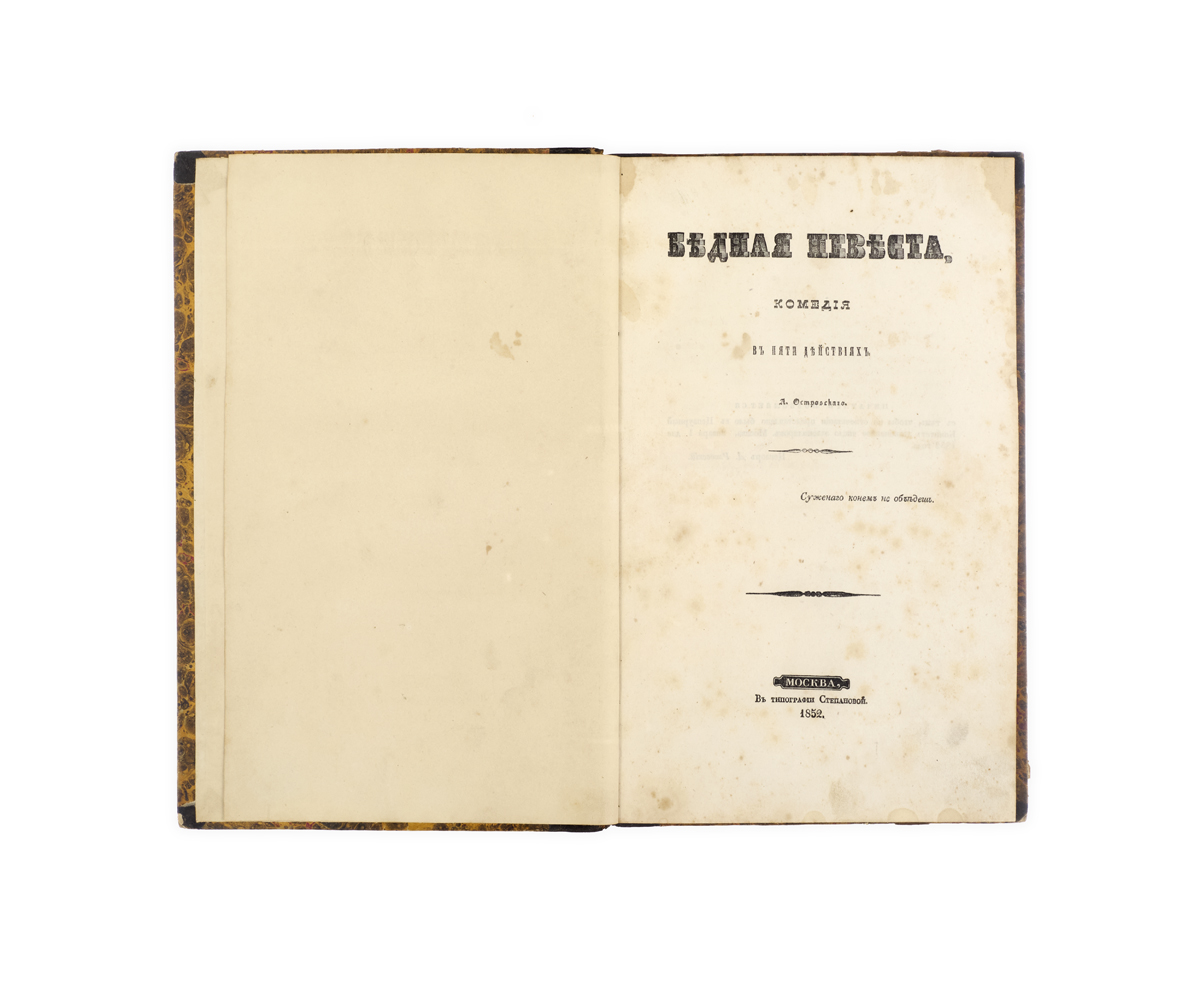
Бѣдная Невѣста. Бѣдная невѣста, комедія въ пяти дѣйствіяхъ. [Bednaya Nevesta, komediya v pyati deistviyakh; ‘The poor bride, a comedy in five acts’]. Moscow, Stepanov, 1852.
Large 8vo, pp. 128; some light spotting and staining; but a very good copy in Russian contemporary quarter sheep with orange pseudo-marbled sides, spine lettered in gilt; minor repairs to spine.
Added to your basket:
Бѣдная Невѣста. Бѣдная невѣста, комедія въ пяти дѣйствіяхъ. [Bednaya Nevesta, komediya v pyati deistviyakh; ‘The poor bride, a comedy in five acts’].
First separate edition, rare, of the second play by one of the leading Russian playwrights of the nineteenth century, drawing attention to the plight of young women who forced to marry for money rather than love, thought by Turgenev to be one of Ostrovsky’s finest works.
Ostrovsky (1823–1886), author of some forty-seven plays, ‘almost single-handedly created a Russian national repertoire. His dramas are among the most widely read and frequently performed stage pieces in Russia’ (Encyclopaedia Britannica). The Poor Bride, his second play, was first published in the literary magazine Moskvityanin (The Muscovite, edited by Mikhail Pogodin) earlier in 1852 and tells the story of Marya Andreyevna, the dowry-less daughter of a widow who has no choice but to marry an older businessman.
Initially banned from production by the censor for its undercurrents of social criticism, The Poor Bride was one of Ostrovsky’s first plays to be produced on stage, at the Maly Theatre, Moscow, in 1853. From this date until his death no year passed without a new play by Ostrovsky appearing on the stage of the Imperial theatres.
‘The Poor Bride realistically shows the unfortunate position of women in Ostrovsky’s time, whose only hope of economic security was in marrying for money, not love. Though at moments the author parodies the romantic archetype, he states no thesis, but merely implies one in the relentless realism characteristic of both his first plays’ (Terras).
OCLC records six copies only, of which five in the US (Columbia, Indiana, Kansas, LoC, UNC Chapel Hill), and one in Australia (Melbourne); no copies traced in the UK.
Not in Kilgour or Smirnov-Sokol’skii.