Rubricated at Tegernsee by Paulus Wigg
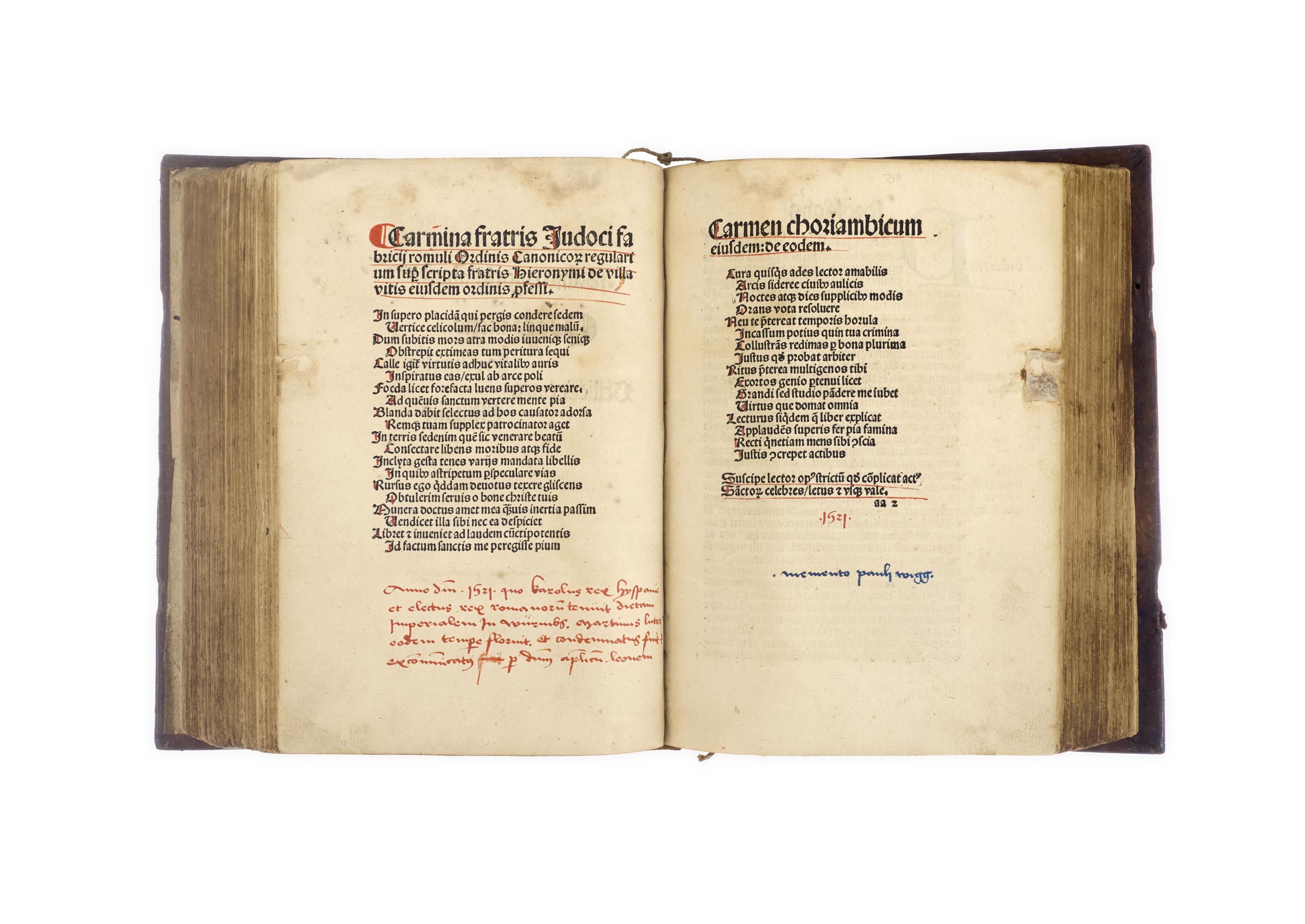
With Reference to Luther and the Diet of Worms
HIERONYMUS de Villa Vitis.
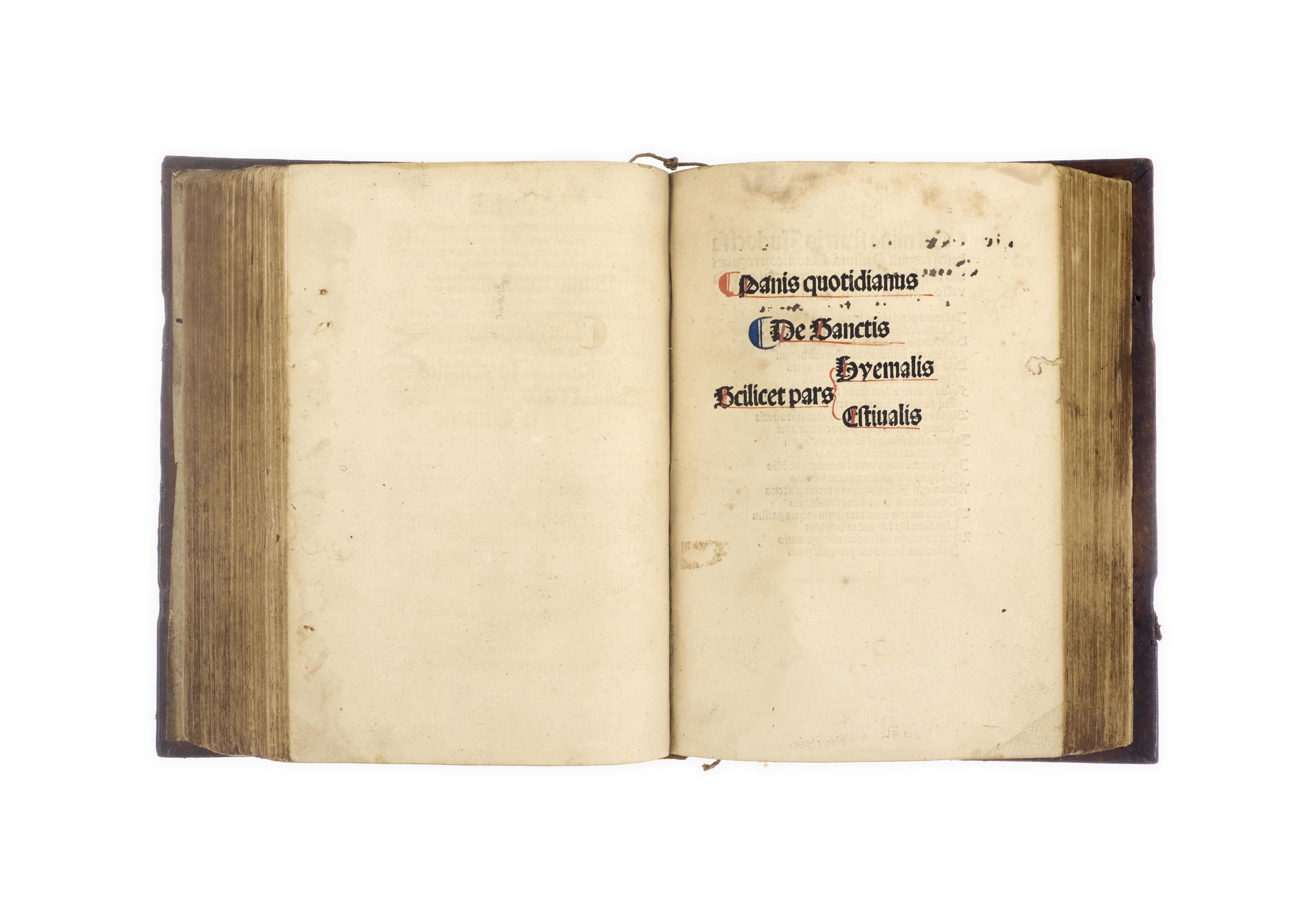
Panis quotidianus de tempore [– de sanctis scilicet pars hyemalis estivalis]. Iste liber i[de]o sic dictus est q[uia] quotidie p[er] totu[m] annu[m] [con]tinet speciale[m] oratione[m] cu[m] utilibus et eva[n]gelicis doctrinis insertis in q[ui]bus devotio et v[ir]tutu[m] dilectio faciliter hauriri poterit q[uia] p[re]cipua dilige[n]tia o[mn]ia illa p[ro] salute viventiu[m] edita. [(Colophon:) Hagenau, Heinrich Gran for Johann Rynmann von Öhringen, 1509.]
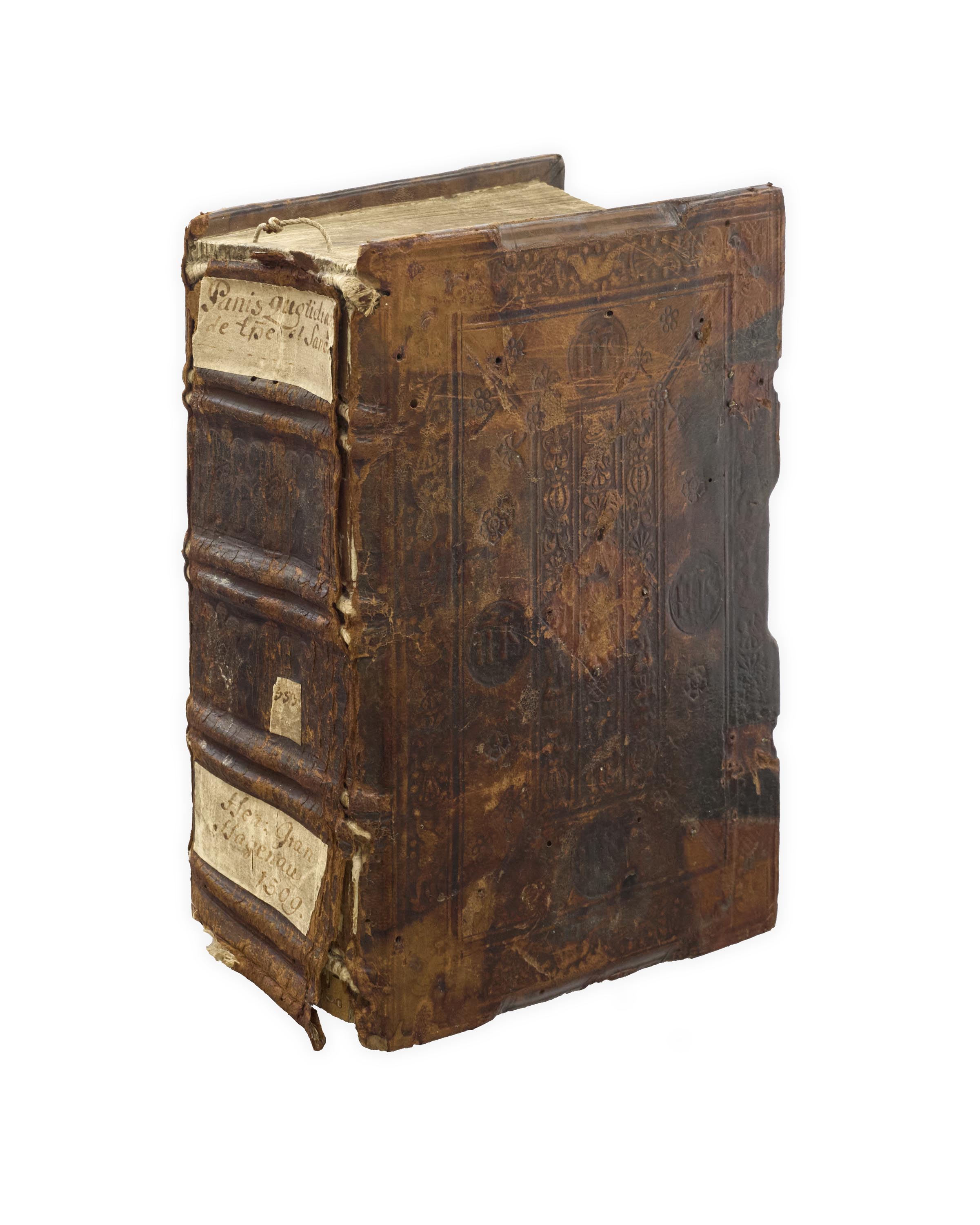
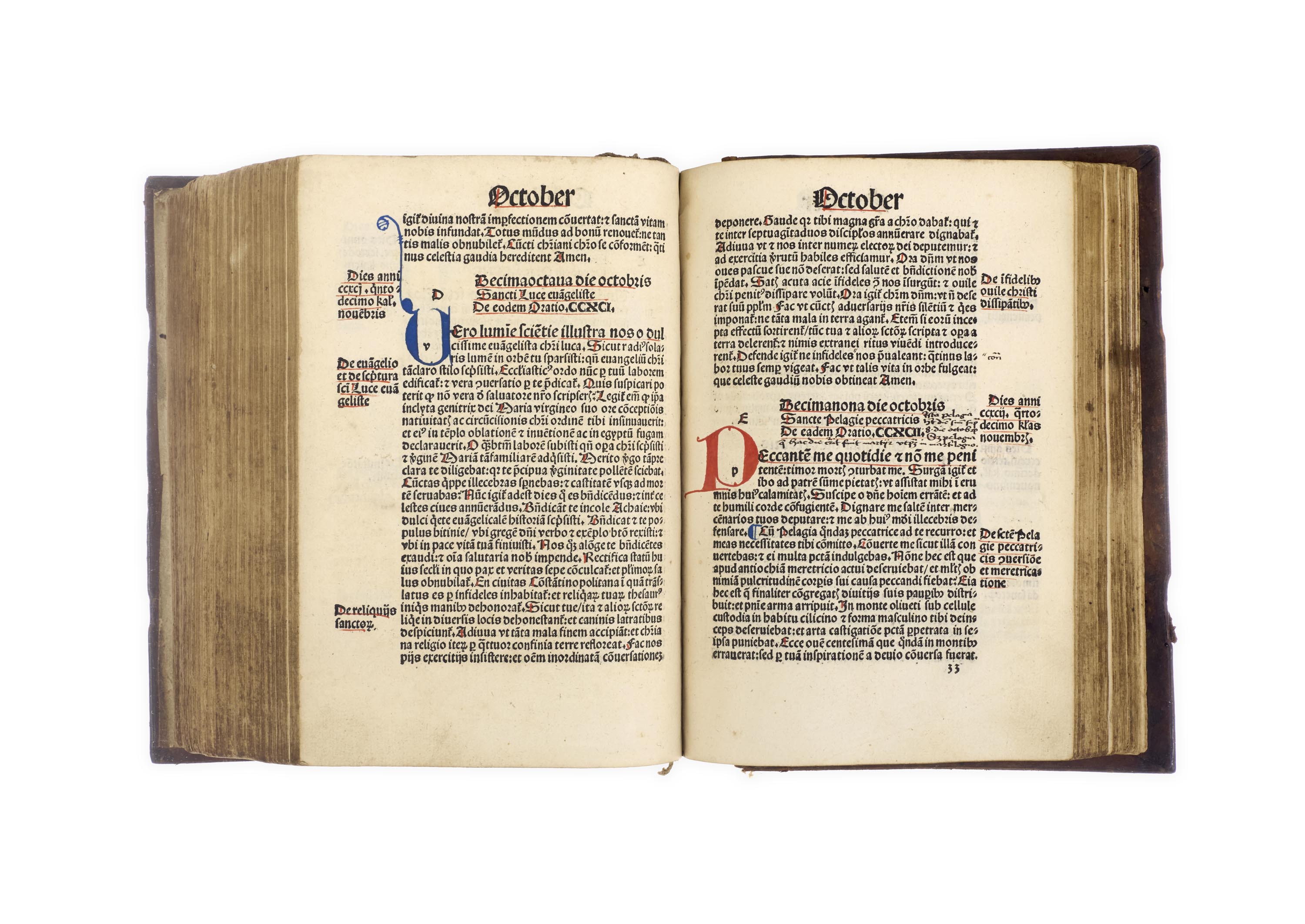
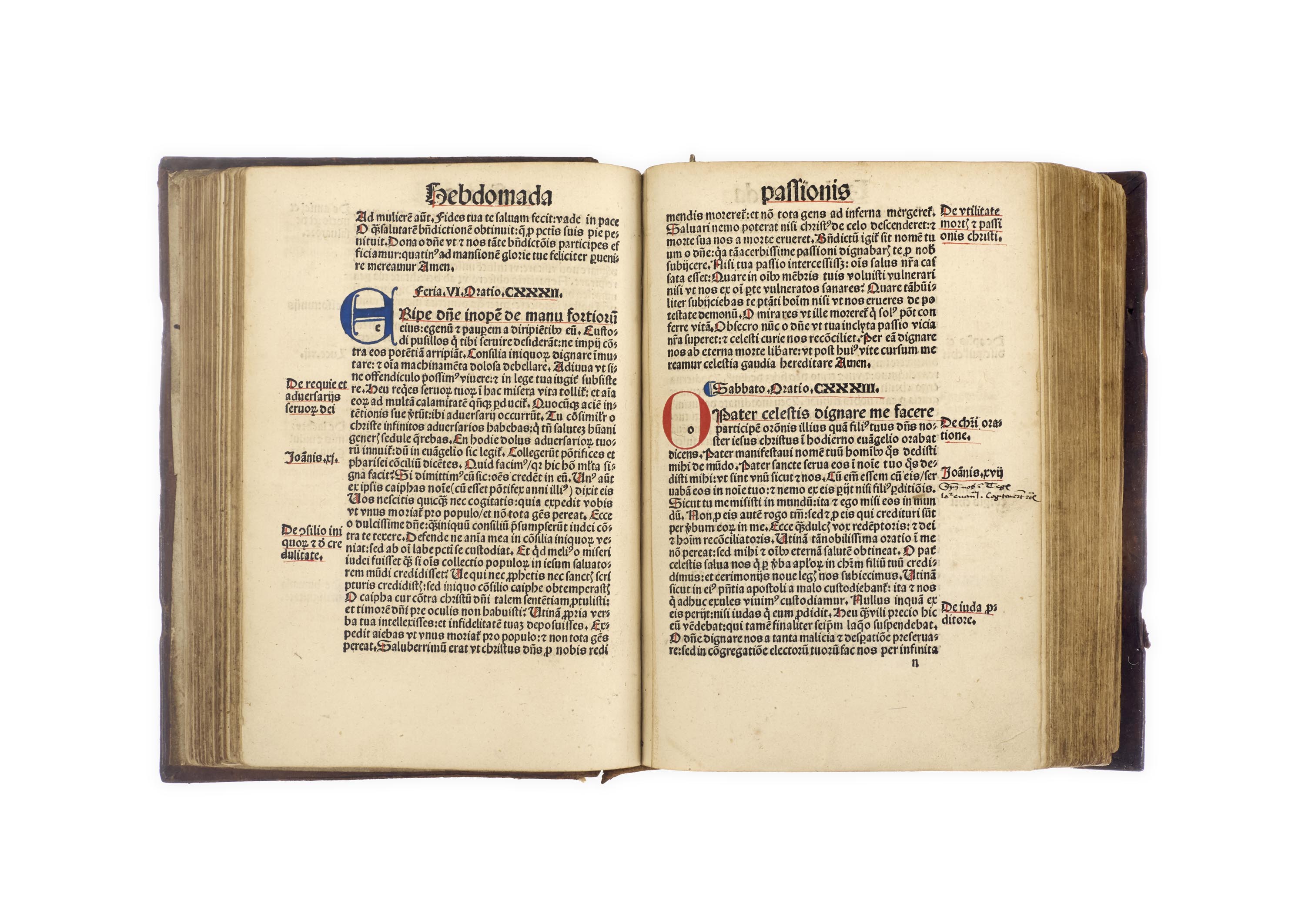
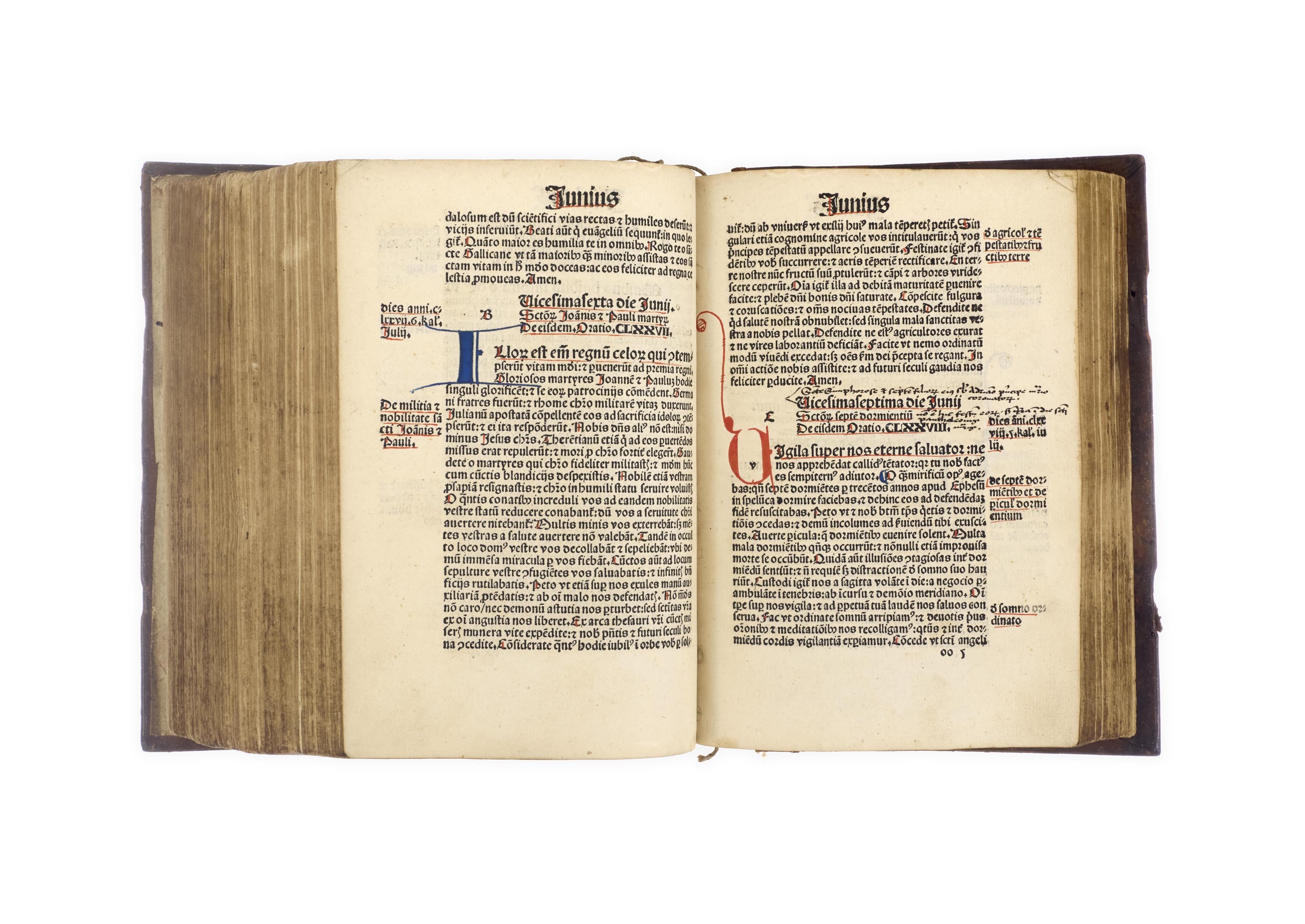
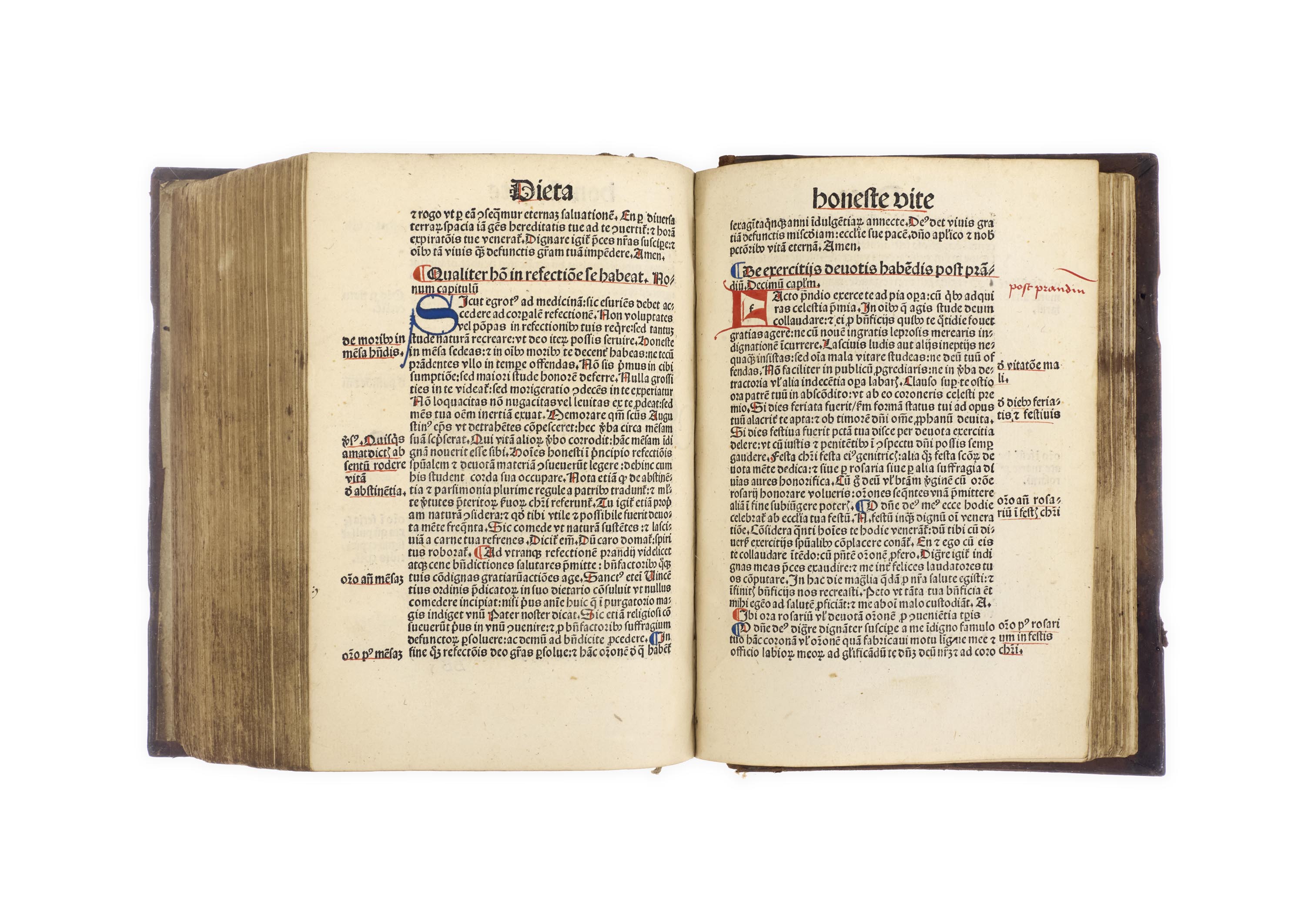
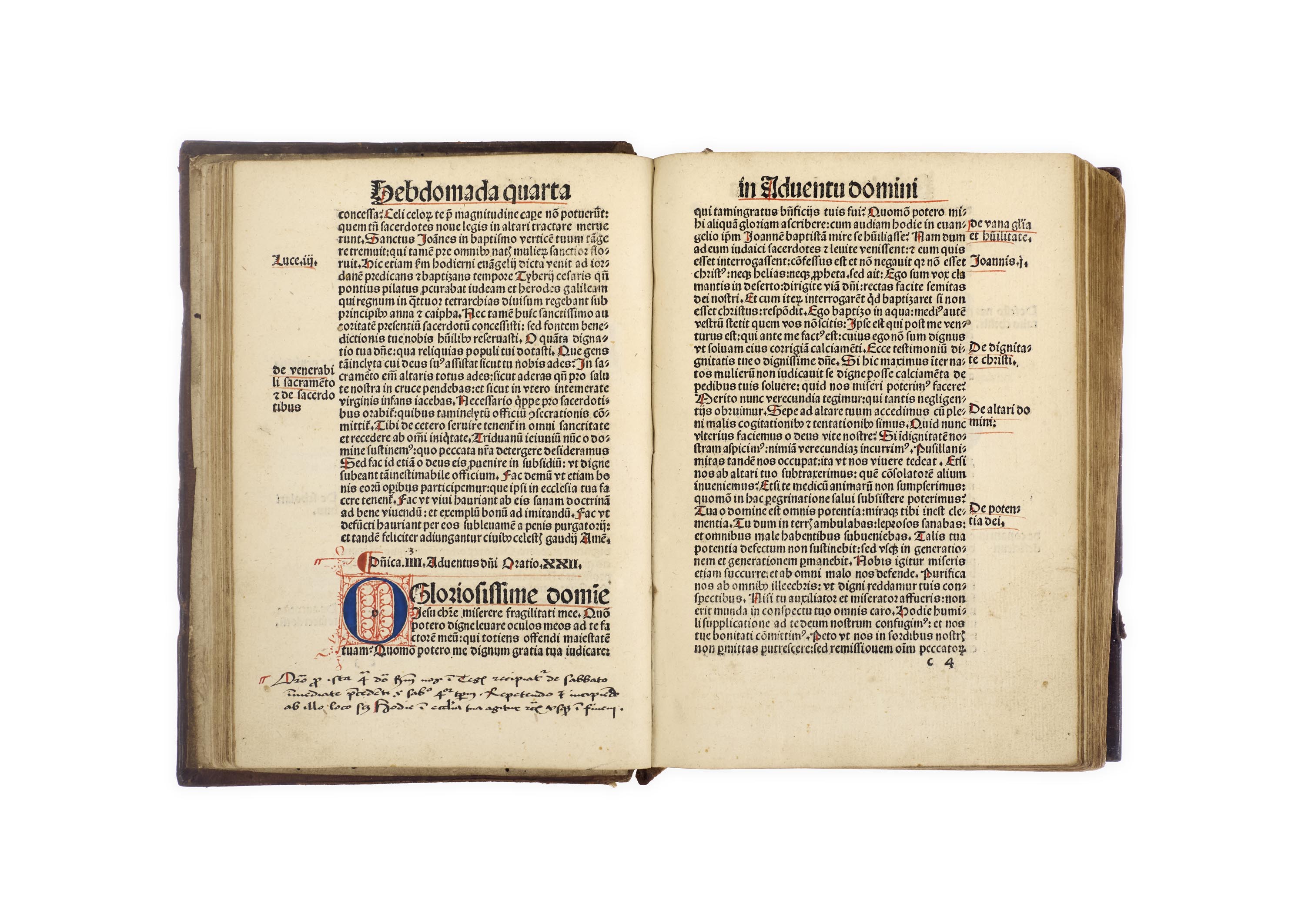
Two parts in one vol., 4to, ff. I: [326], II: [304] (of 312, bound without first quire 2π8 containing the calendar); with blanks M8 and R8; capitals supplied in alternating blue and red by Paulus Wigg, some with pen flourishing and infilling, paragraph marks in blue and red, small capitals highlighted in red, underlining in red; some marginal wormholes at beginning of each part, occasional small marks, wormhole to outer margin of R8–aa5, D4.5 short at head, old marginal repair to E2, but overall a very good copy; bound at Tegernsee in near-contemporary calf over bevelled wooden boards (see below), boards roll-tooled and stamped in blind to a panel design, later paper labels to spine, fore-edge tabs, sewn on 3 pairs of cords with single kettlebands, spine lined with manuscript waste on vellum, several backfolds repaired before rubrication, quires numbered in Arabic numerals at backfolds; a little rubbed and scuffed, spine worn with losses to spine ends and some splitting to joints, wanting metal corner- and centrepieces, clasps, and catches, minor worming to endpapers; inscriptions to first title ‘1521’, and ‘HR 1524 Vital[i]s no[min]e’, ‘memento pauli wigg’ (in blue ink) with the date 1521 to aa2r and LL6r, a note signed by him ‘fr[ater] paulus wigg’ to Pp8r, a few neat contemporary annotations in black and red ink in Wigg’s hand, seventeenth-century inscription ‘Mon[aste]rij Tegernsee’ to first title, bookplate removed from front pastedown.
Added to your basket:
Panis quotidianus de tempore [– de sanctis scilicet pars hyemalis estivalis]. Iste liber i[de]o sic dictus est q[uia] quotidie p[er] totu[m] annu[m] [con]tinet speciale[m] oratione[m] cu[m] utilibus et eva[n]gelicis doctrinis insertis in q[ui]bus devotio et v[ir]tutu[m] dilectio faciliter hauriri poterit q[uia] p[re]cipua dilige[n]tia o[mn]ia illa p[ro] salute viventiu[m] edita.
First edition, bound and handsomely rubricated in 1521 at the Benedictine abbey of Tegernsee in Bavaria by the scribe Brother Paulus Wigg, whose notes refer to the Diet of Worms (‘Würmbs’), Charles V, and the excommunication of Martin Luther by Pope Leo X.
The text, compiled by the Augustinian canon Hieronymus de Villa Vitis, of Rebdorf in Upper Bavaria, outlines prayers and readings for each day of the liturgical year – the ‘daily bread’ of the title. The pioneering and prolific Hagenau printer Heinrich Gran (d. c. 1527) primarily issued theological works – sermon collections, treatises on liturgy, pastoral theology, morality, and church history – and writings of the Church Fathers and medieval theologians. From 1497 he worked closely – as here – with the important Augsburg publisher-bookseller Johann Rynmann (d. 1522), ‘one of the most significant booksellers, perhaps the most significant, from the turn of the fifteenth century’ (Deutsche Biographie, trans.).
Provenance:
From the Benedictine abbey of Tegernsee in Bavaria. The handsome decorative initials are the work of Paulus Wigg, whose name appears in several places along with the date 1521, and who has added several annotations. The final blank has five lines of prognostics: if the weather is clear on St Paul’s day, then profit will be abundant; if it is cloudy, then animals will die; snow or rain promise costly times ahead; and wind means war; while if the sun shines on the feast of St Vincent, then there will be wine. A liturgical note describing local practice at Tegernsee appears on c3v.
Remarkably, another copy of this same work (complete with the calendar to part II) at the Bayerische Staatsbibliothek in Munich (Res/4 Asc. 466 m) was likewise bound at Tegernsee Abbey and rubricated by Paulus Wigg, bearing his name beneath the colophon and the date 1524. Several manuscripts by Wigg also survive, e.g. Beinecke MS 28 (a collection of prayers) and BSB Clm 19201 (a Psalter).
Binding:
The binding, with different decoration to the front and rear boards, was executed at Tegernsee Abbey. Several of the tools are identified on the Einbanddatenbank as belonging to Tegernsee, e.g. circular stamps with ‘IHS’ (s011177) and entwined heart-shaped flowers (s011175), and a rosette (s011178). The manuscript slips employed as spine liners have distinctive v-shaped ends, like those in the Munich copy, apparently a quirk of local practice. They are here taken from a near contemporary liturgical manuscript elegantly written in red and black.
Adams H547 (part II); USTC 682476; VD16 H 3478.