Egyptian Hieroglyphics with Chinese Origins?
[PALIN, Nils Gustaf.]
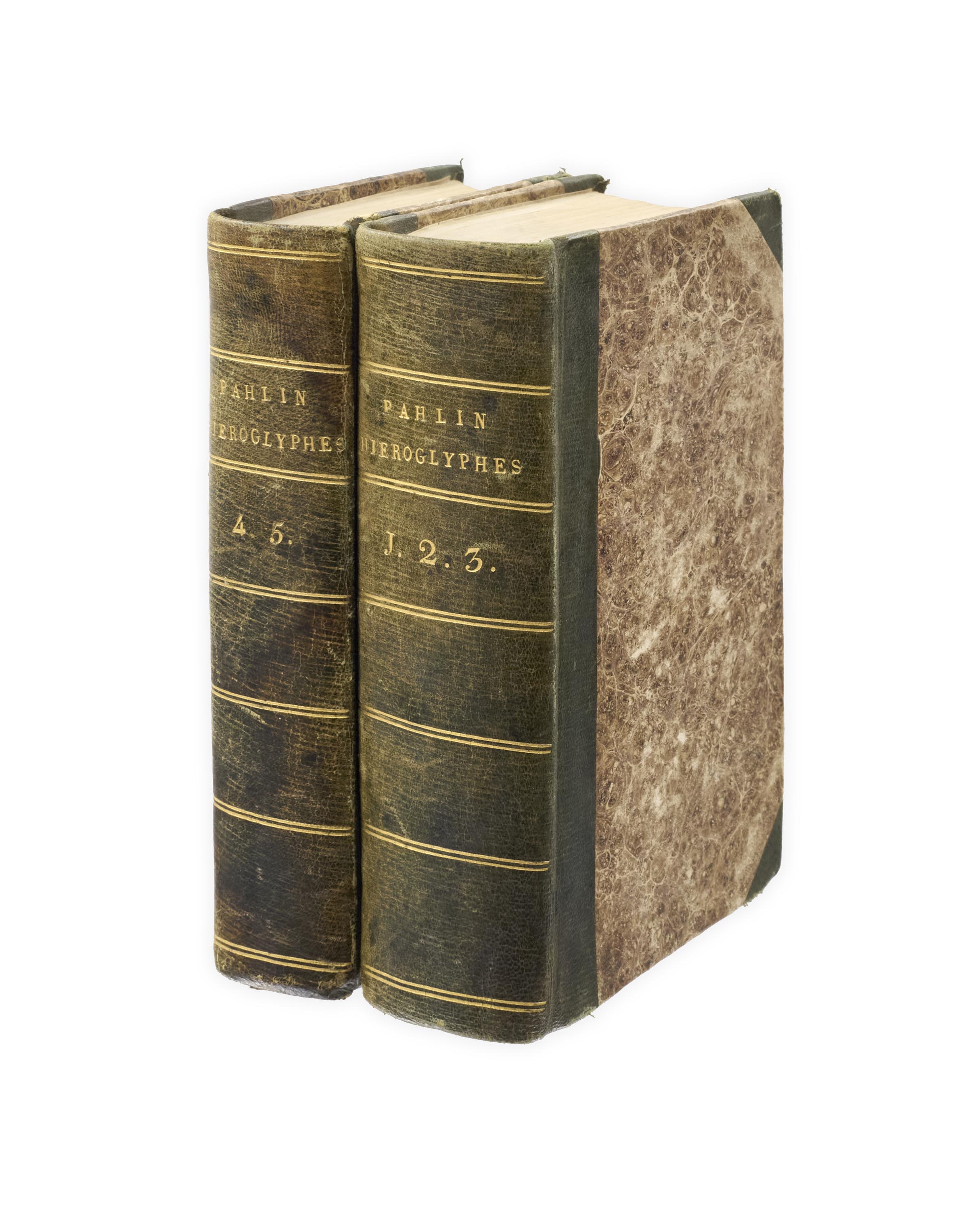
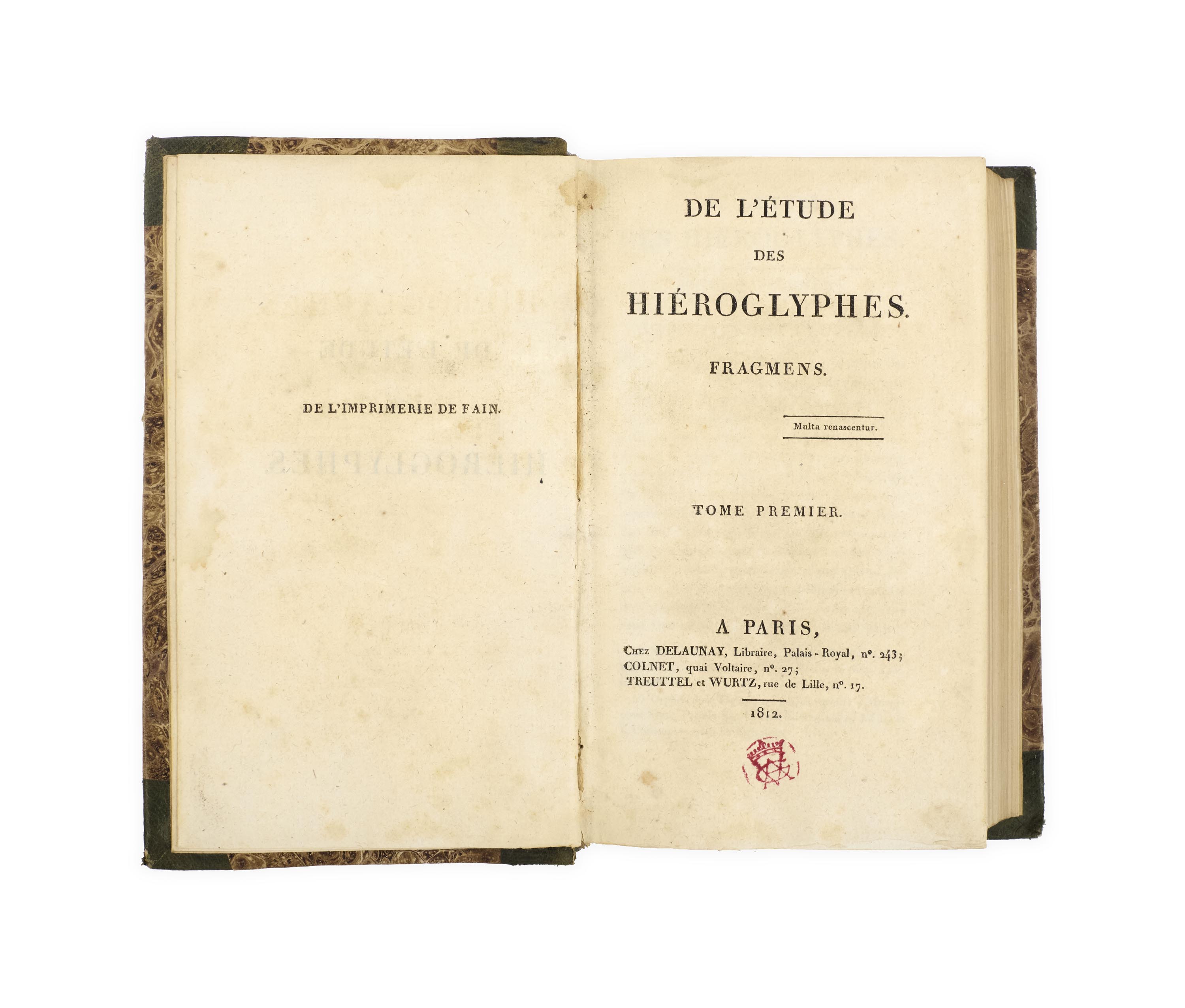
De l’étude des hiéroglyphes. Fragmens. Tome premier [–cinquième]. Paris, Fain for Delaunay, Colnet, Treuttel, and Wurtz, 1812.
Five parts in two vols, 8vo, I: pp. [iv], 219, [1, blank]; II: pp. [iv], 207, [1, blank]; III: pp. [iv], 224; IV: pp. [iv], 302; V: pp. [iv], 153, [1, blank]; sporadic light browning and foxing, marginal paperflaw to pp. 123–4 of vol. III; else a very good set in nineteenth-century half green straight-grained morocco with marbled sides, spines ruled in gilt and lettered directly in gilt; slightly rubbed, corners bumped.
First edition of this curious work on Egyptian hieroglyphics by the Swedish diplomat and Sinologist Nils Gustaf Palin (1765–1842).
Palin entered the Swedish Royal Chancellery in 1783, accompanied Gustav III on his trip to Italy, and was at various points Secretary of Legation in Vienna, Madrid, and Constantinople. During his posting to Constantinople (1805–1814) he was knighted and named Minister President, during which time he travelled extensively in Egypt, Greece, and Asia Minor. His De l’étude des hiéroglyphes was published amidst the race to decipher the meaning of hieroglyphs following the discovery of the Rosetta stone and of other treasures uncovered during Napoleon’s campaign.
Preceding Champollion’s phonetic and ideographic analysis of Egyptian hieroglyphs by a decade, Palin argues that Chinese and Egyptian characters were identical in both meaning and form and that ‘if either the ancient forms of Chinese characters, or those which their values indicate, were given to them, true hieroglyphs similar to those that exist on the Rosetta Stone would very often be found. And he thought that if the Psalms of David were translated into Chinese, and they were written in the ancient characters of that language, the inscriptions in Egyptian papyri would be reproduced’ (Webb, An Egyptian hieroglyphic Dictionary I (1920), p. xvi). His claims were largely dismissed by contemporary Egyptologists as spurious, much like his Analyse de l’inscription on the Rosetta Stone, which he claimed to have deciphered during a single sleepless night.
OCLC finds eight copies in North America (Boston Athenaeum, Brown, Cleveland Public Library, Cornell, Guelph, LoC, NYPL, and USC) and four in the UK (BL, Bodley, CUL, NLS).
See Allen, ‘The Predecessors of Champollion’, in Proceedings of the American Philosophical Society 104:5 (1960), pp. 527–547.