A Tour of Classical Greece
PAUSANIAS; Romolo AMASEO, translator; Wilhelm XYLANDER, Fridrich SYLBURG, and Joachim KÜHN, commentators.
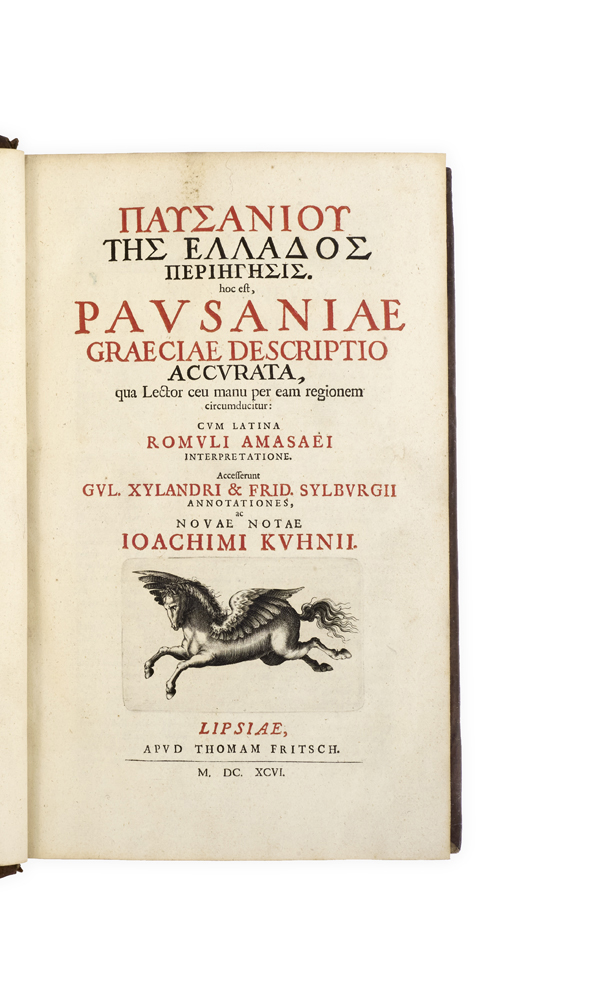
Της Ελλαδος περιηγησις. Hoc est … Graeciae descriptio accurata, qua Lector ceu manu per eam regionem circumducitur … Leipzig, [Christian Götze for] Thomas Fritsch, 1696.
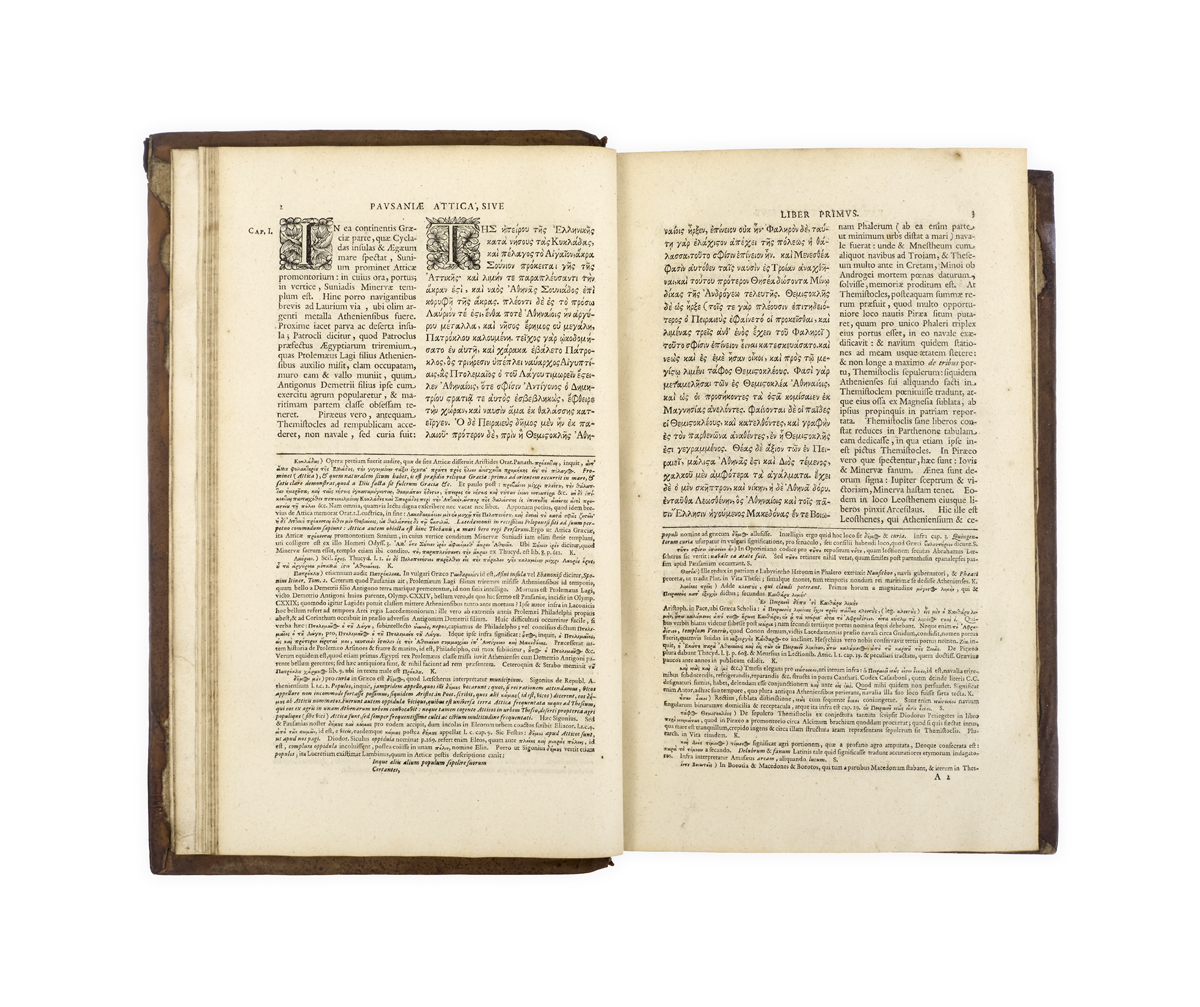
Folio, pp. [xxvi], 898, [23, cols ‘899–943’], [1, blank], [76, index]; printed in Greek and Latin in parallel columns, title printed in red and black with copper-engraved Pegasus device, woodcut initials, woodcut head- and tailpieces; two small wormholes from p. 865 onwards (affecting a few characters without loss of sense), a few leaves slightly browned, nonetheless a very good copy; bound in contemporary speckled calf, spine gilt in compartments with gilt red tawed sheep lettering-piece, edges mottled blue and red; joints very lightly rubbed.
Added to your basket:
Της Ελλαδος περιηγησις. Hoc est … Graeciae descriptio accurata, qua Lector ceu manu per eam regionem circumducitur …
First edition with the notes of Joachim Kühn of Pausanias’s comprehensive description of Classical Greece, ‘the only major surviving example of ancient travel literature’ (OCD).
‘The single surviving work in ten books betrays a polymath and erudite author with multifaceted and diverse interests, whence his many characterisations: Pausanias the traveller, the tour guide/Baedeker, the (literary) scholar, the copyist/plagiarist, the philologist, the archaeologist, the art historian, the topographer/geographer, the flora and fauna ecologist, the antiquarian, the stéleokopas/epigraphist, the historiographer/historian in the broader sense of Herodotus or the more limited of Thucydides, the historian of religion, the pilgrim’ (Tzifopoulos, p. 150).
The editio princeps was issued by Aldus in 1516, Romolo Amaseo’s Latin translation was first printed in Florence in 1551, and the text and commentary by Wilhelm Xylander, completed by Fridrich Sylburg, in Frankfurt in 1583. This edition of the Sylburg text contains new notes by Joachim Kühn (1647–1697), printed in a large format to accommodate the extensive scholarly apparatus. The previous prefaces from the earlier editions are repeated here, with an initial prologue by Kühn, in which he discusses the manuscripts in the Royal Library in Paris.
Provenance:
From the library of the Scottish mathematician James Stirling (1692–1770), recently dispersed.
USTC 2685238; VD17 39:128725Q. See Tzifopoulos, ‘Inscriptions as literature in Pausanias’ Exegesis of Hellas’, in Inscriptions and their Uses in Greek and Latin Literature (2013).