‘The Satellites of Satan’
PERPIÑA, Pedro Juan.
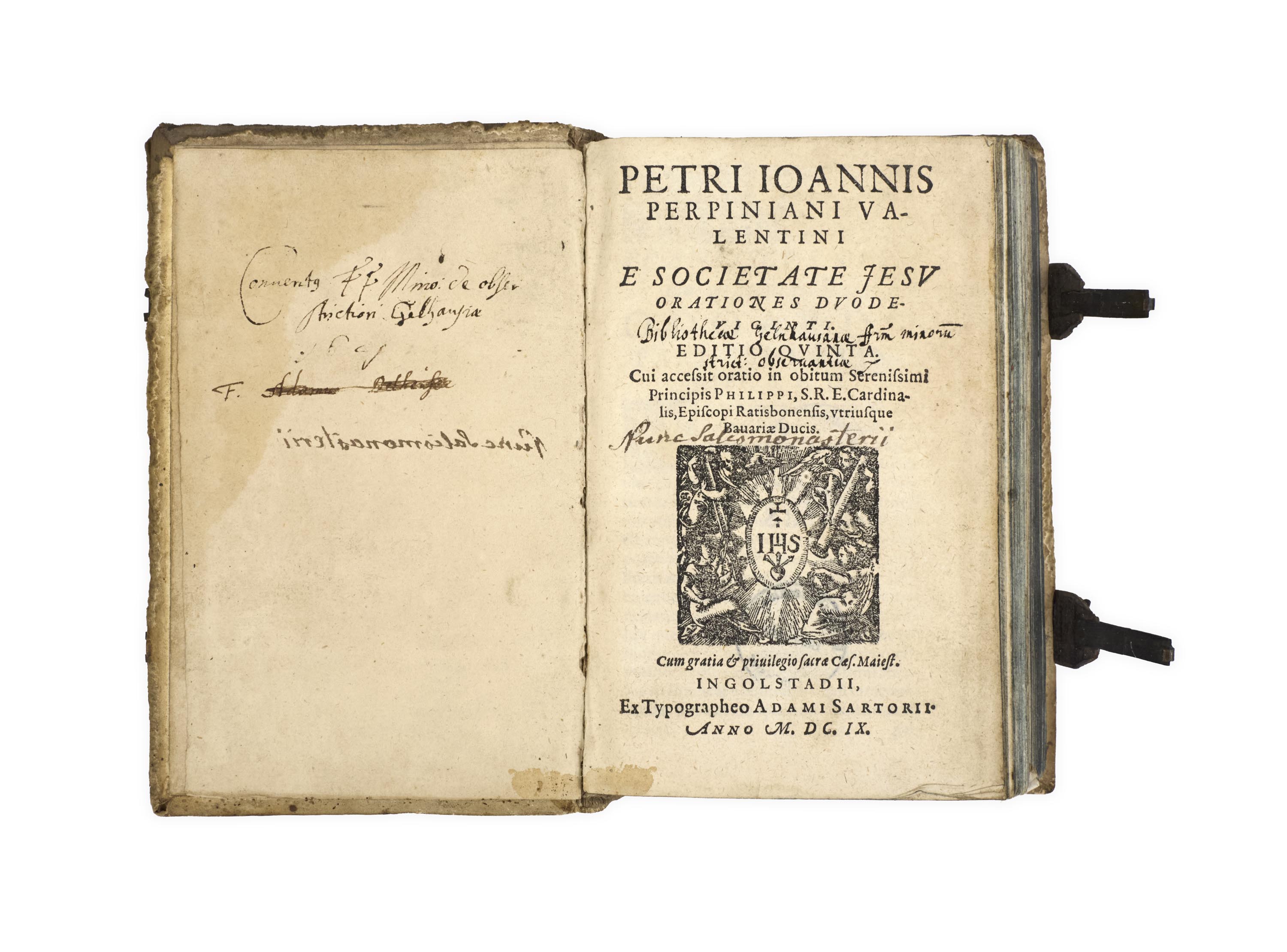
Orationes duodeviginti. Editio quinta. Cui accessit oratio in obitum Serenissimi Principis Philippi, S.R.E. Cardinalis, Episcopi Ratisbonensis, utriusque Bavariae Ducis. Ingolstadt, Adam Sartorius, 1609.
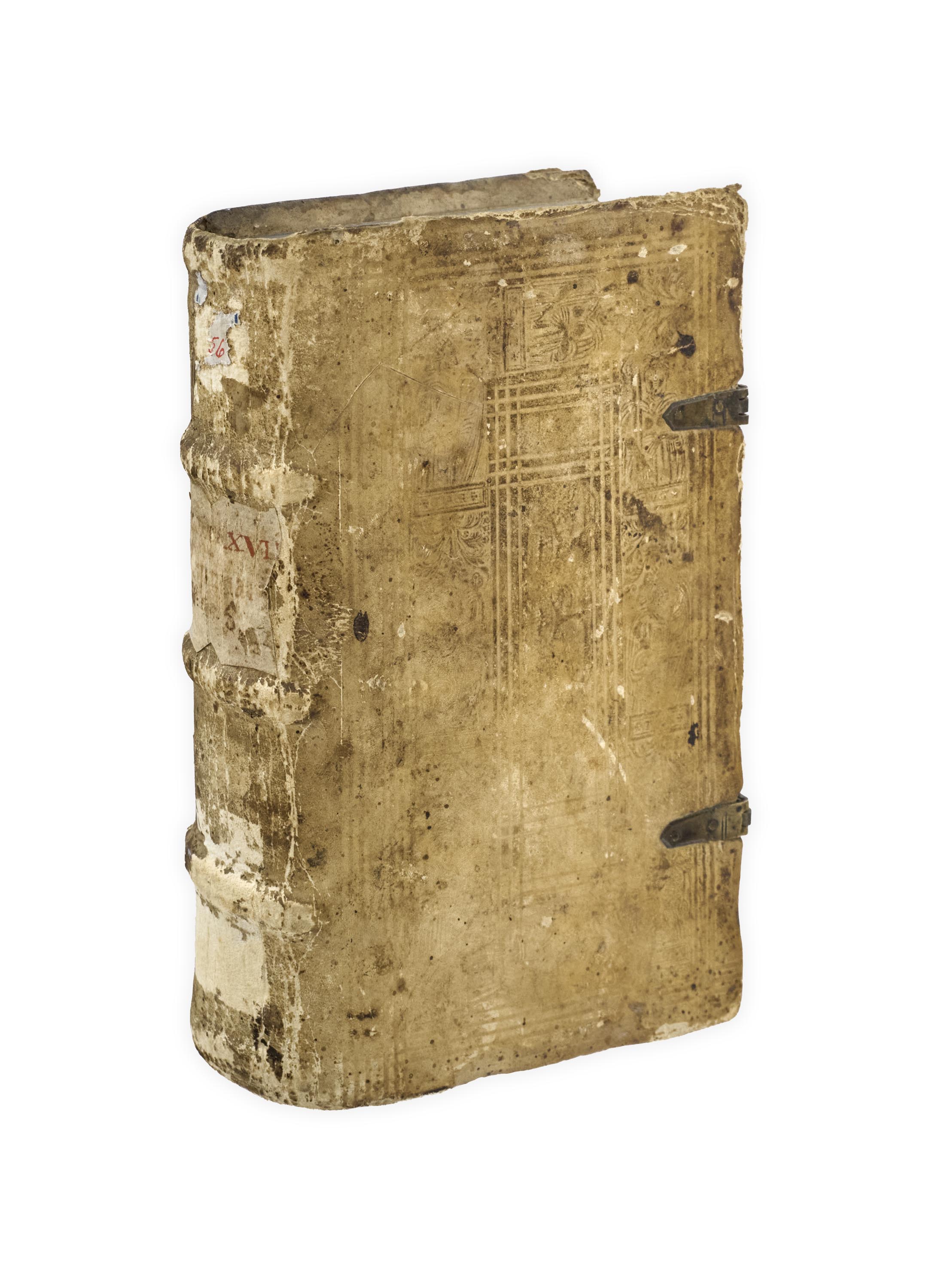
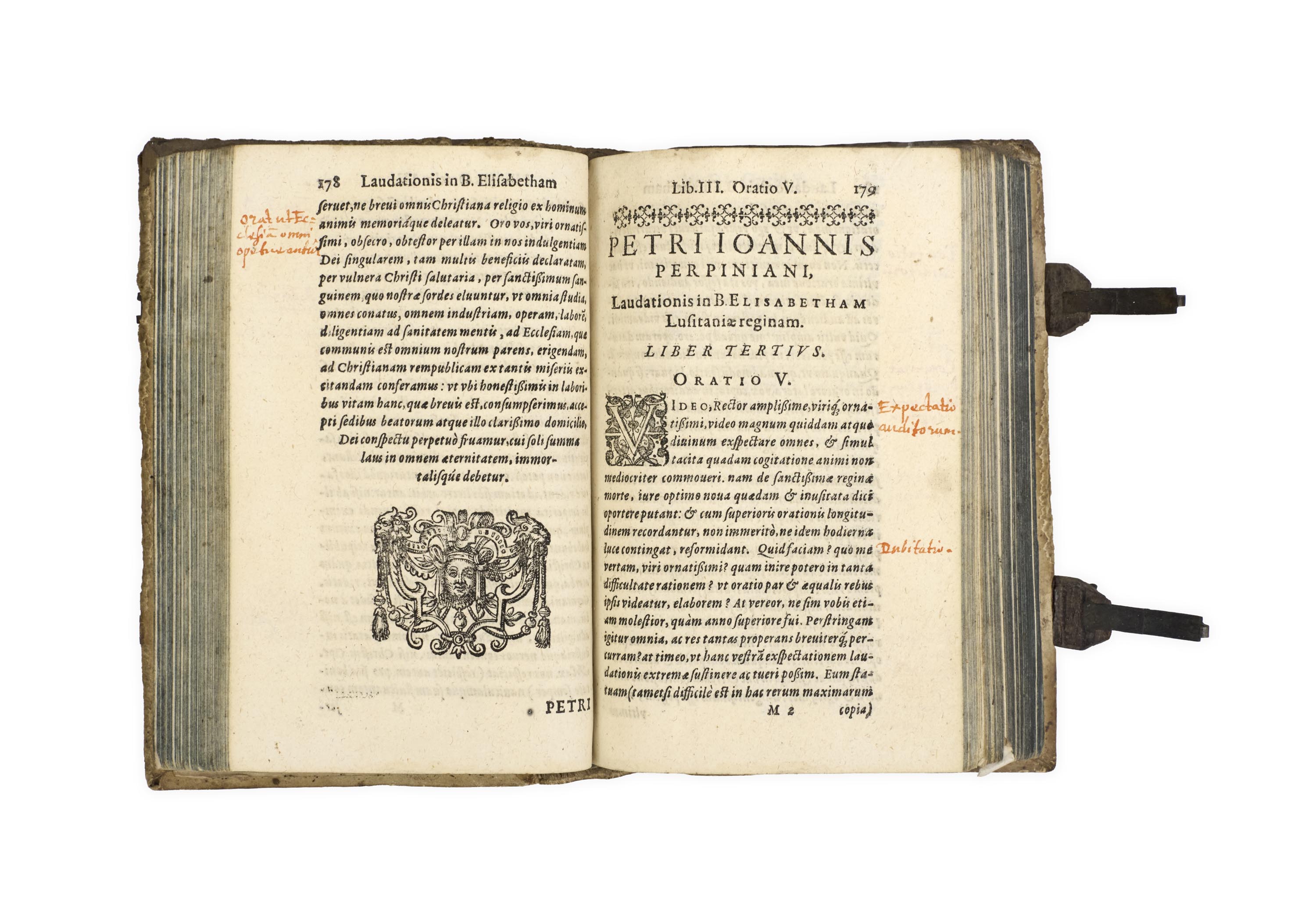
8vo, pp. [xvi], 589, [3, blank]; woodcut Jesuit device to title-page, woodcut and typographic headpieces, woodcut initials and tailpiece; occasional light staining to upper margin, but a very good copy; bound in contemporary blind-tooled white calf over bevelled wooden boards, the roll tool depicting the Muses Terpsichore, Calliope, Thalia and Polyhymnia playing musical instruments, paper labels to spine, two clasps, edges stained blue; binding somewhat rubbed with slight loss to edges, spine covering partly defective, front free endpaper detached; seventeenth-century annotations in red ink to c. 465 pp., annotations to c. 9 pp. in a smaller hand in faded grey ink, contemporary inscriptions (crossed through) of Fr. Adamus Betheuser to both sides of front free endpaper, seventeenth-century inscription ‘Conventus FF Mino: de obser. strictiori Gelhausiae’ to front free endpaper verso and ‘Bibliothecae Gelnhausanae ffrm minoru[m] strict. observantiae’ to title, followed by ‘Nunc Salismonasterii’ (‘now of Salmünster’), ink stamps of the Franciscans of Salmünster and of Kloster Frauenberg (Fulda) to verso of title, old shelfmarks to front pastedown and to spine.
Added to your basket:
Orationes duodeviginti. Editio quinta. Cui accessit oratio in obitum Serenissimi Principis Philippi, S.R.E. Cardinalis, Episcopi Ratisbonensis, utriusque Bavariae Ducis.
A richly annotated copy of Perpiña’s set speeches, highlighting the author’s antipathy towards Luther, in a contemporary white calf binding, from the libraries of several Franciscan monasteries in Hesse.
Pedro Juan Perpiña (Pere Joan Perpinyà, 1530–1566), from Valencia, joined the newly founded Jesuit order in 1551, teaching across Spain and Portugal, before moving to Rome in 1561 where he met humanist scholars such as Paolo Manuzio. He sought pedagogical reform at the Jesuit Collegio Romano, later reflected in the Jesuit Ratio studiorum (1599) which provided the standard teaching methodology for all Jesuit schools.
Perpiña’s speeches cover topics from Jesuit education, praise of St Elizabeth, the teaching of rhetoric, the Trinity, and a long speech about adhering to the old religion in the face of new heresies, originally delivered in Lyon. These eighteen orations were first printed in Brescia in 1581, edited by the Jesuit Orazio Torsellini, though editions containing his speeches in increasing numbers (from five up to the present eighteen) had been issued from 1565 onwards. They are here joined by an additional oration by the Jesuit Wolfgang Stark, given at the funeral of Cardinal Philipp of Bavaria, Bishop of Regensburg, in Ingolstadt in 1598 and first printed in Sartorius’ edition of the following year.
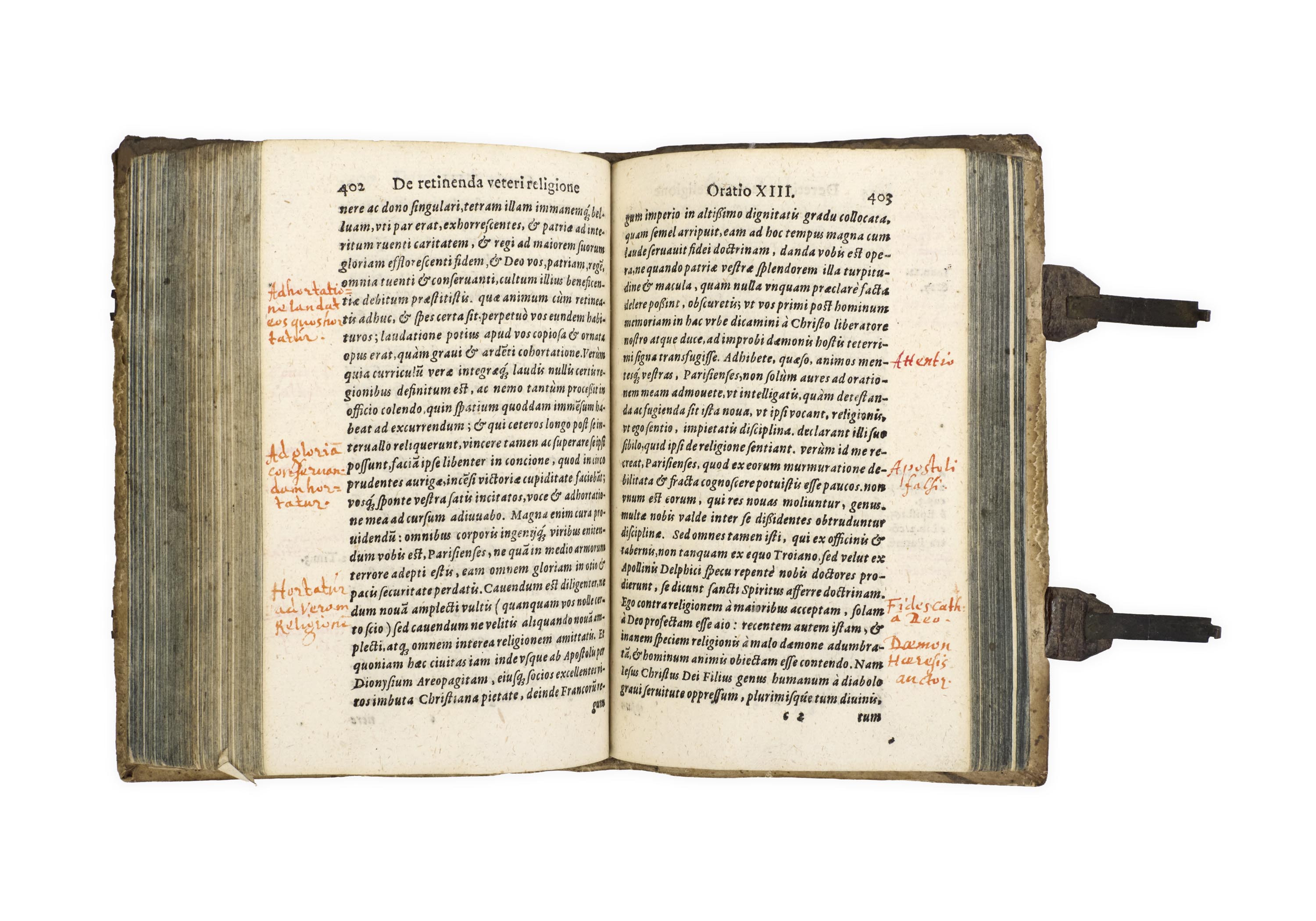
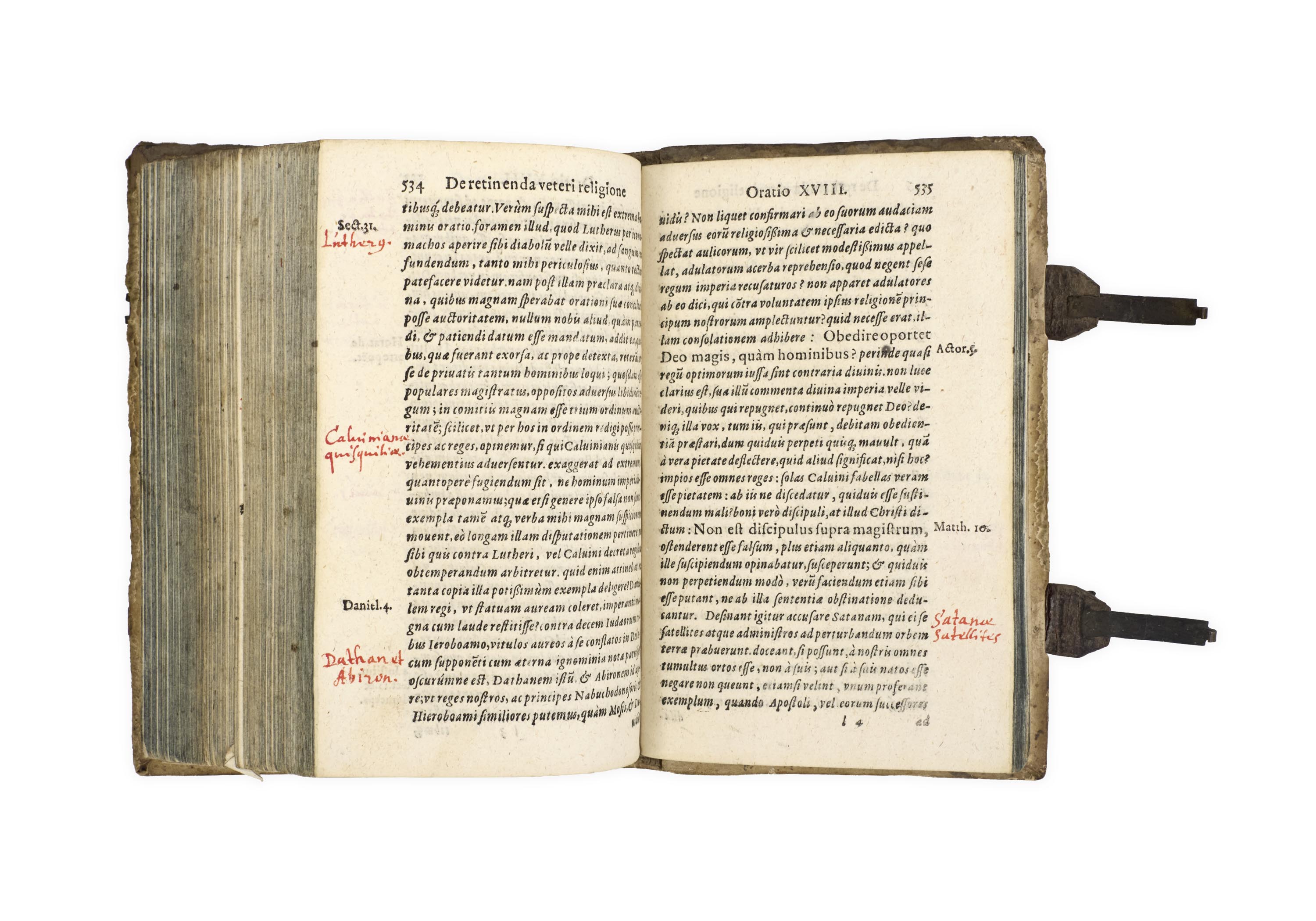
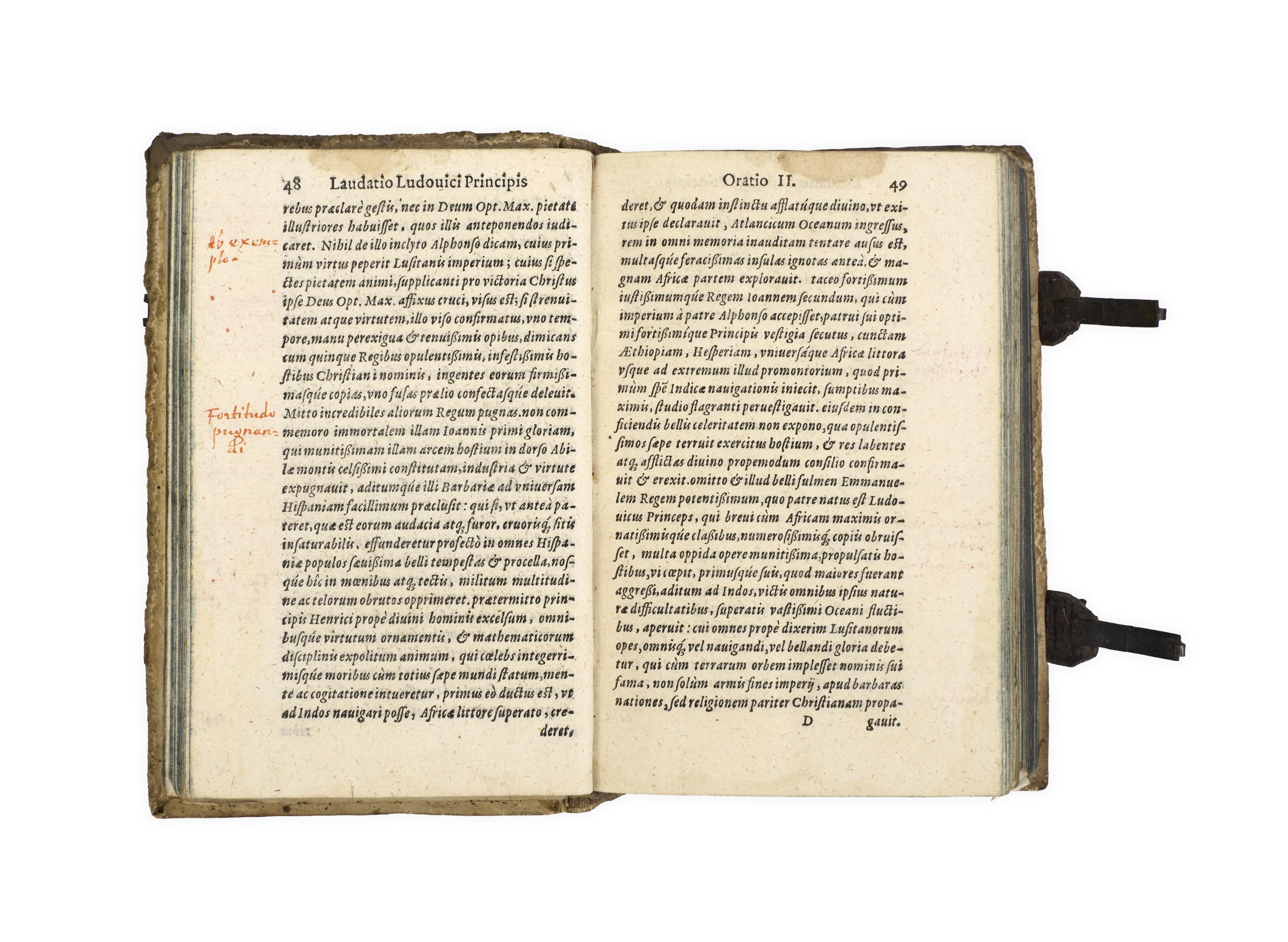
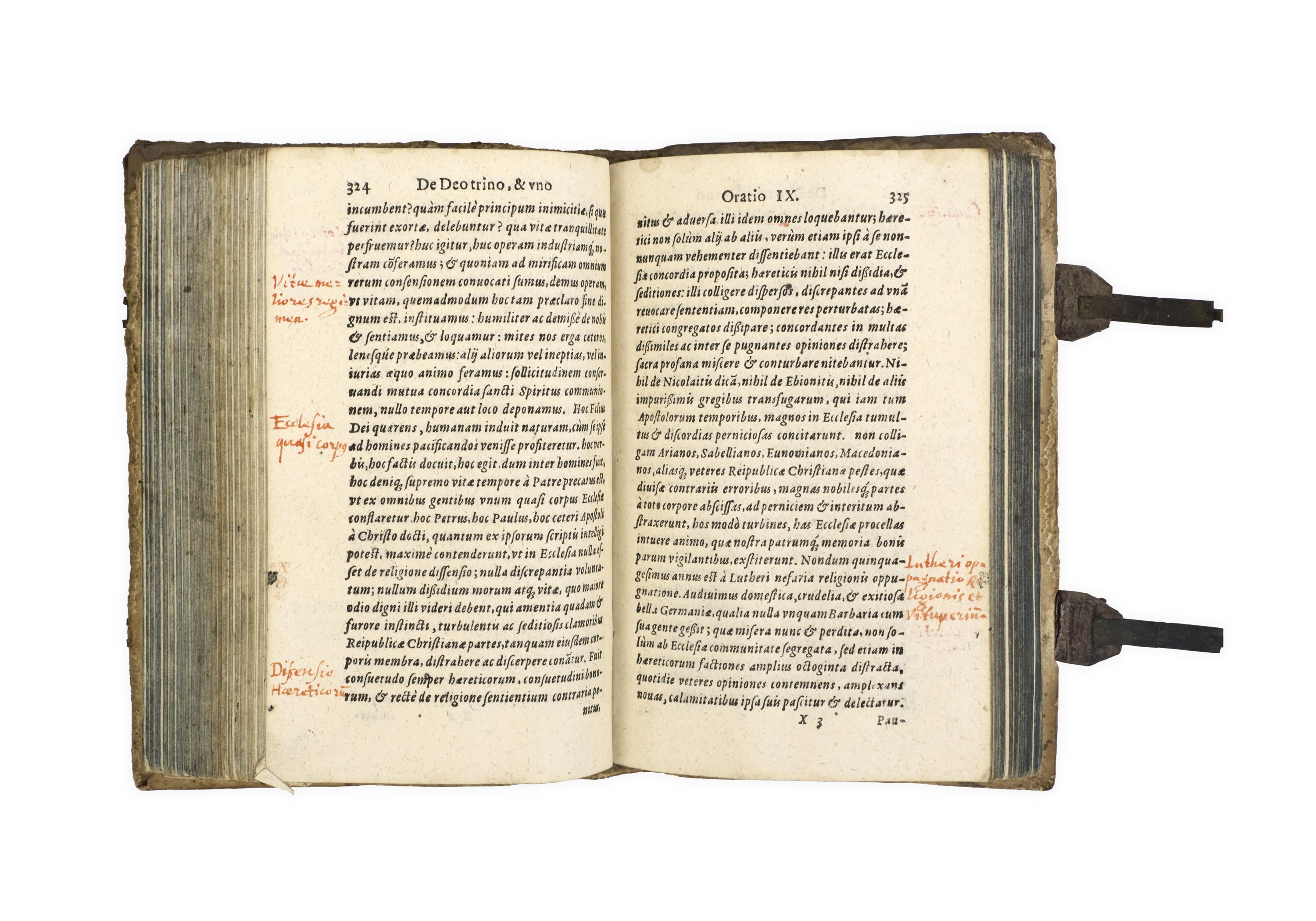
The numerous annotations indicate rhetorical devices but also make mention of Luther, Lutherans, and heresy, but rather than repeating words of phrases from the text, the annotator summarises the meaning or significance of a particular section. Perpiña’s antipathy towards Luther (and Calvin) is obvious, and the annotator follows suit, talking of the blindness of the heretics, that they have no authority, have never been shown a divine sign, and have no faith, that the Devil is the source of heresy, and that Luther was motivated by a desire for wealth ; on p. 535 they are referred to as ‘Satan’s satellites’ (‘Satanae Satellites’). The annotator also knew Greek, writing ‘αναφορα’ on p. 57.
Provenance:
The Franciscan monastery in Gelnhausen (Hesse) was dissolved and transferred to the town council at the time of the Reformation, though between 1635 and 1649 the Observant Franciscans occupied the buildings, before being expelled again. They moved to neighbouring Salmünster in 1650 and took the monastery library with them. The library was then moved to the Franciscan convent of Frauenberg in nearby Fulda. Fr Adamus Betheuser was presumably a member of the Order.
An uncommon edition: we have not located any copies in the US, and only one copy in the UK, at Cambridge University Library.
USTC 2137109; VD17 3:606331Q; cf. Palau 223610 (1599 Sartorius edition).