Olaudah Equiano in the Arctic
PHIPPS, Constantine John.
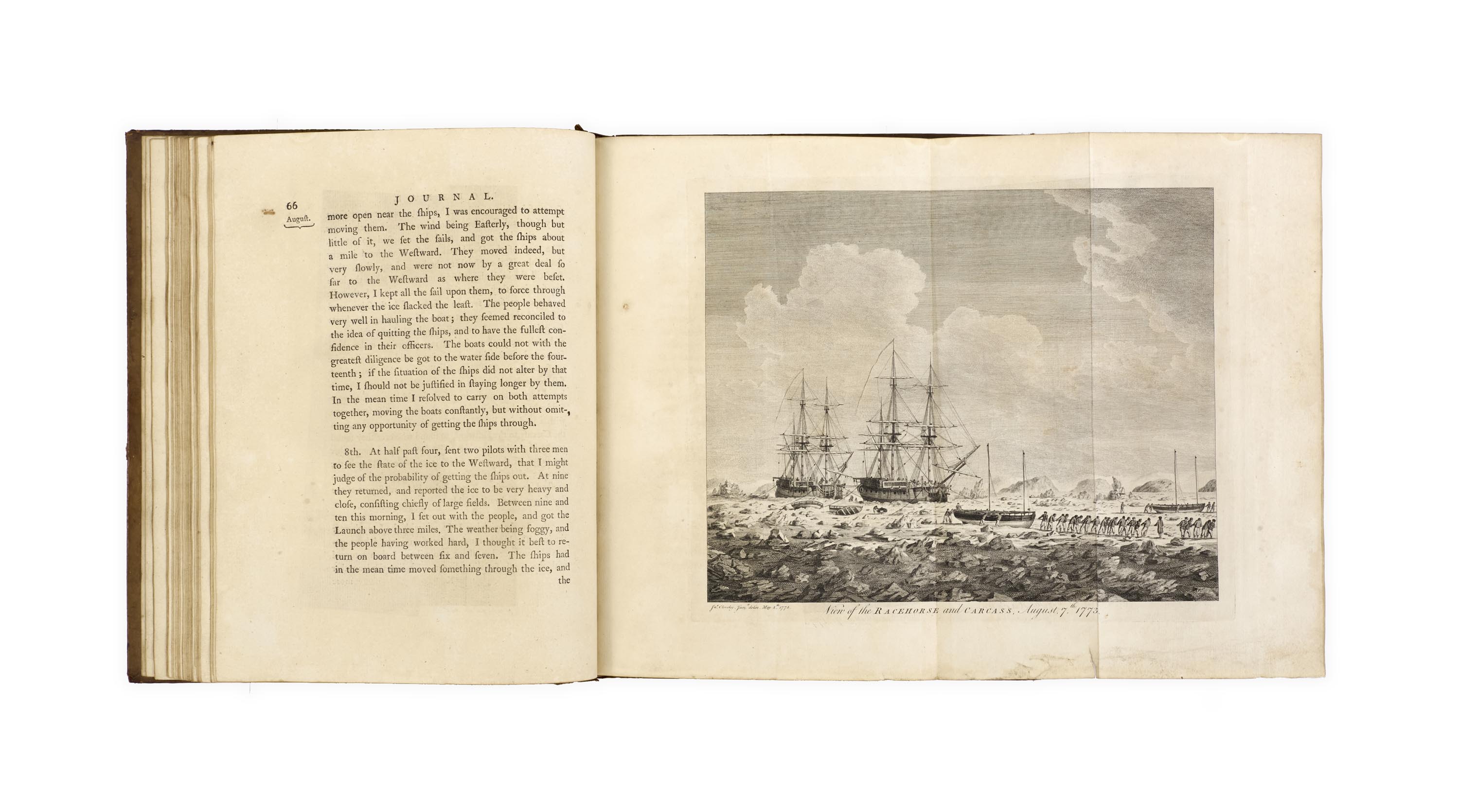
A Voyage towards the North Pole undertaken by His Majesty's Command 1773 … London, W. Bowyer and J. Nicols for J. Nourse, 1774.
Large 4to, pp. viii, 253, [1], with a half-title, a folding chart bound as a frontispiece, and thirteen other folding engraved plates of views, plans, and diagrams, but without the leaf of directions to the binder; folding tables within the pagination; some occasional foxing, but a very good copy in contemporary polished calf, covers slightly scraped; ownership inscription excised from head of front free endpaper.
Added to your basket:
A Voyage towards the North Pole undertaken by His Majesty's Command 1773 …
First edition of Phipps’s account of his expedition to the Arctic in 1773 – his crew included both Horatio Nelson (then a midshipman) and the former slave Olaudah Equiano (as assistant to the surgeon Charles Irving), whose later autobiography became a sensational bestseller and boosted the cause of abolition.
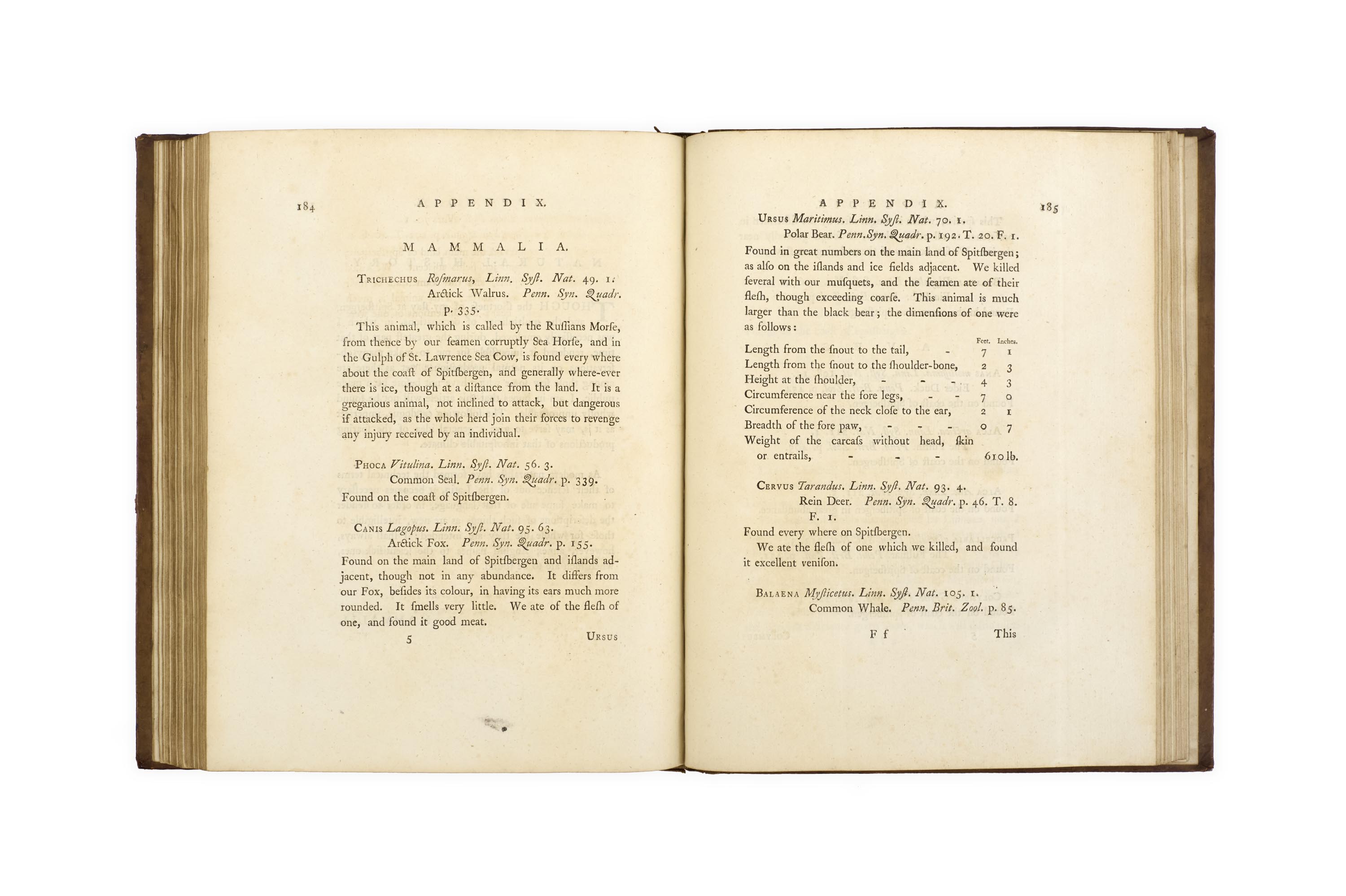
Phipps, later second Baron Mulgrave (1744–1792), was appointed by the Admiralty to investigate the supposed Northwest Passage, departing on the ships Racehorse and Carcass via the Shetlands to Spitsbergen and Svalbard, where they were unable to penetrate the pack ice on several attempts – indeed the Racehorse was nearly crushed by the ice. The crew did however make some significant scientific observations, identifying several new species, and Phipps made the first adequate description of the polar bear as a distinct species, which he called Ursus maritimus (described here on p. 185, where he notes ‘We killed several with our musquets, and the seamen ate of their flesh, though exceeding coarse’). Equiano’s Interesting Narrative later reported that nine were killed – ‘I thought them coarse eating’ (perhaps echoing Phipps), ‘but some of the ship's company relished them very much’. Overall, though, his impression was not favourable: ‘on the 19th of August, we sailed from this uninhabited extremity of the world, where the inhospitable climate affords neither food nor shelter, and not a tree or shrub of any kind grows amongst its barren rocks; but all is one desolate and expanded waste of ice, which even the constant beams of the sun for six months in the year, cannot penetrate or dissolve’.
ESTC T152604; Hill 1351; Sabin 62572.