Impious Epistles: the Sunderland Copy
PIUS II, Pope (Enea Silvio PICCOLOMINI); Nicolaus DE WYLE, editor.
[Epistolae familiares; De duobus amantibus Euryalo et Lucretia; Descriptio Urbis Viennensis.] [Reutlingen, Michael Greyff, not after 1478.]
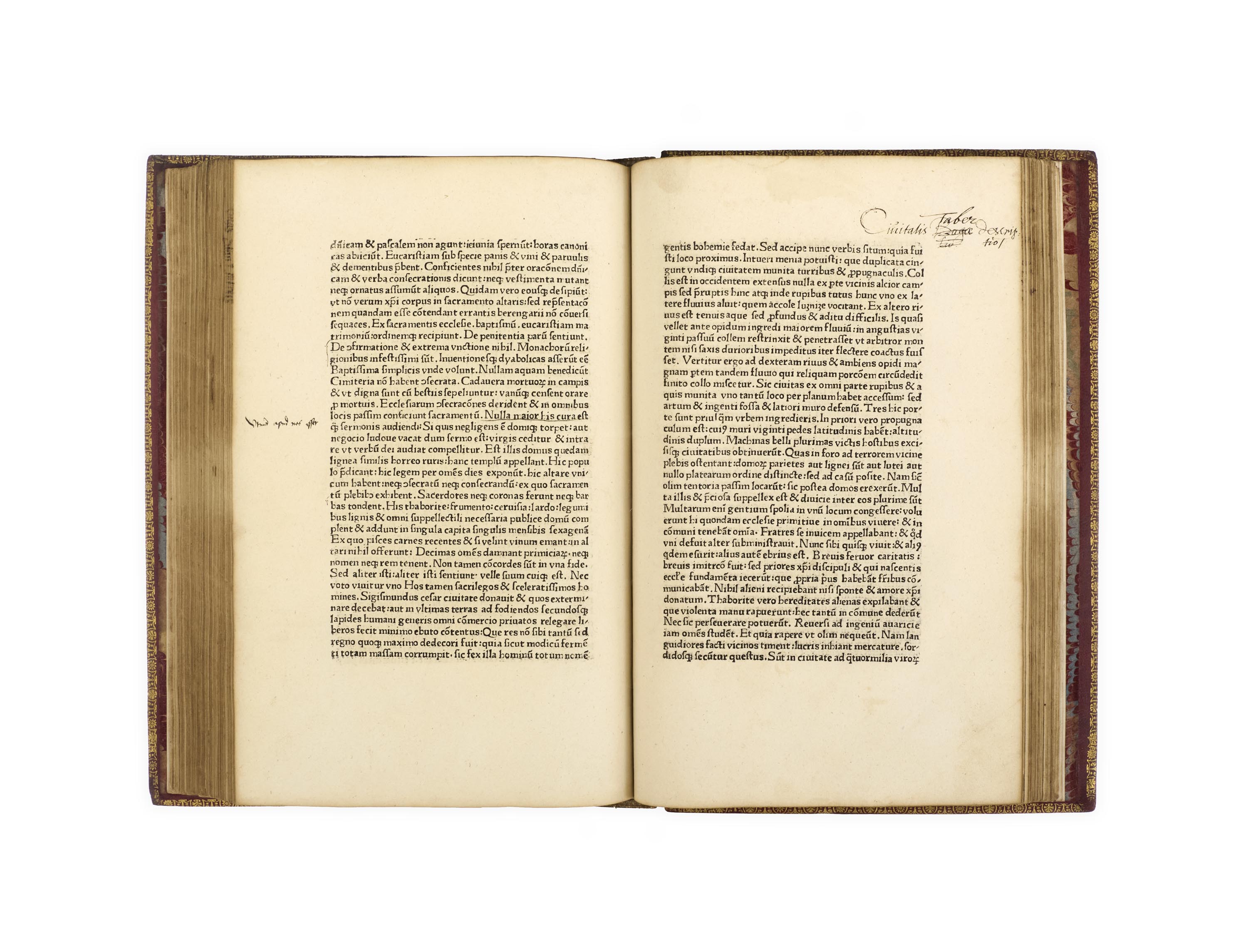
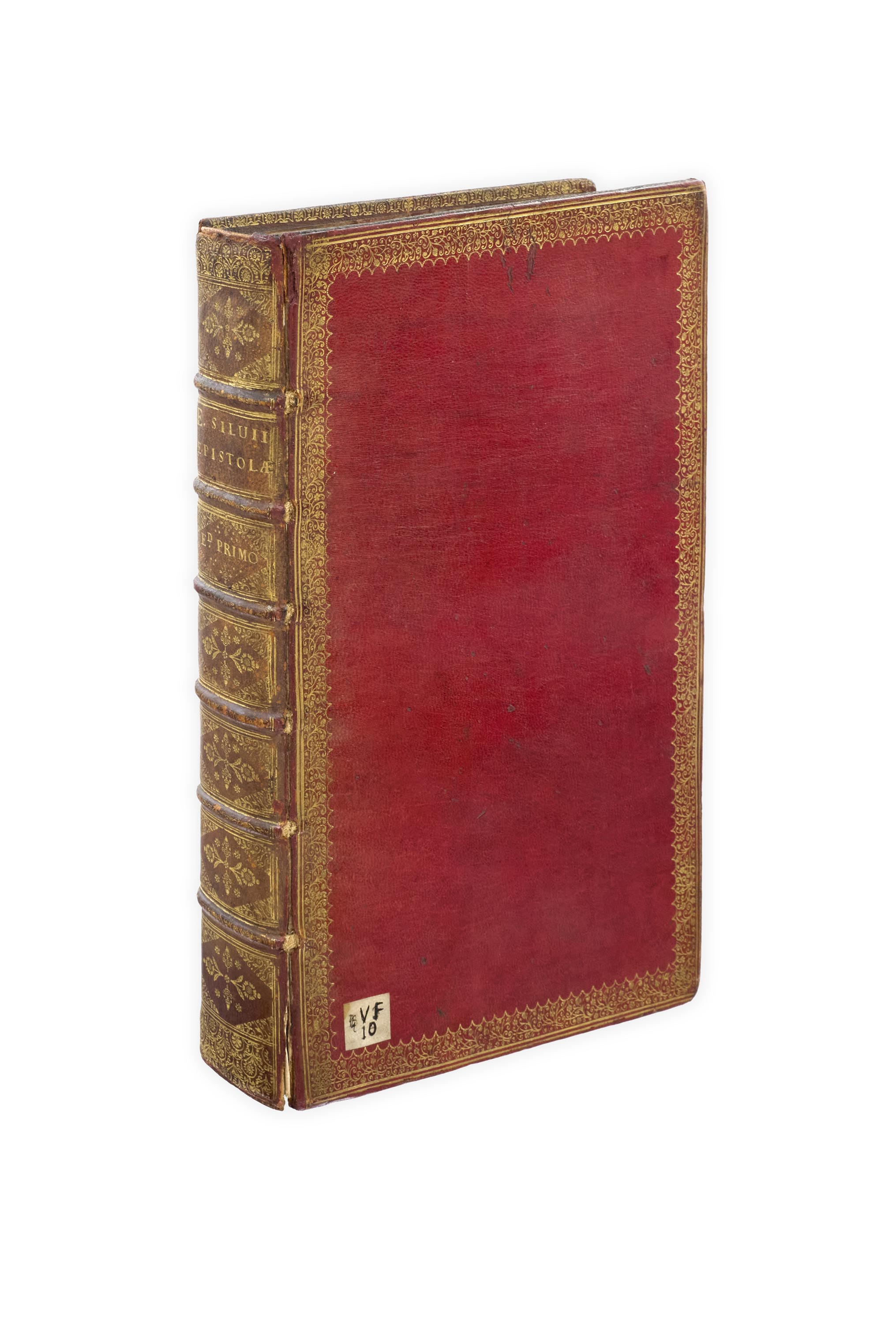
Chancery folio, ff. [215] (of 216); [a–c10 d8 e–s8/10 t10 v8 x–y10 z8 A1–5] (without final blank [A6]); roman letter; very slight ink stains on first few leaves, old marginal repairs to [a8], [h6], and [m1], marginal paper-flaw to [h2], two small wormholes to upper margins of last few quires, small marginal tear to last two leaves, otherwise a very good copy; in early eighteenth-century English red morocco plausibly by Thomas Elliott (see provenance, below), gilt Harleian-style border, spine gilt in compartments and lettered directly in gilt, fore-edges with small manuscript title ‘Eneas Silvius in epi[sto]lis’ (edges untrimmed from previous binding), marbled endpapers; joints cracked, spine a little faded, endcaps chipped; early notes to a1r (blank) including the title and an ownership inscription in a German hand (‘Her[r] hans vo[n] stůrg[?]’), a few manuscript annotations and underlinings with manicules in red or black ink, early manuscript signatures, Quaritch’s Sunderland Library bookplate and armorial bookplate of John Vertue to front pastedown, twentieth-century paper shelf label to front board.
Added to your basket:
[Epistolae familiares; De duobus amantibus Euryalo et Lucretia; Descriptio Urbis Viennensis.]
First combined edition of Pius II’s personal correspondence, his best-selling epistolary erotic novel the Tale of Two Lovers, and his Description of the City of Vienna, which appears here in print for the first time.
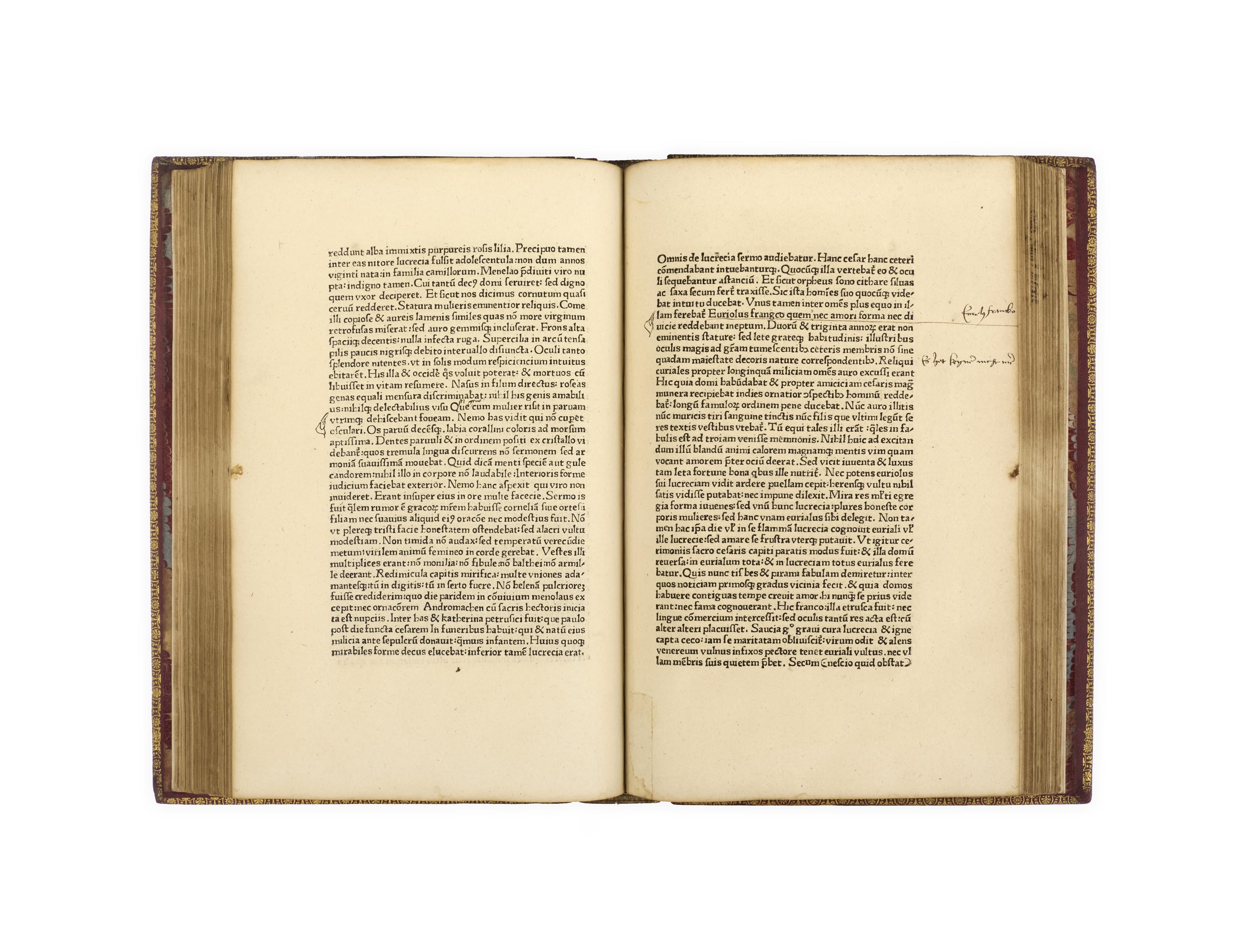
The Epistolae familiares, first printed in 1470, here in their fourth edition and mostly composed before Piccolomini’s papacy, modelled the humanist use of the epistolary genre, addressing a range of recipients (friends, scholars, princes) with literary, political, moral, and religious discussions, uniting personal narrative with public instruction. Their printing was often combined with the enormously popular, pioneering epistolary erotic Tale of Two Lovers, which had also been composed by Piccolomini before taking holy orders, had first appeared in an edition of 1467–70, and enjoyed very many editions throughout the fifteenth century. Set in Siena and alternating letters with dialogue, this stylistically innovative novella frankly explored adulterous love, with associated passionate longing and dangers, joining classical with medieval motifs of erotic poetry and rhetoric.
Printed here for the first time is Piccolomini’s Description of the City of Vienna (ff. 213v–215r), which dates from his time there as ambassador on behalf of the Council of Basel, in 1438. He notes Vienna’s large size, the wealth and prosperity of its population, and its general sense of liveliness and solidity, whilst taking issue with the ‘backwards’, non-humanistic, overly scholastic methods of its University, compared with the intellectual, architectural, and artistic modernity of Italian cities and centres of culture.
The German origin of this edition reflects Pius II’s importance and influence on contemporary German lands, following his time spent there. The editor, Nicolaus de Wyle (c. 1410–1479), was a municipal official in Nuremberg and then Esslingen; he was a correspondent of Piccolomini in the 1450s and they met in person at court in Vienna. He translated the Tale of Two Lovers into German (first printed c. 1477–1478) and had this selection of letters by Piccolomini printed in either Reutlingen or Esslingen (current scholarship favours Reutlingen).
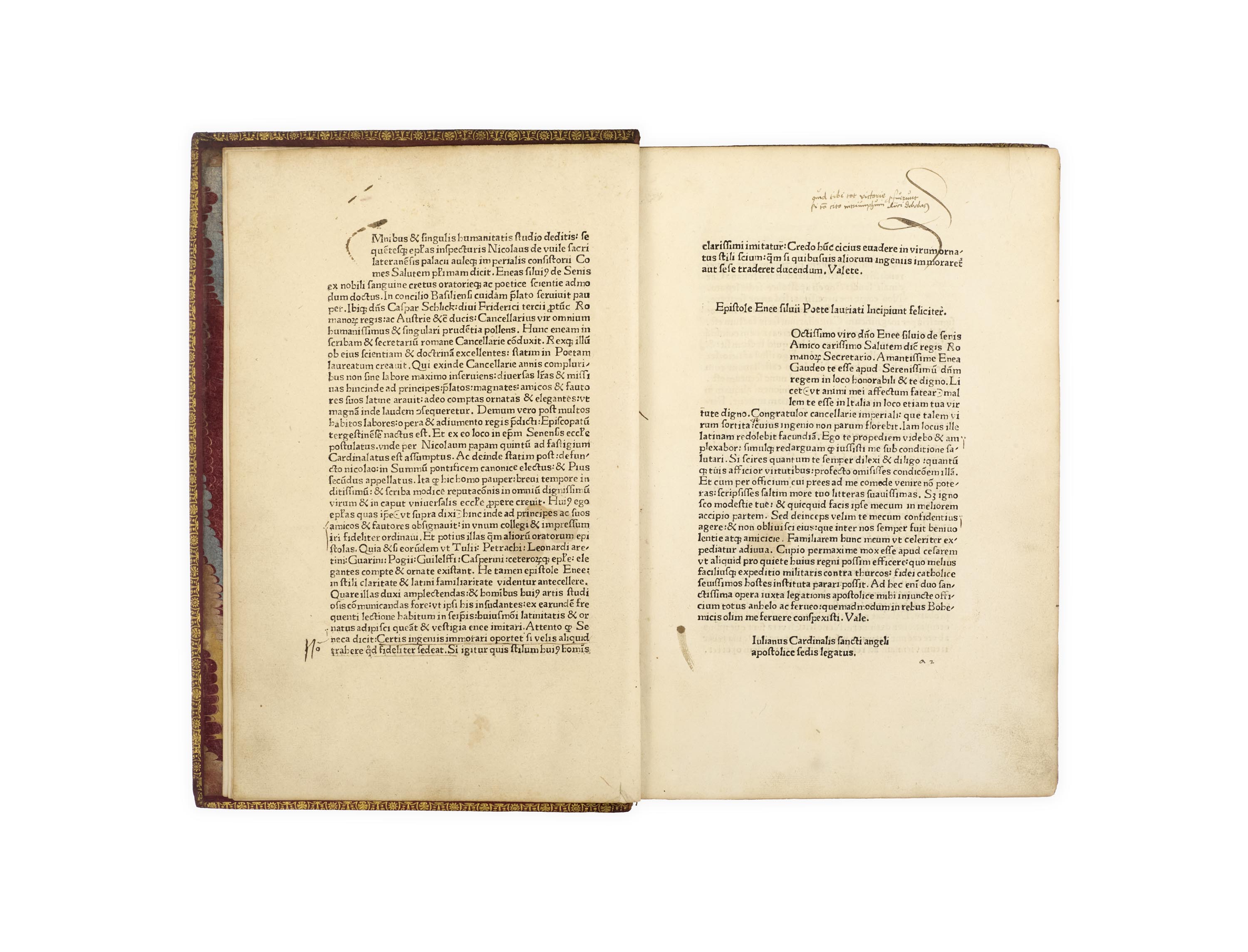
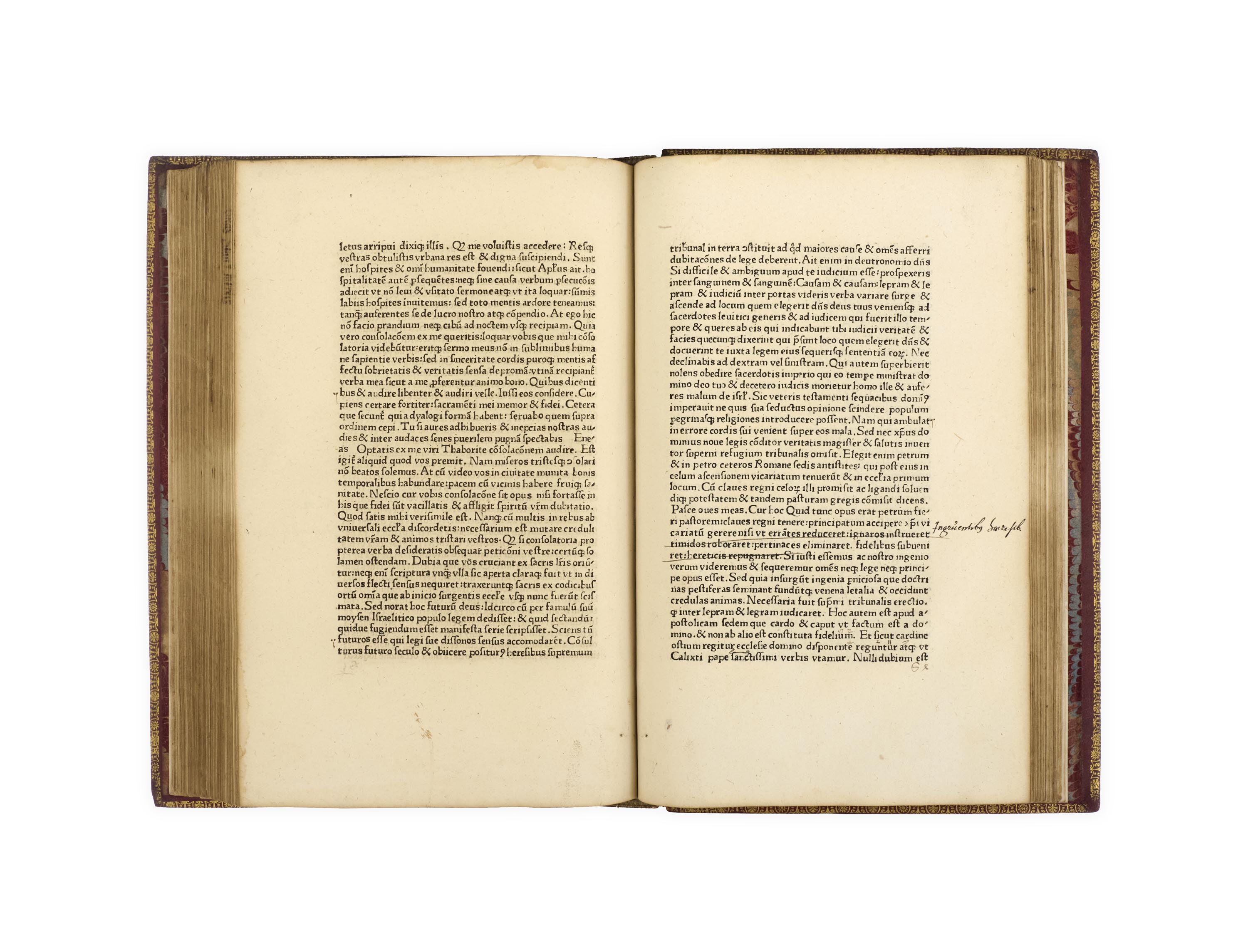
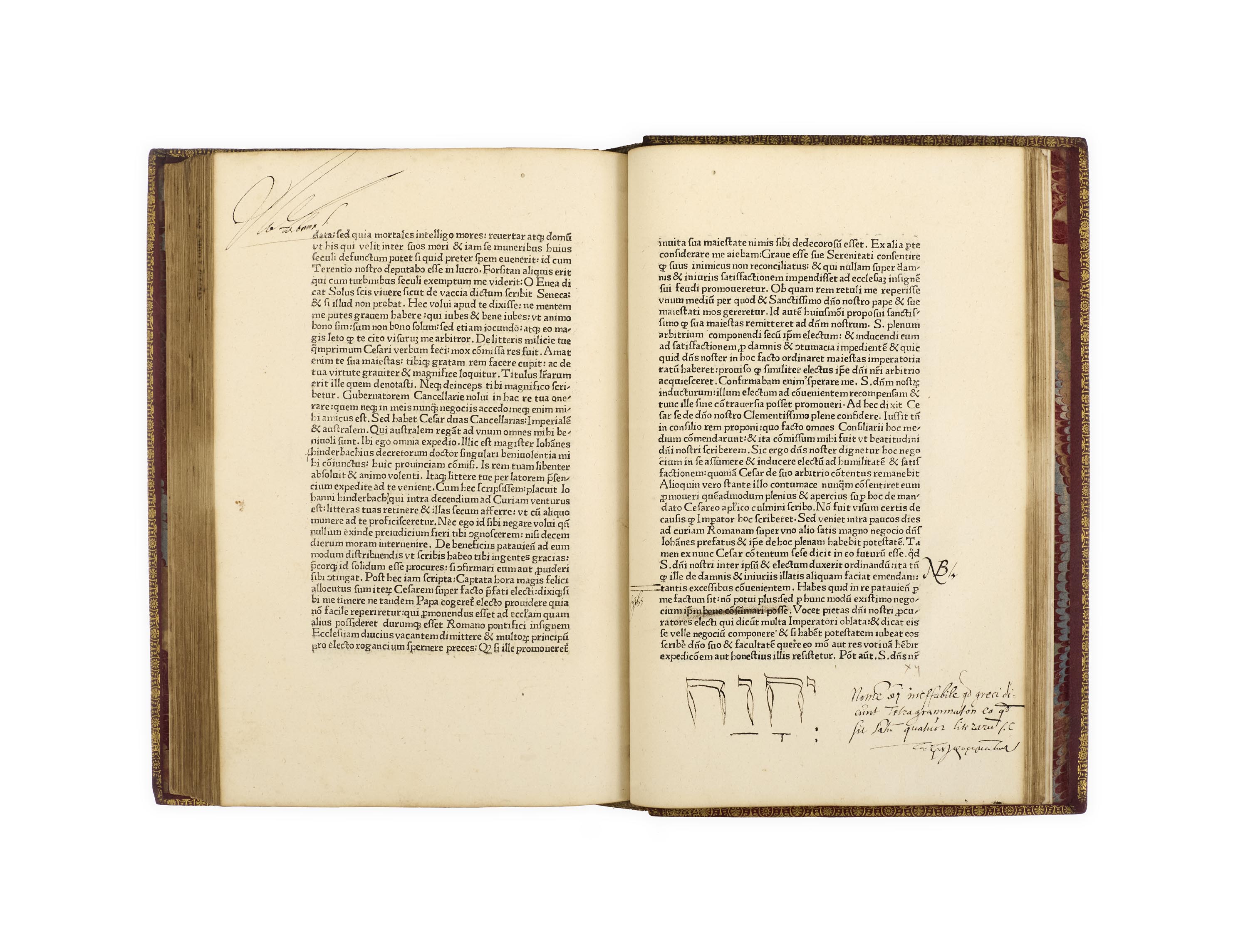
This copy contains annotations in contemporary and later (probably eighteenth-century) German hands. At the top of [a2]r an early hand has written a quote from a 1445 letter or speech of Piccolomini to the Archbishop of Esztergom, ‘quid tibi tot victoriae profuerunt | si tam cito in triumphum duci debebas’, about the state of the Kingdom of Hungary. A later hand has noted ‘Civitatis Taber descriptio’ on [r6]r, referring to the town of Tábor in southern Bohemia, and ‘ingruentibus haeresibus’ on [s4]r; Tábor was home to a Hussite sect known as Taborites who reconciled themselves with the King of Hungary in 1452 (Piccolomini had attended the Council of Basel where Hus was burned at the stake despite his safe conduct). This later hand has also written the four letters of the name of God in a large square Hebrew script at the foot of [x2]r, with a note about the Tetragrammaton.
Provenance:
1. Charles Spencer, 3rd Earl of Sunderland (1674–1722), with old ink shelfmark ‘B3:44’ and newer pencil one (erased) to flyleaf. The binding can be attributed to Thomas Elliot whose work – although most closely associated with bindings for Robert Harley, Earl of Oxford and his son Edward in the 1720s – has also been identified in the Sunderland library, e.g. on a copy of the Jenson Scriptores rei rusticae of 1472 (Sunderland sale, 10–21 March 1883, lot 11255). The Sunderland Library was removed from Blenheim Palace and sold by Puttick and Simpson across fifty days between 1881 and 1883; the fifth sale, 10–22 March 1883, lot 11915 (£4 12s 6d to Quaritch). Quaritch bought so extensively at the Sunderland sales that he commissioned a special bookplate to mark his purchases.
2. John Vertue (1826–1900), appointed the first Roman Catholic Bishop of Portsmouth in 1882.
ISTC lists four other copies in the UK (BL, Bodley, Rylands, and the Royal Library, Windsor) and five copies in the US (Ann Arbor, Harvard, Huntington, Morgan, and Niagara University).
HC 160*; BMC I 63; GW M33709; Goff P716; BSB-Ink P-519; Bod-inc P-316; ISTC ip00716000.