Unrecorded Bolognese Borrowings
PLINY the Younger; Filippo BEROALDO, editor.
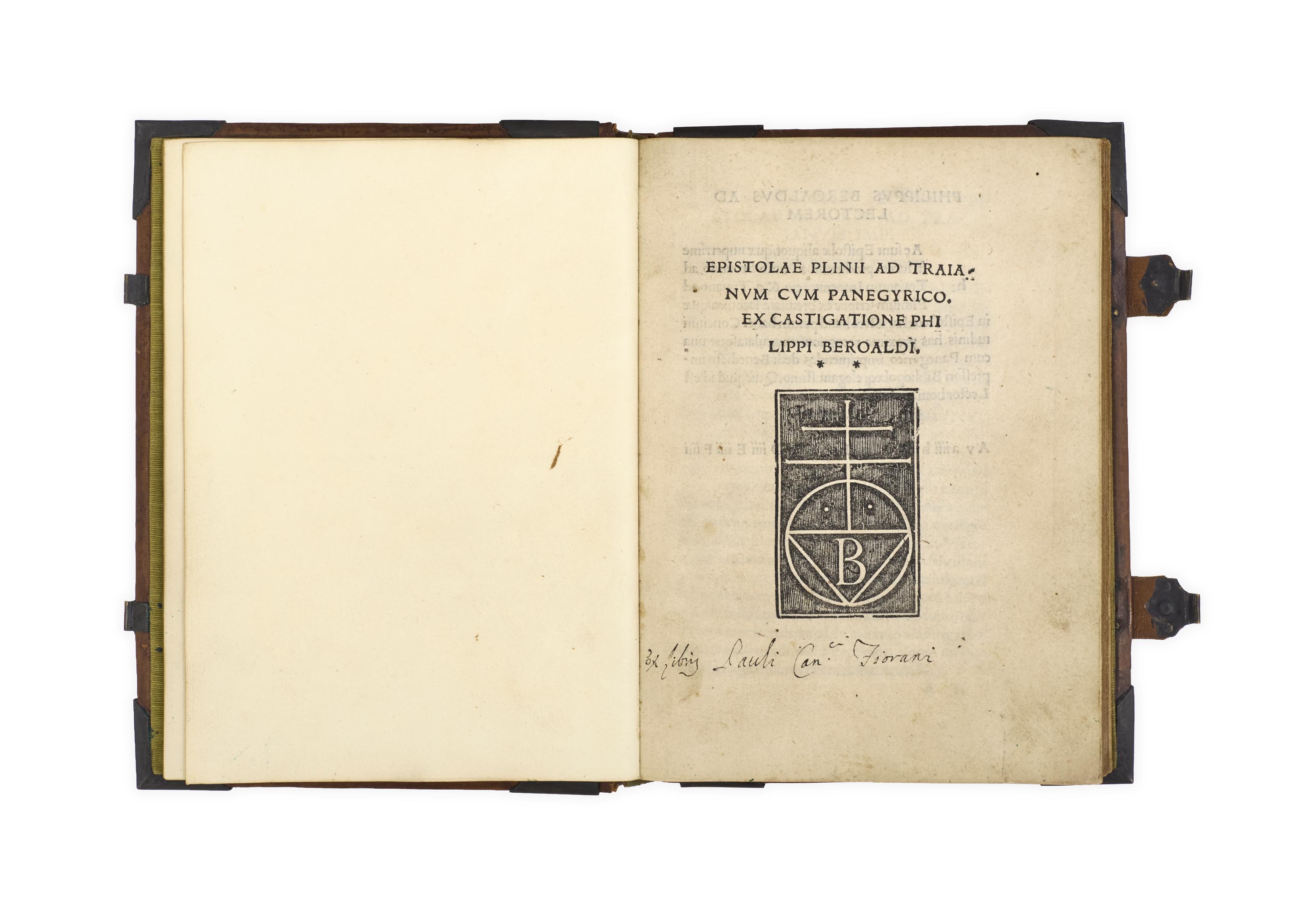
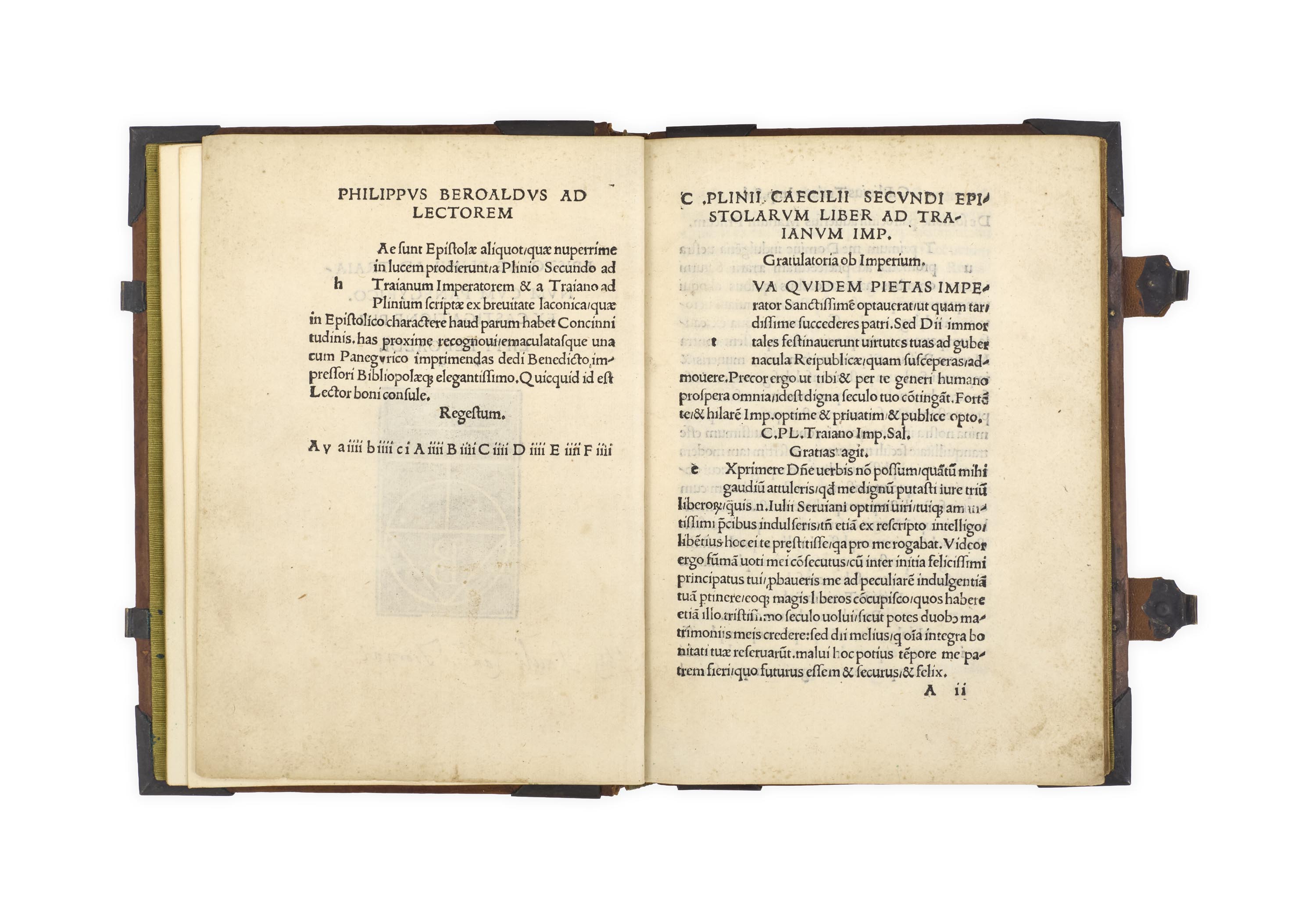
Epistolae Plinii ad Traianum cum panegyrico. Ex castigatione Philippi Beroaldi. [(Colophon:) Bologna, Benedetto Faelli, 24 January 1502 (i.e. 1503; but really c. 1510–1515?)]
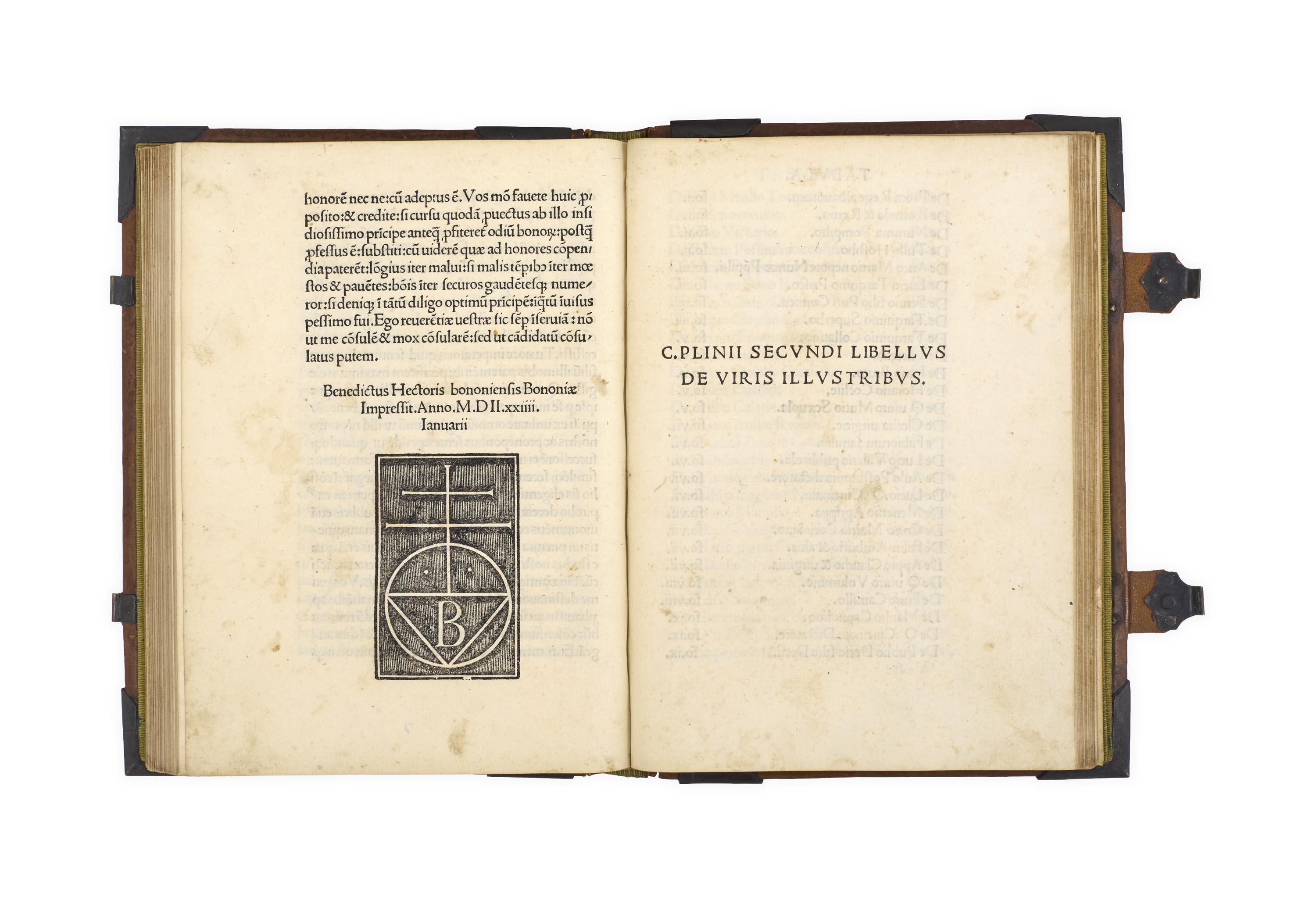
[bound with:]
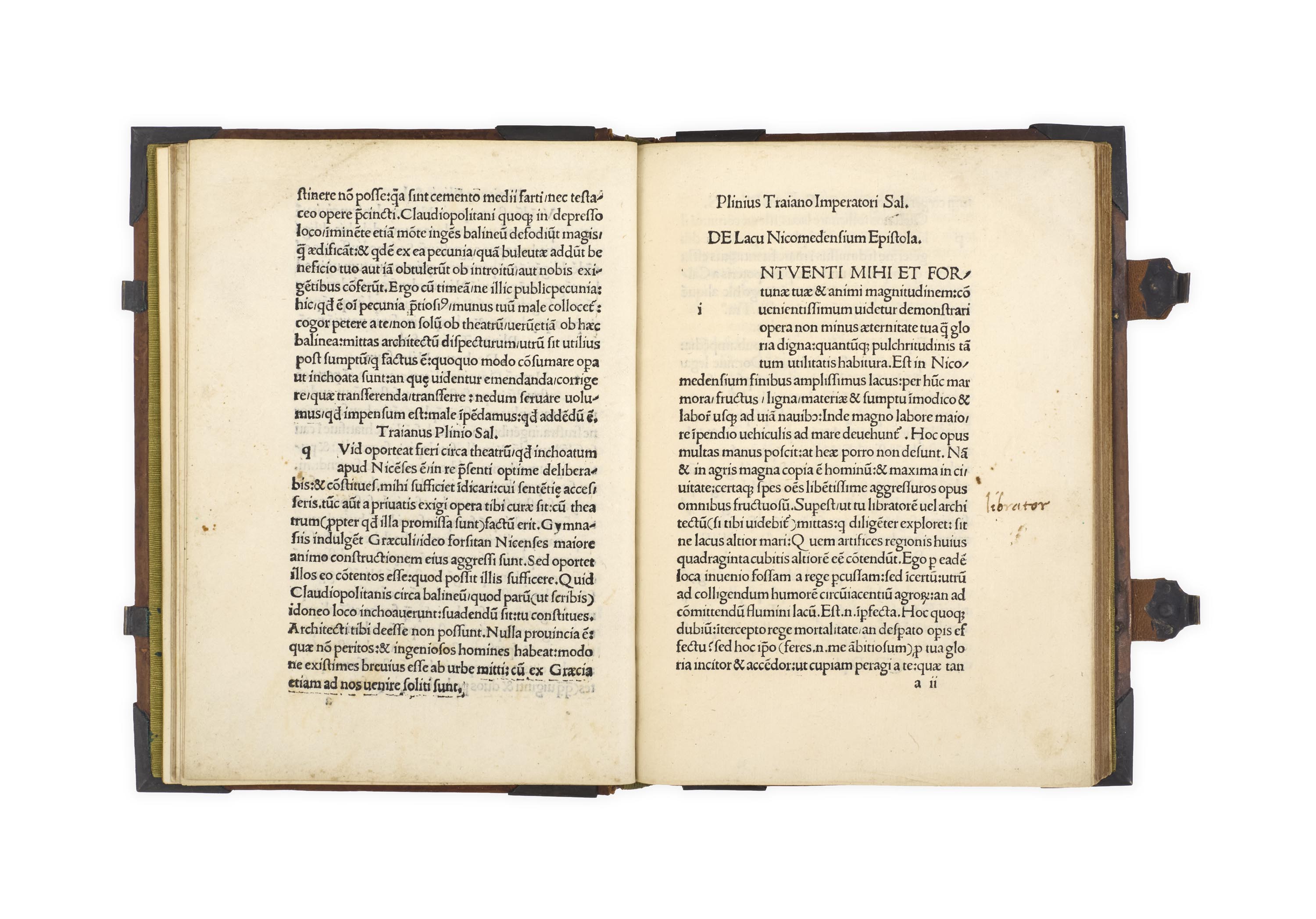
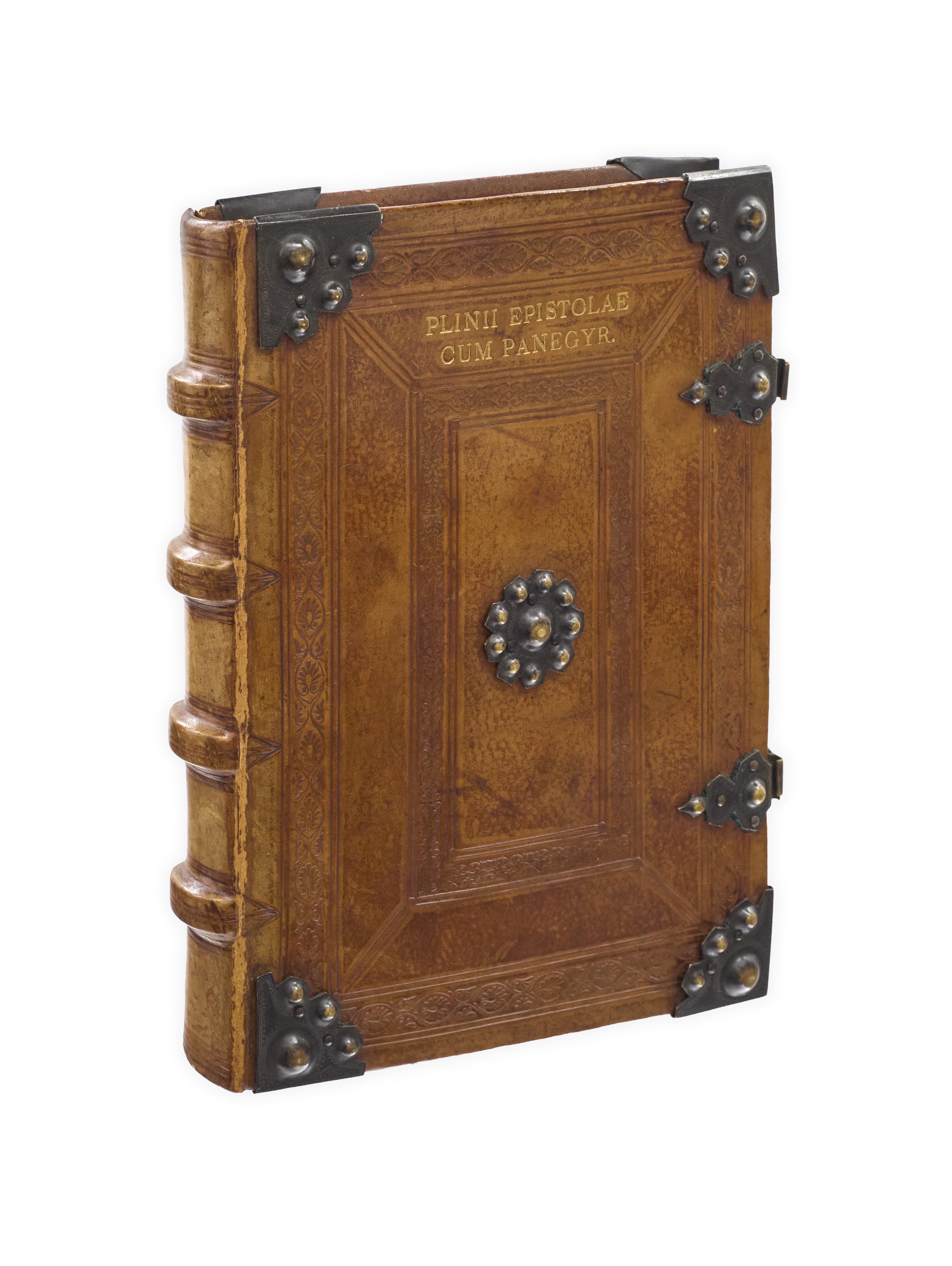
PLINY the Younger, pseud.; Filippo BEROALDO, editor. Libellus de viris illustribus. [(Colophon:) Bologna, Benedetto Faelli, 22 January 1504 (i.e. 1505).]Two works in one vol., 4to, I: ff. [76]; A10 a–b8 c2 A–F8; roman type, woodcut white-on-black printer’s device to title and final recto; II: ff. [ii], 23, [1], roman type, woodcut white-on-black printer’s device to final recto; light soiling to first two leaves, but a very good copy; bound in 1901 by Cesare Galiani of Bologna in imitation of a contemporary Bolognese binding, blind-tooled calf over wooden boards with metalwork centre- and corner-pieces and two clasps, lettered in gilt at head of upper cover ‘PLINII EPISTOLAE CUM PANEGYR.’ and imprint to lower cover ‘BONONIAE M.DIV’ (corrected from M.DII), prominent spine bands, edges gilt, endleaves of green watered silk with calf hinges; lower joins cracked; seventeenth-century inscription to title-page ‘Ex libris Pauli Can[oni]ci Fiorani’ (of Fiorano, near Modena), and contemporary inscription to penultimate leaf ‘liber mei petri vitriani’, 5 pp. with short marginal notes likely by one of these owners.
Added to your basket:
Epistolae Plinii ad Traianum cum panegyrico. Ex castigatione Philippi Beroaldi.
A pair of Bologna printings of short works by or attributed to Pliny the Younger, both edited by Filippo Beroaldo, the first an unrecorded variant with additional text, in a fine pastiche binding by Galiani of Bologna.
The letters of Pliny the Younger (61/62–c. 112 AD) reveal much about his personal life and the attitudes of the aristocracy after a century of imperial rule. They are generally arranged in two groups: the letters to friends, which were edited and published by Pliny himself in c. 109 AD (books 1–9), and his correspondence with the Emperor Trajan, drawn from the imperial archives (now referred to as book 10).
The first work in this volume contains Pliny’s correspondence with the Emperor Trajan, 124 letters in all, followed by Pliny’s speech in praise of Trajan, delivered in the Senate on 1 September 100 AD, in which he denigrates Trajan’s predecessor, Domitian. The letters include his reports as governor in Pontus and Bithynia, with various legal and administrative queries, as well as mentions of the new Christian cult in his province; they ‘constitute an exceptional corpus of imperial correspondence’ (OCD). Bound second is a collection of lives of famous men from King Procas of Alba Longa to Pompey the Great; while it is attributed to Pliny on the title-page, it is more likely to be a fourth-century compilation.
The first printing of any part of book 10 occurred in Venice on 11 May 1502, comprising letters 41–121 in the modern numbering (’46 letters to Trajan recently found, with his replies’), edited by Girolamo Avanzi. The second was Beroaldo’s edition of 24 January 1503 (dated more veneto, i.e. 1503, not 1502), ‘corrected by conjecture … in fact much better than Avanzi’s’ (Ciapponi, p. 85), containing the same group of letters, though without Avanzi’s own numbering of the letters (from 27 to 73), and to which Beroaldo appended the Panegyric to Trajan.
This copy, however, also contains a seemingly unrecorded printing of letters 1–40 of Pliny’s correspondence with Trajan. All the other recorded copies of the Beroaldo 1503 edition have the collation a–b8 c2 A–F8 and do not have the printer’s device on the title-page. The collation here, however, is A10 a–b8 c2 A–F8, where A1 is the title-page (now with device) and letters 1–40 appear on the following ten leaves (A2–10 and a1), resuming with letter 41 on a2r. Leaf a8 (conjoint with a1, the last leaf to contain this new text) has also been reprinted, with some variants from the original setting (it contains the end of letter 67 up to the start of letter 71). From the state of the block used for the printer’s device, the device on the reprinted title must post-date the second work (dated 22 January ‘1504’, i.e. 1505, more veneto), and indeed examination of other uses of this block suggest a date of printing in the early 1510s, though the block was still being used by Faelli into the 1520s.
The editio princeps of letters 1–40, supplied from a manuscript in France, was the November 1508 Aldine edition of all the letters of Pliny (also accompanied by the De viris illustribus and other short related texts). This copy of Beroaldo’s 1503 edition was presumably still in the print shop in 1508, after which time Faelli reprinted the first quire and the bifolium a1.8 in order to update his edition in line with the new and complete Aldine text. Beroaldo himself had died in 1505, and was therefore unable to provide a new preface to the reader. One would presume that these new printed sheets would have been used to update more than one copy of the earlier edition, but we have not been able to locate another similarly expanded copy. (In 1504, Faelli had also printed a combined edition of books 1–9 and the defective book 10.)
Provenance: A Pietro Vitriani is recorded as a notary in Reggio Emilia in the early sixteenth century.
The two texts were most likely issued or sold together by Faelli: copies of both are held by the Library of Congress, Chicago, and the Bodleian. We have not located any other copies of either work in the US or UK.
EDIT16 CNCE 69336 & 16245; USTC 849913 & 800059. Ciapponi, ‘Gaius Plinius Caecilius Secundus’ in Catalogus translationum et commentariorum IX, pp. 85–87.