Pope’s Mentor
[WALSH, William].
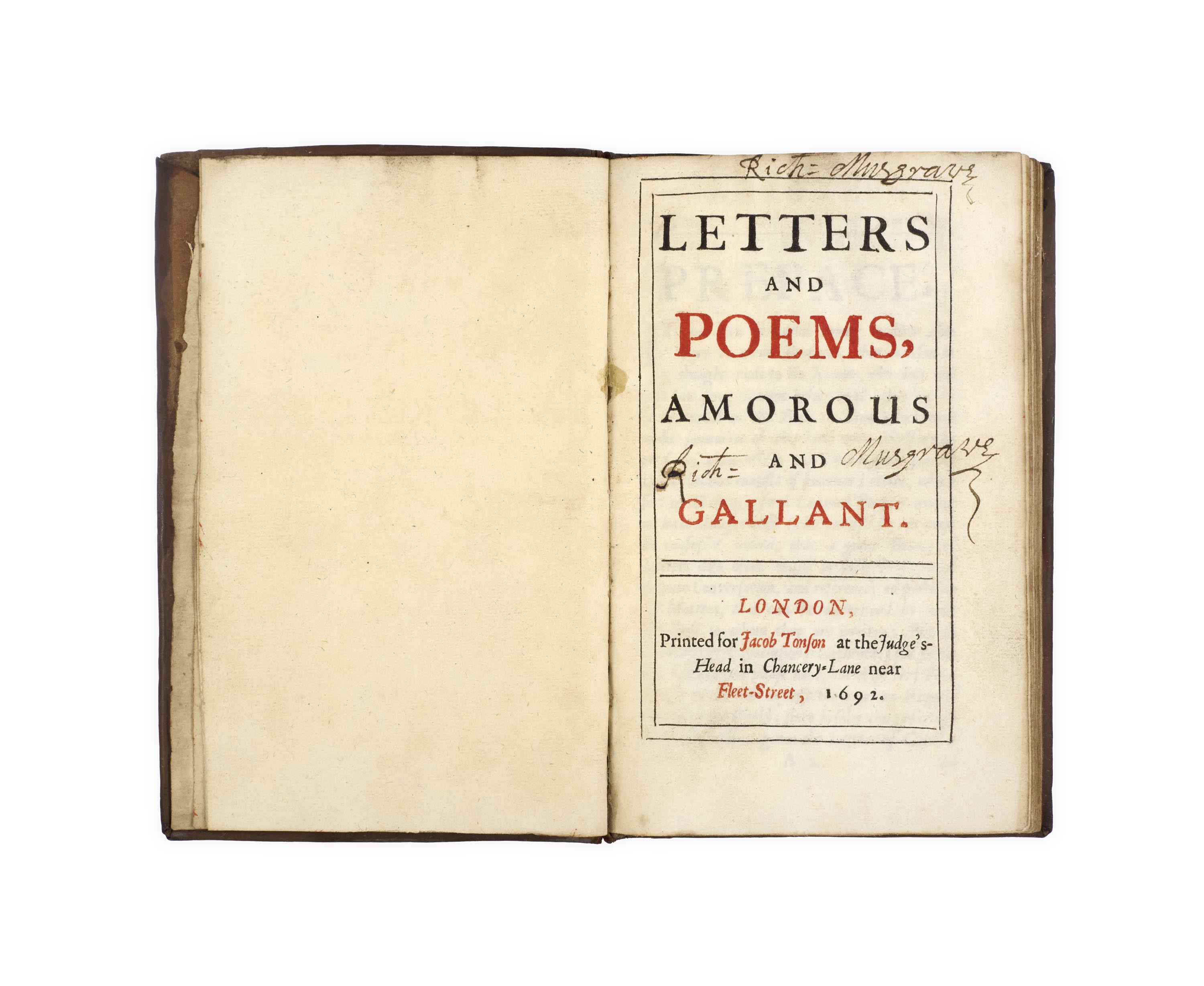
Letters and Poems, amorous and gallant. London, Jacob Tonson, 1692.
8vo, pp. [xvi], 120; title-page printed in red and black; a fine, crisp copy in contemporary mottled calf; ownership inscriptions to title-page of Richard Musgrave (1652–1727).
First edition of Walsh’s principal work – following the publication of his Dialogues concerning Women the year before – a collection of playful letters, elegant love lyrics, Virgilian pastorals, and witty epigrams.
Walsh (1662–1708) was one of Dryden’s circle of wits at Will’s Coffee House in Covent Garden, where Dryden praised him as ‘without flattery, the best Critick of our Nation’ (postscript to Virgil). An example of his wry insight is to be seen here in the Preface: elevating Catullus and debunking Petrarch, he praises Donne, Cowley, Waller and Suckling for their wit (though ‘Softness, Tenderness, and Violence of Passion … is wanting’), and notes that ‘to write of Love well, a Man must be really in Love; and to correct his Writings well, he must be out of Love again’.
In the letters and poems, he plays with conventions of courtship, mixing self-conscious foppery with black humour. In one letter he withholds praise for ‘the brightness of your Eyes’ in case they ‘prove blear’d and squinting’; elsewhere, he rejects hanging or drowning oneself for love, as ‘Drowning will spoil your Clothes, and Hanging your Complexion … I wou’d rather recommend Mr. Boyle’s Air-Pump as a newer Invention; or being poisoned in Perfumes, as somewhat that looks pleasant enough’.
Walsh’s amorous gallantry never led to marriage, though the Countess of Kingston was among his amours – ‘as for Amourettes, those are not worth mentioning’. He served several times in Parliament, was a member of the Kit-Kat Club, collaborated with Congreve and Vanbrugh, and was a mentor to the young Pope, whom he befriended when Pope was still a boy. The two carried on a literary correspondence, and Pope, in turn, acknowledged his debt with some flattering lines in his Essay on Criticism.
ESTC R8169; Wing W 647; Hayward 136.