Portuguese Processional
[PROCESSIONAL.]
[Processionarium monasticum secundum consuetudinem ordinis S. Benedicti de observantia, auctum et accurate emendatum.] [Coimbra, António de Mariz, 1571.]
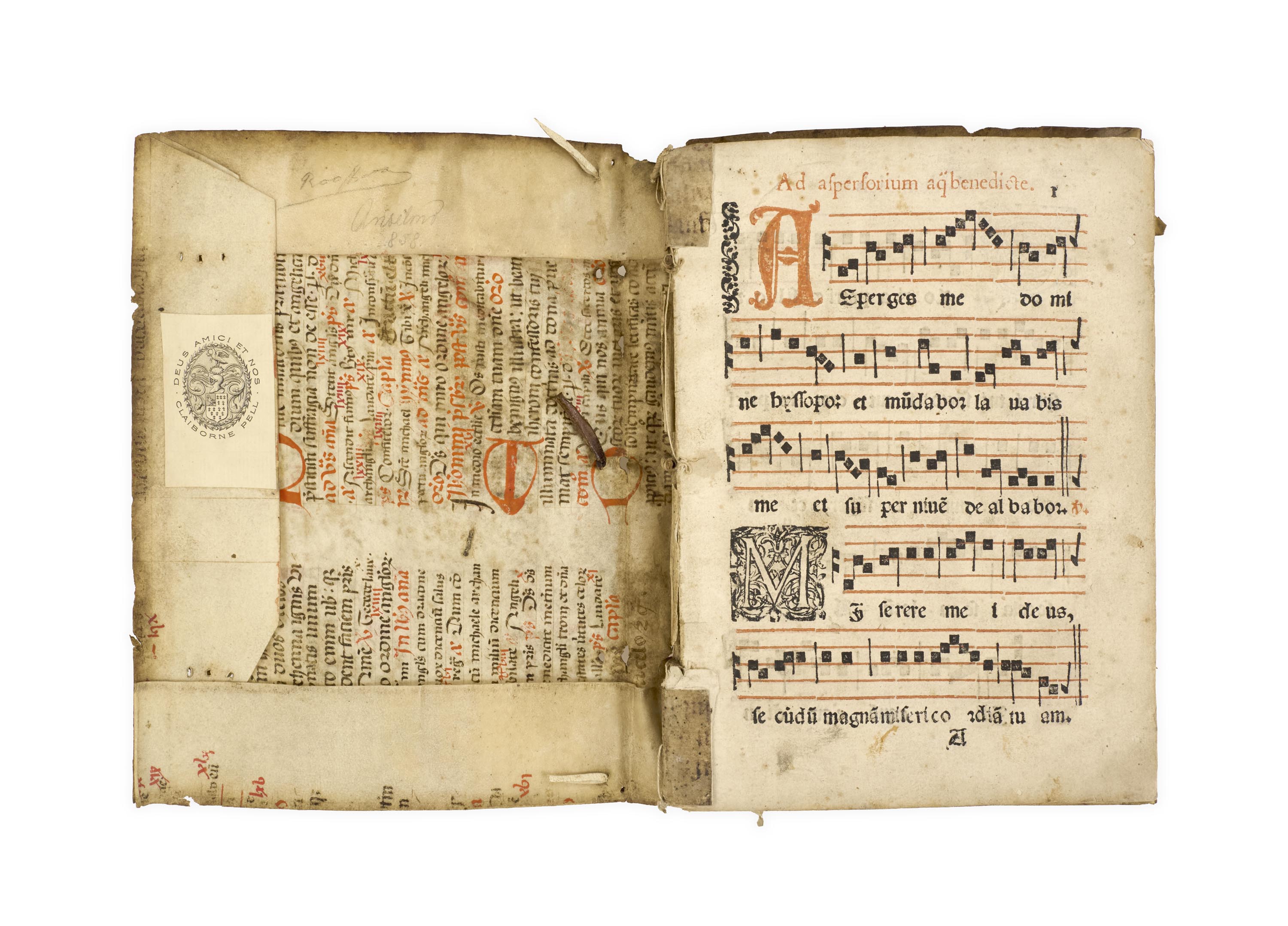
Small 4to, ff. 1–96, 121–122, 127–128 (i.e. 100 of 154 leaves), without ff. [4, title and table of contents], 97–120, 123–126, and 129–150, evidently never bound in; printed music on five-line red staves throughout, woodcut initials in black and red, rubrics and headlines in red; first leaf dusty with a few small marginal holes, very slight worming to lower margins towards the end, light damp-staining to lower corners, otherwise a very good copy in a limp vellum binding of manuscript waste (see below), ‘Proces. antigo’ in manuscript to spine; text block detached, fore-edge of rear cover gnawed, covers stained and cockled; armorial bookplate ‘Claiborne Pell’ pasted inside front cover.
Added to your basket:
[Processionarium monasticum secundum consuetudinem ordinis S. Benedicti de observantia, auctum et accurate emendatum.]
An extremely rare Processional of Benedictine Use, printed in Coimbra in Portugal, bound in a fragment from a medieval Iberian manuscript breviary.
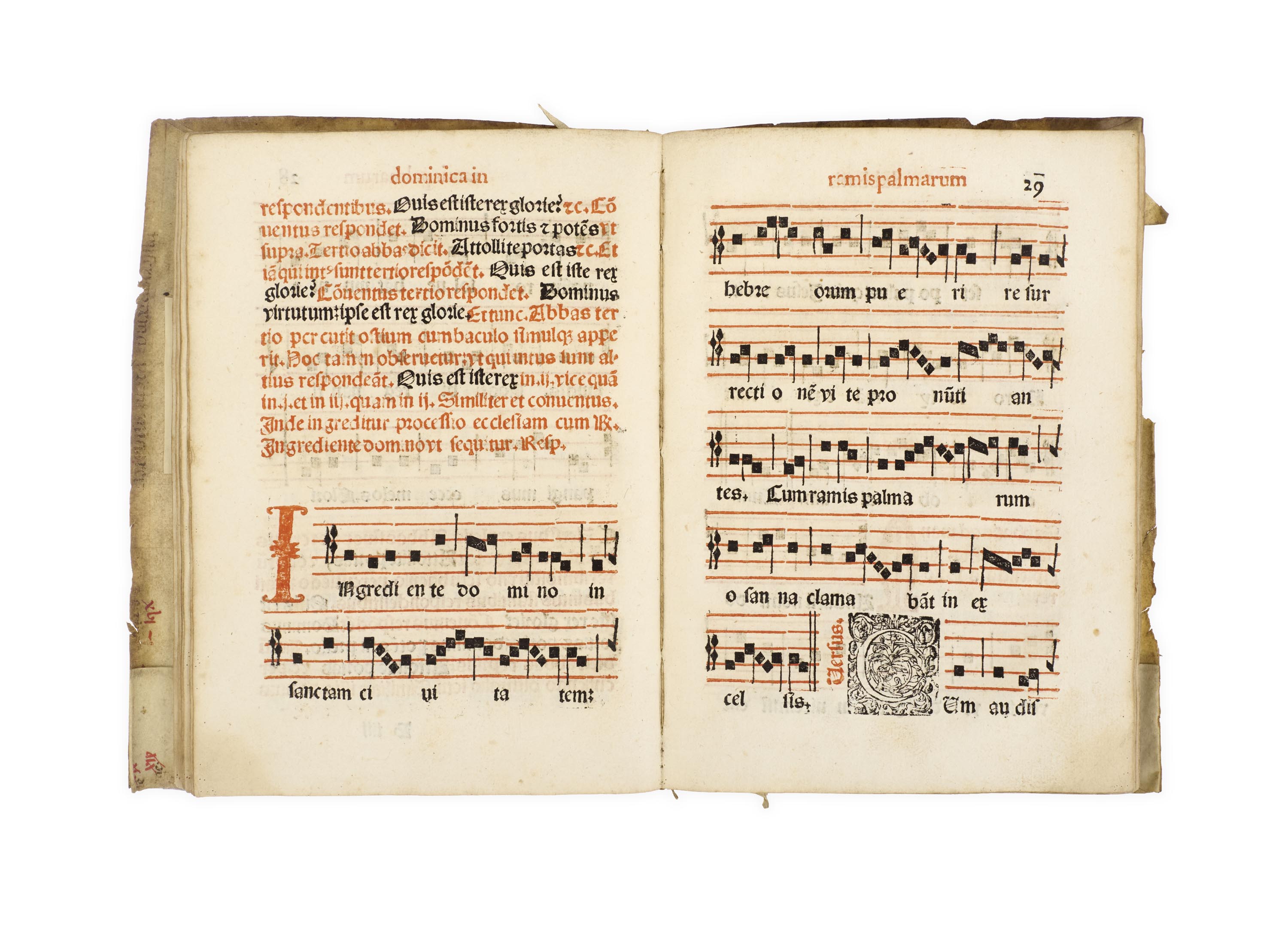
The first half supplies the words and music required for the Temporale – the Christological feasts including Christmas, Easter, Ascension, and Pentecost – and the second those for the Sanctorale, for the celebration of saints’ days. There are extensive rubrics for Palm Sunday, Good Friday, and Candlemas, for example, with ceremonial instructions for abbot, deacons, singers, and monks. A splendid initial ‘S’ opens the nativity chant Sancta et immaculata virginitas on f. 121v.
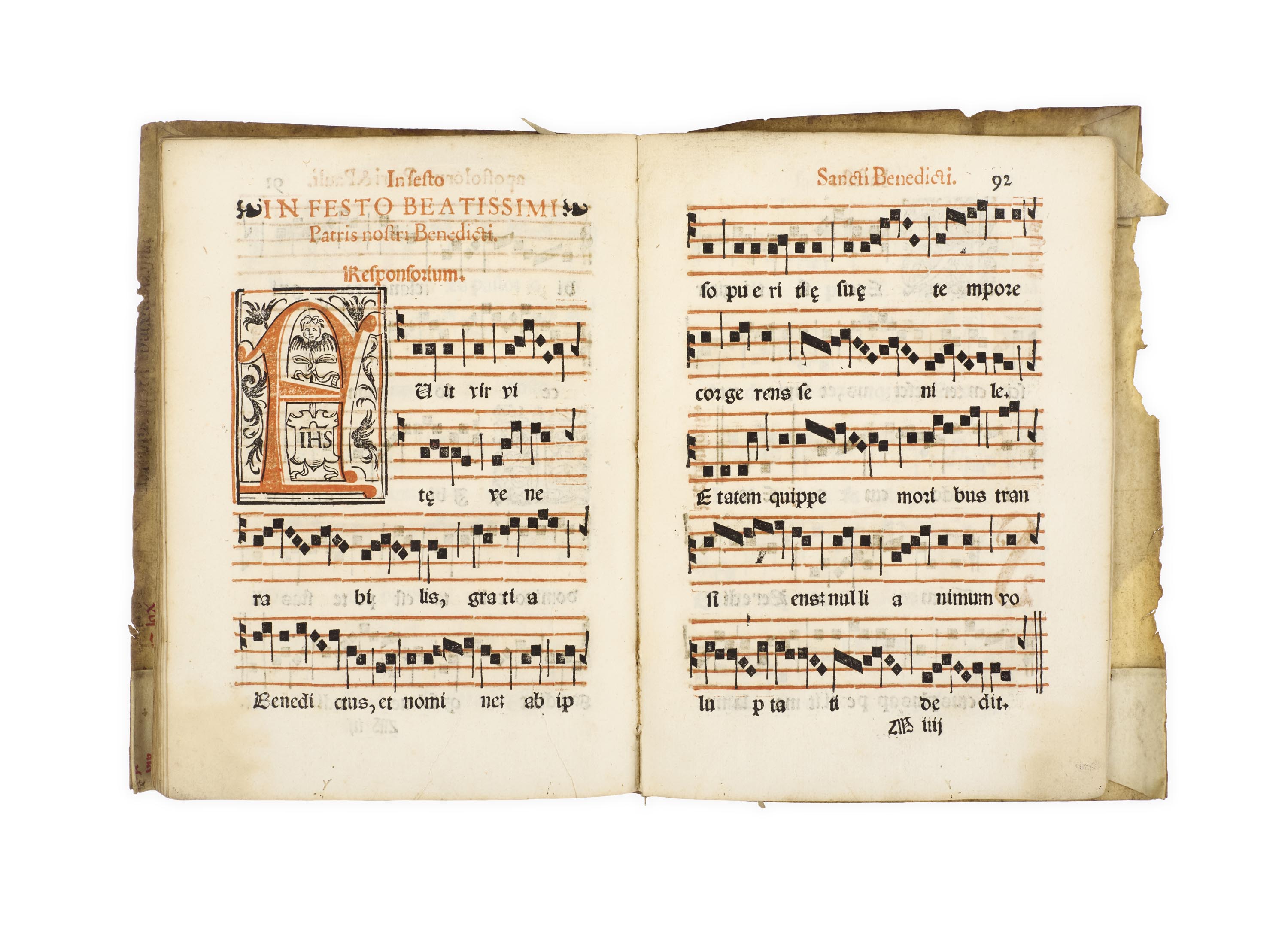
St Benedict’s name appears in larger print in the litanies, and the rubric for his feast describes him as ‘our father’, with the chant Fuit vir vitae venerabilis gratia beginning with an attractive initial ‘F’ (f. 91v). The litanies feature a number of Iberian saints, including St Leander, St Ildefonsus, and St Turibius.
António de Mariz (fl. 1556–1599) was arguably the foremost Portuguese printer-publisher of his day, chiefly active in Coimbra but also in Braga and elsewhere. He served both as royal printer and printer to the University of Coimbra, and worked closely with the Jesuits. He ‘possessed an important workshop, well-supplied with materials, as we can see from the variety of Gothic, Greek, and Roman typefaces he employed’ (Anselmo, p. 238, trans.). His typographical skills are certainly in evidence here.
The binding comprises a fragment from a fifteenth-century Iberian, most likely Portuguese, Latin breviary, the text covering the feasts of St Michael (29 September) and St Jerome (30 September).
We have located a single copy, at the Biblioteca Nacional de Portugal. USTC 346029; Anselmo, Bibliografia das obras impressas em Portugal no século XVI 858.