Pseudo-Protestant Psalms
[PSALMS.]
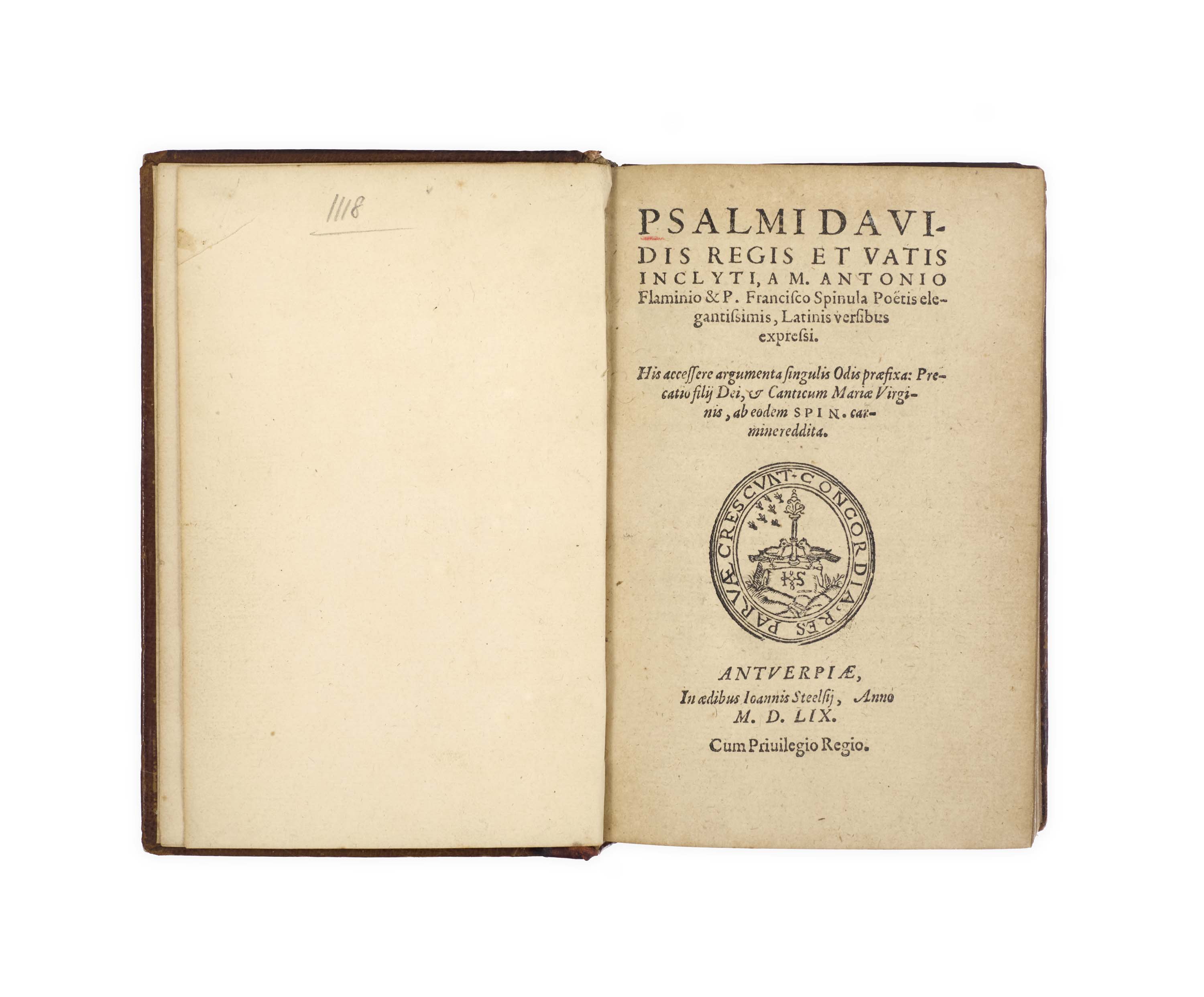
Psalmi Davidis regis et vatis inclyti, a M. Antonio Flaminio & P. Francisco Spinula pietis elegantissimis, Latinis versibus expressi. His accessere argumenta singulis Odis praefixa: Precatio filii Dei, & Canticum Mariae Virginis, ab eodem Spin. carmine reddita. Antwerp, [(colophon:) Jan Verwithagen for Joannes Steelsius], 1559.
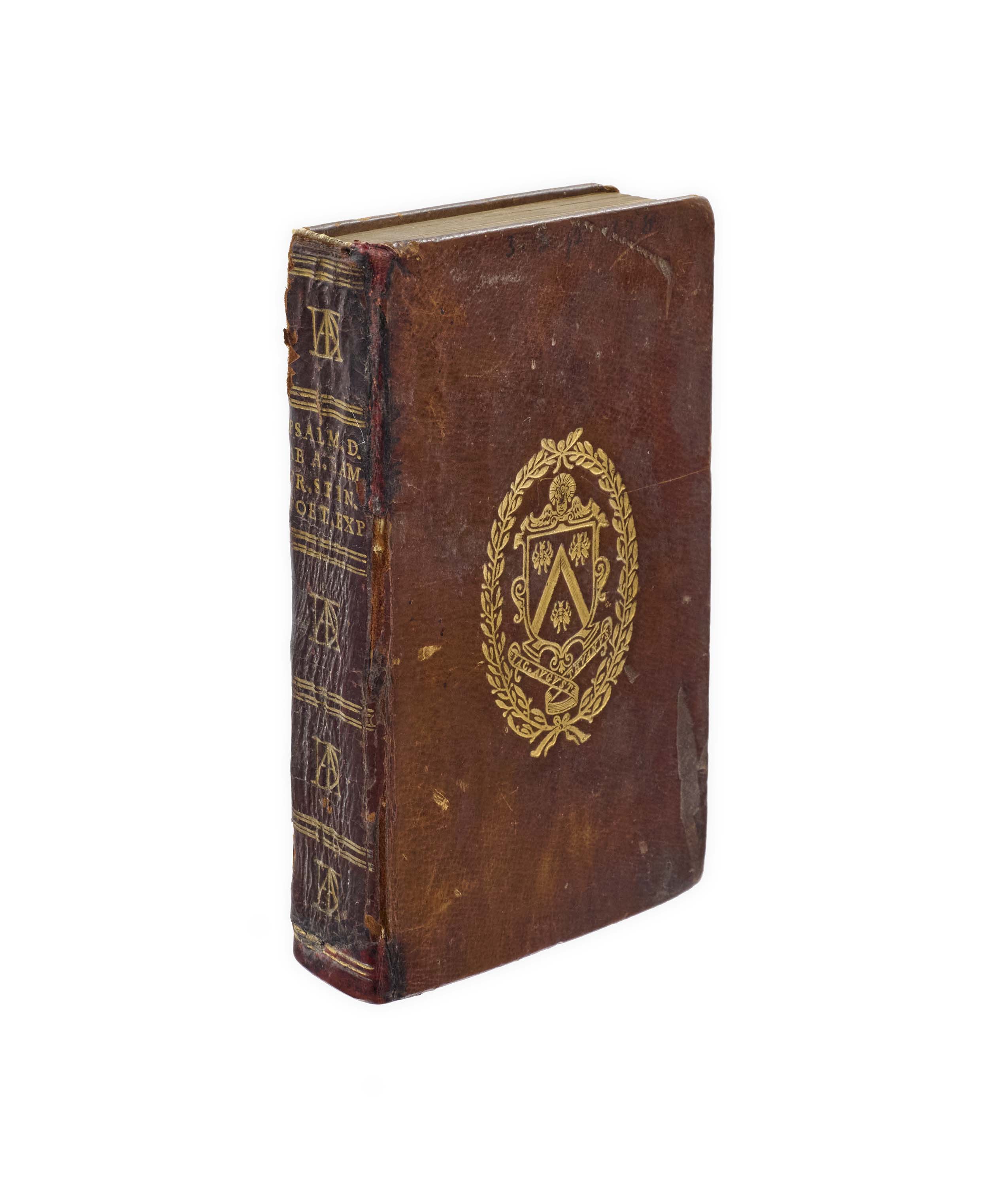
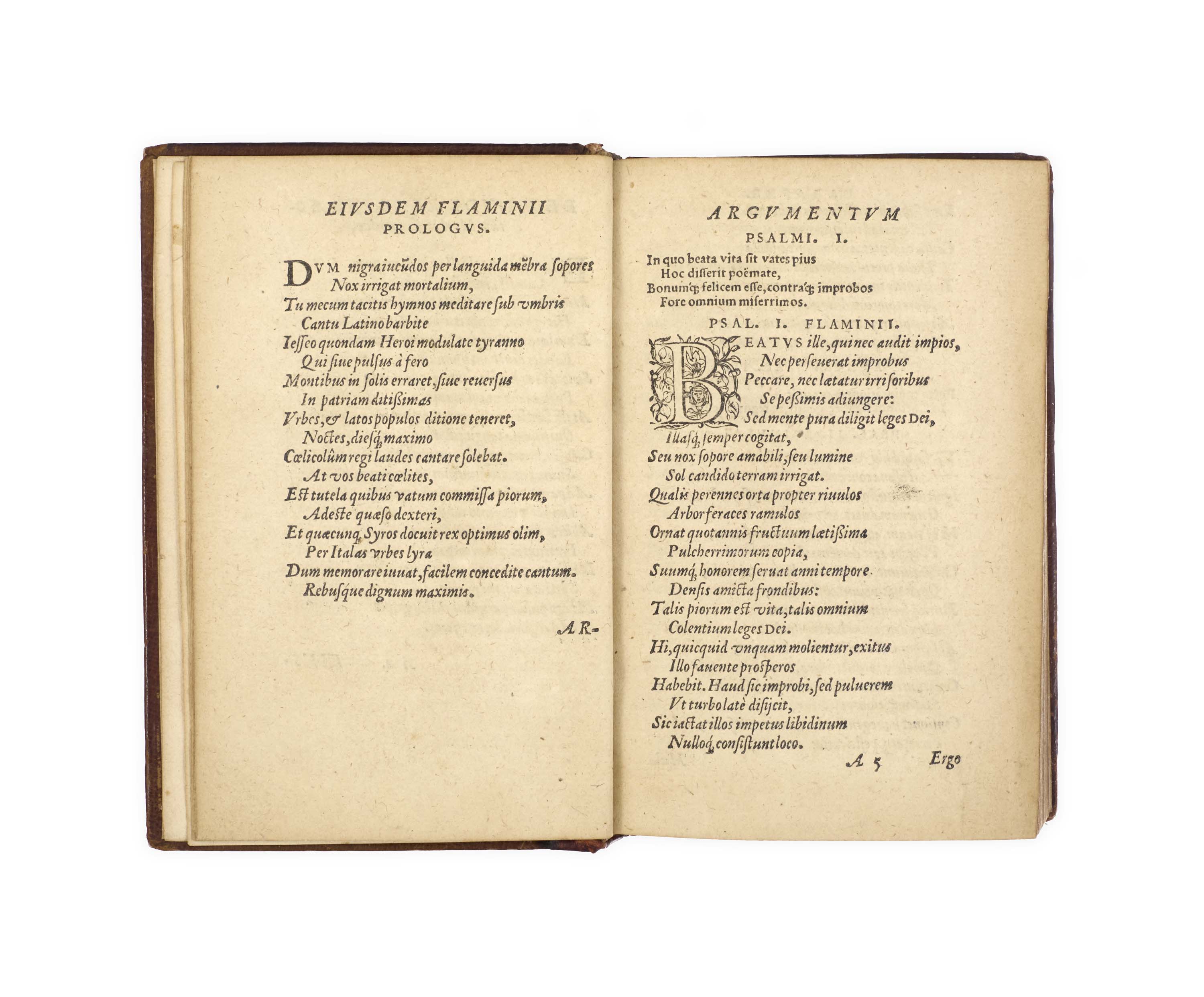
8vo, ff. [208]; A–Z8 Aa–Cc8; woodcut printer’s device to title-page, woodcut initials; a very good copy retaining some deckle edges; bound in later sixteenth-century French sheep with the gilt arms of Jacques-Auguste de Thou (see below), flat spine ruled in gilt with de Thou’s IADT monogram in each compartment, title lettered directly in gilt to second compartment; binding somewhat tight and slightly rubbed with a few small scrapes, repairs to front joint and tailcap, foot of spine restored; ink shelfmark of the Rohan-Soubise library to head of upper cover (3. 3. P. 158) and upper pastedown (3 C.P.T.3.P.158), pencil note ‘of Thorpe 1836’, inscription of Rolf Wistrand dated London, 11 March 1934 to flyleaf.
Added to your basket:
Psalmi Davidis regis et vatis inclyti, a M. Antonio Flaminio & P. Francisco Spinula pietis elegantissimis, Latinis versibus expressi. His accessere argumenta singulis Odis praefixa: Precatio filii Dei, & Canticum Mariae Virginis, ab eodem Spin. carmine reddita.
A collection of verse paraphrases of the Psalms, by the poets and humanist scholars Marcantonio Flaminio (1498–1550) and Publio Francesco Spinola (c. 1520–1567), bound for Jacques-Auguste de Thou (1553–1617).
Flaminio’s own paraphrases of the Psalms had been published in 1546, and after his death Spinola continued working on them until the first printing of his version in 1558. A manuscript containing these paraphrases and other laudatory verses survives in Bergamo (Biblioteca Civica MA 310), dedicated to Vittore Soranzo, bishop of Bergamo from 1547 until his death in 1558, though Soranzo is not mentioned in the printed editions. Both Spinola and Soranzo were accused of heresy; Soranzo was protected from the Pope by the Venetians, but ten years later they executed Spinola by drowning (had he lived longer, it is possible that Flaminio might have been tarred with the same brush.)
The verses were first printed by the Italian Protestant printer Pietro Perna in Basel in 1558, and later reprinted in 1561. This Antwerp edition is copied from Perna’s 1558 text, with the same preliminary verses, but with the additional imprimatur of a Louvain pastor. Presumably the heretical associations of this work were not a problem for someone as well-connected and influential as de Thou.
This is an early binding for de Thou, bound for him before his first marriage in 1587 and with his arms as a bachelor. His library was inherited by his son, whose financial situation resulted in his creditors issuing a sale catalogue in 1679; the collection was bought en bloc by Jean-Jacques Charron de Menars, subsequently purchased by Cardinal Armand de Rohan-Soubise, inherited by Charles de Rohan, prince de Soubise (1715–1787), then sold by auction in Paris in 1789; this volume was part of lot 123, but seemingly sold separately. It then entered the English book trade, and was bought from Thomas Thorpe in 1836. Rolf Wistrand (1912–1974), the last named owner, was a Stockholm lawyer who collected historical bookbindings.
No copies in US libraries; USTC records three copies in the UK, all in Scotland (NLS, Glasgow, and St Andrews); LibraryHub adds one copy at the London Library.
USTC 405004; NB 4141; STCV 12925788; Catalogus bibliothecae Thuanae (1679), p. 18.