English Baroque Emblems
QUARLES, Francis.
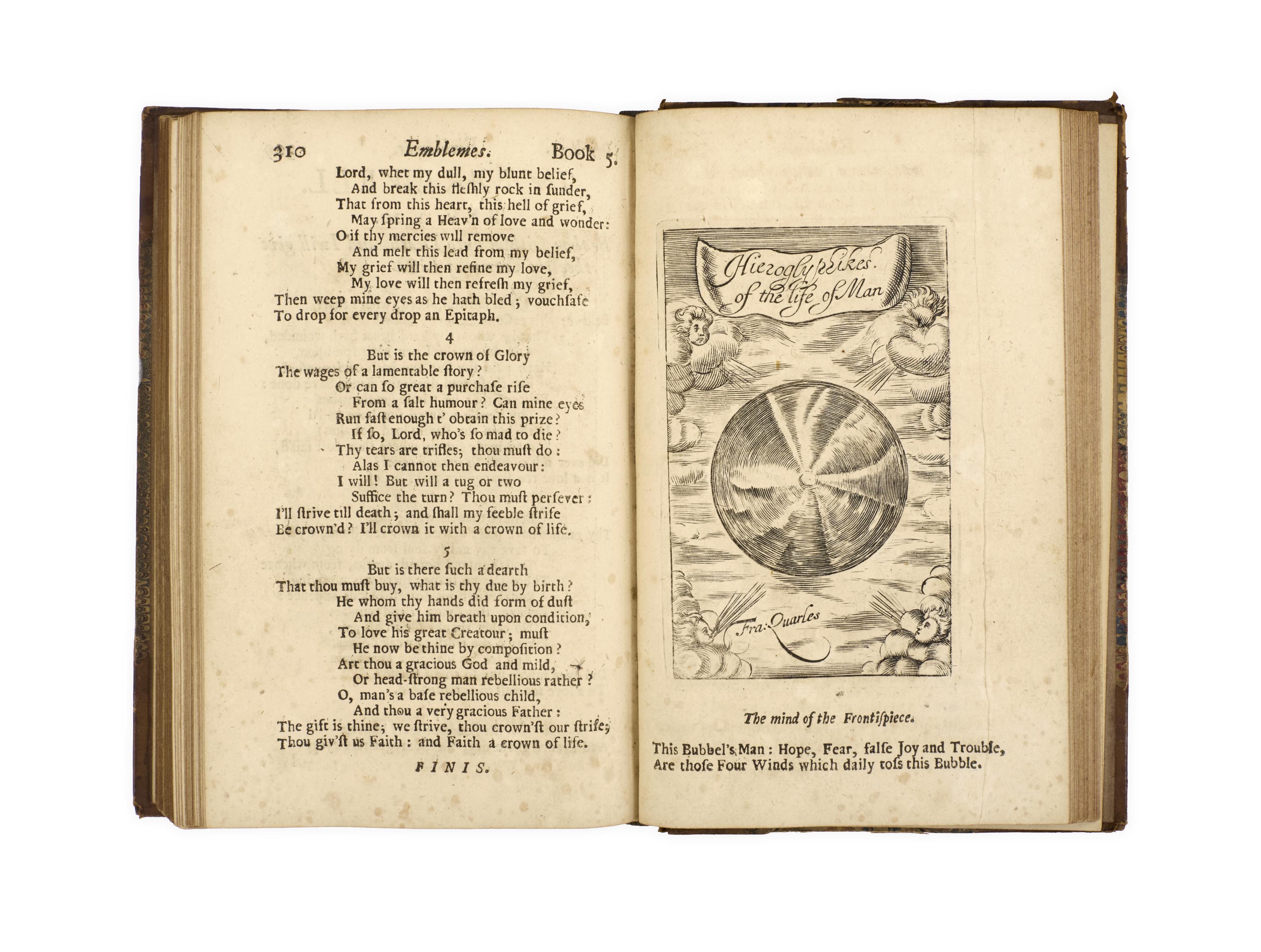
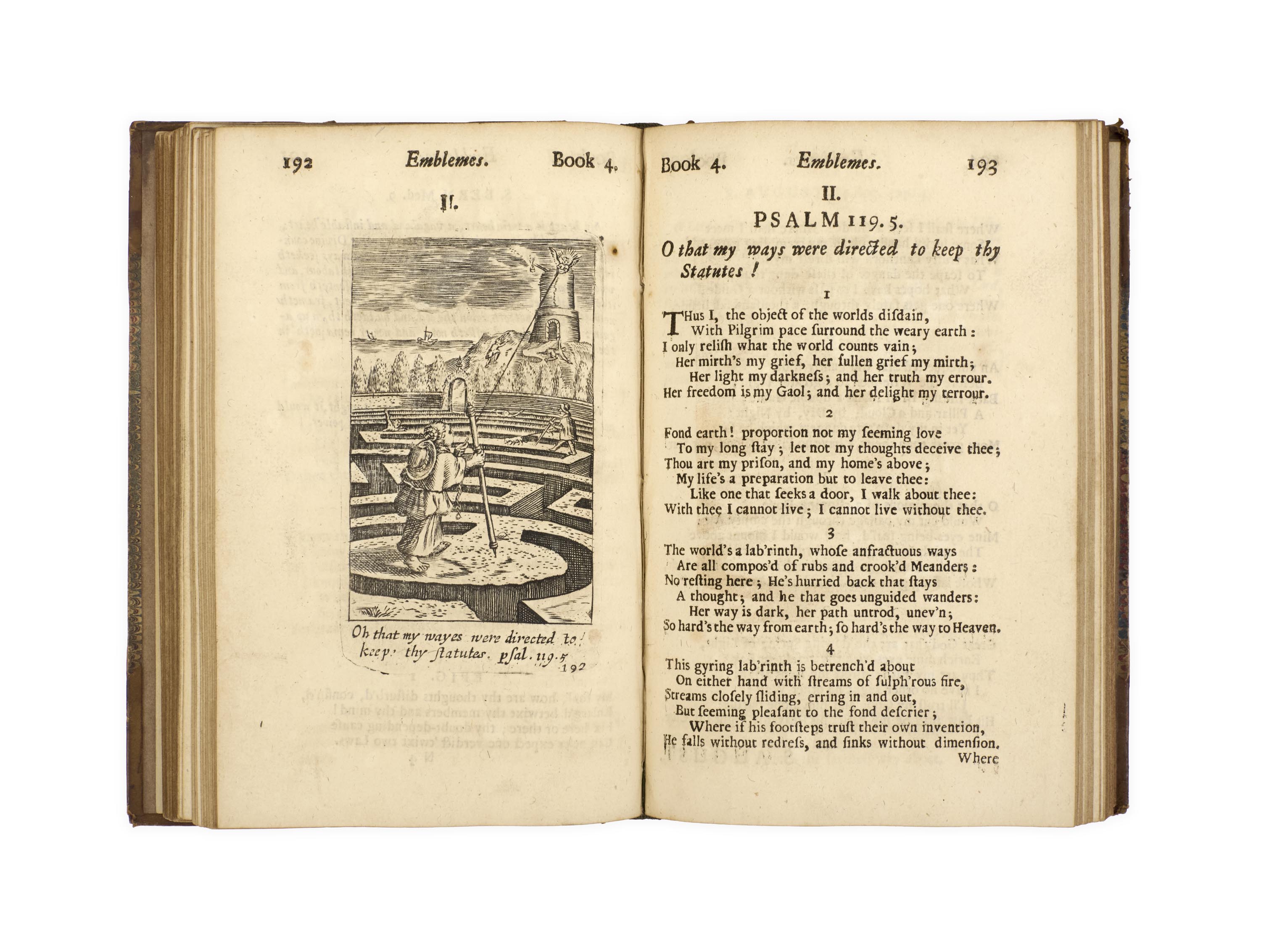
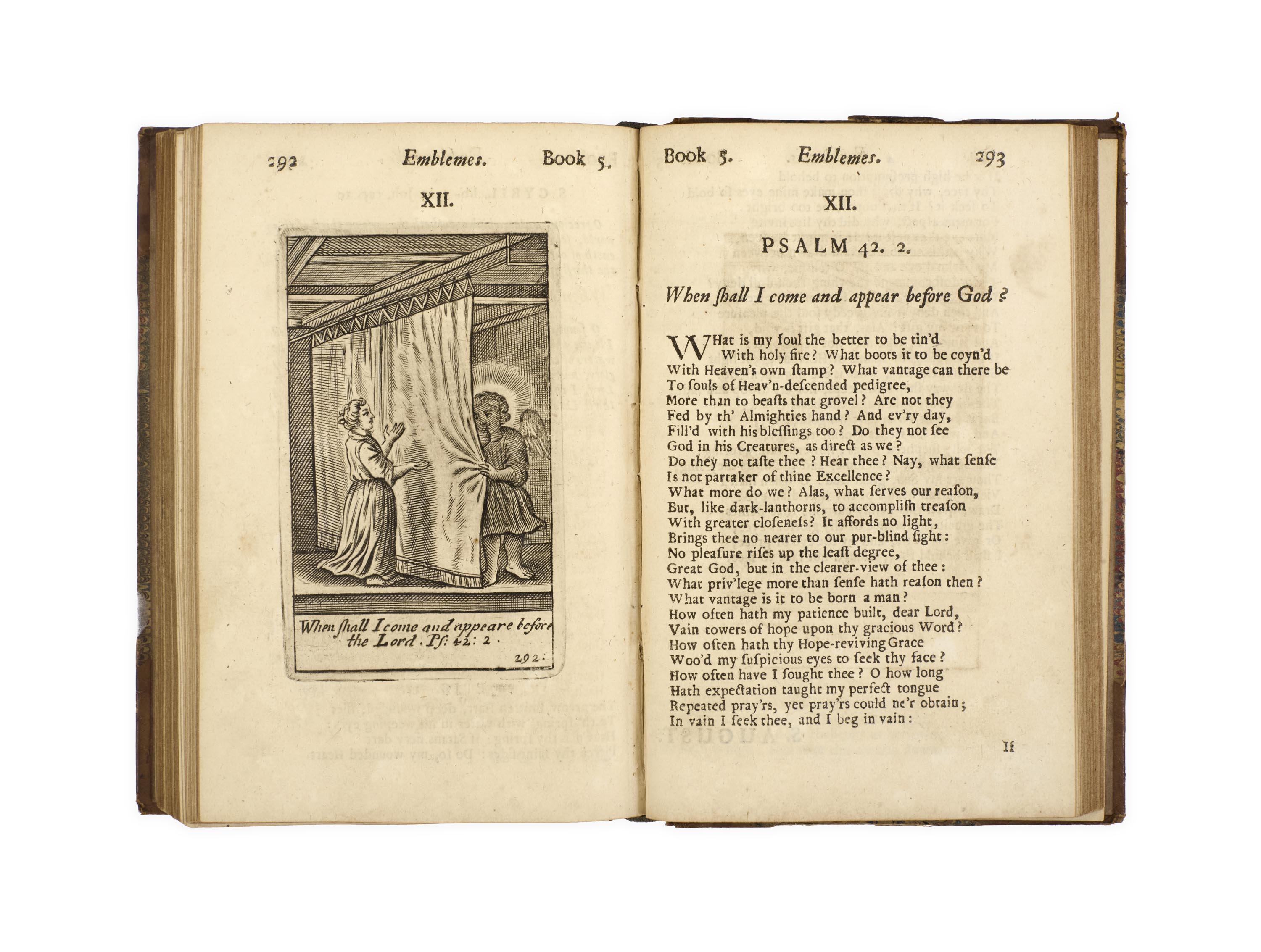
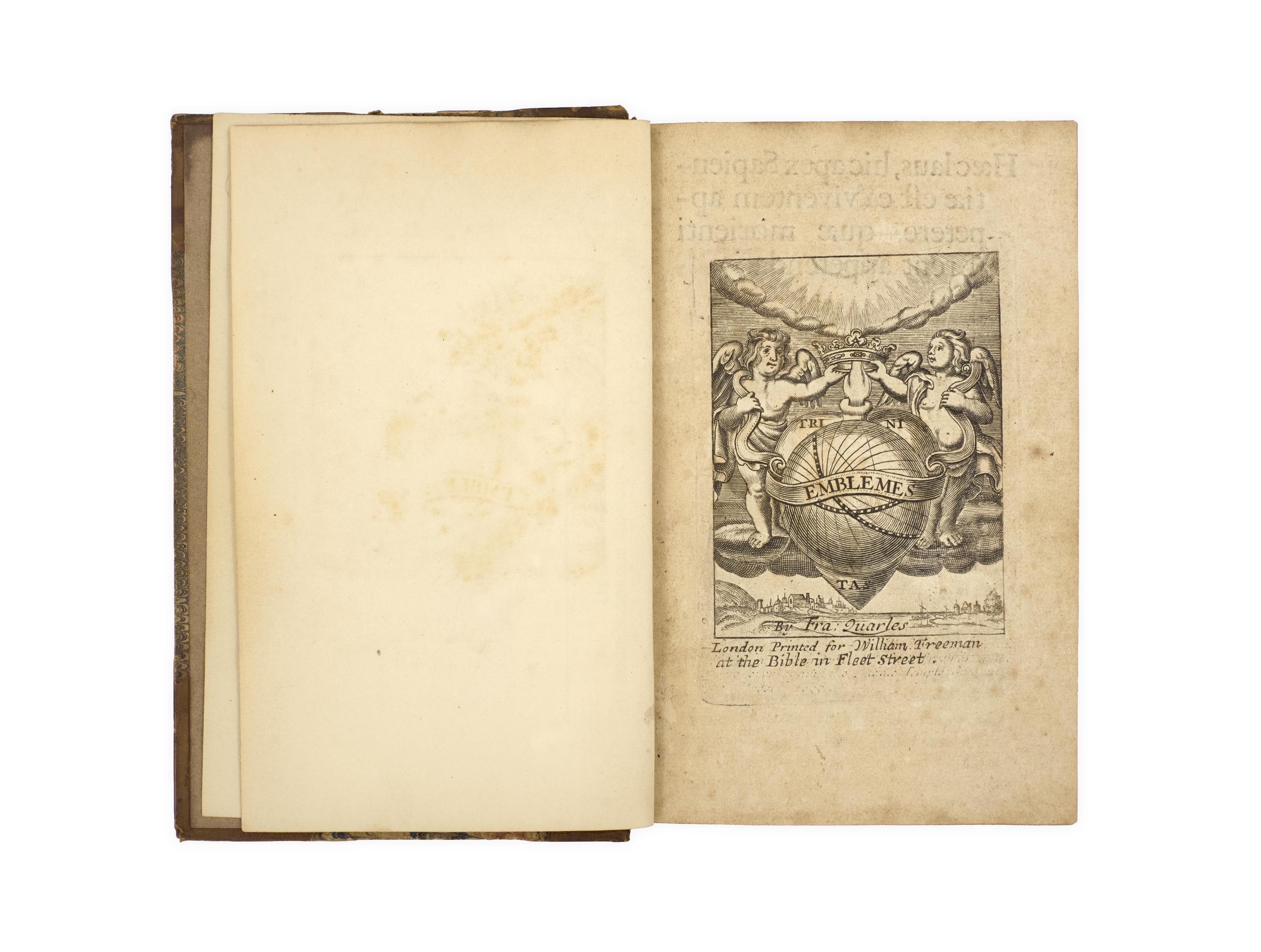
Emblemes [– Hieroglyphikes of the Life of Man]. London, for William Freeman, [1709].
Two parts in one vol., 8vo, pp. I: [8], 310; II: [5], 322-381, [1]; title and part-title copper-engraved, with 93 copper-engraved illustrations printed in-text (some signed P. Holmes, William Simpson, or F. H. van Houe); occasional light toning or spotting, some staining to final quire, short closed tears to upper inner corners of F1, H1, and L7 (the last touching two characters), Q4 with crease across engraving, but a good copy; bound in early nineteenth-century half sheep with marbled paper sides, spine gilt-ruled in compartments with gilt red morocco lettering-piece; somewhat rubbed, with small losses to corners and headcap; armorial bookplate of William Tooke to front pastedown.
Quarles’ Emblemes, ‘the work that secured his fame’ (ODNB) and popularised the Catholic baroque emblem in Protestant England, issued together with his Hieroglyphikes.
Edward Benlowes (1603−1676), wealthy patron and friend to Quarles (1592–1644), furnished the author with two Jesuit model emblems, Pia desideria (1624) by Herman Hugo and Typus mundi (1627), compiled at the Antwerp Jesuit college, which he had brought home from the Grand Tour. Emblemes, first published in 1635, replicates the forty-five emblems from Pia desideria in the original order and draws selectively from Typus mundi. Hieroglyphikes, a work Quarles called ‘a second Service’ (X2r) of the same dish as Emblemes, was published four years later, in 1639, and comprises a further fifteen emblems on the theme of the ages of man. In 1639, the two works were reprinted and issued in one volume.
Quarles’s emblem book occupies a significant place in history of emblem convention, promoting the tenets of Christian life through intricate verse as well as allegorical image. Placing fresh emphasis on the twinned literary and visual arts, ‘for the first time the emblem book begins to lay claim to some serious consideration of its merits as literature. Quarles [and his followers] … saw in their material the potentialities of real poetic form; they were not content simply to describe and interpret the picture before them, but attempted also to base varieties of poetic effect upon it. The poems they produced were lyrical, or dramatic, or narrative, instead of merely didactic’ (Freeman, p. 114). Quarles’s reinvigoration of the emblem book proved wildly popular, passing through about sixty editions or issues, more than thirty of them after 1800.
Provenance:
William Tooke (1777–1863), lawyer, Fellow of the Royal Society, and President of the Society of Arts, was variously involved in the formation of St Katharine’s Dock, the Society for the Diffusion of Useful Knowledge, and University College London. He was the author of several works on, inter alia, the poet Charles Churchill, the Ancien régime, and the University of London, as well as publications of his own verse.
ESTC N505458 (dating the printing to [1709] from the Term Catalogues); Horden, Bibliography of Francis Quarles XV, 11 (dated [1710?]).