An Illustrious ‘Son of Ben’
RANDOLPH, Thomas.
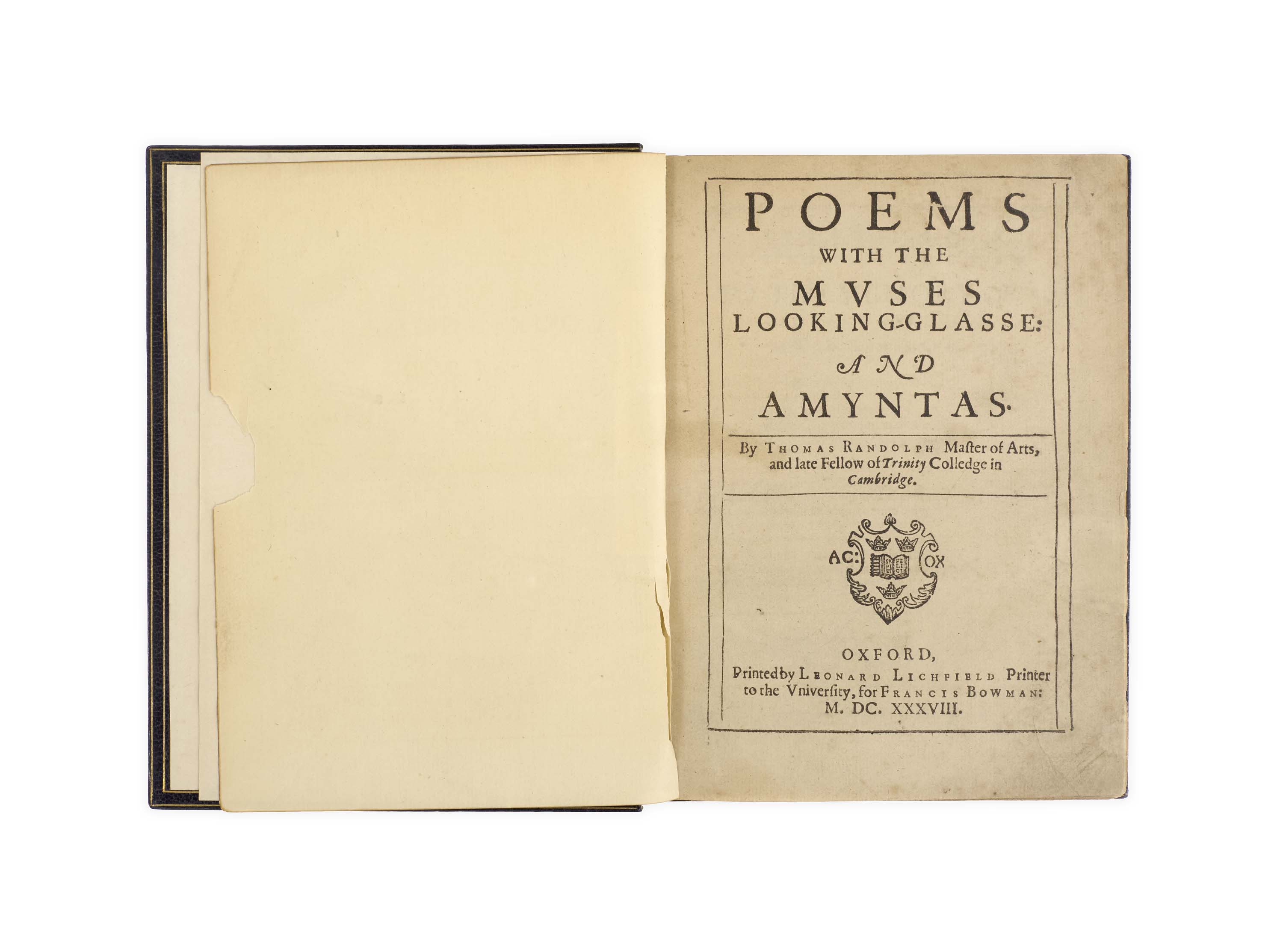
Poems with the Muses Looking-Glasse: and Amyntas … Oxford, Leonard Lichfield for Francis Bowman, 1638.
4to, pp. [24], 128, [2], 93, [7], 114; a little toned, somewhat inevitably given the poor paper stock used, lower corner of Q1 neatly renewed, inner margin reinforced on final leaf, but a very good copy in modern dark blue morocco by Rivière & Son, rebacked, new endpapers; the Wilmerding-Rabinowitz-Berland copy, with their bookplates in loose.
First edition of the major collection – pastoral, erotic, and festive verse, followed by two plays – of one of the more illustrious of the ‘sons of Ben’, published two years after his death some three months short of his thirtieth birthday.
Randolph began his literary career at Trinity College, Cambridge, where he was known for his wit and ingenuity, and organized student productions of his earliest plays. Leaving Cambridge for London in 1632, he engaged with too much enthusiasm in the dissipations of metropolitan literary life, and his ‘immoderate way of living in all probability shortened his days’ (Phillips, Theatrum Poetarum, 1675). Commendatory verses here come from other ‘sons’ including Owen Feltham, and there are several poems addressed to Jonson himself, and ‘A Parley with his empty Purse’:
Purse, who’l not know you have a Poets been
When he shall look and find no gold herein?
In the opening scene of The Muses Looking-Glass, set in the Blackfriars Theatre, two puritan hawkers who are strongly prejudiced against the stage are accosted by a third character, Roscius, who undertakes to convert them. In the play that follows, to a counterpoint of commentary from the puritans, virtues and vices appear in couples or singly and (in accordance with the theory of comedy put forward in the first act) hold up a mirror in which spectators may note their own defects. Bentley describes the play as ‘oddly academic’ for the London stage, and suggests that it may be a reworking of one of the Cambridge comedies, mixing the allegorical characters from an earlier play with the marvellous, realistic, vigorous sketch of the Puritan onlookers. On the other hand the vices clearly owe much to Jonson’s theory of humours.
Provenance: from the libraries of Lucius Wilmerding (sold Parke-Burnet, 27 November 1950, lot 599), Hannah D. Rabinowitz, and Abel E. Berland (sold Christie’s, 9 October 2001, lot 303).
ESTC S115618; STC 20694; Greg III, pp. 1100–1101; Hayward 74; Madan I, p. 209; Pforzheimer 828; Bentley, The Jacobean and Caroline Stage V, pp. 986–9.