The Art (And Ruse) of War
ROCCA, Bernardino.
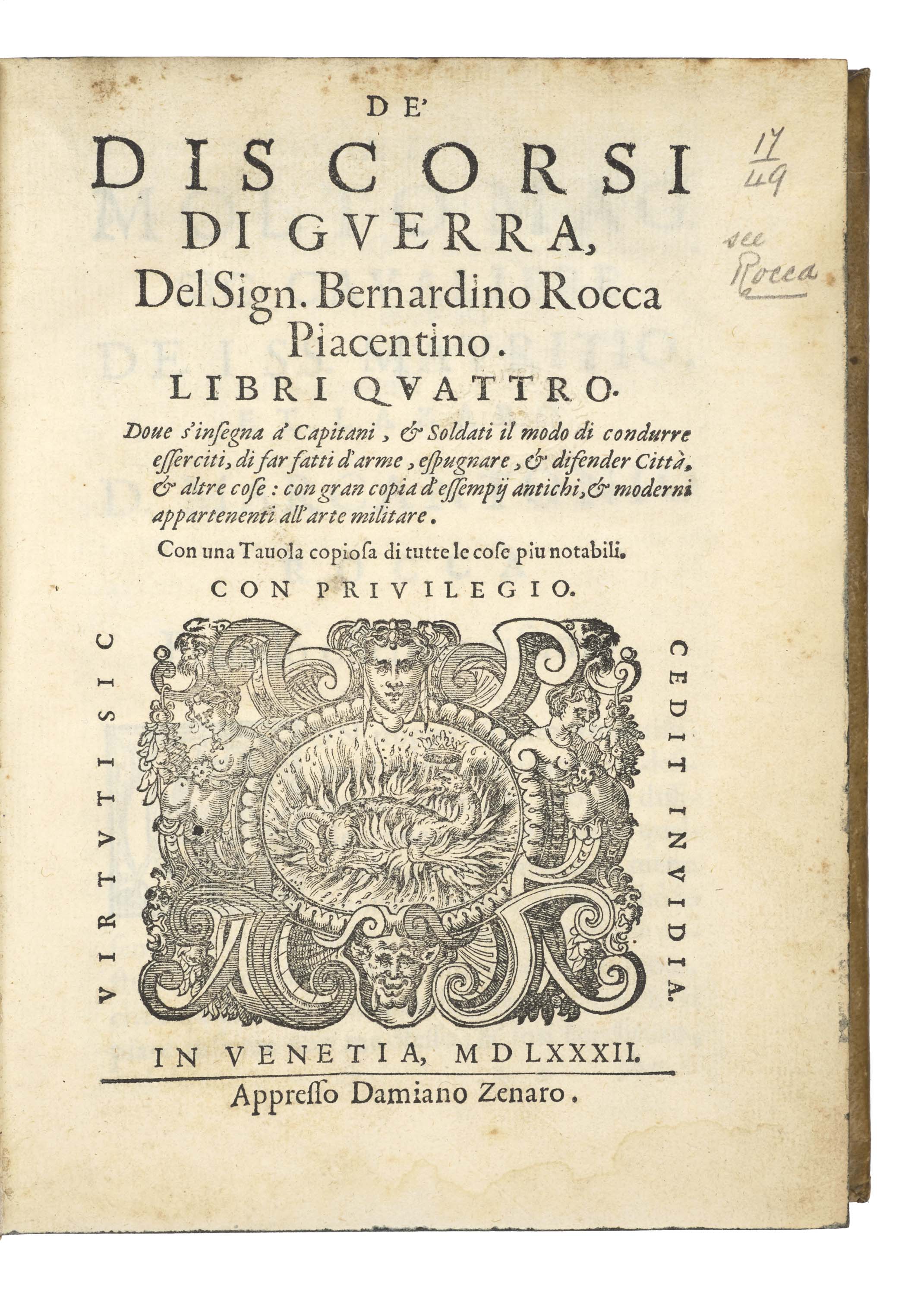
De’ discorsi di guerra … libri Quattro, dove s’insegna a’ capitani, et soldati il modo di condurre esserciti, di far fatti d’arme, espugnare, et difender città, et altre cose… Venice, Damiano Zenaro, 1582.
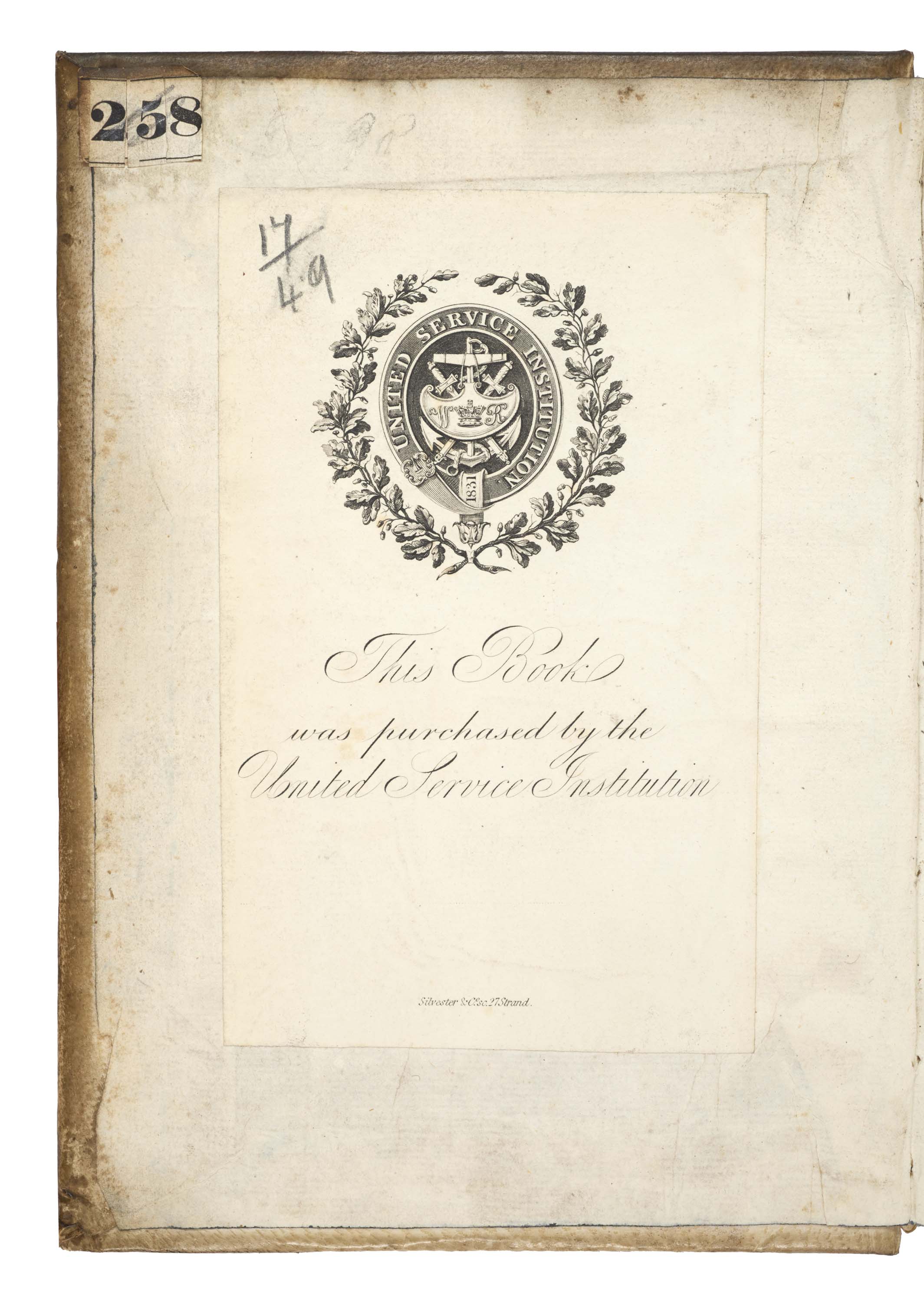
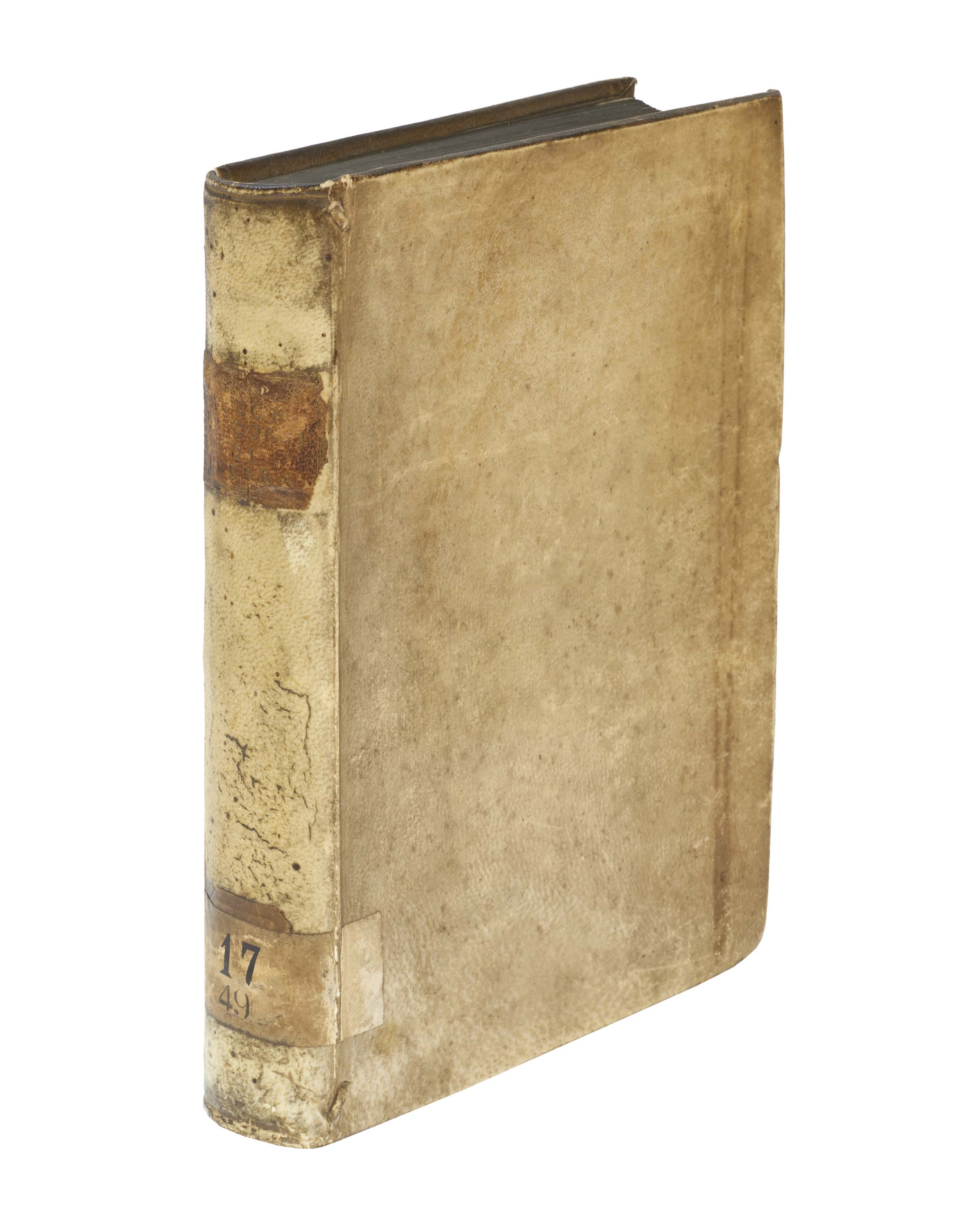
4to, ff. [16], 268; large woodcut device to title and woodcut initials throughout; a very good, clean copy; bound in eighteenth-century Italian vellum over boards, gilt red morocco label to spine, edges stained blue; slightly soiled, printed shelfmark labels to spine, from the library of the United Service Institution, with pre-1860 engraved bookplate to front pastedown and later blind stamp to title (as ‘Royal United Service Institution’, see below).
Added to your basket:
De’ discorsi di guerra … libri Quattro, dove s’insegna a’ capitani, et soldati il modo di condurre esserciti, di far fatti d’arme, espugnare, et difender città, et altre cose…
First edition of Rocca’s military treatise, from the library of the world’s oldest defence and security think tank.
Born into a noble family from Piacenza, Bernardino Rocca (c. 1515–1587) trained as an armourer and served under Emanuele Filiberto, Duke of Savoy at the battle of St Quentin in 1557. His Discorsi di Guerra, dedicated to Emanuele Filiberto’s son Carlo Emanuele, consists of practical military and strategic precepts in Latin (printed in roman letter), many drawn from the Classics, each followed by a fuller explanation and commentary by Rocca in Italian (printed in italic).
Aside from instructions on how to be a good military leader, how to form, fit out, and manage an army, and offensive and defensive strategy, Rocca recommends the use of deceits and ruses de guerre to avoid larger conflict and subdue the enemy: ‘The use of fraud in warfare had been fully justified by Christian theorists; and the requisite techniques could be found partly in the Scriptures and, more comprehensively, in the work of classical authors … A Renaissance military specialist such as Bernardino Rocca was simply following a well-trodden path when he … argued not only that men had overcome brute beasts by the use of art, cunning, and reason, but also that it was licit to employ these faculties against other men. He concedes that human beings are not naturally evil, but fears that sensuality may overcome the very intellect which has properly earned man the rule of the universe. Thus, because man is diverted from the true course of reason and falls prey to evil behaviour, Rocca cannot see “by what route one may worthily achieve one’s end than by that of fraud and deceits”. And, he continues, although “fraud and deceit may be against justice and Christian humanity: nevertheless, to use them against the enemy is not something for which one must render account at the tribunal of worldly justice nor at the court of honour”’ (Anglo, Machiavelli – The First Century. Studies in Enthusiasm, Hostility, and Irrelevance (2005), pp. 535–6).
The Royal United Services Institute (once also known as the Royal United Services Institute for Defence and Security Studies), is a body founded by the Duke of Wellington in 1831 for the study of military science, making it the oldest such institute in the world.
EDIT16 CNCE 39495; USTC 852786; Adams R 634; Argegni, III, p. 48; Cockle 550 (mentions a 1573 Bologna edition, though no other trace of it could be found); Sticca, p. 101.