Masquerade Satire
[SATIRE.]
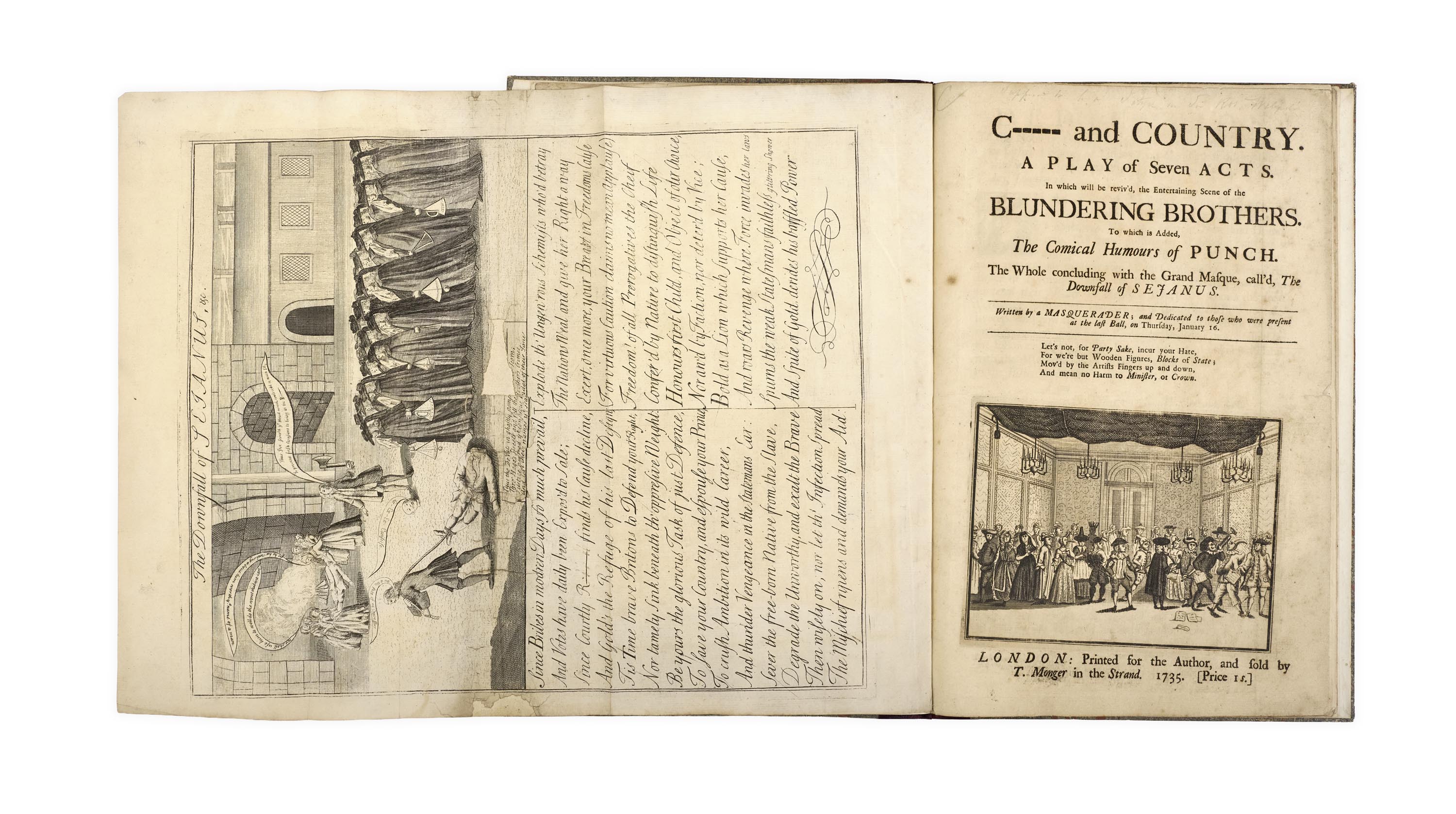
C----- and Country. A Play of seven Acts. In which will be reviv’d, the entertaining Scene of the blundering Brothers. To which is added, the comical Humours of Punch. The whole concluding with the grand Masque, call’d, the Downfall of Sejanus. Written by a Masquerader, and dedicated to those who were present at the last Ball, on Thursday, January 16 … London, Printed for the Author, and sold by T. Monger, 1735.
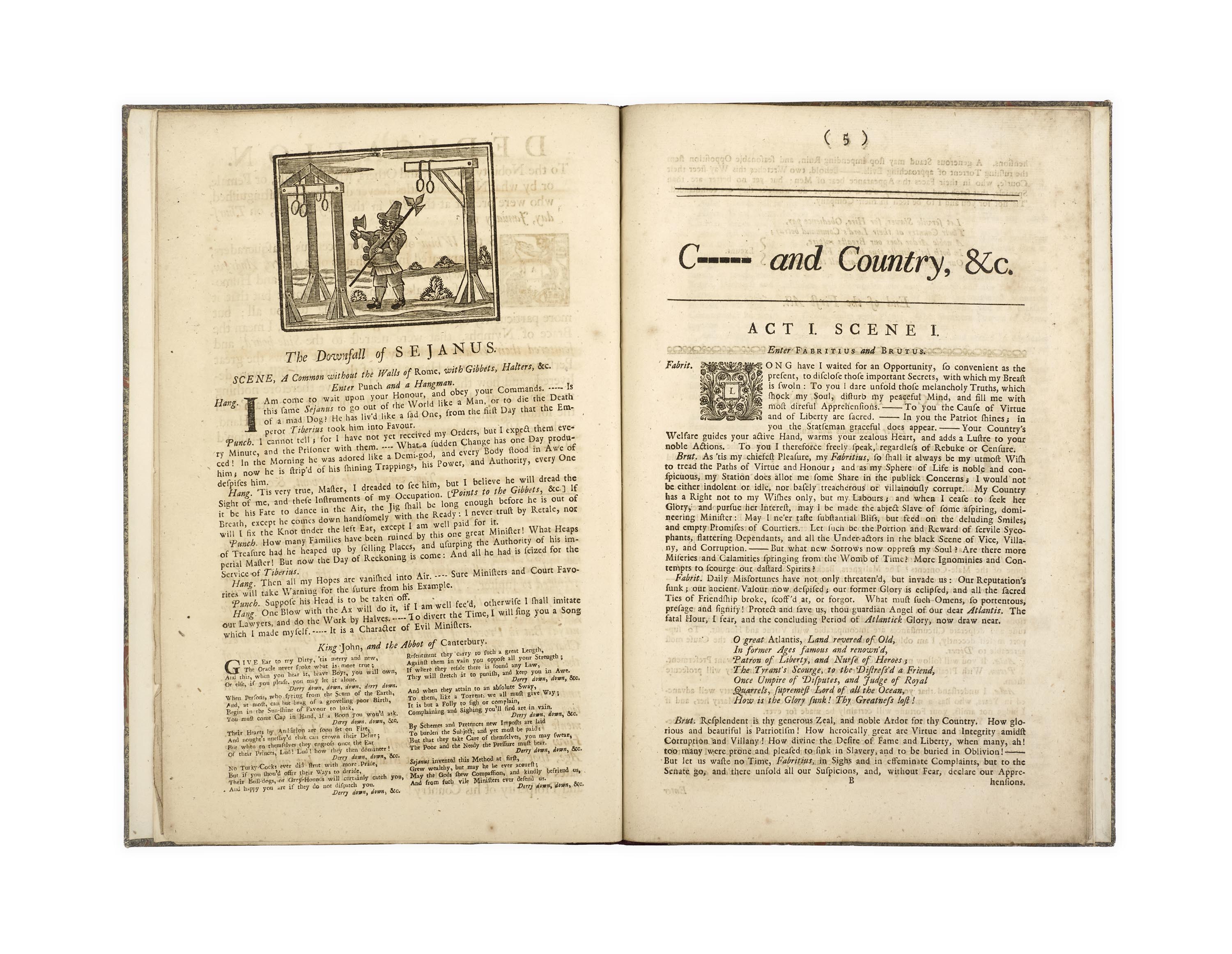
Folio, pp. 14, with a large, folding engraved frontispiece (often wanting, entitled ‘The Fall of Sejanus’, with an illustration above and engraved verse below), an engraved illustration of a masquerade on the title-page, a woodcut illustration of an executioner and gibbets on p. 4, and woodcut initials (one of which also satirical); neat old repairs to tears in frontispiece where once folded (with small loss), else a good copy; in nineteenth-century quarter roan, marbled paper sides.
Added to your basket:
C----- and Country. A Play of seven Acts. In which will be reviv’d, the entertaining Scene of the blundering Brothers. To which is added, the comical Humours of Punch. The whole concluding with the grand Masque, call’d, the Downfall of Sejanus. Written by a Masquerader, and dedicated to those who were present at the last Ball, on Thursday, January 16 …
One of two similar editions of this scarce mock play satirising Robert and Horatio Walpole and the Excise Bill, capitalising on a famous political stunt at a masked ball in early 1735.
Opposition to the ministry of Robert Walpole reached a peak in 1733 with his attempts to pass the Excise Bill – London merchants and vested interests were incensed and lobbied hard, and a number of influential court figures such as Chesterfield were also against the measure. Walpole was burnt in effigy and an explosion of anti-Walpole and anti-Excise satire in print and pamphlet form followed throughout 1733 and during the elections of 1734, which Walpole narrowly won.
At a masquerade ball at the Haymarket attended by the King in January 1735 ‘there was an incident that has made a good deal of noise …’. Attendees dressed as Harlequin, Punchinello and other characters ‘came in … with bundles of printed play bills in their hands, one of which Harlequin gave the King, and then all throwing down their papers disappeared’ (Diary of Viscount Percival afterwards first Earl of Egmont) – this scene is depicted in the title-page vignette here. The playbills presented the opening of Parliament as a ‘comical and diverting play of seven acts calld Court and Country’ by ‘the Norfolk Company of artificiall Commedians’ with a ‘new sett of Puppets’, featuring also a ‘scene of the Blundering Brothers with the Cheats of Rabbi Robin’, and a masque of ‘the Downfall of Sejanus’ (quoted in McGeary, The Politics of Opera, 2013).
Whether by those responsible for the stunt or by others seeking to capitalise on it, the present satire claims to present the work mentioned in the playbills: a dramatic skit in seven acts, showing the downfall of the senator Dives at the hands of the patriotic Brutus. Dives is evidently Walpole but the Dedication pretends he is ‘a Picture of Prince Menzicoff’ i.e. the infamously corrupt Russian politician Aleksandr Menshikov (1673–1729). The ‘blundering brothers’, ‘Rabi Blunder’ and ‘Saphick’, also the Walpoles, appear in Act V, which is in verse. The masque of Sejanus is a short dialogue between Punch and a Hangman, proposing Sejanus’ execution. From Ben Jonson onwards, the Roman usurper Sejanus had been used in Britian as a model for an illegitimate tyrant who receives his just deserts.
The extremely graphic frontispiece, often wanting and evidently available separately, shows the decapitation and burning of two figures in the name of ‘Freedom! of all Prerogatives the Cheif [sic]’, mourned by a crowd of weeping excisemen. The victims are ostensibly the De Witt brothers, the Dutch statesmen who had been brutally executed at the Hague in 1672, but they are stand-ins for the Walpoles.
The two editions of the work are largely from the same setting of type, this one with ‘The Downfall of Sejanus’ before rather than after ‘Court and Country’. Of this printing ESTC lists two copies in the UK only, both at the Bodleian (at least one without the frontispiece); and seven in the US.
ESTC N39166.