
Presentation Copy of a Rare Utopia
SAY, Jean-Baptiste.
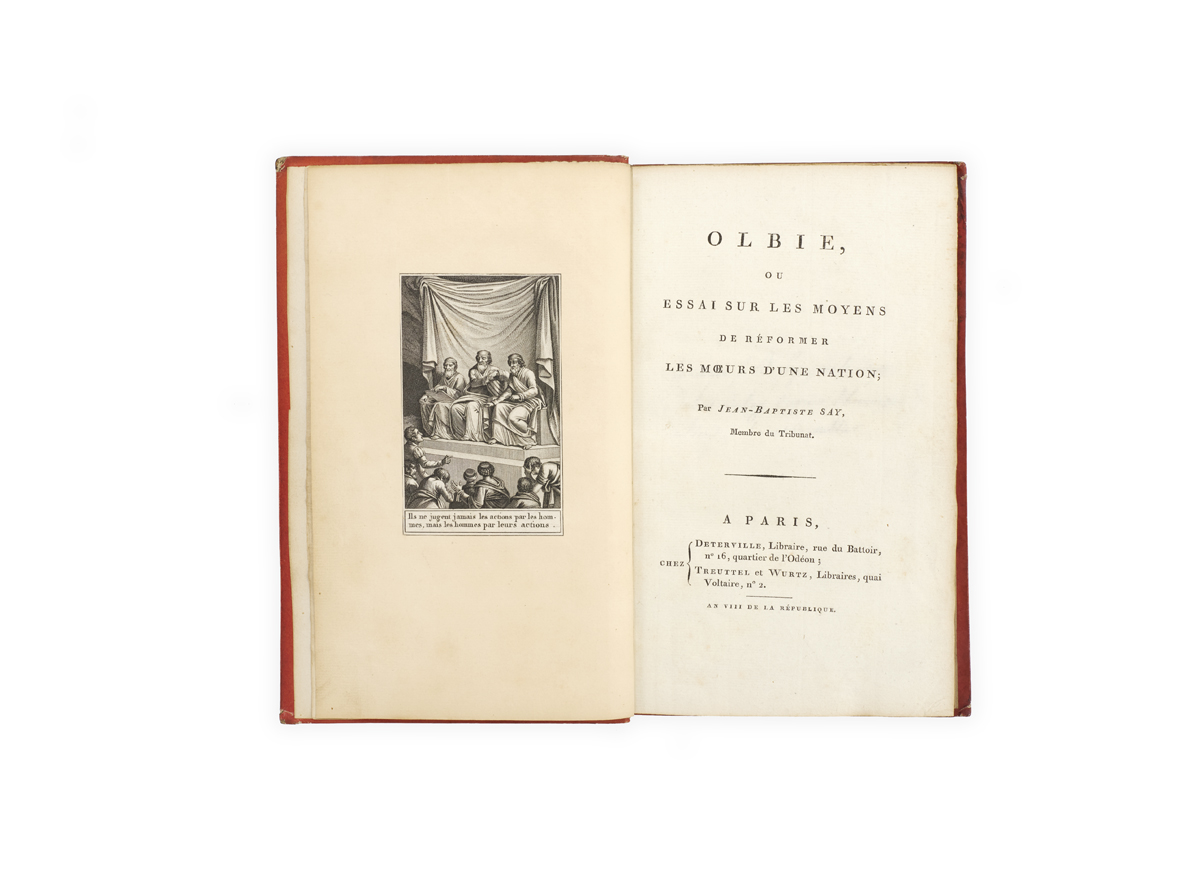
Olbie, ou Essai sur les moyens de réformer les moeurs d’une nation. Paris, Deterville and Treuttel & Wurtz, ‘an VIII de la République’ [1799–1800].
[bound with:]
[ANON.] Principes politiques, par F. M. S***. Paris, Demonville for Magimel, Anselin, and Pochard, December 1818.
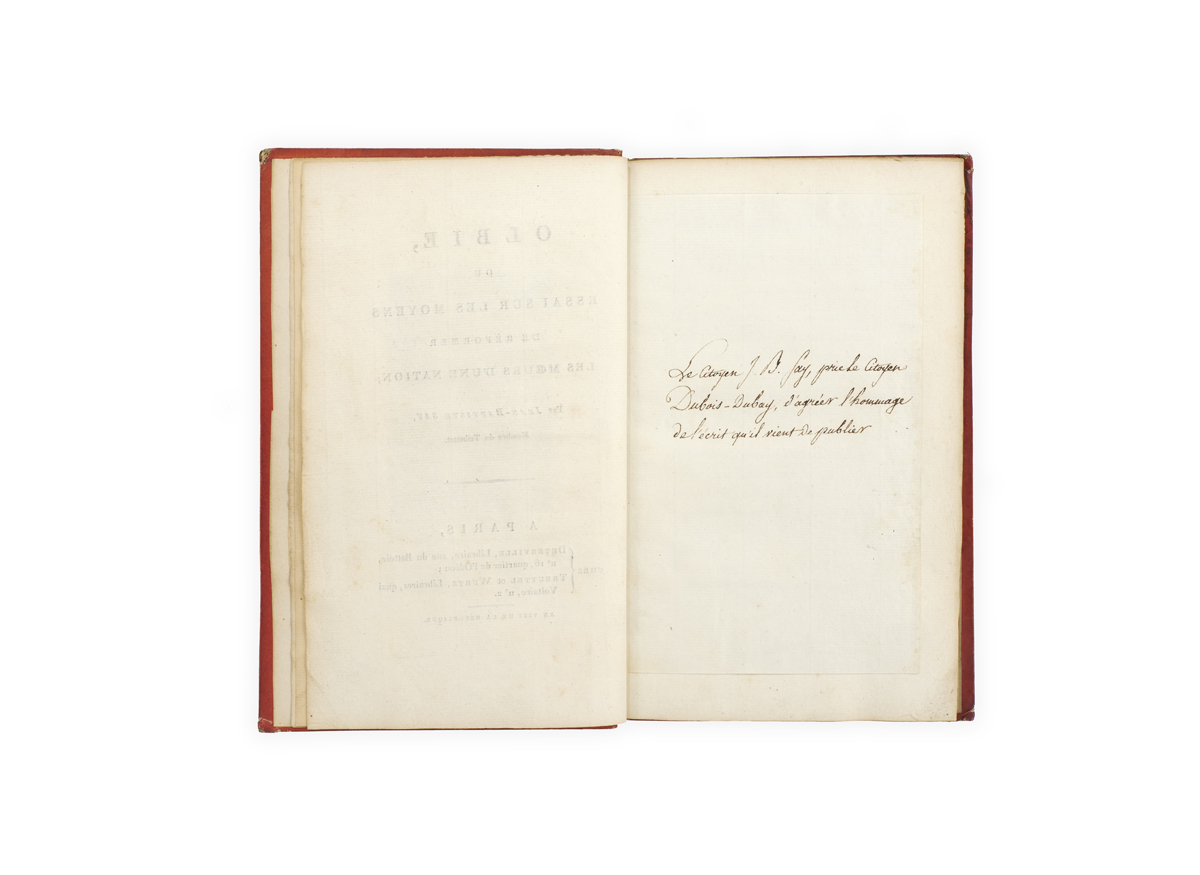
Two works in one vol., 8vo, pp. xi, [1], 132; [2 (blank)]; [2], 28; Olbie: with an extra leaf inserted after the half-title, bearing an engraved vignette showing a trial scene with a caption; fine copies, clean and crisp, uncut in the original orange boards, flat spine filleted in gilt with a contrasting gilt lettering-piece; some loss to orange paper at upper joint and foot of spine, label slightly chipped, some rubbing to covers and extremities; authorial dedication inscription to Mr Dubois Du Bais tipped in after first title-page (see below), later inscription by one of Dubois Du Bais’s descendants in red ink to front free endpaper.
Added to your basket:
Olbie, ou Essai sur les moyens de réformer les moeurs d’une nation.
Rare first edition of Say’s utopia, our copy presented to a politician from Calvados, written in response to a competition organised by the Académie des Sciences Morales et Politiques on the question: ‘Which institutions are capable of establishing morality among a people?’. Say treats the question from an economic viewpoint, and this work can, in some ways, be seen as a preface to his Traité d’économie politique of 1803.
With Olbie, ‘Say built a new order from the ruins of absolute monarchy, an order based on reason : “Thus the first book of morality was, for the Olbians, a good treatise on political economy. ” In Olbie, women had jobs suited to their abilities, while workers had pensions. Finally, idleness was stigmatised, as was vice : “It costs more to feed a vice than it does to raise two children …”’ (Versins, Encyclopédie de l’utopie et de la science fiction, p. 798, trans.).
The work bound after Say’s is an exceedingly rare item, of which one copy only is recorded in OCLC (BnF): a work of political philosophy which places the notion of force/strength at the centre of its examination of governments. The unidentified author sees the dynamics between government and oppositions in terms of physics: if the two opposing forces are equal, inertia is the result. This inertia is what blights many European governments, he claims. Public opinion is the resulting figure of the sum of individual minds. Any governing body ought to – first and foremost – count its heads. The author goes on advising states on how to deal with public opposition to taxation when seen as too high. His definition of a working and modern state, which he sees as a democracy, consists of ‘citizens all equal before the law; a monarch or head who is elected and temporary; a chamber of representatives re-nominated at regular intervals’ (pp. 18–19, trans.).
Provenance:
Tipped-in dedication leaf inscribed ‘Le citoyen J.B. Say, prie le citoyen Dubois-Dubay, d’agréer l’hommage de l’écrit qu’il vieut de publier’. The recipient of this copy, Louis-Thibault Dubois Du Bais (1743–1834), was a politician from Calvados. In 1799 he was elected as a member of the Sénat conservateur, remaining in post through to 1814.
Principes politiques: OCLC records only one copy, at the BnF.
Olbie: Einaudi 5117; INED 4109; Kress B.4266; Negley 1002; not in Goldsmiths’.