Reynard the Fox in Silesia
SCHOPPER, Hartmann, translator.
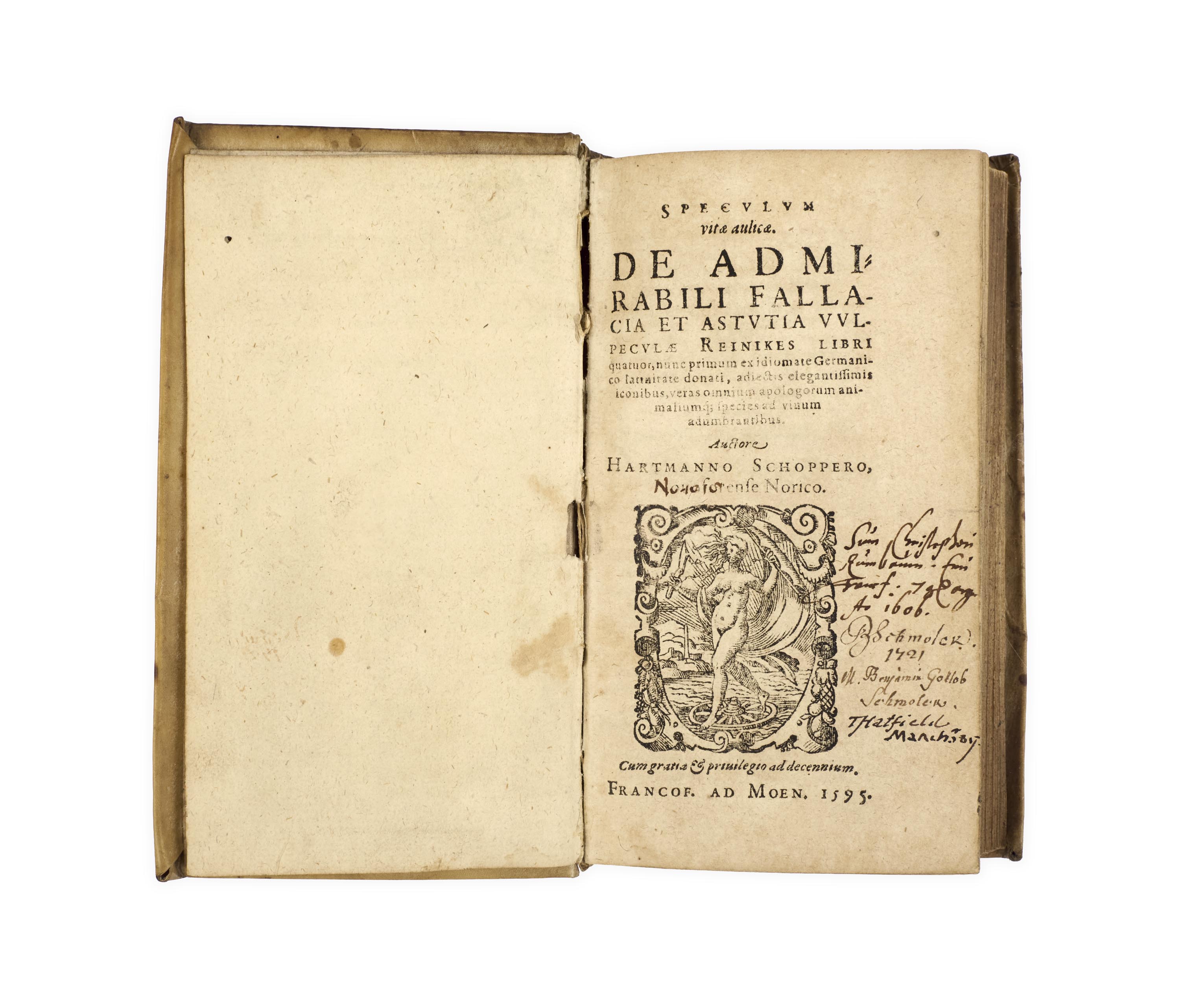
Speculum vitae aulicae. De admirabili fallacia et astutia vulpeculae Reinikes libri quatuor, nunc primum ex idiomate Germanico latinitate donati, adiectis elegantissimis iconibus, veras omnium apologorum animaliumq[ue] species ad vivum adumbrantibus. Frankfurt, [(colophon:) Nikolaus Basse], 1595.
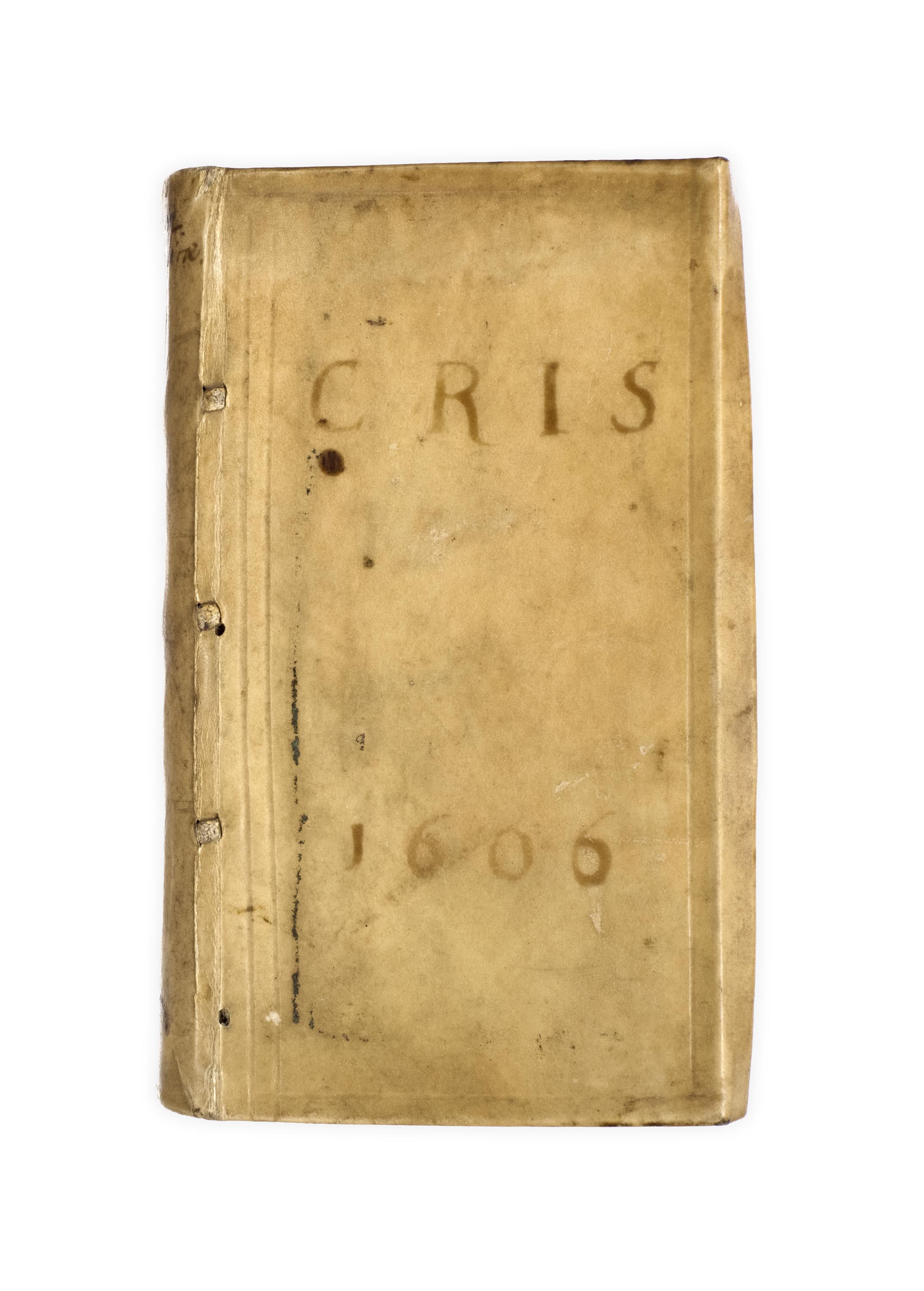
12mo, pp. [xx], 465, [17], [2, blank]; woodcut device to title-page, 57 woodcut illustrations (several signed ‘A’ or ‘IA’, that on p. 20 upside-down); very lightly toned with the occasional spot, nonetheless a very good copy; bound in contemporary vellum, yapp fore-edges, manuscript lettering to spine; acquisition inscription to title ‘Sum Christophori | Rumbaum. Emi | Francf. 7 […] arg. | Ao 1606’ and front cover lettered ‘CRIS | 1606’ in manuscript (see below), subsequent ownership inscriptions to ‘B Schmolck | 1721’, ‘M. Benjamin Gotlob | Schmolck’, and ‘THatfield | Manchr 1817’ to title, bookplate of Allan Heywood Bright to front pastedown, eighteenth-century bibliographical notes by Schmolck to front free endpaper.
Added to your basket:
Speculum vitae aulicae. De admirabili fallacia et astutia vulpeculae Reinikes libri quatuor, nunc primum ex idiomate Germanico latinitate donati, adiectis elegantissimis iconibus, veras omnium apologorum animaliumq[ue] species ad vivum adumbrantibus.
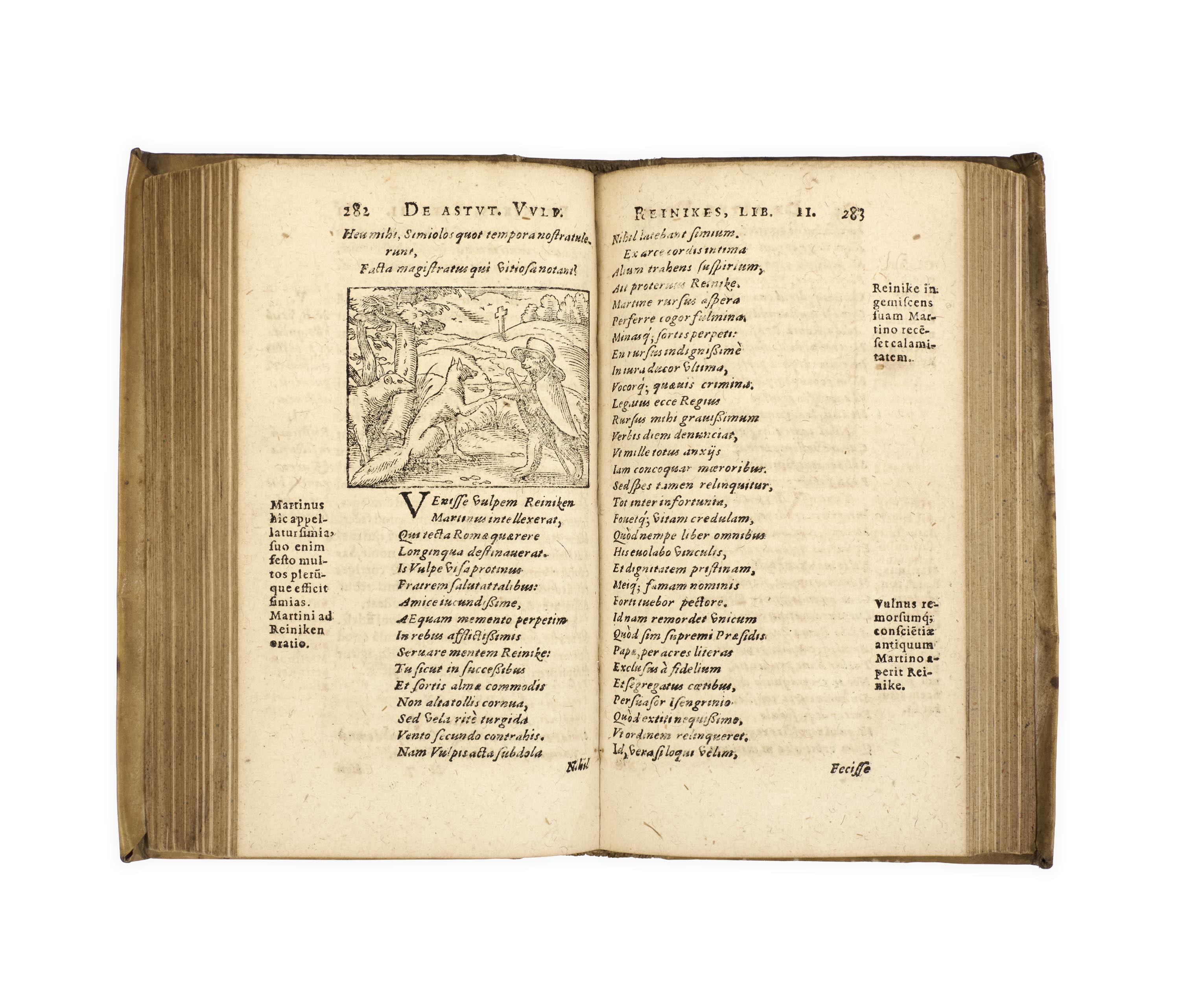
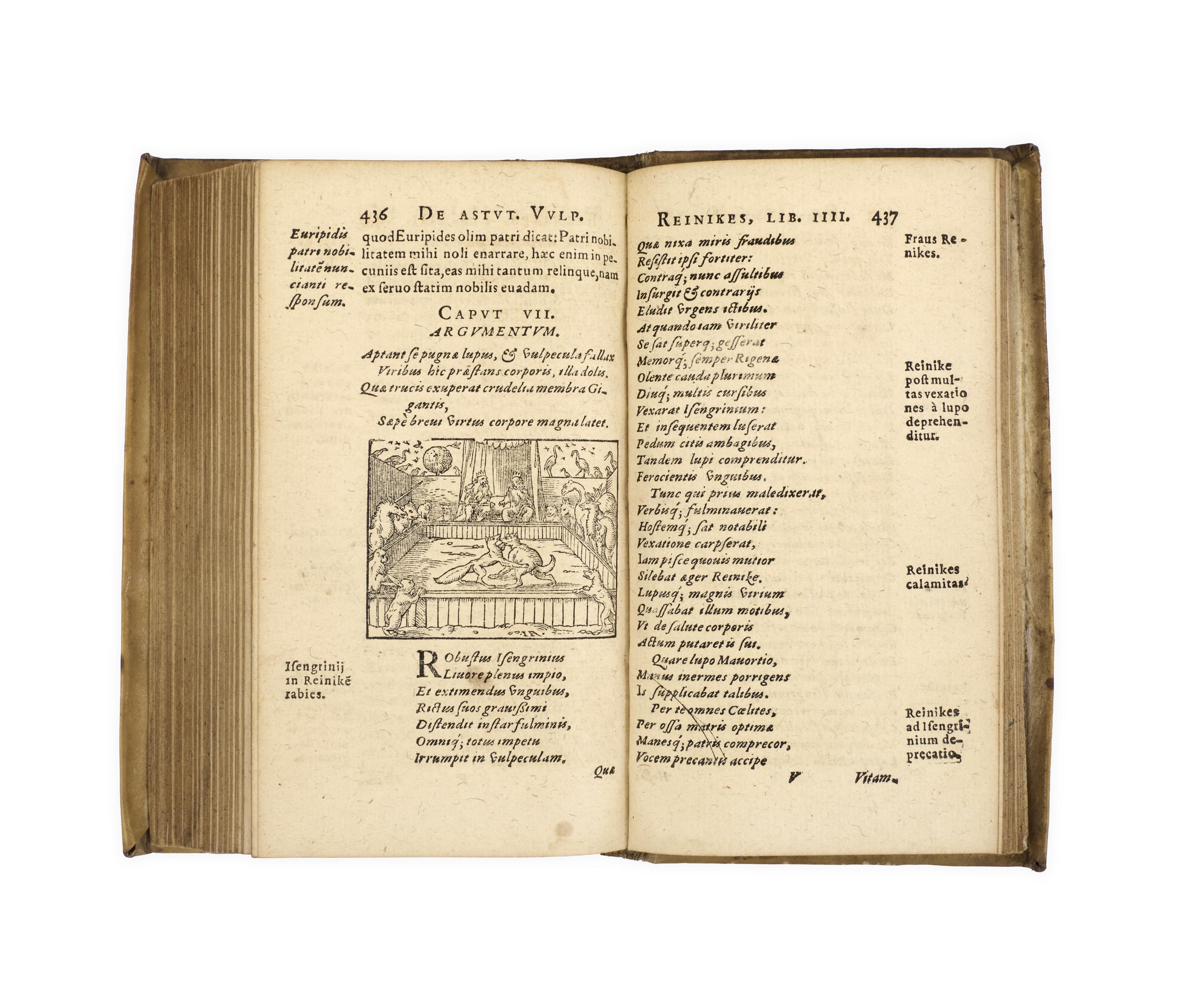
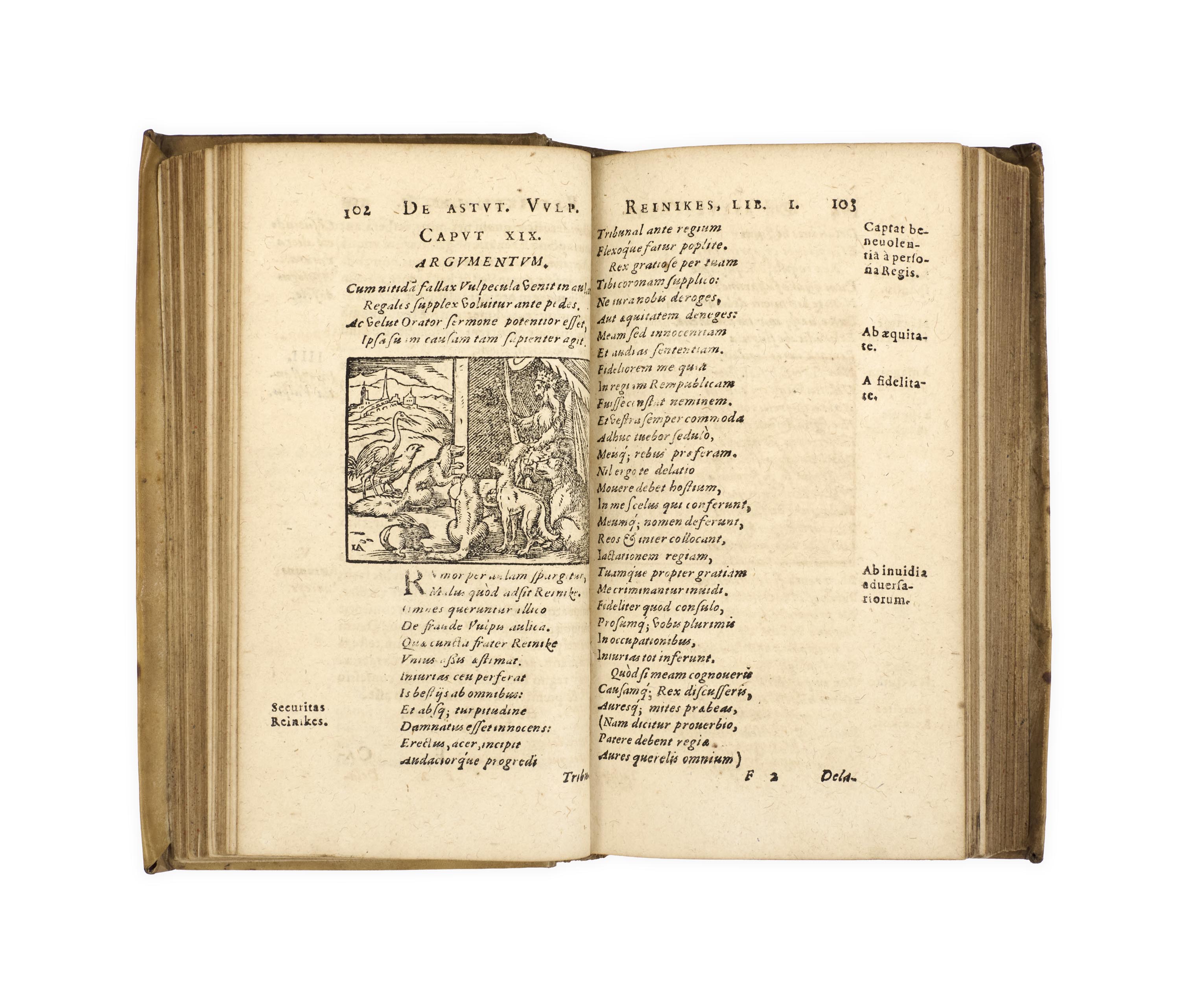
Fifth and final edition of the first Latin translation of the adventures of the trickster fox Reynard (or Reineke), translated from the German and illustrated with fifty-seven woodcuts by Jost Amman and Virgil Solis.
First printed in 1567, Schopper’s (1542–after 1595) translation is based on the anonymous High German version of 1544, itself adapted from the medieval Low German folk epic first published at Lübeck in 1498 as Reynke de vos. The story of Reynard – incorporating a clever folk hero who outwits his enemies, and a misinformed king (a lion) who is tricked by the conniving fox – proved immensely popular for centuries, praised by Martin Luther during his lifetime as a mirror of society, and later adapted by Goethe.
Amman’s rather violent woodcuts depict a cat beaten by a band of women, an attempted drowning in a well, Reynard devouring his prey, and bears armed with swords. Schopper’s Reynard coolly slays enemies and innocents alike in an atmosphere filled with ‘beastly Landsknechts wielding mysterious weapons and swearing oaths of military glory’, elements likely drawn from the translator’s own life (Schouwink, p. 185). Expelled from both Heidelberg and Freiburg, Schopper fought for Maximilian II (to whom this work is dedicated) against the Turks in 1565, the year he commenced his translation. After experiencing abject poverty and a near-fatal fever in Vienna, he was taken in by Johann Cuipius, who encouraged him to complete the translation upon his return to Frankfurt.
Provenance:
1. The inscription ‘Sum Christophori Rumbaum’ and the initials ‘CRIS’ to the front cover likely point to the Silesian physician Christoph Rumbaum (1555–1605), from Jauer (now Jawor) near Breslau (Wrocław), who published medical works as ‘Christophorus Rumbaum jauranus silesius’. It may, however, be a son or relative, as the inscription is dated ‘1606’; the book was, in any case, later in the neighbouring town of Schweidnitz (Świdnica).
2. Benjamin Schmolck (1672–1737) was a Lutheran theologian and hymn writer in Schweidnitz (Świdnica), and his son M. Benjamin Gottlob Schmolck (1708–1758) a deacon in the same town.
3. T. Hatfield of Manchester.
4. Allan Heywood Bright (1862–1941), Liberal politician and bibliophile.
VD16 R 1016; USTC 694321. See Schouwink, ‘Hartmann Schopper’s Latin Reinike of 1567’ in Reynard the Fox (2000).