The Fourth Folio in Black Morocco
SHAKESPEARE, William.
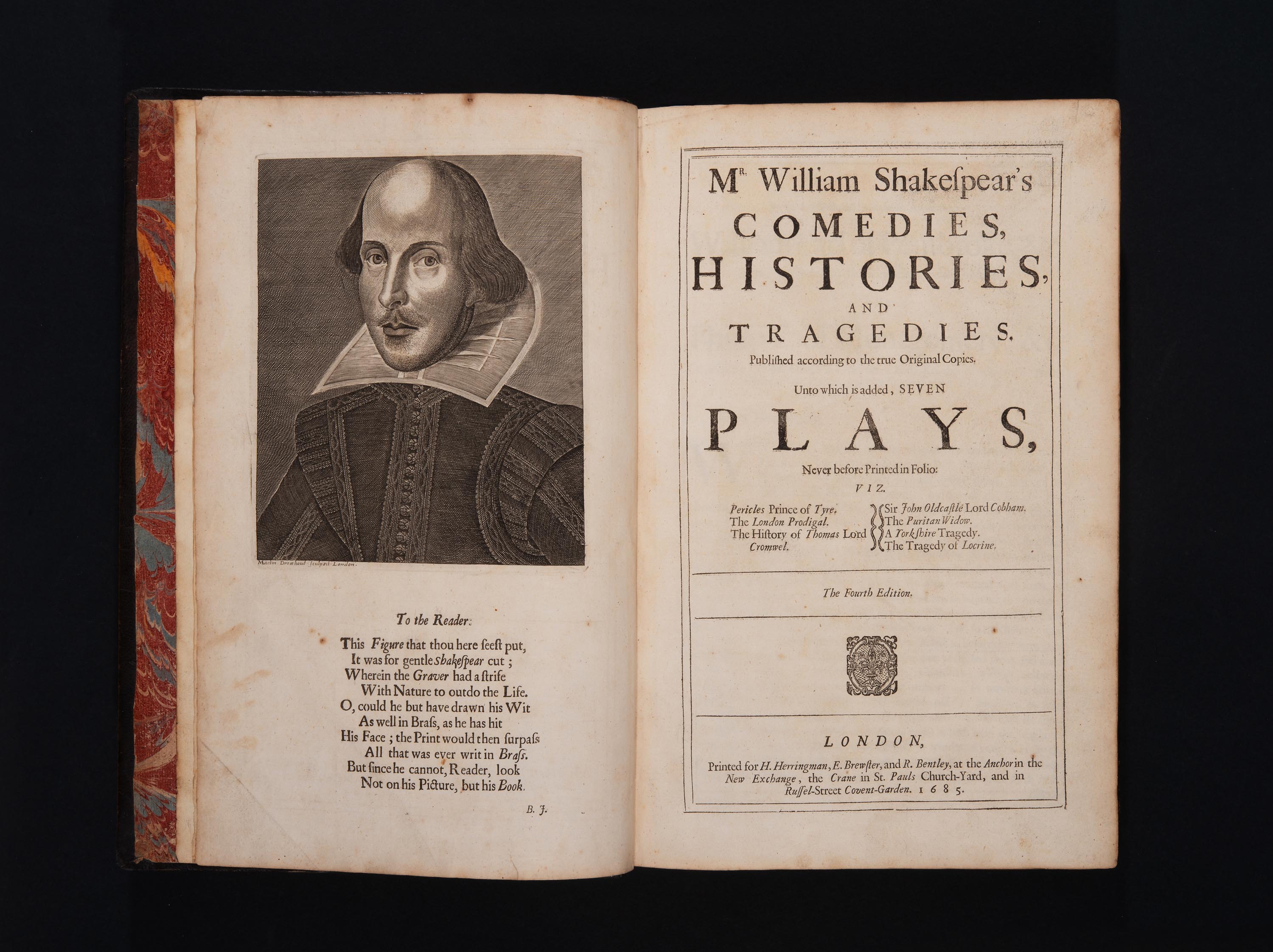
Mr. William Shakespear’s Comedies, Histories, and Tragedies. Published according to the true Original Copies. Unto which is added, seven Playes, never before Printed in Folio … The fourth Edition … London, H. Herringman, E. Brewster, and R. Bentley, 1685.
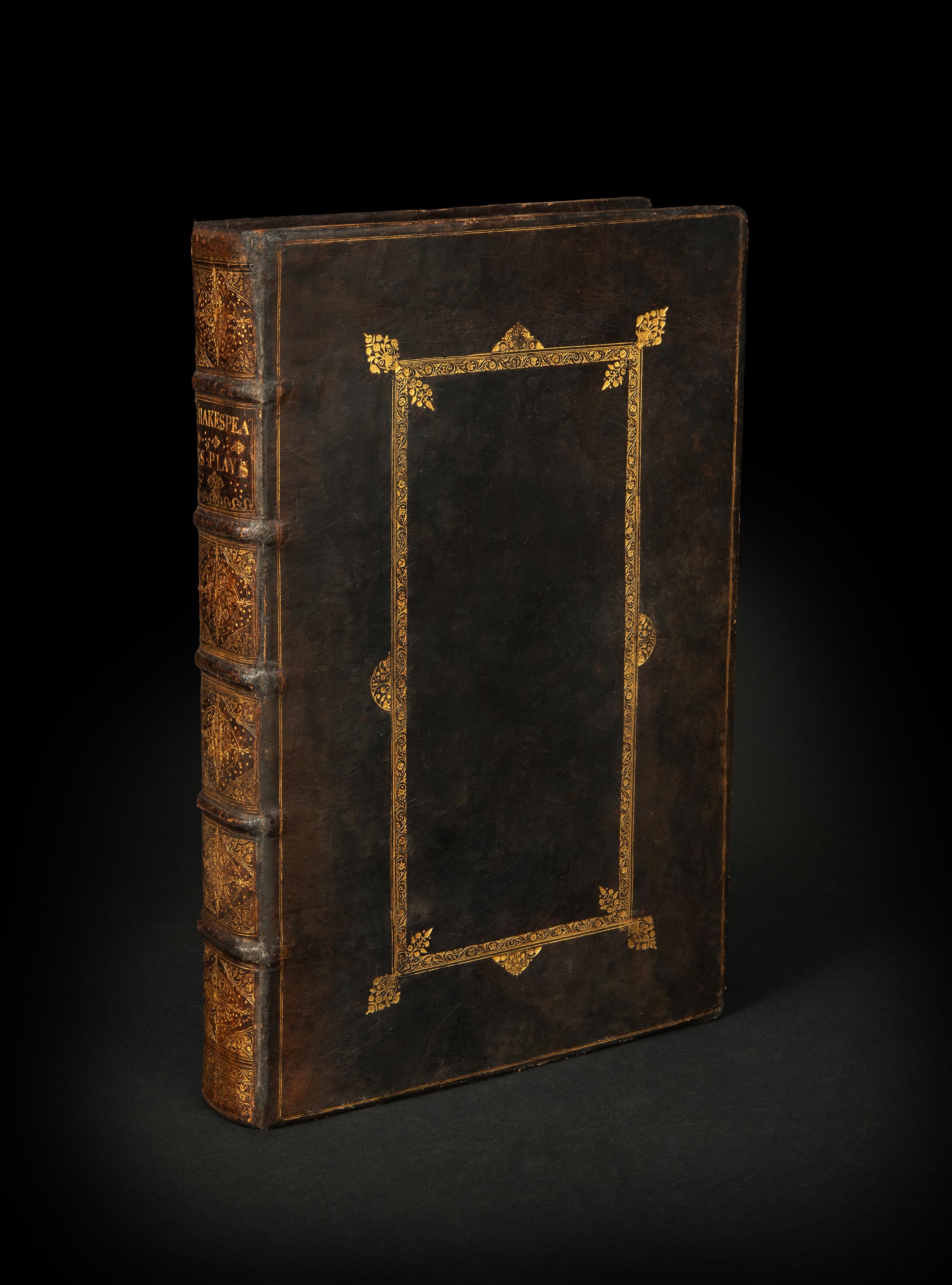
Folio, pp. [x], 272, [1], 303, [1], with the frontispiece portrait by Droeshout, slightly retouched for this edition, with Jonson’s verses below; wood-engraved initials; twelve conjugate bifolia are in the early reprint as per Greg (see below); a few small holes and paper flaws, the odd bifolium somewhat foxed, but withal a fine, crisp copy, in a handsome late seventeenth- or early eighteenth-century binding of black morocco, covers with a gilt panel of three fillets and a foliate roll, corner pieces with a vase of flowers, foliate semi-circles and triangles at the centre of each side of the panel, spine elaborately gilt in six compartments, lettered directly in the second ‘Shakespea / re’s Plays’, with a line of canted Ss below, the other compartments with a large foliate lozenge and corner pieces, on a field of dots; marbled endpapers, gilt edges; joints neatly repaired, covers refurbished; traces of bookplate removed from front endpaper.
Added to your basket:
Mr. William Shakespear’s Comedies, Histories, and Tragedies. Published according to the true Original Copies. Unto which is added, seven Playes, never before Printed in Folio … The fourth Edition …
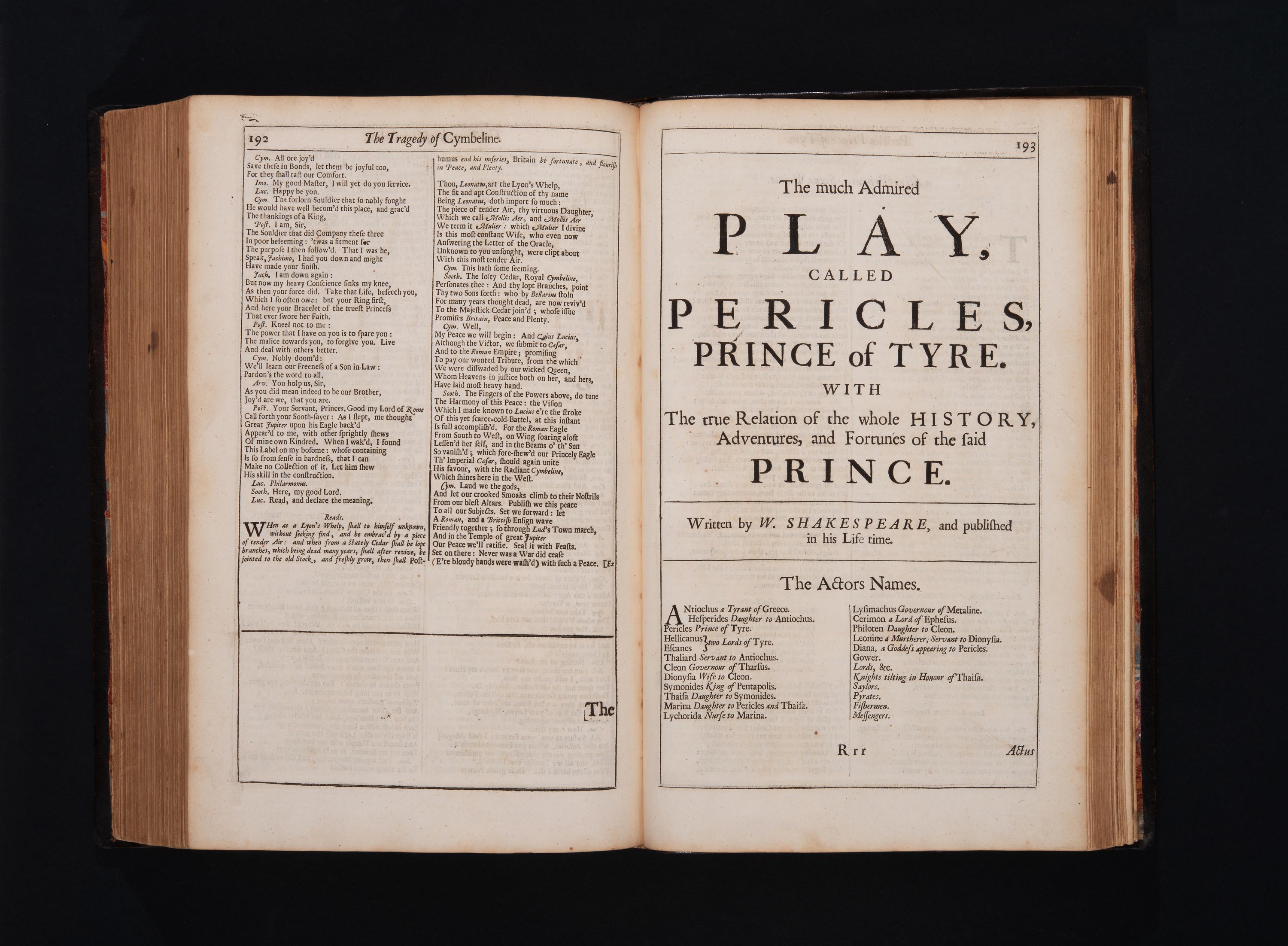
An exceptional copy of Shakespeare’s Fourth Folio. Despite the statement ‘never before Printed in Folio’, the seven new plays (of which Pericles is the only one still commonly attributed to Shakespeare) had earlier appeared in the second issue of the Third Folio in 1664, but this edition, the last in so grand a format and the last in Shakespeare’s own century, was the principal textual basis of eighteenth-century recensions from Rowe, Theobald and Pope to Hanmer and Johnson.
One of the endemic faults of the Fourth Folio is the thin paper which is susceptible to tears and browning. Our copy, although not without blemish, is in a more than acceptable condition. Three variants of the imprint are recorded, this one, another adding Richard Chiswell to the list of names (no precedence established between these two), and the third a cancel, and therefore later, ‘for H. Herringman, and are to be sold by Joseph Knight and Francis Saunders’.
A number of sheets in this edition ‘appear to have been printed short, or else some accident happened to the stock. When, as the supply became depleted, the discrepancy was discovered, the deficient sheets were reprinted. These sheets are readily distinguished from the originals by the absence of rules at the sides and foot of the text’ (Greg). Here twelve (of up to seventeen) bifolia are in these later reprints (2B3.4, 2D3.4, 2G3.4, 2I2.5, 2I3.4, 2M1.6, 2N1.6, 2N2.5, 2O3.4, *3B2.5, *3C2.5, and *3C3.4).
This is one of the finest copies remaining in private hands and one of very few examples in such a handsome early binding.
ESTC R25621; Wing S2915; Pforzfheimer 910.