A Jacobite's Suppressed 'Dying Speech'
[SHEPHEARD, James.]
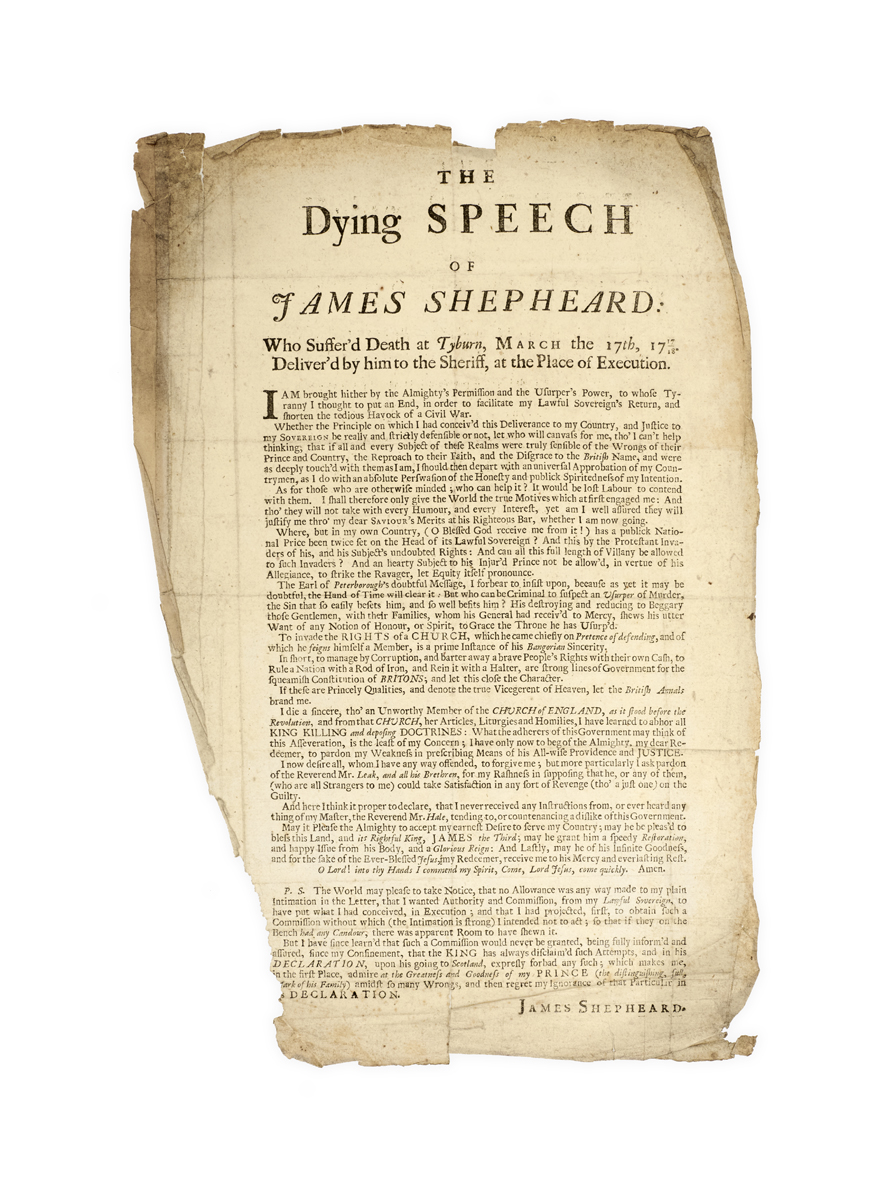
The Dying Speech of James Shepheard: who suffer’d Death at Tyburn, March the 17th, 1717/18. Deliver’d by him to the Sheriff, at the Place of Execution. [London, s.n., 1718.]
Folio broadside; worn and creased at edges, lower corner torn away touching two words at the foot (sense recoverable).
Added to your basket:
The Dying Speech of James Shepheard: who suffer’d Death at Tyburn, March the 17th, 1717/18. Deliver’d by him to the Sheriff, at the Place of Execution.
One of at least five printings of this ‘speech’ allegedly written by the eighteen-year-old Jacobite apprentice coach-painter James Shepheard – hanged at Tyburn for planning the assassination of George I – and illegally circulated at his execution and after his death.
Some printings add a hymn, and the speech’s inflammatory content makes it very unlikely that it was in fact delivered. Not to be confused with his highwayman namesake and contemporary, the present James Shepheard, having been influenced by certain pamphlets published during the 1715 rebellion and being a ‘great frequenter of Jacobite conventicles’, planned the assassination of George I to coincide with an invasion by the exiled Old Pretender. Shepheard revealed his intentions to a nonjuring minister, but said clergyman brought him to the authorities, where he willingly (or naively) embraced martyrdom by repeating his plans.
Jacobites carefully stage-managed the affair for maximum impact – a nonjuring priest gave Shepheard absolution on the scaffold, and ‘a dying speech purported to have been written by him was passed around at his execution scene but the government forbad its publication’. In spite of this, they ‘managed to circulate broadside copies of it throughout London’ (Schonhorn, p. 449). Defoe penned a number of pro-Government works on the matter, including Some Reasons why it could not be expected the Government wou’d permit the Speech or Paper of James Shepheard to be printed.
ESTC (N498381) records Harvard only (cropped) of this printing.
See Schonhorn, Defoe and James Shepheard’s Assassination Plot of 1718’, in Studies in English Literature 1500–1900 29:3 (1989), pp. 447–462.