Against Western Astronomy
SHŌKOKU Dōjin 勝圀道人, pseud.
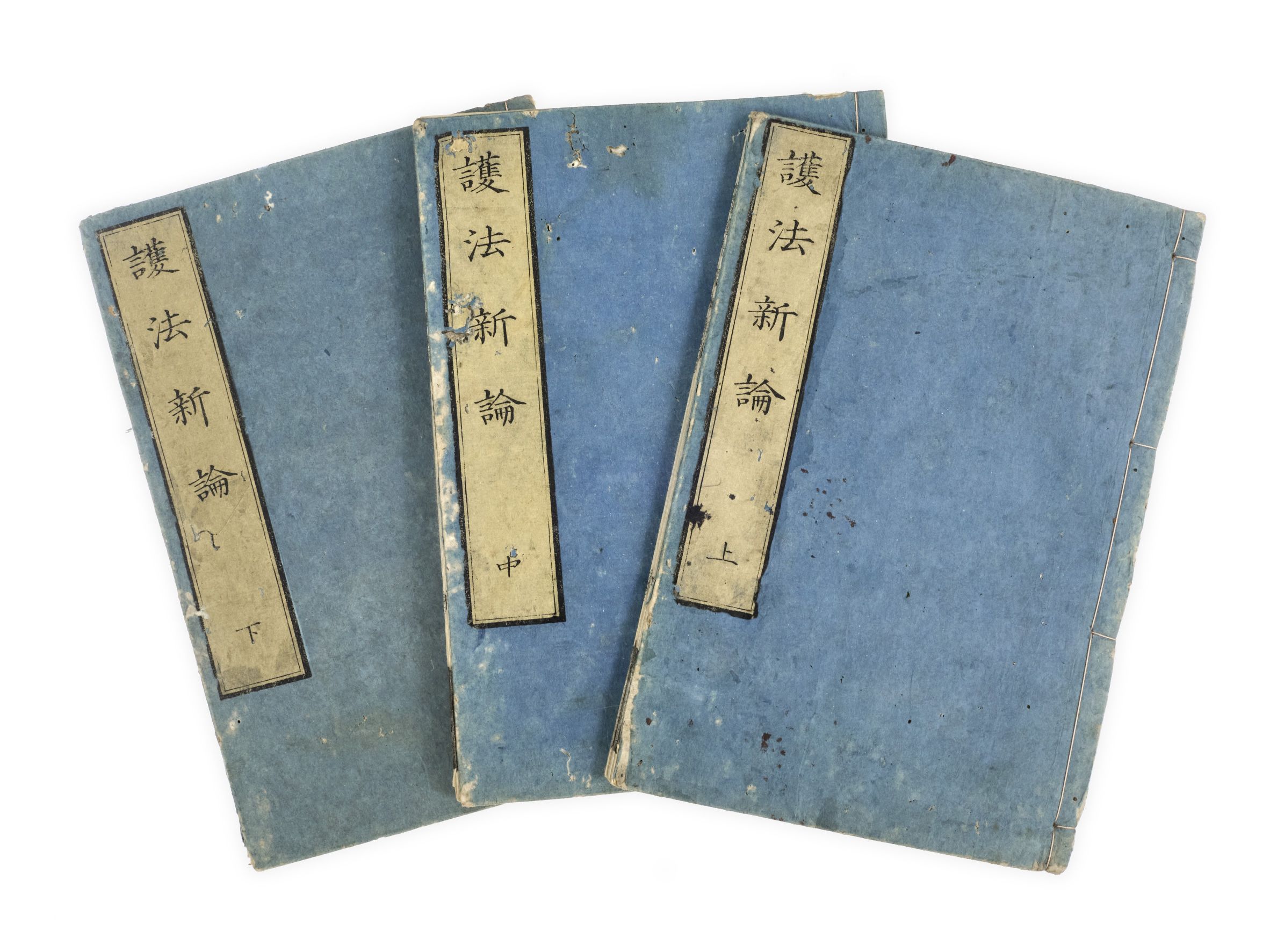
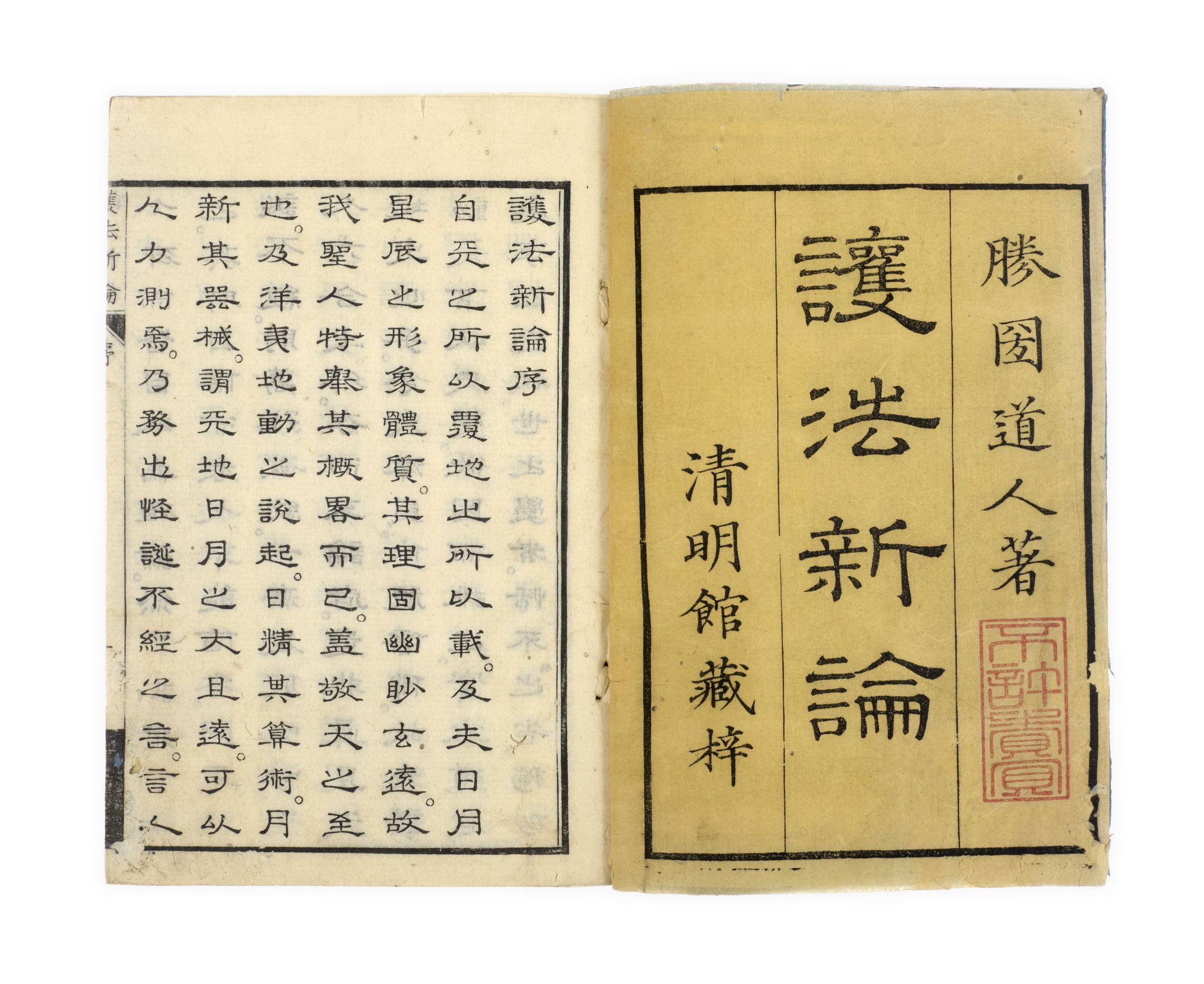
[KAMURO An’e 禿安慧]. 護法新論 [Gohō shinron; ‘A New Treatise in Defence of the Dharma’]. [Japan], Seimeikan, (colophon:) Keiō 3 [1867].
Three vols, 8vo, ff. I: [1], 2, 33, II: 37, III: 38, [1]; printed on double-leaves, woodcut illustrations in-text throughout; occasional worming affecting a handful of characters in a few cases, some repaired, sporadic light dampstains; else a very good set, stitched in the original blue paper wrappers, printed paper label to front cover of each volume; minor worming and wear to covers; tail-edges lettered with title in manuscript, red ownership seals to title of vol. I and final leaves of each volume.
Added to your basket:
[KAMURO An’e 禿安慧]. 護法新論 [Gohō shinron; ‘A New Treatise in Defence of the Dharma’].
First edition, very rare, of this illustrated attack on Western cosmology in favour of Buddhist astronomy published in pre-Meiji Japan.
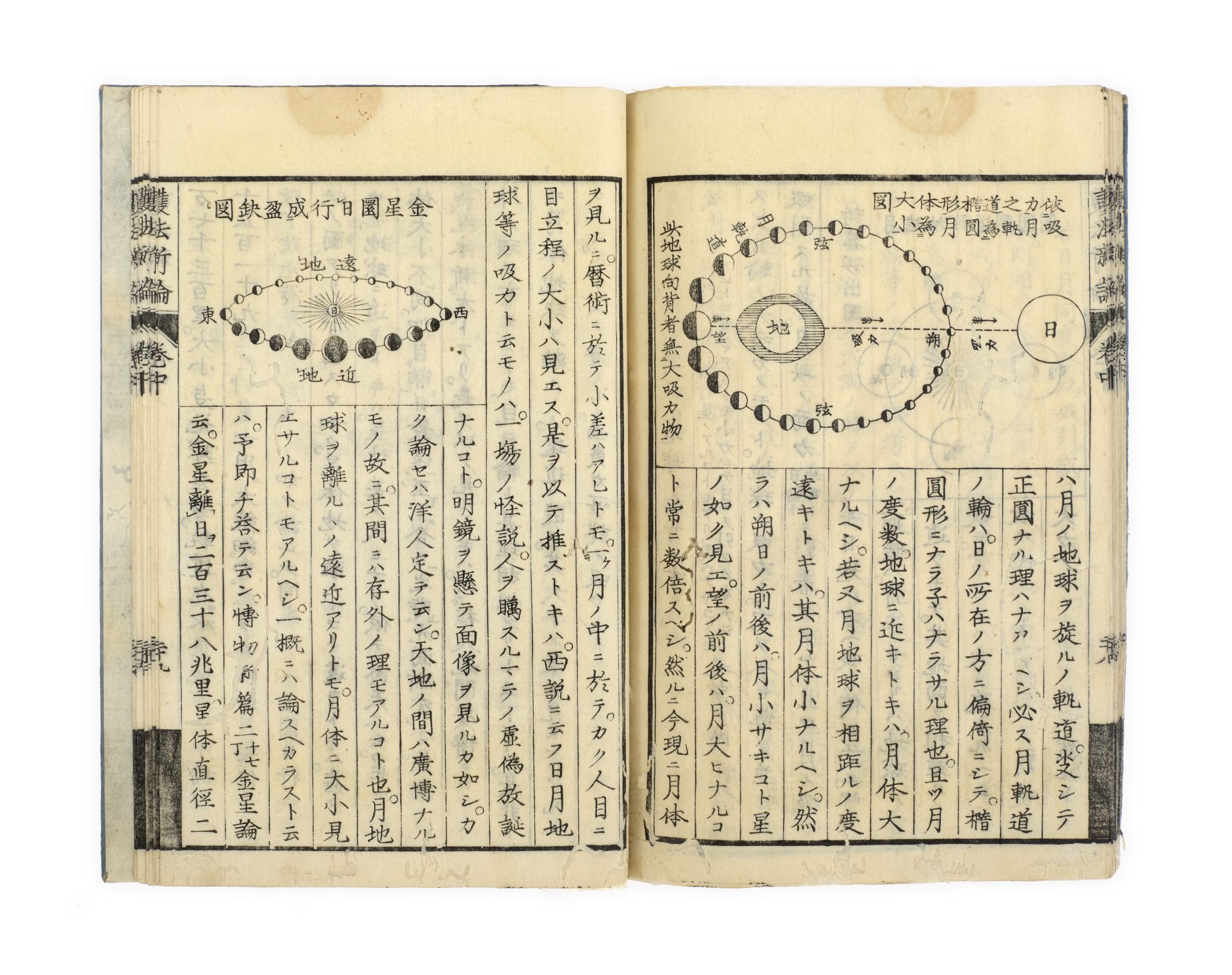
The author Kamuro (1819–1901) – a member of the bonreki school of Japanese Buddhist cosmology, writing here as Shōkoku Dōjin – begins his polemic by declaring that ‘the greatest threat in the world today to laws and to the Buddha’s teachings are the astronomical theories of the Western barbarians’ (trans.). His treatise aims to refute these theories and defend the traditional cosmological teachings of Buddhist India.
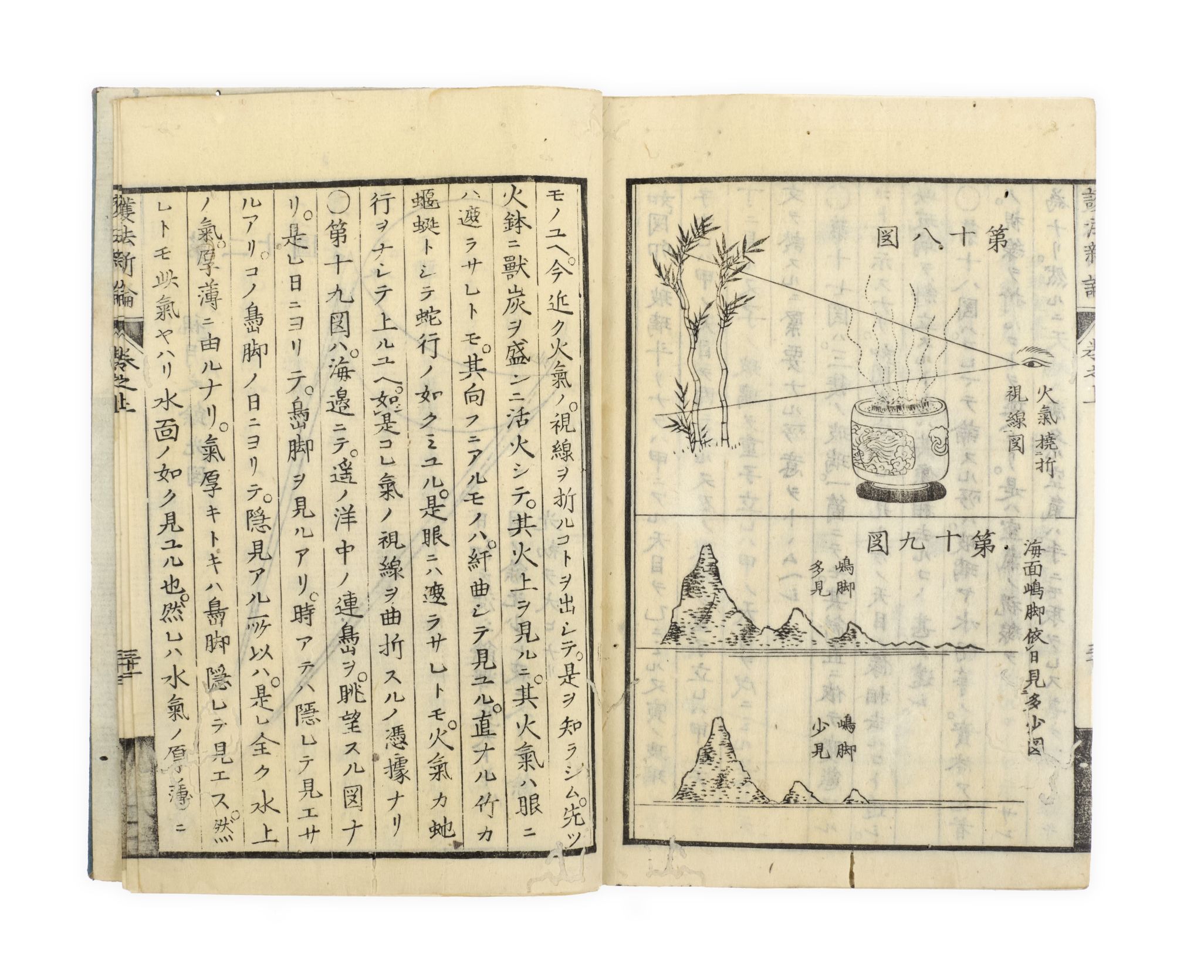
Of particular interest is his ‘rather unusual’ first volume, on optics: ‘Instead of the scholastic arguments and scriptural citations of earlier defenses of Buddhist cosmology, Kamuro opens with what looks like a primer on modern physics. He explains, though the use of simplified illustrations, the nature of optical phenomena in order to argue that the distortions produced by the refraction of light reveal the limitations and flaws of human vision. … [He] attempts to show how the “small matters of human vision” are flawed, limited, and ultimately unreal. Turning the empirical facts of ocular perception against themselves, Kamuro mobilizes the visual vocabulary of Western science for the purposes of its own undoing’ (Moerman, p. 354). Aiding his argument is a series of more than sixty woodcut illustrations and diagrams borrowed, curiously, from a Western work – Benjamin Hobson’s Natural Philosophy, published at Canton in 1855 and in Japan in 1864: ‘The technical and visual vocabulary of scientific explanation, the laws of physics, and the empiricism of the experimental method are here turned against themselves’ (ibid., p. 357).
Very rare: OCLC and Library Hub find only two copies outside Japan (CUL, Stanford).
See Moerman, ‘The Epistemology of Vision: Buddhist versus Jesuit Cosmology in early modern Japan’ in Curvelo and Cattaneo eds, Interactions between Rivals: the Christian Mission and Buddhist Sects in Japan (c.1549–c.1647).