A Notorious Literary Forgery
[SIGONIO, Carlo.] Marcus Tullius CICERO, attributed; [Claude MIGNAULT, editor].
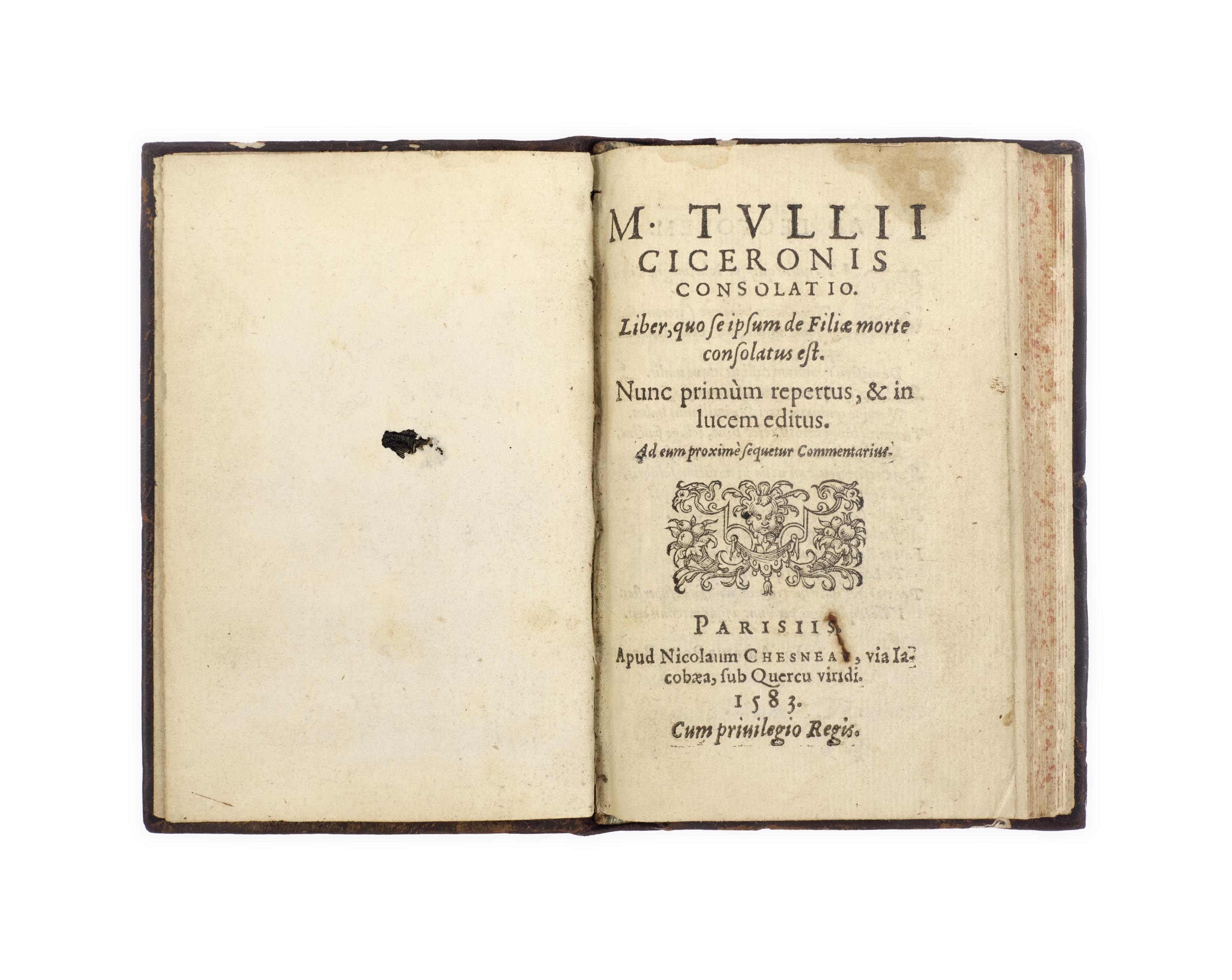
M. Tullii Ciceronis consolatio. Liber, quo se ipsum de filiae morte consolatus est. Nunc primum repertus, et in lucem editus … Nunc primum repertus, et in lucem editus … Paris, Nicolas Chesneau, 1583.
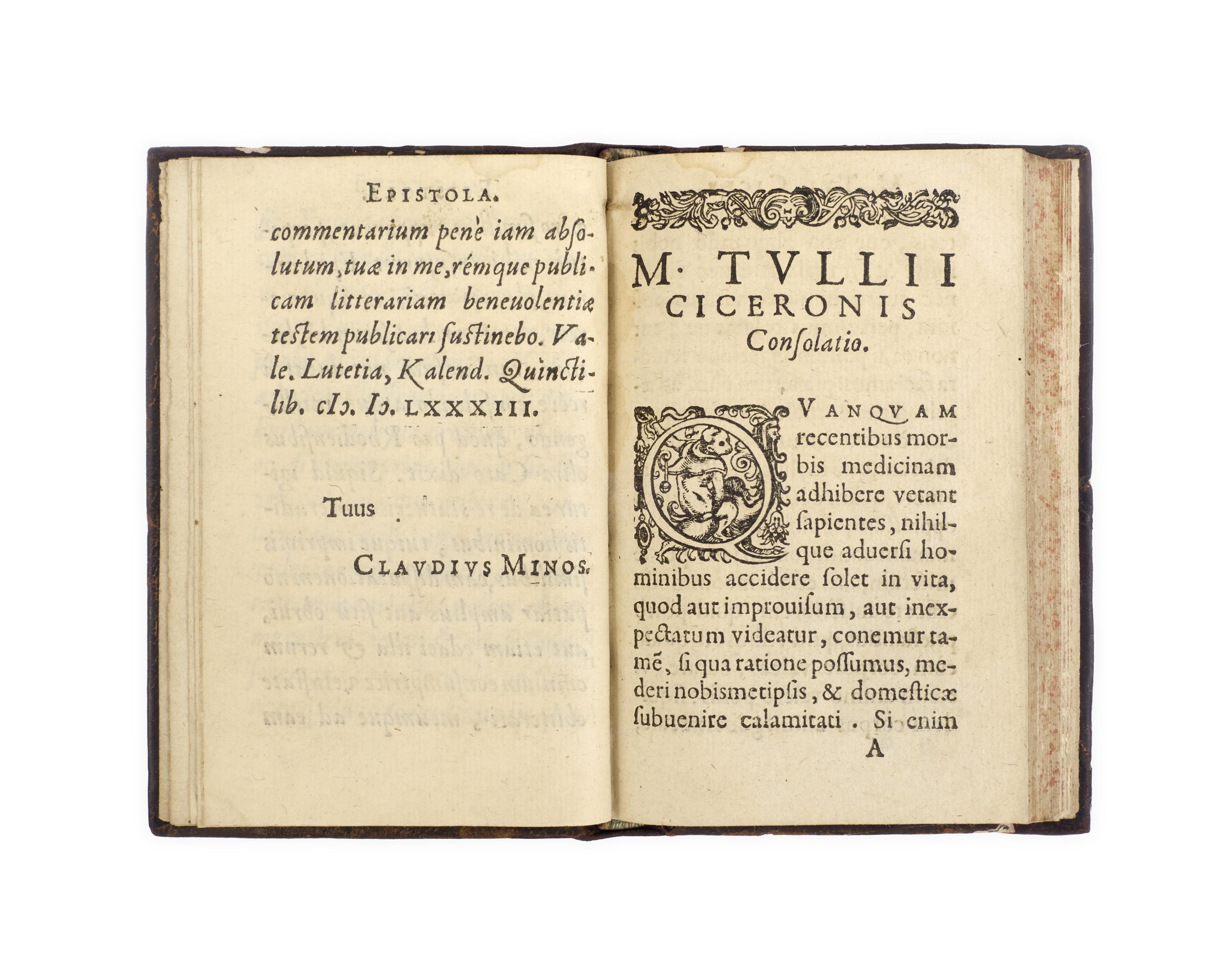
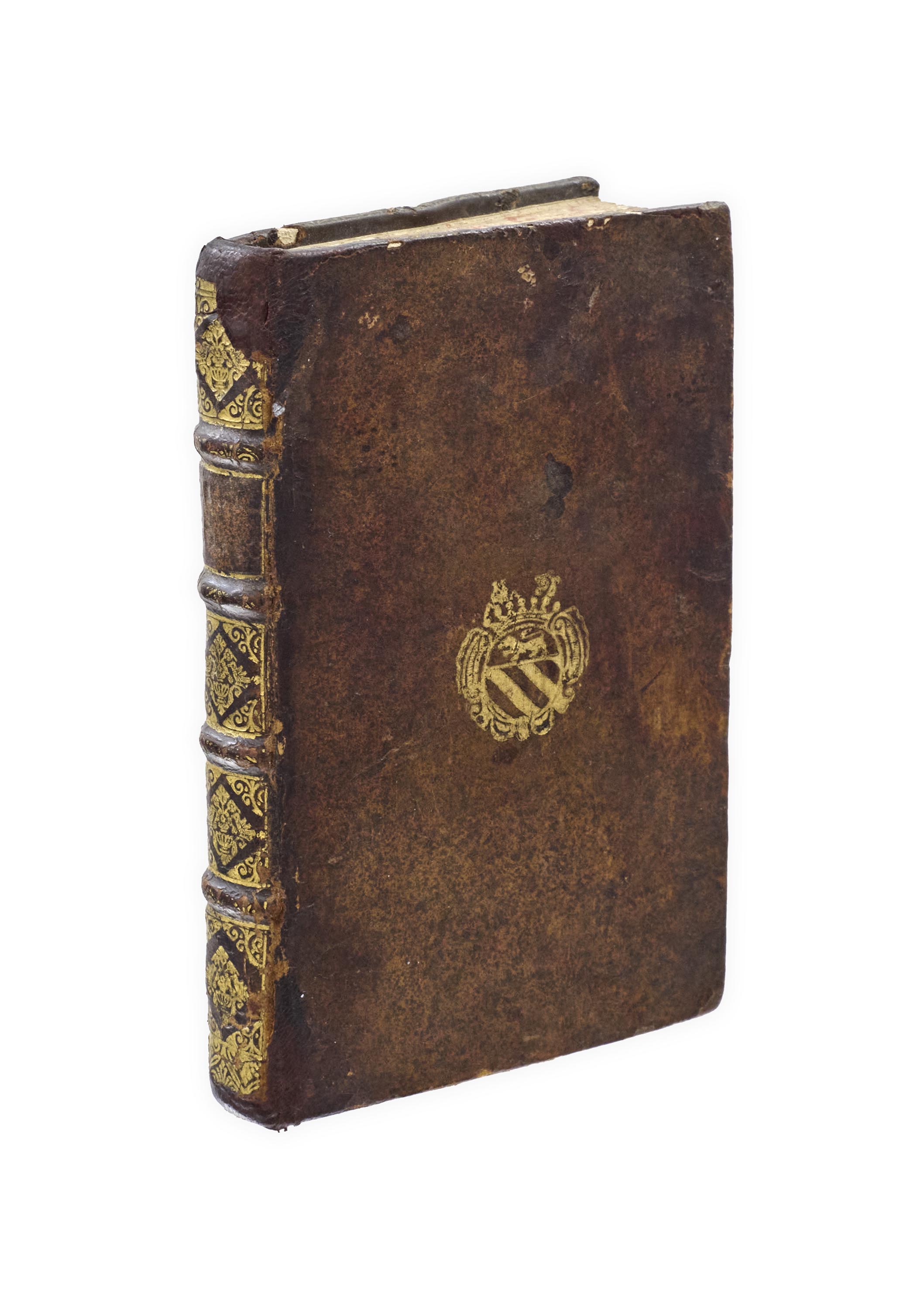
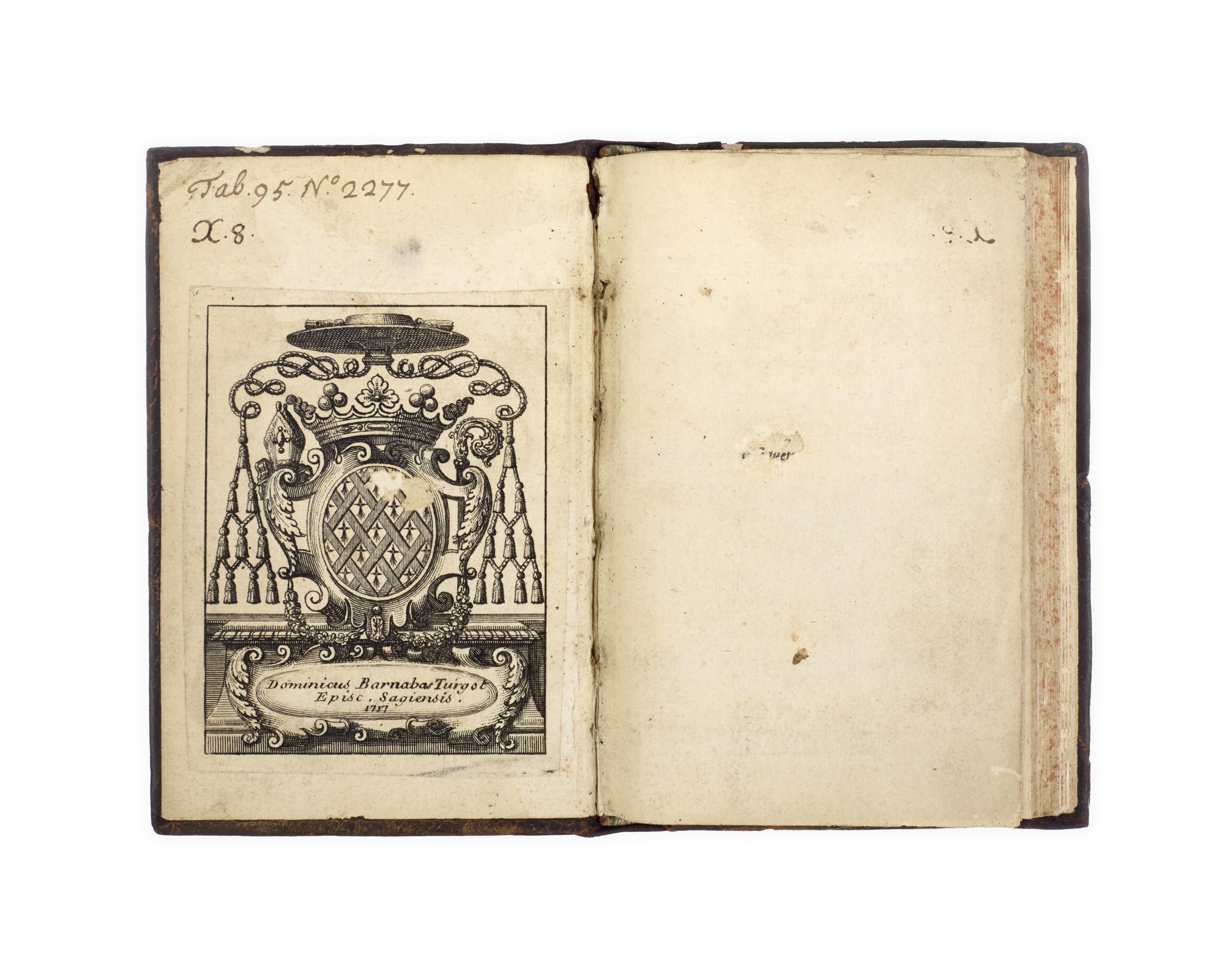
16mo in 8s, ff. [iv], 104; final quire erratically foliated; a very good copy, bound in seventeenth-century French sprinkled calf, spine gilt in compartments, lettering-piece lost, edges speckled red; neat repairs to endcaps and corners; arms of Louis Thomas d’Aquin, Bishop of Séez, blocked in gilt to each board (see below), engraved armorial bookplate of Dominique-Barnabé Turgot de Saint-Clair, Bishop of Séez, to front pastedown (dated 1717, with small area of loss to centre), manuscript ink shelfmarks to front pastedown.
Added to your basket:
M. Tullii Ciceronis consolatio. Liber, quo se ipsum de filiae morte consolatus est. Nunc primum repertus, et in lucem editus …
Extremely rare early edition of Sigonio’s notorious Ciceronian forgery, first published in Venice earlier the same year and the centre of ‘one of the more notorious scholarly scandals of the early modern era’ (Baltussen), this copy from the libraries of two successive bishops of Séez.
Preserved in only a few short fragments (mostly in Lactantius) and considered lost, Cicero’s Consolatio drew considerable interest when published in full by Carlo Sigonio (c. 1524–1584), then teaching rhetoric in Venice. The work’s authenticity was almost immediately challenged by Antonio Riccoboni (1541–1599), Sigonio’s former student at the University of Padua, and Sigonio was soon accused of forging the work himself in a Europe-wide debate involving Lipsius, Scaliger, and Muret. Sigonio defended the work until his deathbed, when he supposedly admitted the forgery to Latino Latini.
First printed in February or March by Girolamo Polo, subsequent editions added commentaries and contributions to the ongoing debate, with both the Bologna edition of July – traditionally considered the second edition – including Riccoboni’s attack. This edition, however, includes neither Riccoboni’s attack nor Sigonio’s defence and, with a preface dated 1 July, plausibly predates the Bologna ‘second’ edition.
Provenance:
1. Louis Thomas d’Aquin (1667–1710), Bishop of Fréjus from 1697 and of Séez from 1698. Set on an ecclesiastical career from an early age, Louis Thomas was granted the benefice in commendam of Grande-Sauve Abbey as early as 1678. Both his grandfather and father were prominent physicians at court, the latter, Antoine d’Aquin, eventually occupying the position of first physician to Louis XIV.
2. Dominique-Barnabé Turgot de Saint-Clair (1667–1727), Bishop of Séez from 1710 following the death of Louis Thomas d’Aquin; his sale, Bibliotheca Turgotiana seu, Catalogus librorum bibliothecae Dominici Barnabae Turgot de Saint Clair, episcopi Sagiensis, Martin, Paris, 17 March 1730 onwards, lot 1974.
No copies recorded in either the US or the UK. USTC finds only two copies, both in France; OCLC adds a single copy of a quarto issue, at the Biblioteca Nazionale in Rome.
USTC 171735. This edition not in Bibliotheca fictiva. See Baltussen, ‘A Curious Sidelight on the Reception of ps.Cicero’s Consolatio (1583): Bodleian MS. Rawl. D. 985’ in Bibliothèque d’Humanisme et Renaissance LXXX, no. 3 (2018), pp. 481–506; McCuaig, Carlo Sigonio: The Changing World of the Late Renaissance (1989), pp. 291–326; Sage, The pseudo-Ciceronian Consolatio (1910).