Frenchmen Learning Chinese in Vietnam?
[SINO-VIETNAMESE.]
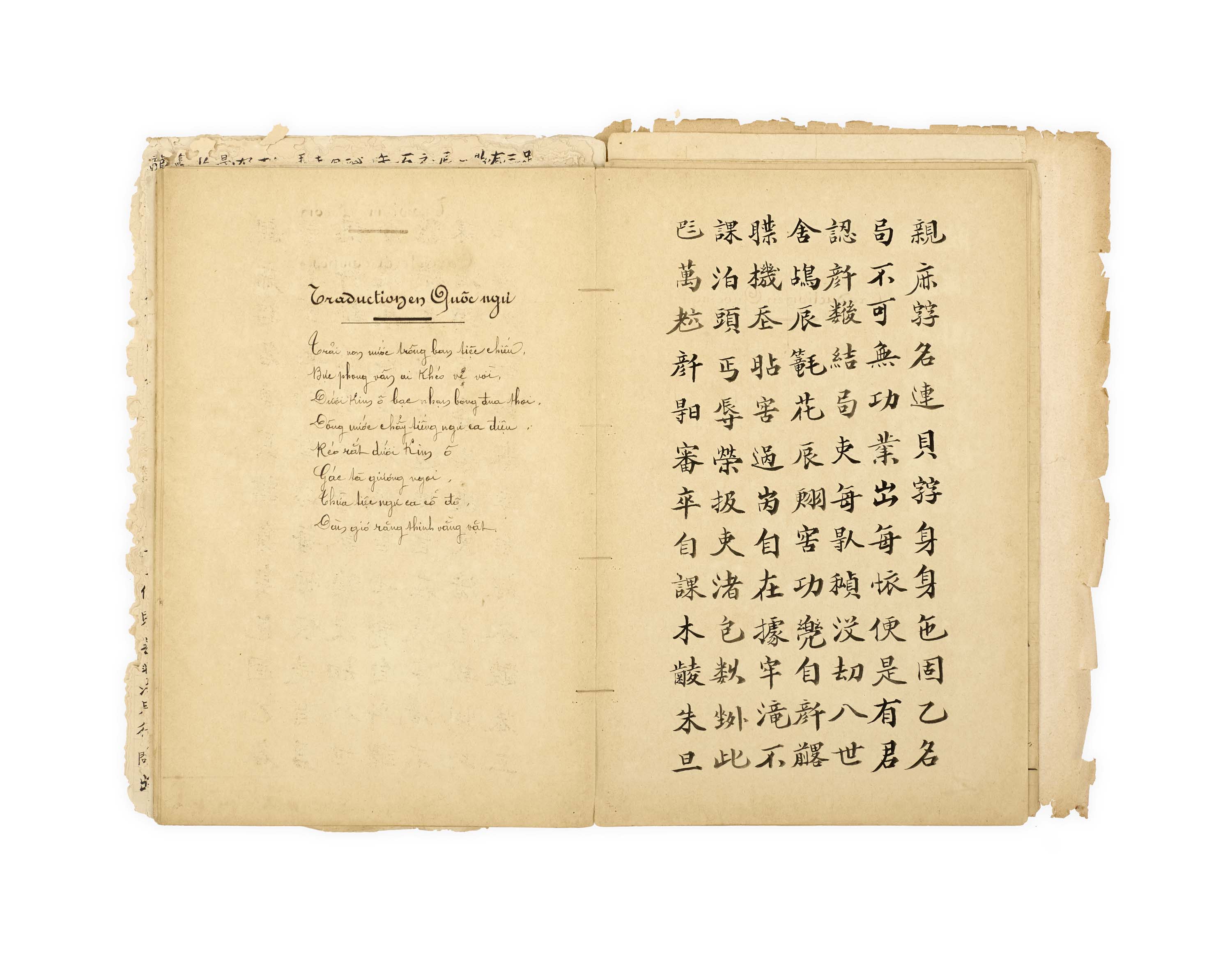
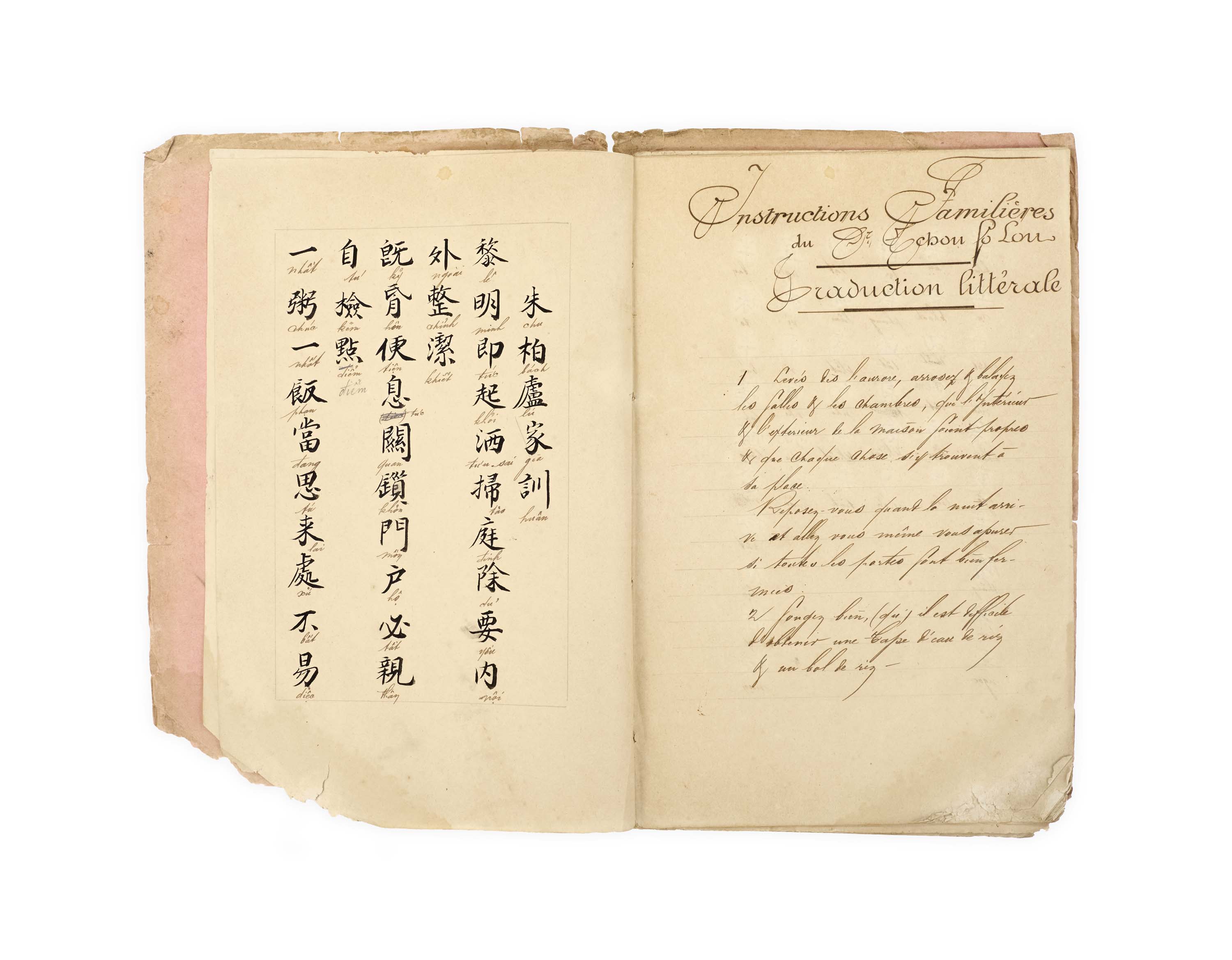
‘朱柏盧家訓 Instructions familières du Dr Tchou-Pou-Lou’.
[Vietnam?, late nineteenth century.]
[with:]
[—.] Manuscript lessons and exercises in classical Chinese, Vietnamese, and French. [Vietnam?, late nineteenth century–early twentieth century.]Manuscripts on paper in Chinese, Vietnamese, and French, two works in two vols, folio (c. 320 x 215), ff. I: [30], II: [43]; occasional stains, gnawing to edges of c. 15 ff. of second work with loss of handful of characters per page; the first work in contemporary pink paper wrappers, manuscript title to front cover, the second stitched but without wrappers; wrappers soiled and worn, a few leaves of second work loose; housed in a custom blue cloth folder.
A set of manuscript lessons and exercises in classical Chinese, partly unique and likely compiled by Frenchmen in late nineteenth-century Vietnam.
The first volume is in part a paginary scribal copy of Les instructions familières du Dr. Tchou Pô-Lou, a bilingual primer by the French diplomat and orientalist Camille Imbault-Huart based on an early Qing pedagogical text. This text, the Zhuzi jiaxun 《朱子家訓》, supplied moral precepts on family life for young children in verse form and soon became an educational classic. Imbault-Huart’s edition, published at Peking in 1881, adjoined a facing French translation together with a vocabulary, commentary, and notes. The present manuscript reproduces Imbault-Huart’s main text and his traduction juxtalinéaire but, interestingly, gives Vietnamese rather than Mandarin readings of the characters. Within the same volume are two further Sino-French vocabularies, also with Vietnamese readings, and seemingly unrelated to the Instructions familières.
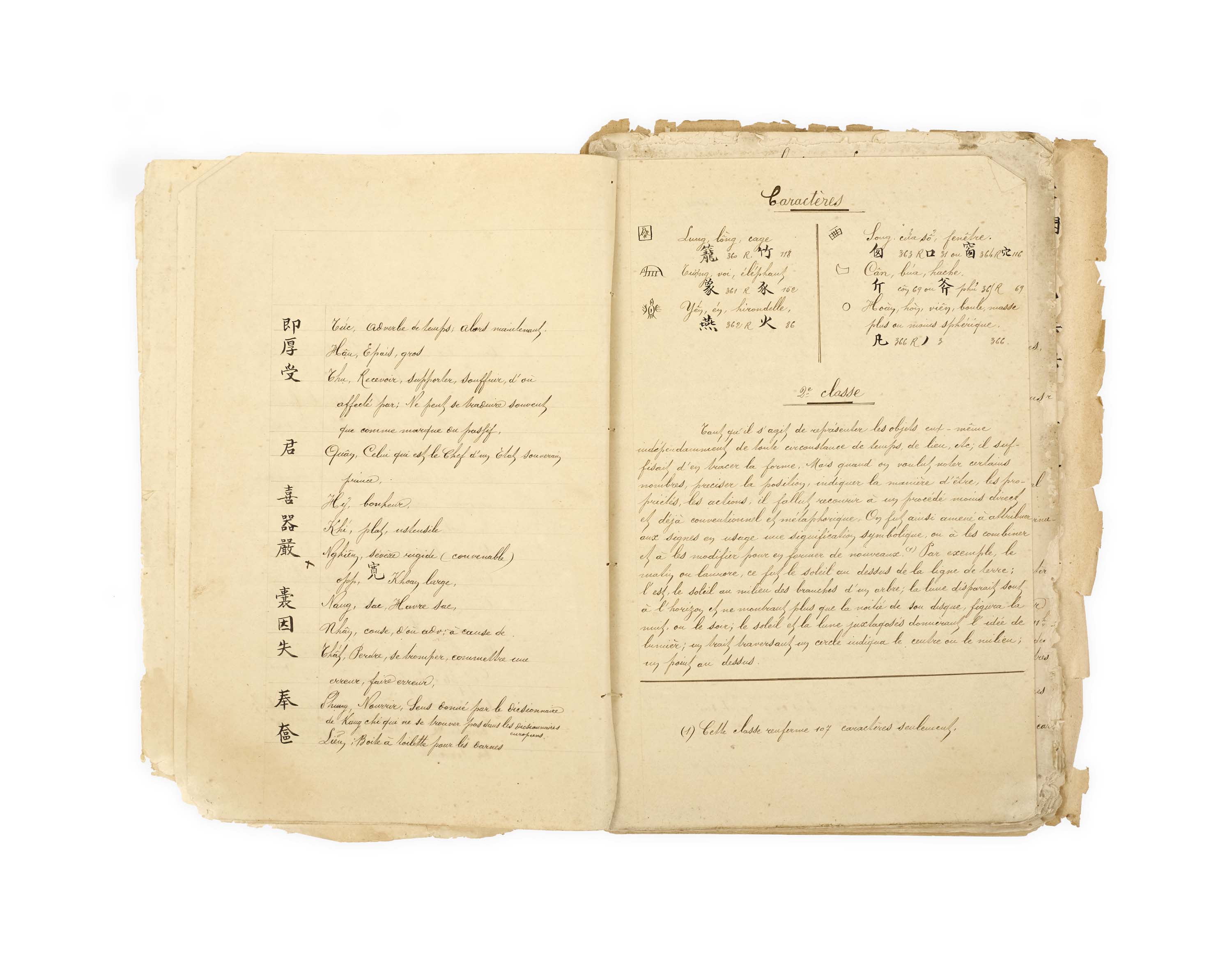
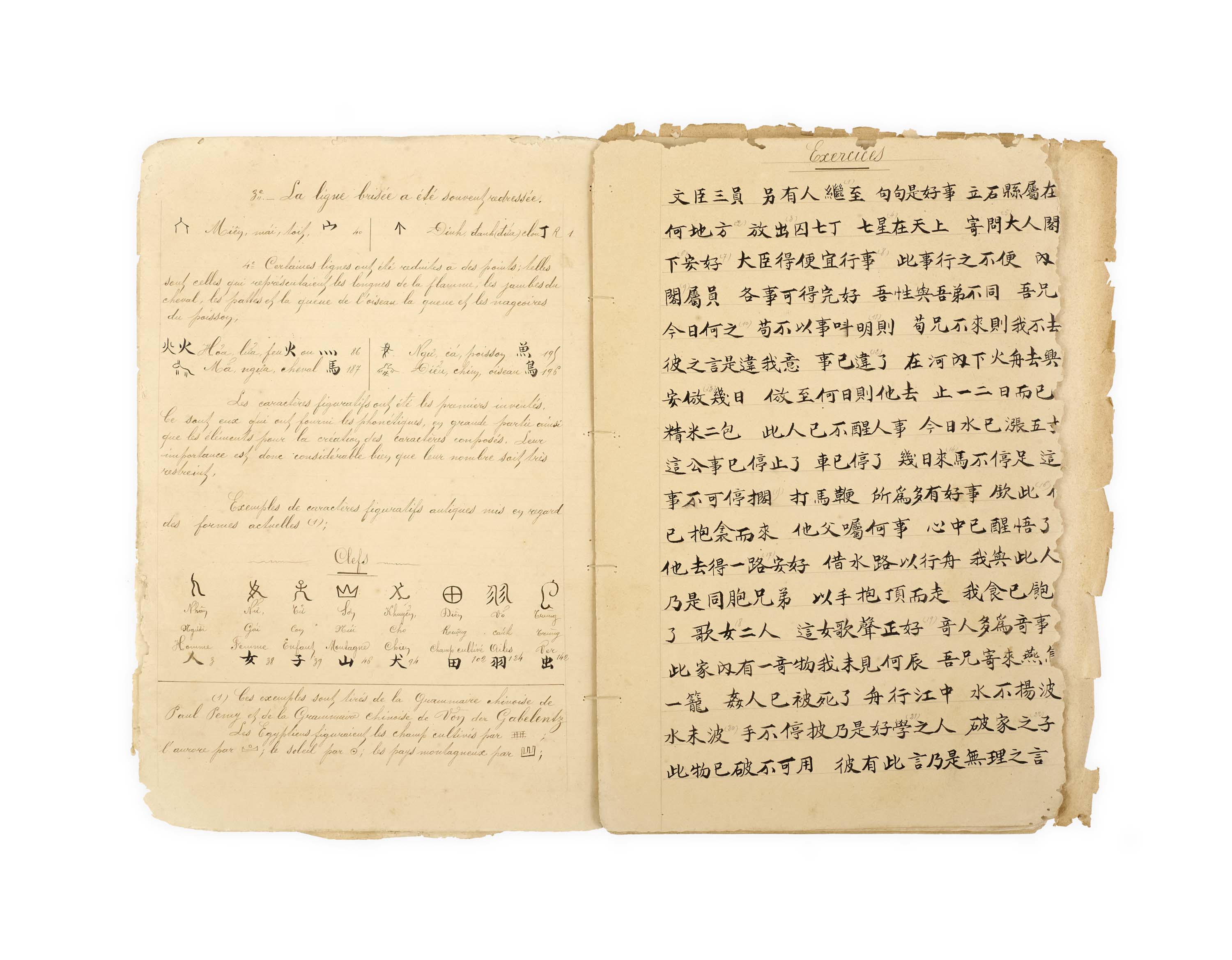
The second volume begins with a partial copy in a different hand of one of these unrelated vocabularies. Then, in this same second hand and a third, the manuscript continues with a series of apparently unique and unpublished lessons and exercises in Sino-Vietnamese, again glossed and explained in French. These are evidently fragmentary, beginning with the ‘2e classe’ of Chinese characters and proceeding to the ‘Septième Leçon’ and beyond, but are nevertheless of strong interest. Particular attention is paid to the origins and composition of Chinese characters, with examples showing the transition from oracle bone script to regular forms and a classification of characters according to their make-up (simple, composite, etc.). The exercises consist of individual characters copied out, graduating to short phrases thereafter, as well as translations into French. Once again, all the character readings are Vietnamese, and in the latter pages there are passages in chữ Nôm as well as in classical Chinese. It is unclear if these lessons derive from lectures or a written source, or if they were composed by the scribes themselves, but all appear to be unrecorded.
Classical Chinese was the written language of Vietnam for most of the first two millennia CE, declining only in the twentieth century with the French administration’s abolition of the Confucian examination system and enforcement of the alphabet. Our manuscripts seem to be the work of French officers or missionaries learning the local written language in the early days of French rule but at the very end of the millennia-long linguistic dominance of Chinese in Vietnam.