
New Context, New Content
SMITH, Samuel Stanhope.
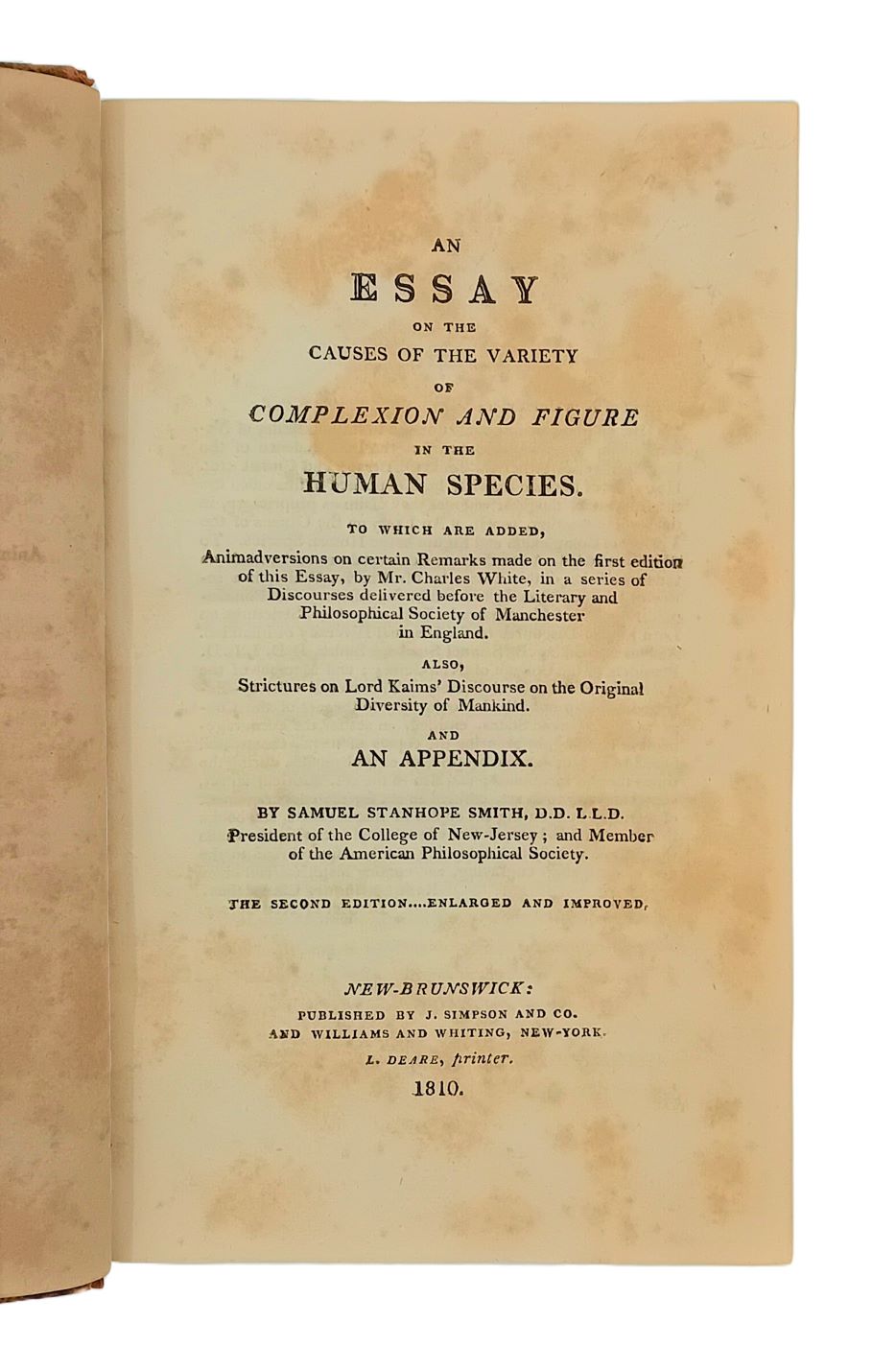
An essay on the causes of the variety of complexion and figure in the human species. To which are added, animadversions on certain remarks made on the first edition of this essay, by Mr. Charles White, in a series of discourses delivered before the literary and philosophical society of Manchester in England. Also, strictures on Lord Kaims’ discourse on the original diversity of mankind … New-Brunswick, Simpson, and New York, Williams and Whiting, 1810.
8vo, pp. 411, [1 blank]; very small tear to title-page; extremities and title-page toned, else a good copy in contemporary marbled sheep, spine gilt in panels, rubbed, morocco label chipped; edges sprinkled red.
Added to your basket:
An essay on the causes of the variety of complexion and figure in the human species. To which are added, animadversions on certain remarks made on the first edition of this essay, by Mr. Charles White, in a series of discourses delivered before the literary and philosophical society of Manchester in England. Also, strictures on Lord Kaims’ discourse on the original diversity of mankind …
‘Second edition, enlarged and improved’, really the third and enlarged American edition, first printed in Philadelphia in 1787. Smith was very much still alive and involved; in the preface he acknowledges his debt to the anthropologist Johann Friedrich Blumenbach, whose works he was unaware of when the first edition was published. This is an interesting and significant appearance of Smith’s work, published in the year following Lamarck’s Philosophie Zoologique, and at a time of American political division, especially with regard to slavery. Smith’s study of physiognomy, though steeped in the language of the dichotomy of savages and civilised peoples, is averse to a racist ethnology in which the slave is, and always will be, inferior to the master. Smith argues that America’s slaves were inheriting the civilised, European-American traits of their owners, making him a proto-Lamarckian and, through this edition, Lamarck’s direct contemporary. In the America of the 1810s where the rights of the individual states – slavery included – were under attack from the Federalists, this viewpoint would have had natural advocates and detractors in pretty equal measure. The ‘enlargements’ to this edition are a defence by Smith of his evolutionary theories, containing a bizarre comparison of Venus de Medici’s proportions with those of various specimens of slavery, and an account of the ‘natural bravery and fortitude of the American Indians’ in the appendix; this edition also reprints Smith’s defence of Common Sense ideas.
Wellcome V, p. 137; Norman 1956 (which incorrectly claims that the ‘animadversions’ are reprinted). Four copies only of this edition on COPAC.