Stein in Central Asia
STEIN, Aurel.
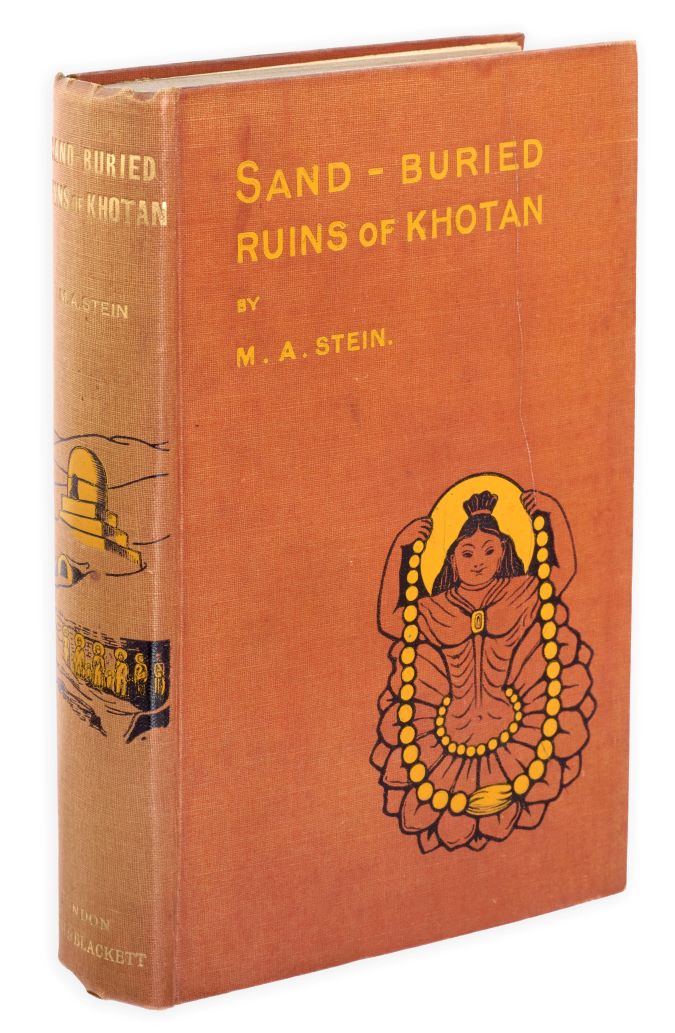
Sand-buried Ruins of Khotan. Personal Narrative of a Journey of archaeological and geographical exploration in Chinese Turkestan … Cheaper Edition. With a Map from original Surveys and numerous Illustrations. London, Hurst and Blackett, 1904.
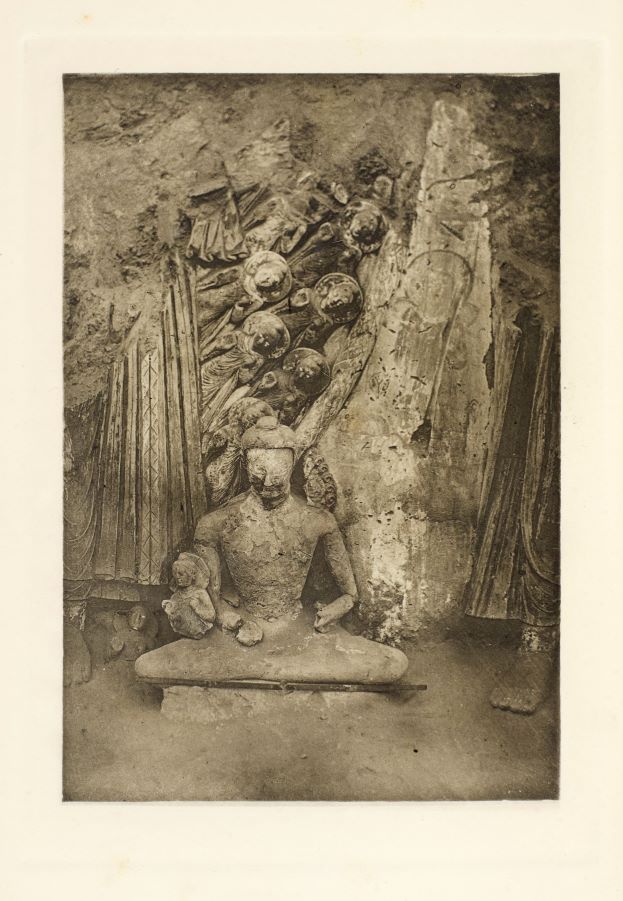
8vo, pp. xl, 503, [1]; with photogravure frontispiece and large coloured folding map, title in red and black, illustrations throughout; some light foxing; very good in original orange pictorial cloth, spine and upper cover lettered in gilt and with vignettes; very slight wear to extremities, small marks to upper cover, spine a little faded; inscription to front free endpaper.
Added to your basket:
Sand-buried Ruins of Khotan. Personal Narrative of a Journey of archaeological and geographical exploration in Chinese Turkestan … Cheaper Edition. With a Map from original Surveys and numerous Illustrations.
‘Cheaper edition’ (published a year after the first) of Stein’s account of his first expedition to Central Asia in 1900–1901.
‘In May 1900 Stein set out on the first of several expeditions to the deserts of Chinese Turkestan which were to make him famous. His curiosity had been stimulated by the explorations of the Swede Sven Hedin and by the arrival in India of manuscripts from the Taklamakan Desert … Stein’s great achievement, during this and two subsequent expeditions (1900–01, 1906–8, and 1913–16), was to establish the existence of a hitherto lost civilization along the Silk Route in Chinese central Asia. Despite the fact that better-financed expeditions from Germany and France … worked in the same area, Stein was the first archaeologist to discover evidence of the spread of the Graeco-Buddhist culture of north-west India across Chinese Turkestan and into China itself. Excavating the lost cities of the Silk Road, he found wooden, leather, and paper documents, painted wall panels, sculpture, coins, textiles, and many domestic objects’ (ODNB).
Stein’s discoveries ‘caused a sensation among European scholars, and at the 13th International Congress of Orientalists the following year a special resolution was passed congratulating Stein on his achievements’ (Howgego).
Cordier, Sinica col. 2865; Yakushi S328a.