The Compleat Statesman
WILLAN, Leonard.
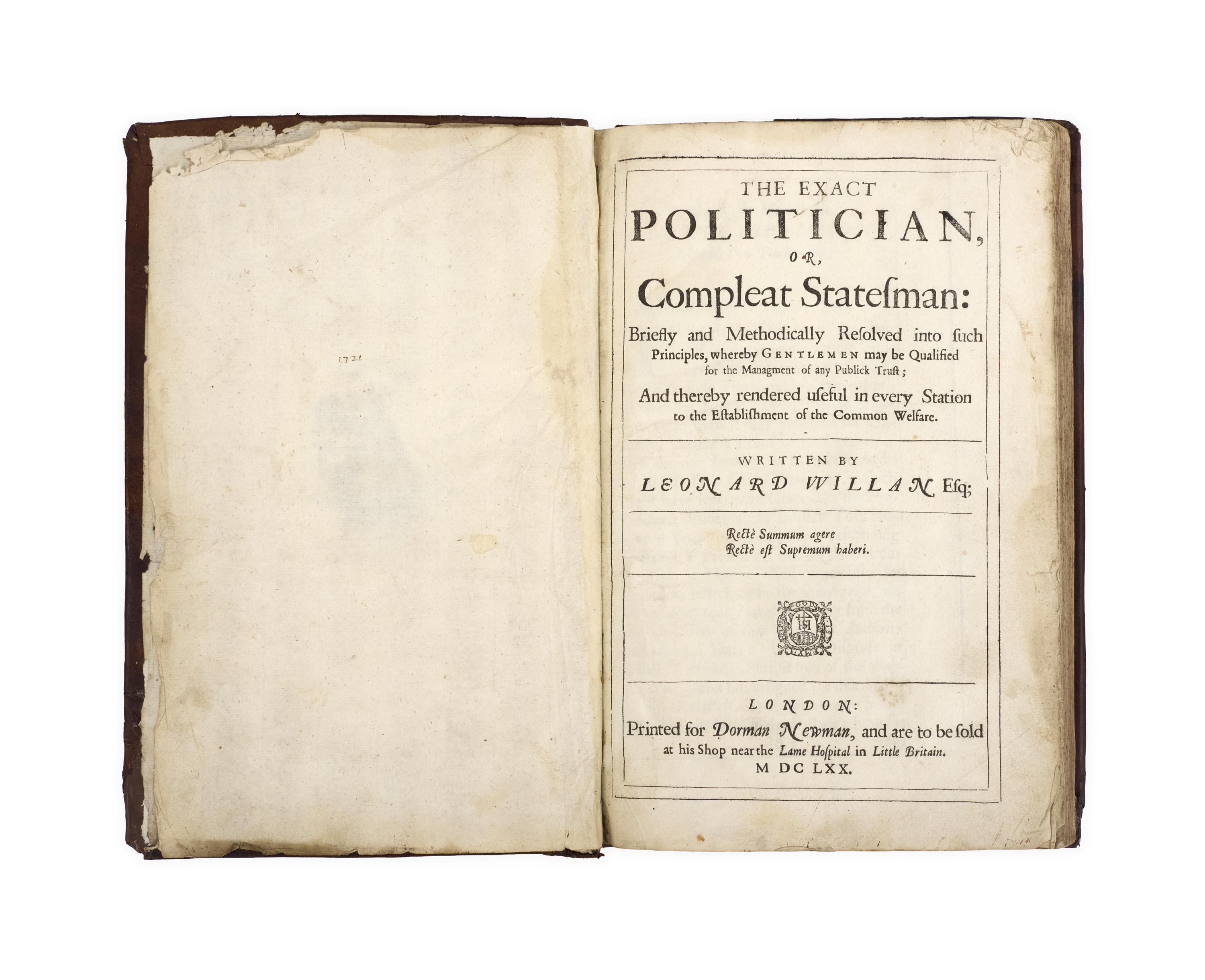
The exact Politician, or, compleat Statesman: briefly and methodically resolved into such Principles, whereby Gentlemen may be qualified for the Management of any publick Trust; and thereby rendered useful in every Station to the Establishment of the common Welfare. London, Dorman Newman, 1670.
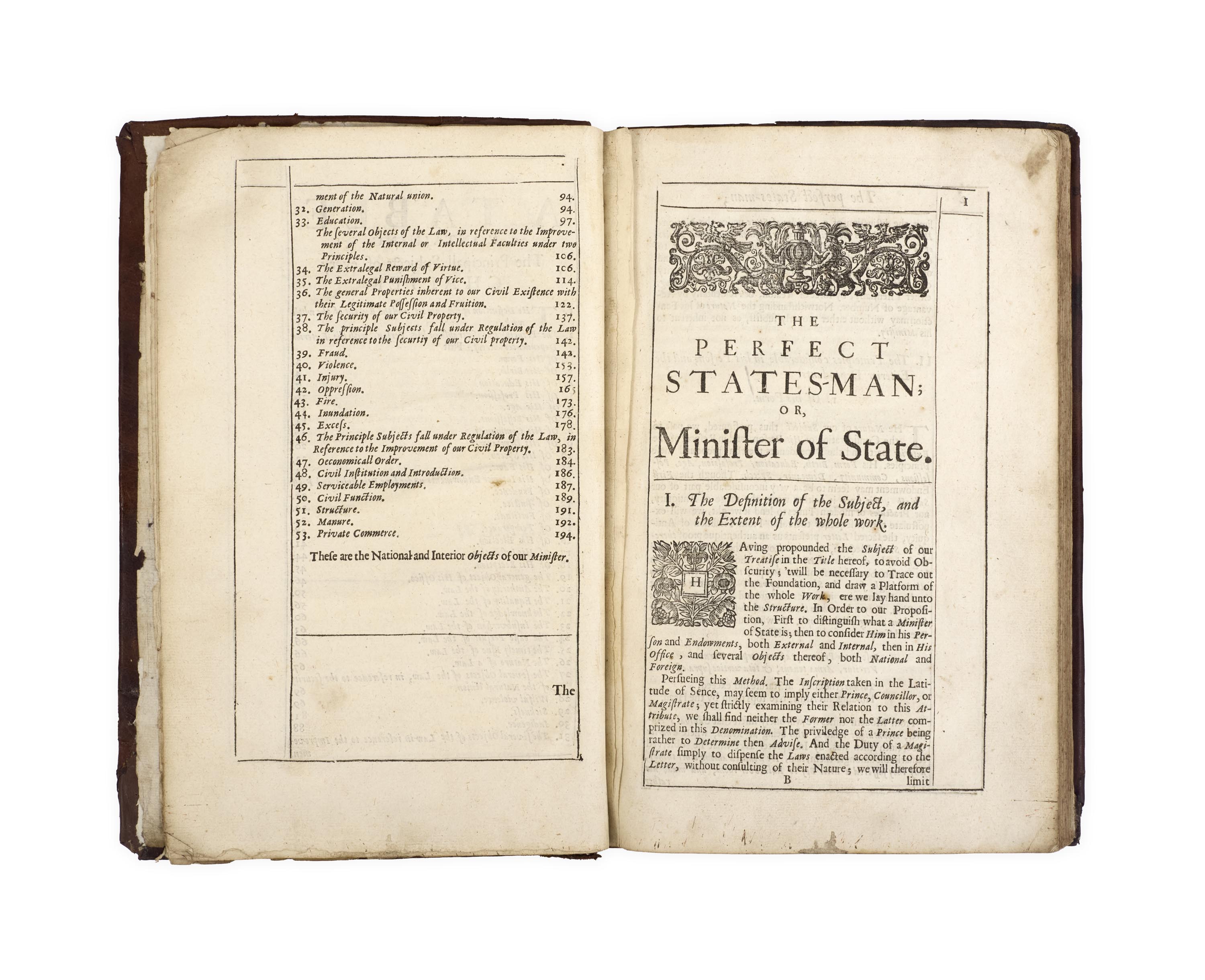
Folio, pp. [viii], 198; woodcut ornament to title, woodcut headpiece and factotum initial; title frayed at edges and a little soiled; the odd minor stain; else a very good copy in contemporary sheep, borders roll-tooled in blind; sympathetically rebacked with old spine laid down, a little scuffed, front endpapers repaired; armorial bookplate of Sir William Maxwell of Monreith, 3rd Baronet (Franks 20100), early manuscript calculations to front pastedown recto.
Added to your basket:
The exact Politician, or, compleat Statesman: briefly and methodically resolved into such Principles, whereby Gentlemen may be qualified for the Management of any publick Trust; and thereby rendered useful in every Station to the Establishment of the common Welfare.
First edition, second issue, employing the sheets of the first edition (The perfect States-man, 1668, printed for the author) with a new cancel title-page, containing one of the earliest assertions that private interests serve the public good.
Playwright and fabulist of mixed allegiances in the Civil War, Willan (fl. 1648–1670) here ‘set out to describe the requisite qualities of the statesman, that combination of politician and functionary who controlled most of the business of monarchies before elected legislatures played much of a part. … What he sought was nothing less than a “perfect harmony in the civil frame”. The means of securing it was best expressed in his statement that the dignity and credit of the civil power must be secured “by the mutual interest of her parts”. … His prime insight, from his point of view, and certainly from ours, was that any totality, such as a community, was reducible into constituent parts, in this case individuals and their interests’ (Gunn, pp. 269–70). Anticipating Mandeville and Adam Smith, Willan was among the first to stress that private interests promoted the public good (Shapiro, p. 241).
Provenance:
Sir William Maxwell of Monreith, 3rd Baronet (1715–1771), of the ancient Wigtownshire family, with his bookplate. In his journal of 24 September 1762 Boswell described him as ‘formerly … a genteel, pretty-looking man. Now he looks like an overgrown drover. He entertained us with many of the exploits of his youth, which however were rather a little too marvellous’. Thence by descent.
We find no other copies of either issue in auction records.
ESTC R33657; Wing W 2263. Not in Goldsmiths’; not in Kress. See Gunn, Politics and the public Interest in the seventeenth Century (1969); Shapiro, ‘Political Theory and the Growth of defensive Safeguards in criminal Procedure, in Law and History Review 11/2 (1993).