The Patient, the Ultra-Patient, and the Unseduceable
[WOMEN-PEARLS.]
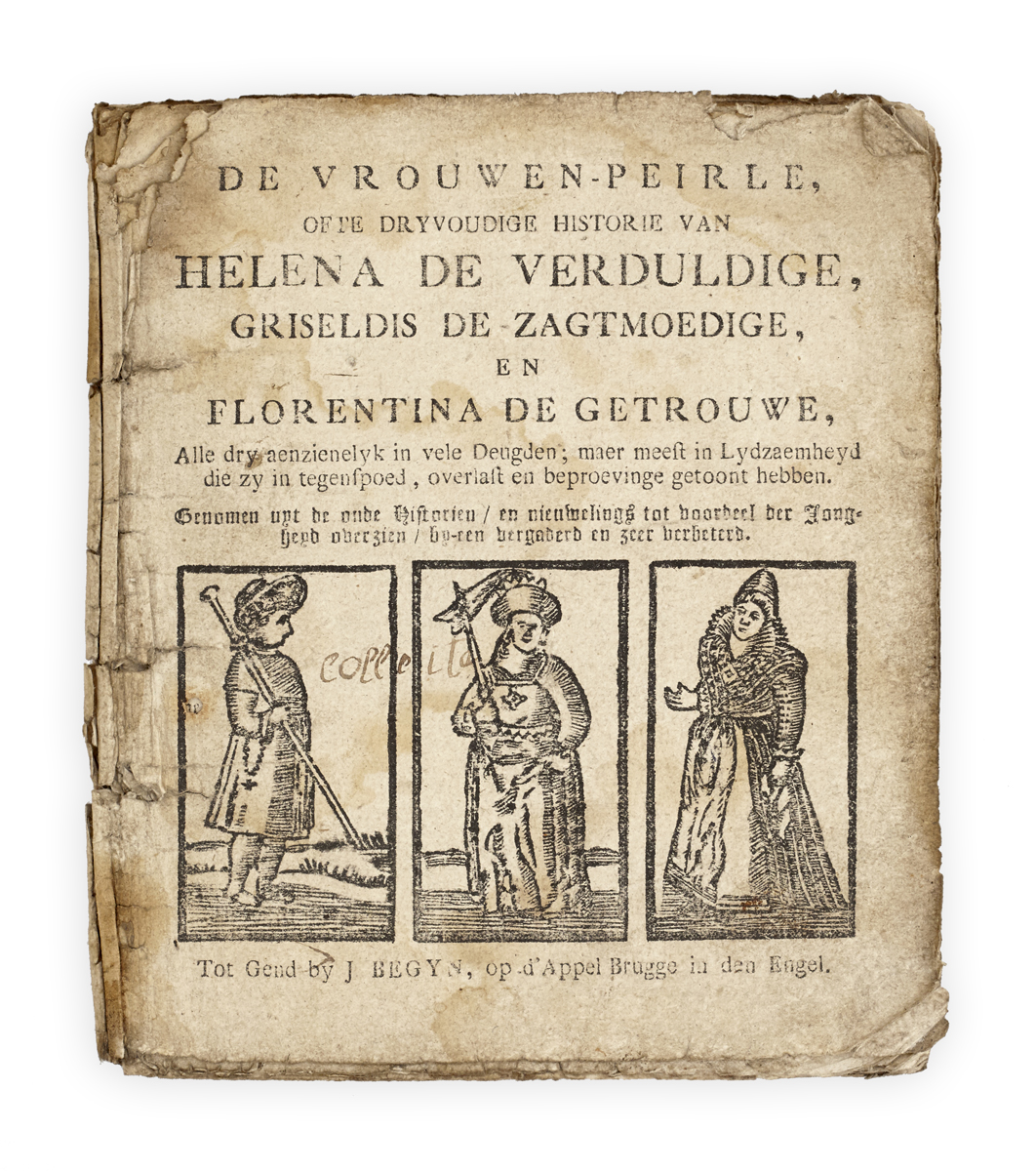
De Vrouwen-Peirle, ofte dryvoudige historie van Helena de Verduldige, Griseldis de Zagtmoedige, en Florentina de Getrouwe. Ghent, J. Begyn, [1780–1810].
Three parts in one volume, 4to, ff. 56, with separate titles but continuous pagination; printed in blackletter in double columns, titles with 3 full-figure woodcuts of female saints each, 13 woodcuts in text, including 2 of the title cut; part I with 5 small woodcuts within ornamental borders; dust-soiling throughout, edges somewhat frayed; disbound with evidence of the original sewing, preserved in recent marbled boards; a contemporary woman’s ownership inscription (‘Collette’) on the first title.
Added to your basket:
De Vrouwen-Peirle, ofte dryvoudige historie van Helena de Verduldige, Griseldis de Zagtmoedige, en Florentina de Getrouwe.
An attractive copy of the ‘Women-pearls’, a Flemish chapbook portraying three remarkable women – Helena the Patient, Griselda the Meek, and Florentina the Faithful – and their marvellous stories derived from medieval romances, featuring seduction, amputation, and narrowly-avoided incest.
The Vrouwen-Peirle went through numerous and mostly undated editions, alluring readers with the added, winning visual appeal of naïve-style woodcuts and archaic types. The stories appeared first separately in the Northern Low Countries and were later published in combined editions in the South. First up is Helena the Patient, the wife of King Henry of England and mother of Saint Martin of Tours. Her attribute is patience, and her story, a tale of lacerating loss and ultimate reunion in which she loses an arm and thinks her children have been eaten by wolves and lions, was apparently first told by the Norman poet Alexandre de Bernay. Helena is followed by an even more patient Griseldis, prey to the sadistic and dubious humour of a heartless husband, who, after forging a bull of annulment, presents his own daughter to her as his intended bride: her tale was retold in various forms by Boccaccio, Petrarch, Chaucer, and Perrault, and in the present version, adapted for school readings in the seventeenth century, the incest references are cleaned up. The unassailable virtue of the last heroine, Florentina the Faithful, is proven by the miraculously unsullied immaculate white (through scenes bathed in blood and mud) of her crusader husband’s shirt. Having frustrated the Sultan’s attempt to seduce her, Florentina sets off for the Orient to rescue her beloved spouse.
OCLC finds a single copy in the US (Newberry), to which Library Hub adds two copies in the UK (BL, NLS).
Van Heurck, Les livres populaires flamands, 1931, pp. 41–45 (different edition).