The Role of Consumers’ Action
an Alternative to Most Socialist Thought
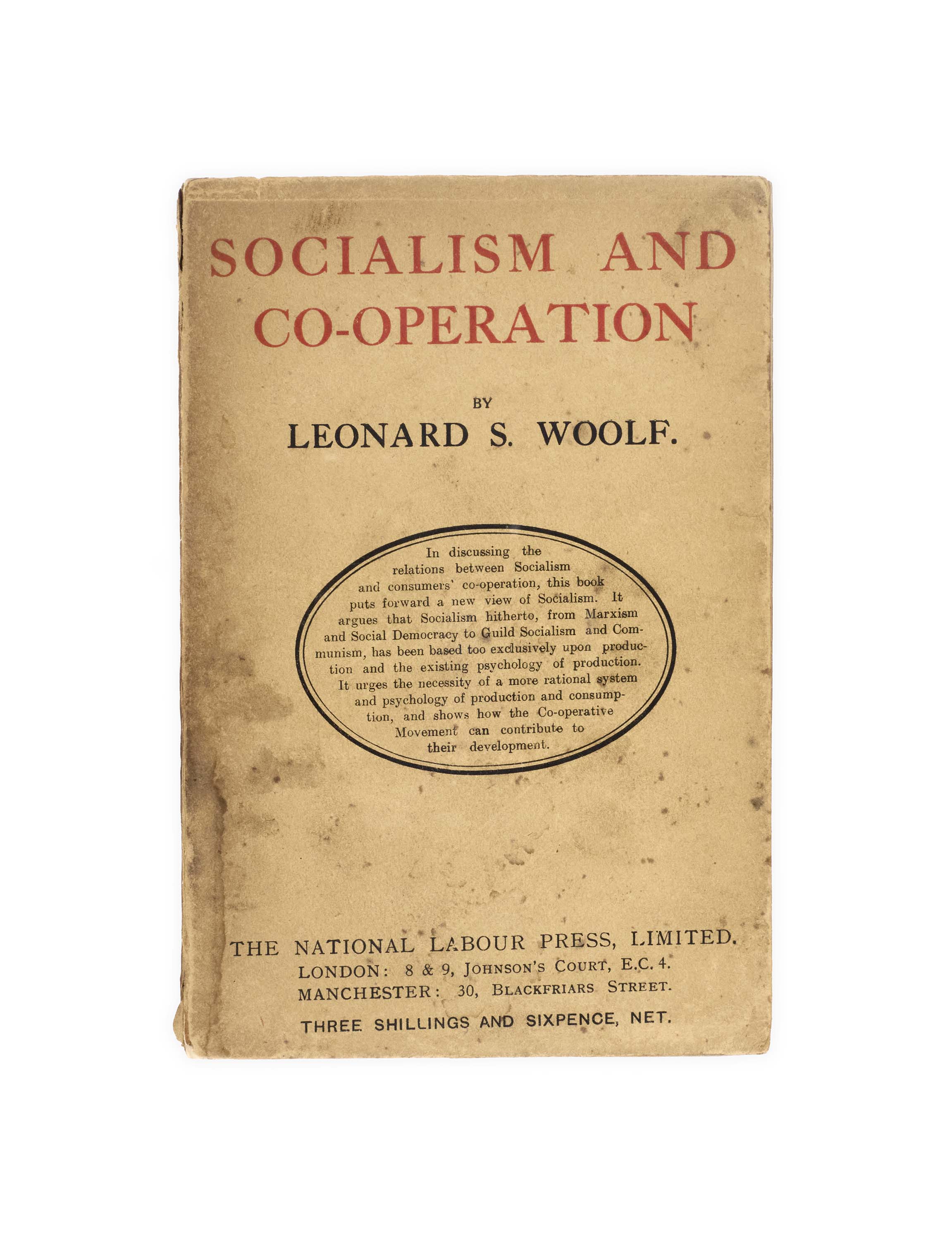
WOOLF, Leonard.
Socialism and Co-Operation. London, National Labour Press, 1921.
8vo, pp. [viii], 129, [1, blank]; very light uniform toning, but a very good copy; in the original off-white paper wrappers with flaps; wrappers a little chipped at spine, with a couple of chips along the extremities, some surface staining or thumbing.
First edition. In the interwar period Woolf was ‘a patient and committed advocate for a cooperative model of participatory, rank-and-file democracy founded on the organization and practices of the Co-operative Movement, whose socialist, transformative aspirations Woolf found most fully realized in the Women’s Co-operative Guild under the leadership of Margaret Llewelyn Davies. Woolf’s interest in radical democratic templates places him in a line of British utopian thought that looks to small-scale models of popular self-government as test cases for overall social transformation—ranging from Robert Owen’s communes, through William Morris’s medieval craft guilds, to the guild socialism advocated by G. D. H. Cole and R. H. Tawney. At the same time, in identifying the consumer rather than the producer as the means and ends of social change, Woolf’s proposals for a socialist commonwealth emerge as an alternative to most socialist thought, a rarely examined case in a British politics of consumption which, as Matthew Hilton has shown, has traditionally offered itself as a “middle” or “third way” solution to a party political system dominated by the interests of capitalists and workers’ (Koppen, Participatory Democracy and the British utopian Tradition: Leonard Woolf’s co-operative Commonwealth in Historical Perspective (2024), abstract).