
Dedication Copy for a Mad King
ZACHARIÄ, Just Friedrich Wilhelm.
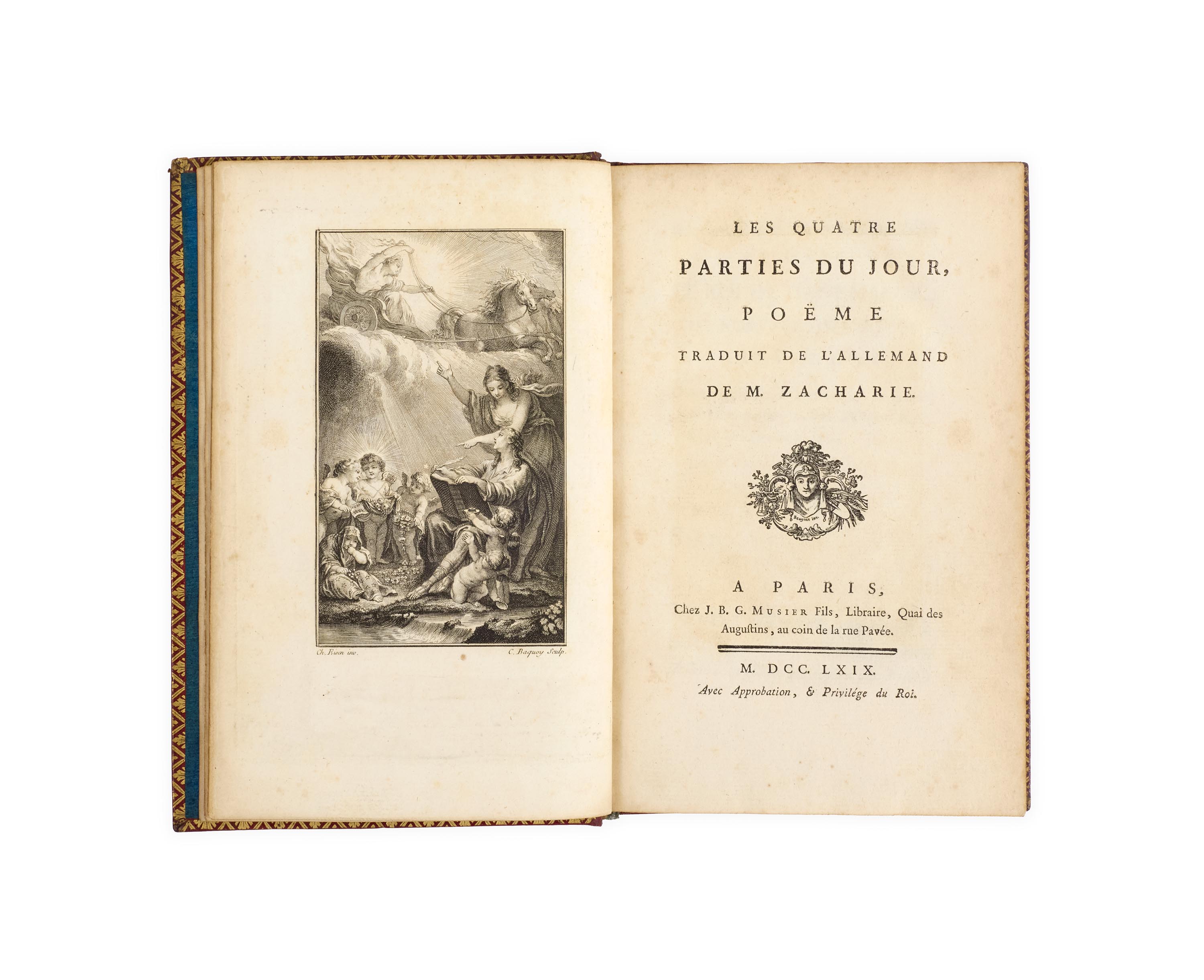
Les quatre parties du jour, poëme traduit de l’allemand de M. Zacharie. Paris, J. B. G. Musier fils, 1769.
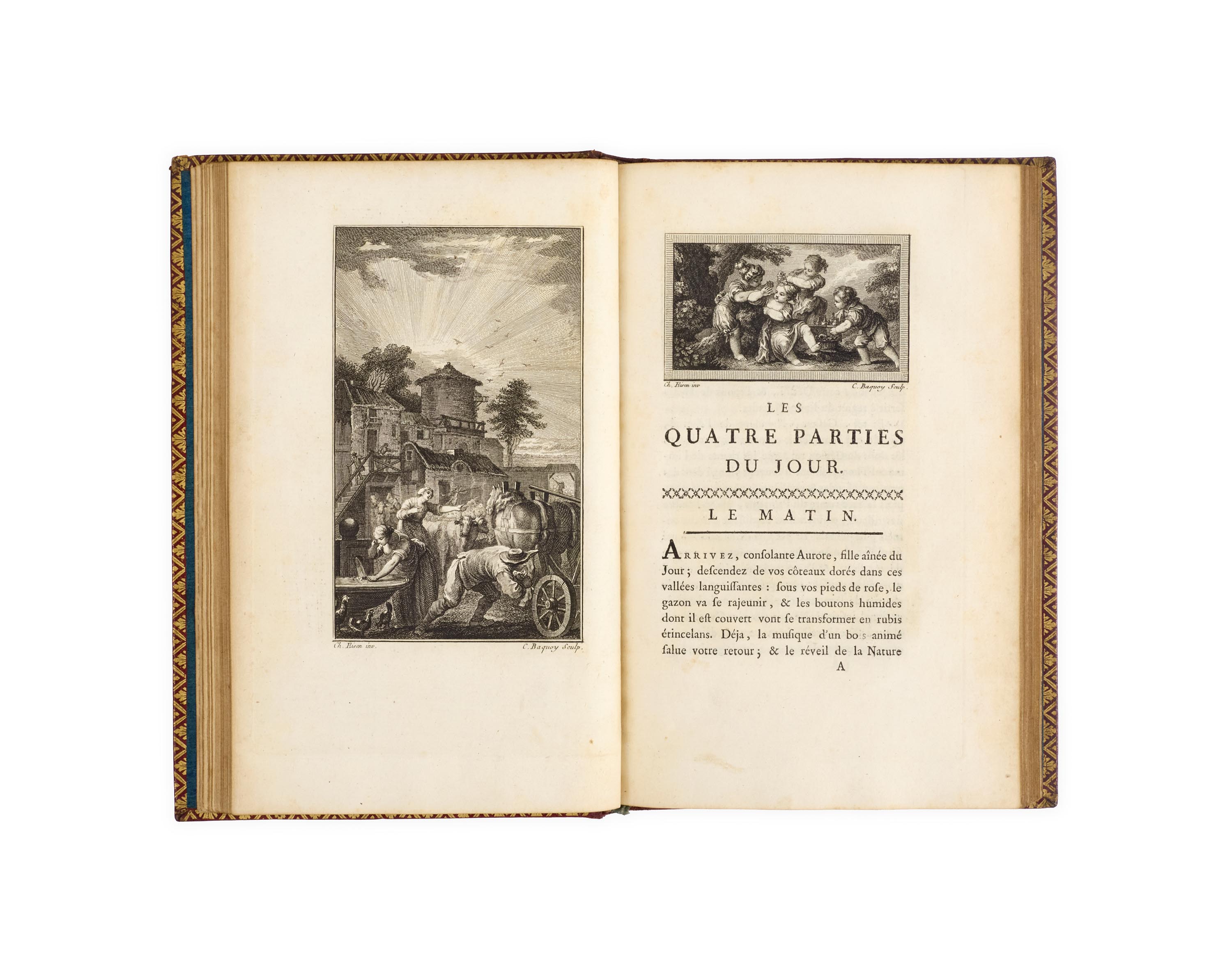
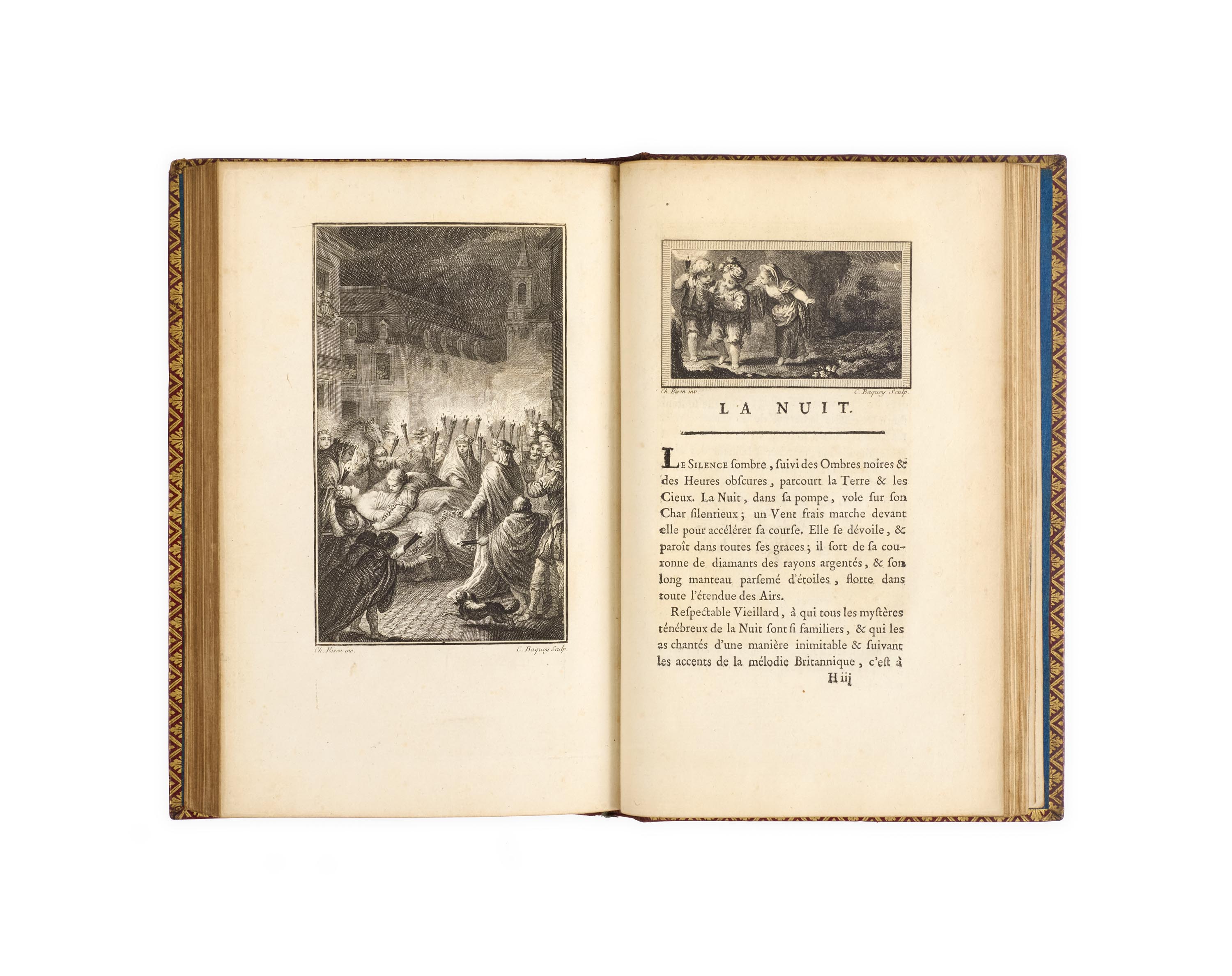
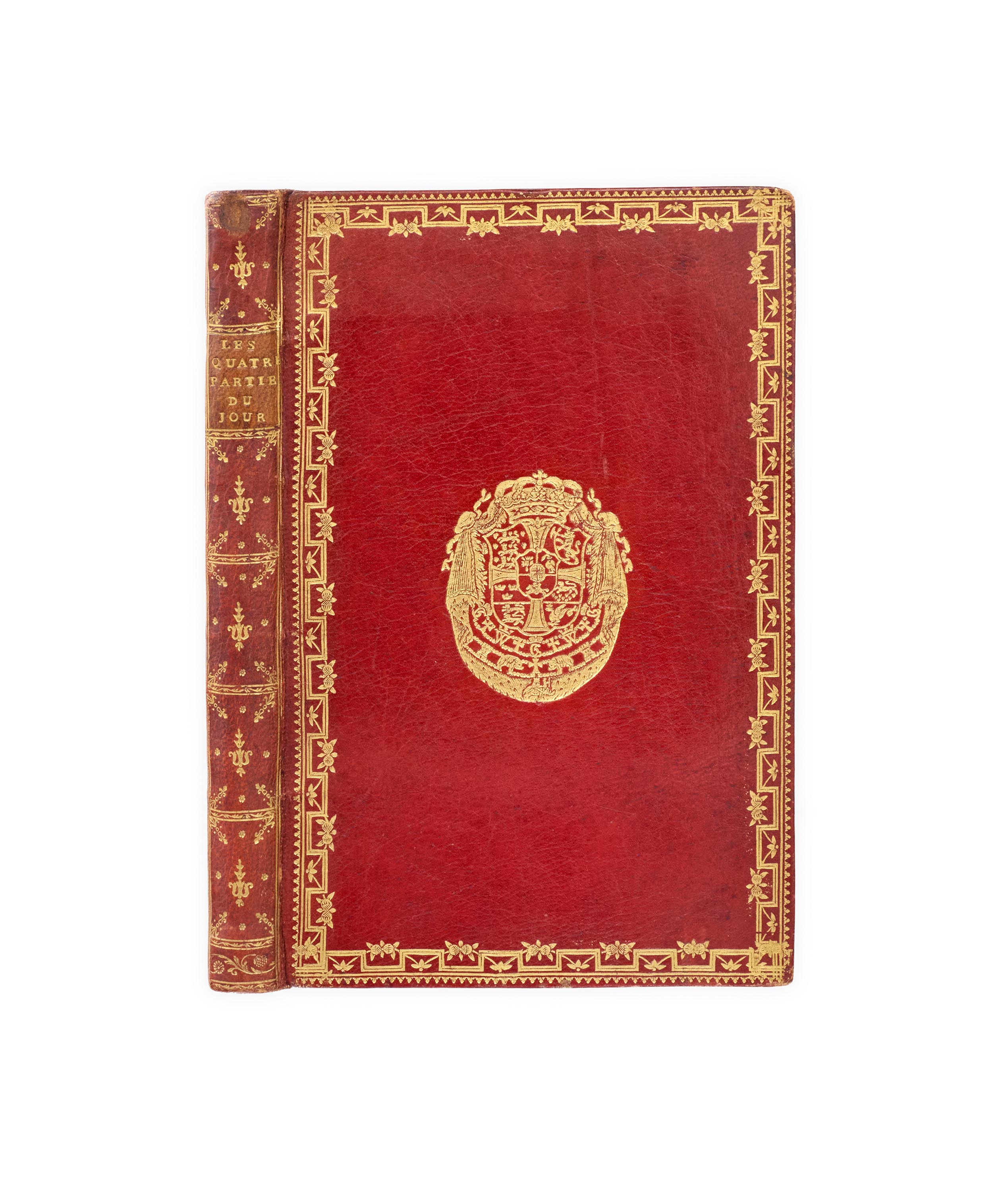
8vo, pp. [4], xxxii, 144, ‘149’–‘163’ [recte 159], with engraved frontispiece and 4 further plates by C. Baquoy after Charles Eisen; 4 engraved vignettes by Baquoy after Eisen, woodcut ornaments throughout; slightly foxed with occasional minor stains; in contemporary French red morocco, covers gilt with the arms of Christian VII of Denmark–Norway (cf. Guigard I, 75–6) and borders of double thistles along a crenellated roll, flat spine gilt in seven compartments with W-shaped pallet and brown morocco lettering-piece with title in gilt, deep blue endpapers, green silk placemarker, all edges gilt; front cover slightly sunned at head, small abrasion to head of spine, a few minor scuffs, spine slightly creased; modern pencil gift inscription to verso of front free endpaper, a couple of pencil markings to margins of preface.
Added to your basket:
Les quatre parties du jour, poëme traduit de l’allemand de M. Zacharie.
First edition in French of this proto-Romantic poem on the times of day, splendidly bound with the arms of its dedicatee, the mentally ill Christian VII of Denmark and Norway.
Active in Brunswick, the poet Zachariä (1726–1777) began his literary career an adherent of the strictly neoclassical Gottsched but soon switched allegiance to the Bremer Beiträge school and its insistence on genius and inspiration. His Tageszeiten, dating from this latter phase, was heavily influenced by James Thomson’s The Seasons and Edward Young’s Night-Thoughts. In its four books of blank descriptive verse Zachariä addressed ‘a host of literary, artistic, and contemporary-historical questions; thus he gives an overview of contemporary German literature, treats of art in mentioning the Salzdahlumer Galerie, alludes to recent military events, and even calls for a German navy and German colonies!’ (ADB, trans.). First published in 1756, the poem was translated into French prose for the present edition by one Muller, minister to the Prince of Lambesc. The nine illustrations, specially engraved for this translation, are after Eisen, ranked by Cohen as ‘celui qui réunit à la fois le plus de grâce, de fini et de perfection’ among eighteenth-century illustrators.
Our copy was richly bound for presentation to the translation’s dedicatee, Christian VII (1749–1808). King of Denmark and Norway from 1766, Christian had toured Germany and France in 1768 (hence, perhaps, the dedication) and was already showing signs of the mental instability (likely schizophrenia or porphyria) with which he would be afflicted for the rest of his life, flying into rages and openly cavorting with his favourite courtesan.
Given the date of the edition’s privilège (9 May 1768) and of its imprint (1769), this copy was likely bound and presented to the king around the time he chose Johann Friedrich Struensee as his personal physician – a fateful appointment resulting in Struensee’s dominance over the king and absolute political power in the years 1770–2, during which the physician enacted far-reaching Enlightenment reforms including freedom of the press and the abolition of the slave trade, of peasant servitude, and of many aristocratic privileges. Struensee also embarked on an affair with Queen Caroline Mathilde, with whom he had a daughter (Louise Augusta) disguised as Christian’s issue. Rumours that Struensee and the queen were plotting to assassinate the king led to the lovers’ arrest and Struensee’s beheading and dismemberment in 1772.
The present copy seems to have been one of several nearly identically bound and presented to the Danish court. We have traced two others: one in the Royal Danish Library and another at Waddesdon Manor (erroneously cited as the 1773 edition in Cohen–De Ricci), the latter with a green (rather than brown) lettering-piece and with the cipher of the illegitimate Princess Louise Augusta to the title-page verso.
Barbier III, 1127; Cioranescu 47648; Cohen–De Ricci 1074. See The James A. Rothschild Bequest at Waddesdon Manor: Printed Books and Bookbindings, W.Cat.766.