‘On Exile’
Annotated by a Once-Exiled Humanist Lawyer
ALCIONIO, Pietro.
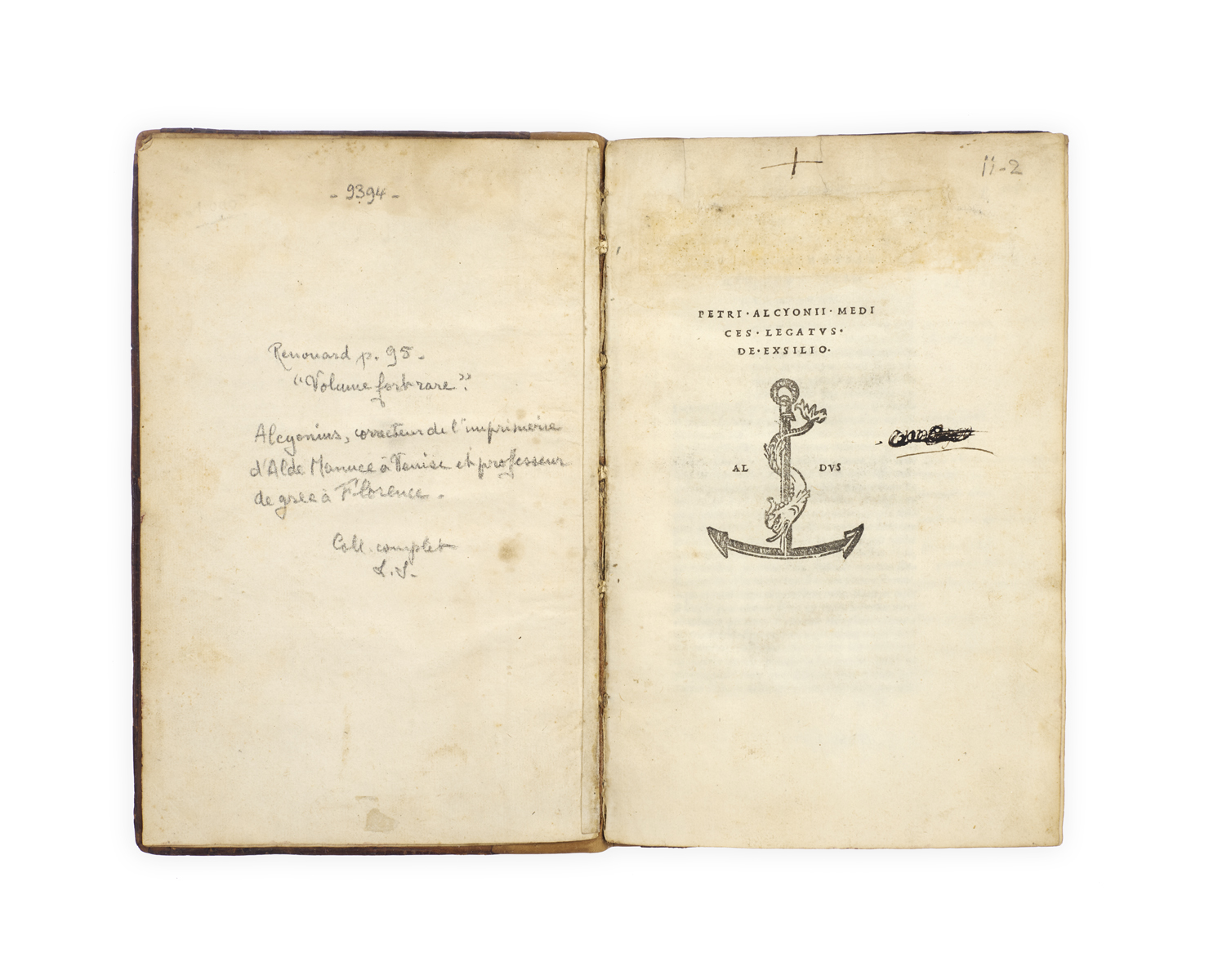
Petri Alcyonii Medices legatus de exsilio. [Venice, in the house of Aldus Manutius and Andrea Torresano, November 1522.]
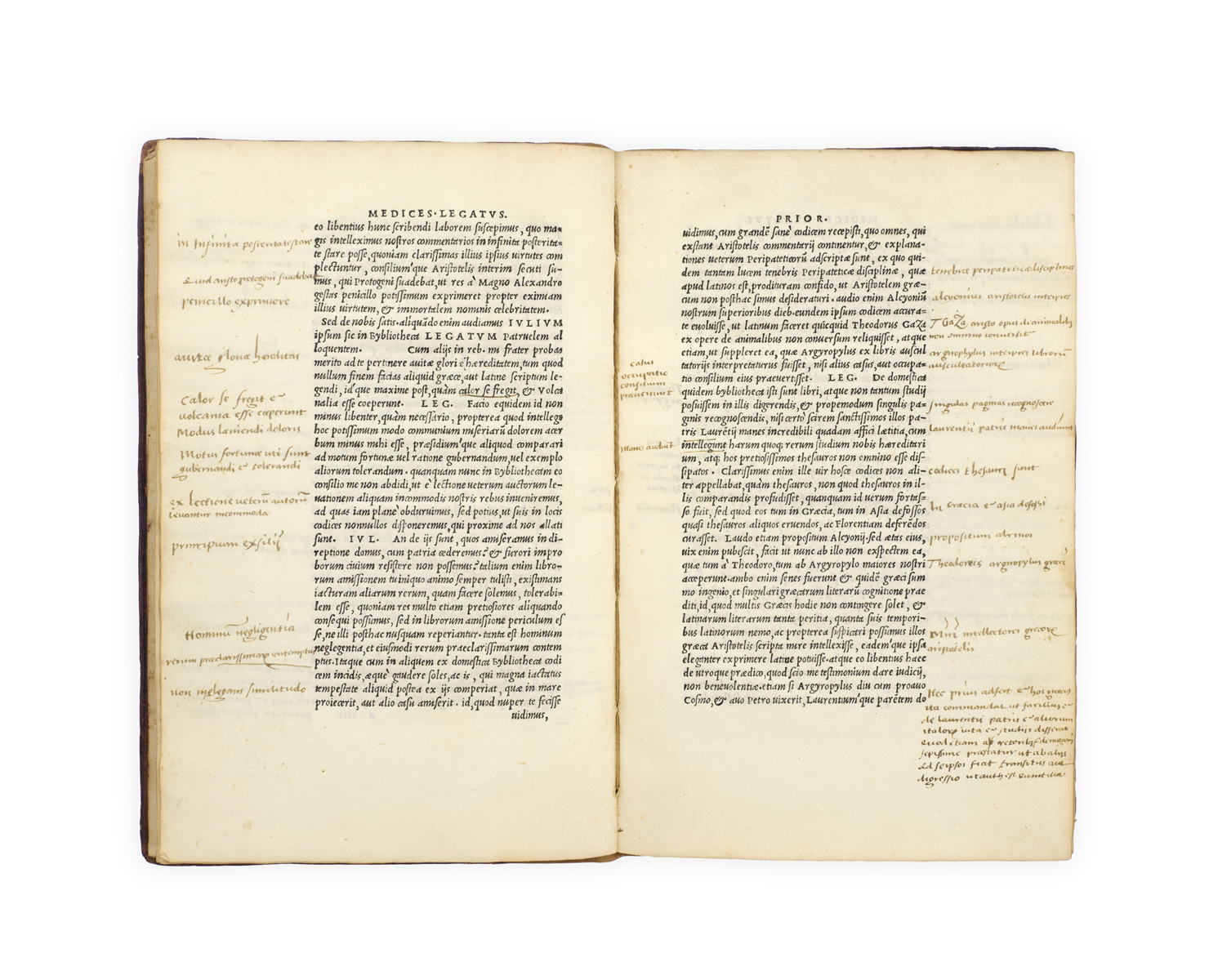
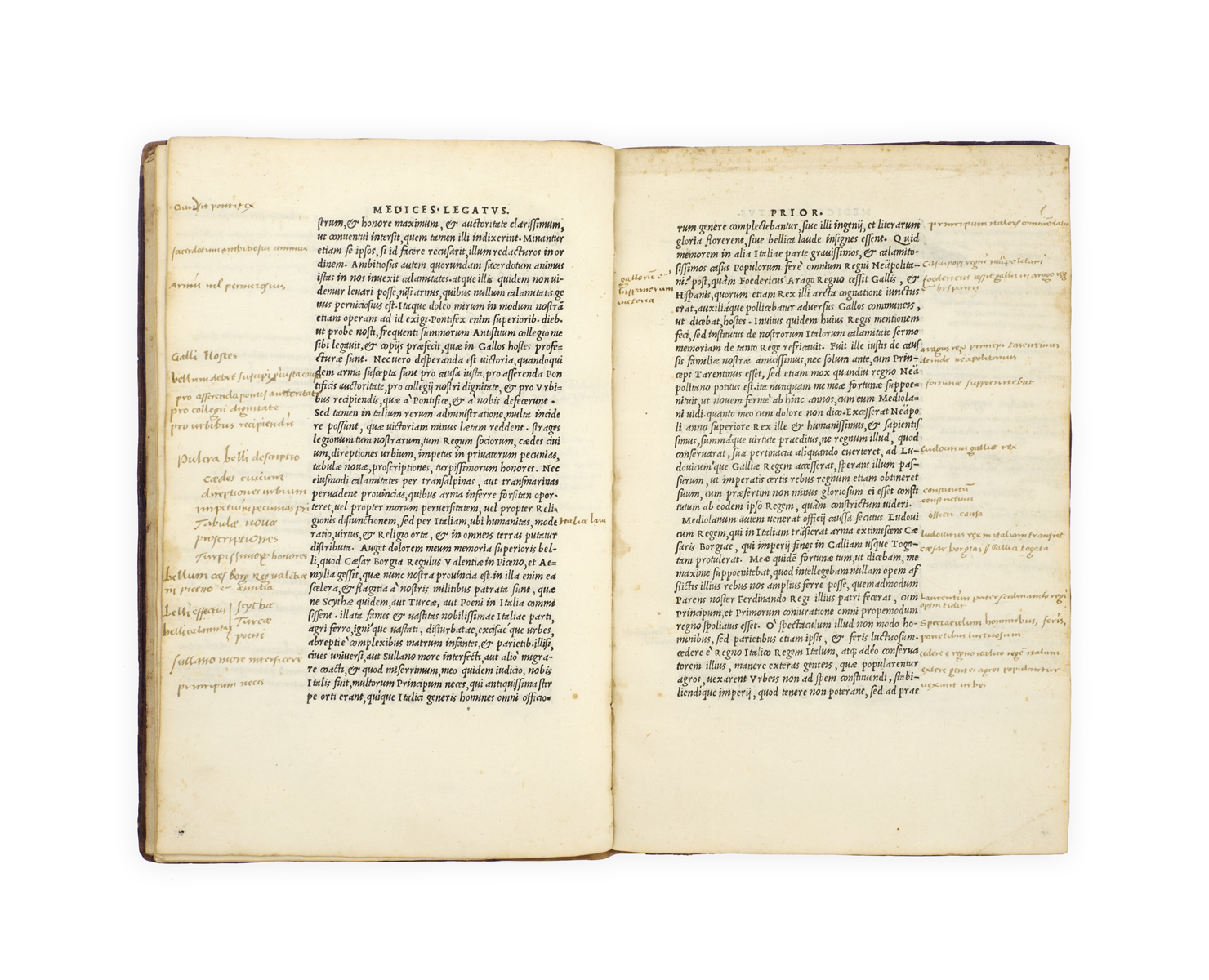
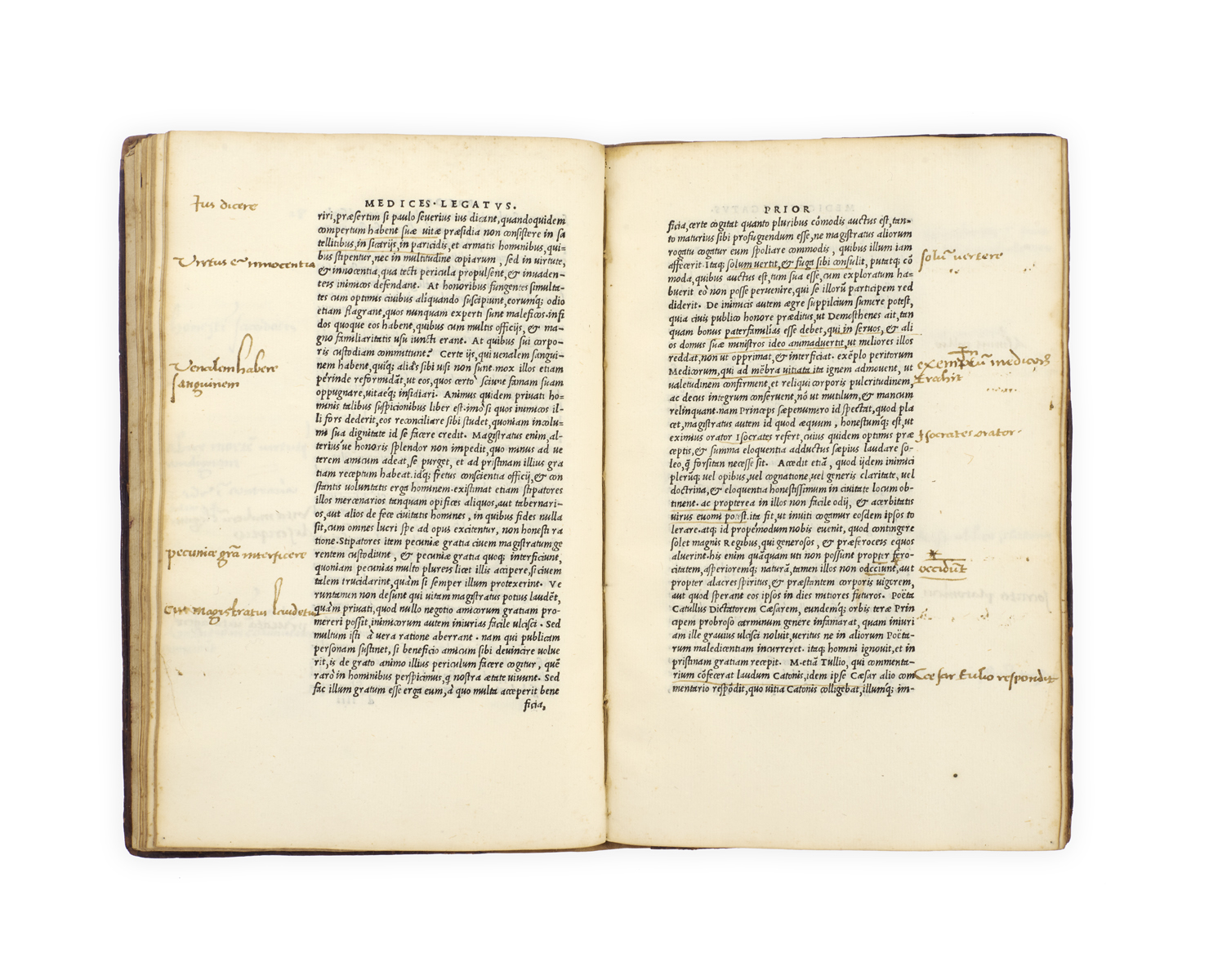
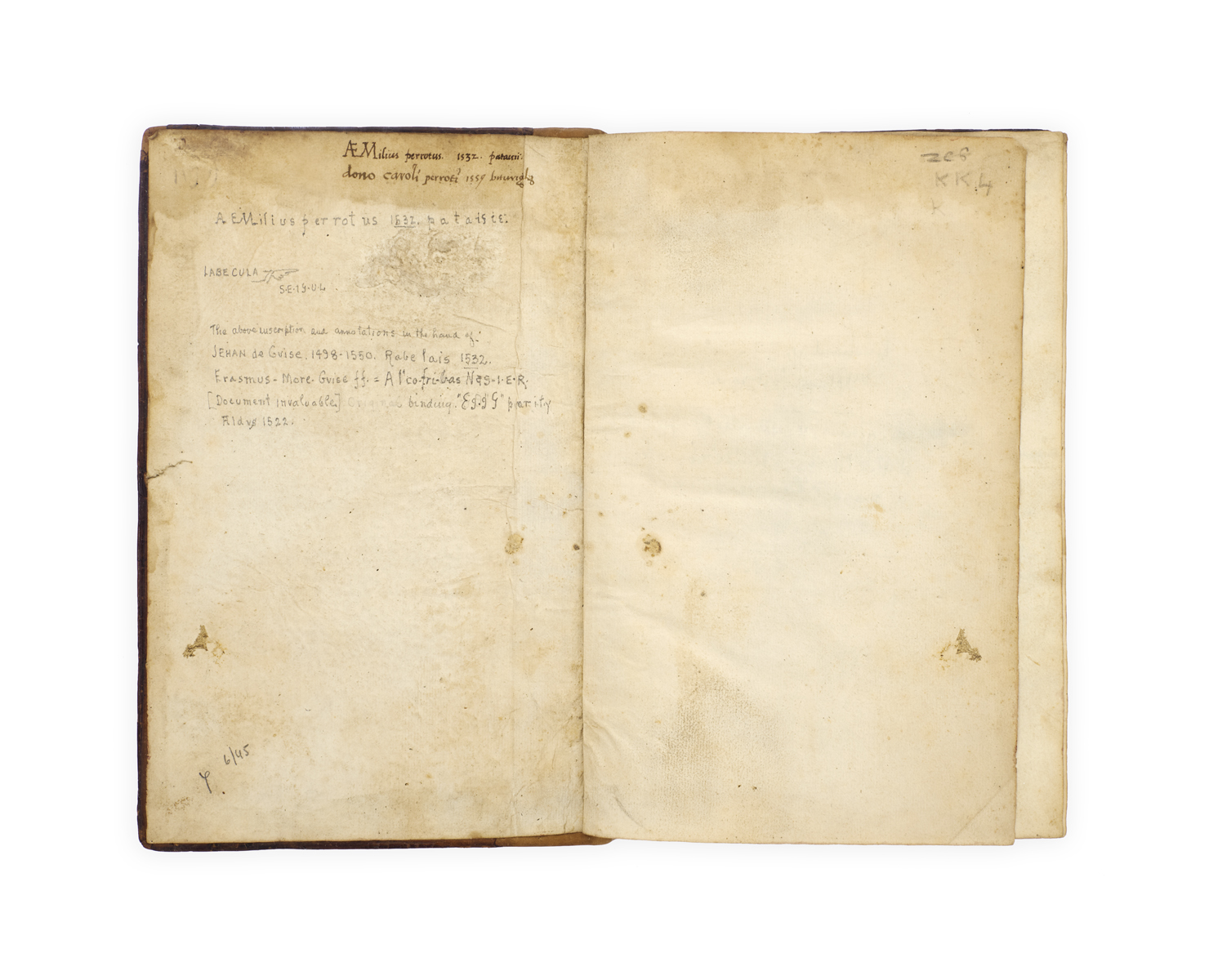
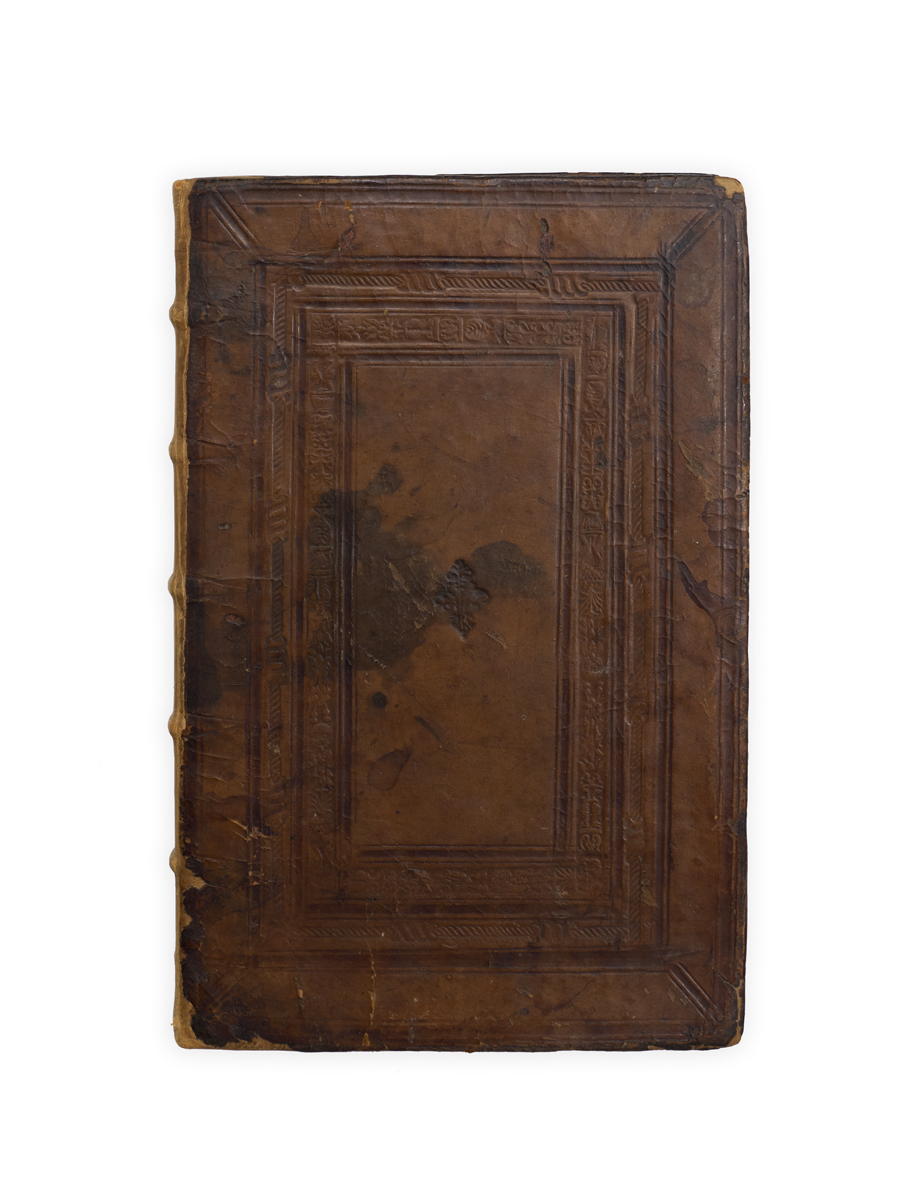
4to, ff. [70]; a–h8 i6, with blanks e7–8; printed in italic type, woodcut Aldine device to title and verso of final leaf; light stain to upper margin of title-page from removal of a slip, small ink stain to a7v, a few occasional slight spots, but a very good, wide-margined copy; bound in contemporary French calf, boards panelled in blind with 2 roll-tools and 1 triple-fillet, small floral centrepiece tooled in blind; neatly rebacked and recornered, a few minor scuffs and stains to boards; extensive early manuscript annotations to c. 74 pages of book I and first section of book II; ownership inscription ‘ÆMilius perottus. 1532. patavii.’ to front pastedown, with presentation inscription ‘dono caroli perroti 1559 biturgalis [Bourges]’ (see below), sixteenth-century inscription ‘D Claudio perroto’ to verso of last leaf, later (mostly eighteenth-century) inscriptions and shelfmarks to title and a2, largely obscured in ink, except for ‘Ex lib. … paris'.
First edition of Alcionio’s dialogue on exile, an intensely annotated copy from a family of French humanists and Reformers. Pietro Alcionio (or Petrus Alcyonius, fl. 1487–1527) was a Venetian humanist, scholar and Aristotelian translator who began his career as a proofreader for Aldus Manutius. His exceptional oratory skills were lauded by Erasmus in a letter to John Watson dated 1516. He honed his knowledge of Greek in Venice under the tutelage of Marcus Musurus of Candia, gained prominence under the patronage of Pope Clement VII, and is particularly remembered for his translations of Aristotle’s works.
In 1522, Alcionio was appointed as a professor of Greek in Florence, through the patronage of Giulio de’ Medici. It was at this time that he published De exsilio, a philosophical dialogue in two books set in 1512 featuring Giovanni de’ Medici (soon afterwards Pope Leo X), Giulio de’ Medici (later Pope Clement VII), and Lorenzo de’ Medici, Duke of Urbino. It was dedicated to Nikolaus von Schönberg, who had been appointed Archbishop of Capua by Pope Leo X and was a close friend to Giulio, and who in 1522 was living in Florence in exile from the Roman Curia. The dialogue explored the theme of exile in an exceptionally accomplished style, so reminiscent of Cicero that it gave rise to allegations (on the part of his rival Paulus Manutius) of it being an essentially plagiarised work, heavily based on Cicero’s lost work De Gloria. Later scholars were to refute this allegation, but at the time it affected Alcionio’s reputation deeply. Following Giulio de’ Medici’s accession to the papacy, Alcionio accompanied him to Rome. He was wounded during the Sack of Rome in May 1527, and died later that year.
This copy was owned and annotated by Émile (or Miles, Mileus) Perrot (c. 1505–1556), and bears his ownership inscription dated 1532. Born into a French bourgeois family, Perrot began his humanities studies in Paris under the tutelage of Guillaume Farel and took an interest in ideas surrounding the Reformation. He opted for studying the law, which he undertook in Toulouse, then Turin, and then Padua from 1530, where he graduated in Canon and Civil Law along with Michel de l’Hôpital. He returned to France in 1533, where he was appointed councillor of the Parliament of Paris and Baron (maître ordinaire) for the Treasury. It is interesting to note that while at the University of Padua, for reasons which remain unknown, in the spring-summer of 1531 Perrot was forced to leave Padua and seek refuge in the nearby town of Marostica: a form of exile (perhaps connected with his early sympathies for Reformed ideas) which must have engendered a very personal interest in this work, acquired by him the following year.
Such keen attention to the theme of Alcionio’s dialogue is evidenced in the copious marginal annotations and underlinings, which pick out the most salient moments in the text and occasionally offer brief expansions.
Émile gifted this book to his son Charles at Bourges in 1559. Charles (1541–1608) studied at the Geneva Academy, and in 1564 became a minister. He married Sarah Cop, daughter of Michel Cop, the Swiss Protestant Reformer and friend of John Calvin. In 1567 Charles became a citizen of Geneva and served as a minister in the city from 1568 until his death, twice assuming the role of rector at the Academy.
EDIT 16 CNCE 859; USTC 808459; Adams A 633; Renouard 95/6; UCLA 215.