
Macaronic Verse on War, Student Life, and Dancing
ARENA, Antoine.
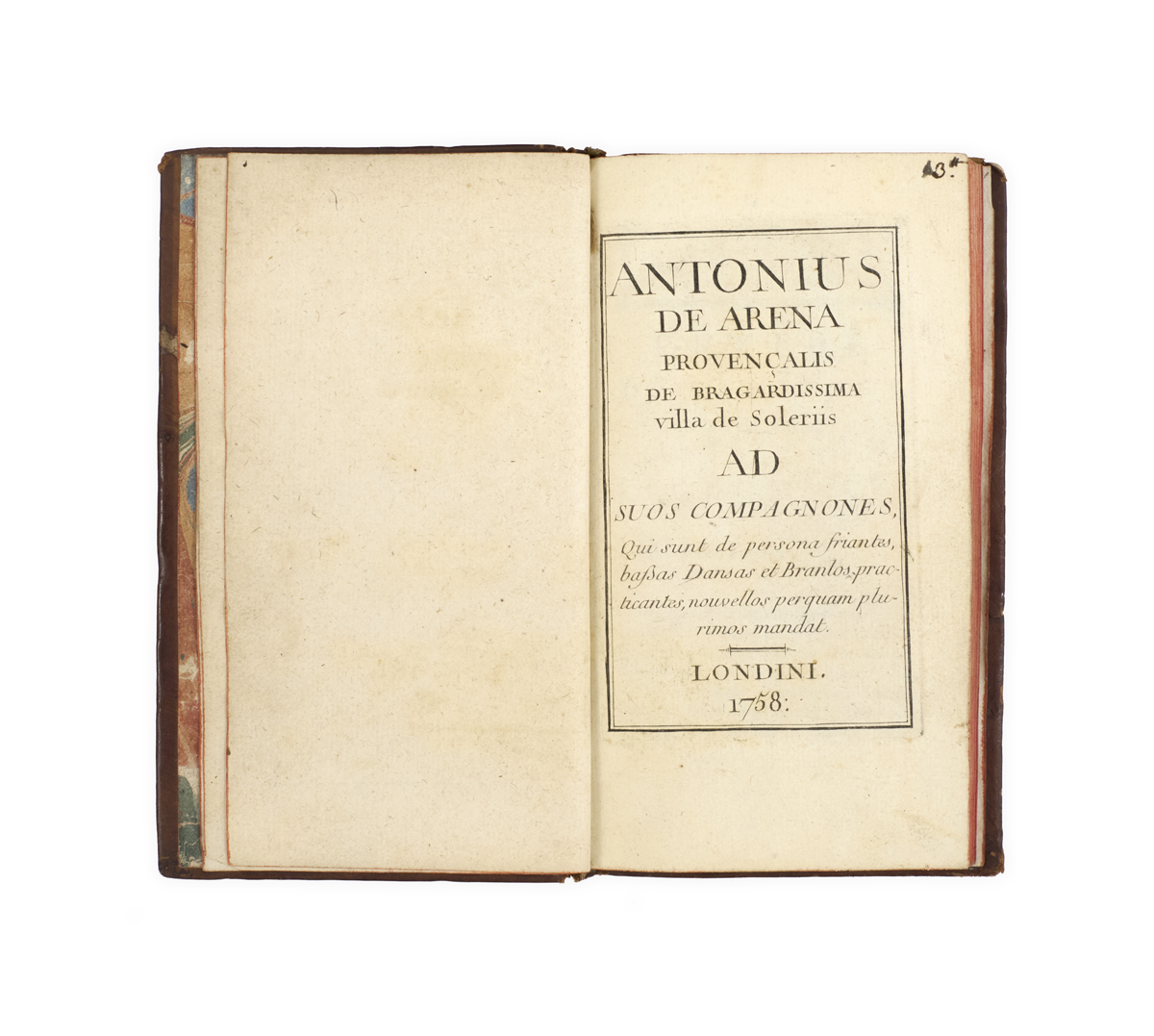
Antonius de Arena Provençalis de bragardissima villa de Soleriis ad suos compagnones, qui sunt de persona friantes, bassas dansas et branlos practicantes, nouvellos perquam plurimos mandat. London [i.e. Paris, Joseph-Gérard Barbou], 1758.
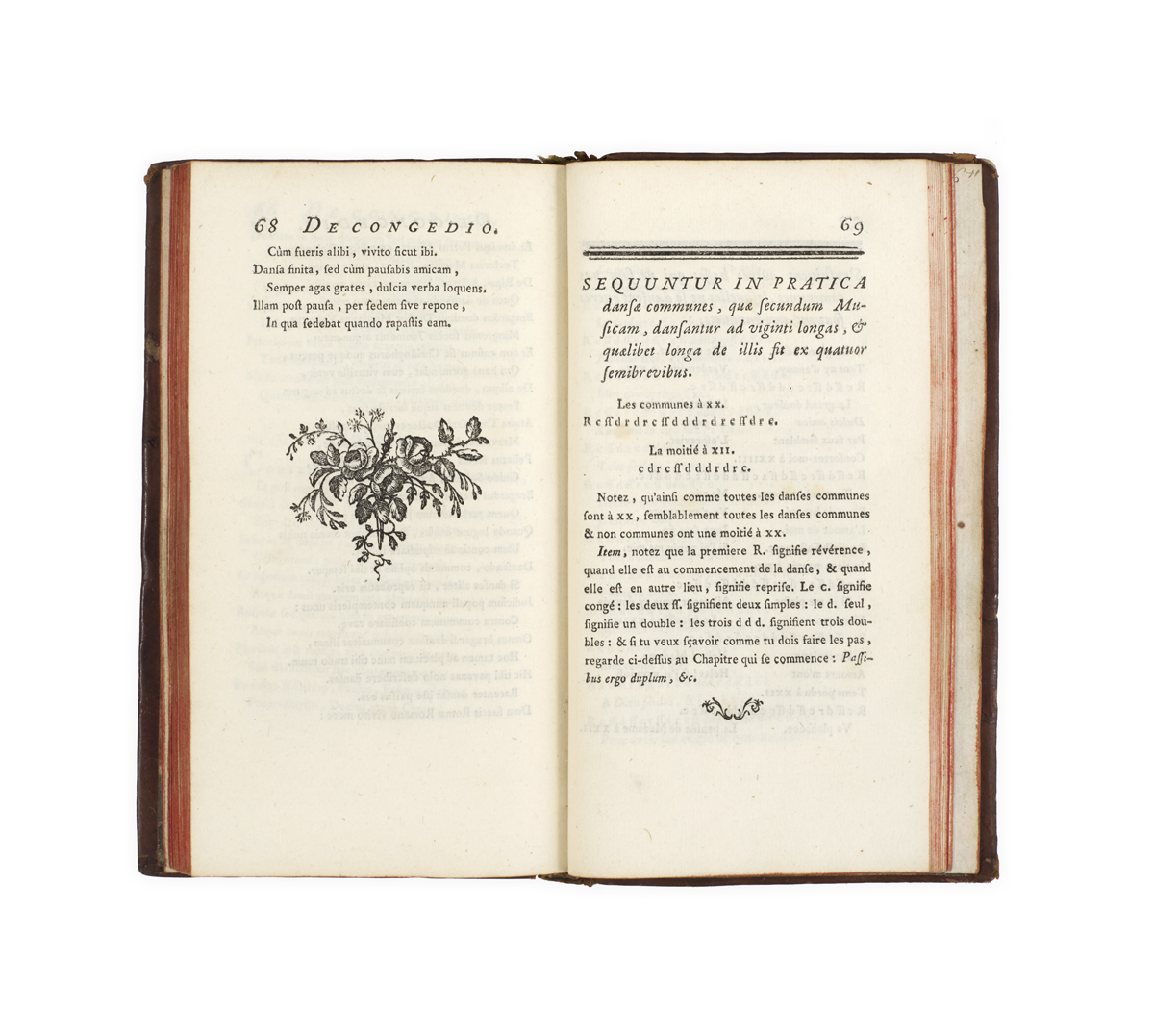
12mo, pp. [vi], xiv, 94; engraved title-page, head-, and tailpieces; some light spotting to first and final leaves; a very good copy in contemporary mottled sheep, triple gilt fillet border to covers, flat spine gilt in compartments to a floral design, gilt morocco lettering-piece, marbled endpapers, edges stained red; light wear to joints, corners worn, small chip to rear cover; old inscription to front free endpaper, price inked at head of title.
Added to your basket:
Antonius de Arena Provençalis de bragardissima villa de Soleriis ad suos compagnones, qui sunt de persona friantes, bassas dansas et branlos practicantes, nouvellos perquam plurimos mandat.
A fine copy of the 1758 edition of this popular macaronic poem by the Provençal poet Arena (c. 1508–63), first published in 1528, an early example of the genre and an important primary source for the basse-dance, a court dance performed in France and England between 1450 and 1550.
Arena was a law student at the University of Avignon, a soldier in the French army, and later a judge at Solliers; no fewer than forty-one editions in two recensions of the Ad suos compagnones appeared up to and including 1758. Macaronic verse, of which Arena is the earliest and most notable French exponent, was particularly popular in the sixteenth and seventeenth centuries, and was written in the vernacular and given the appearance of Latin through the use of Latin constructions and inflexional endings.
A delightful combination of Latin, Provençal, and Italian, the Ad suos compagnones is something of an odd thematic mix. It begins with Arena’s harrowing eyewitness account of the Sack of Rome in 1527 by Charles V’s army, during which thousands were killed and many atrocities committed (‘Oy! mater de Christo, omni la nocte criabam, Frigore de grando mane gelatus eram’). Then follows an account of the subsequent war of Naples and revolt of Genoa in 1528. From war, Arena moves to the lighter subject of the students of Provence, who, he tells us, are fine fellows, forever in love with pretty girls (‘et bellas garsas semper amare solent’), and to the art of dancing. It was this section, amounting to a dancing manual, which was the work’s chief appeal, and which accounted for the thirty-nine editions published in Lyons and Paris in the sixteenth and seventeenth centuries before a decline in the popularity of macaronic verse from 1650. Arena here employs an intriguing stenographic notation system for designating dance steps.
Ad suos compagnones was Arena’s first work and was followed by Meygra entrepriza catoliqui imperatoris (1537), a satirical description of Charles V’s invasion of Provence in 1536 in the face of courageous resistance from the locals.
According to Mullally, the London imprint of this edition is false, the typographic ornaments pointing to Barbou as the publisher. Mullally notes another 1758 ‘London’ edition with a printed title-page.
ESTC T135900; Brunet I, col. 394; not in Quérard. See Mullally, ‘The Editions of Antonius Arena’s “Ad suos compagnones studiantes”’, in Gutenberg-Jahrbuch (1979), pp. 146–157.