‘Most Complete’, with Forty Emblems
BÈZE, Théodore de.
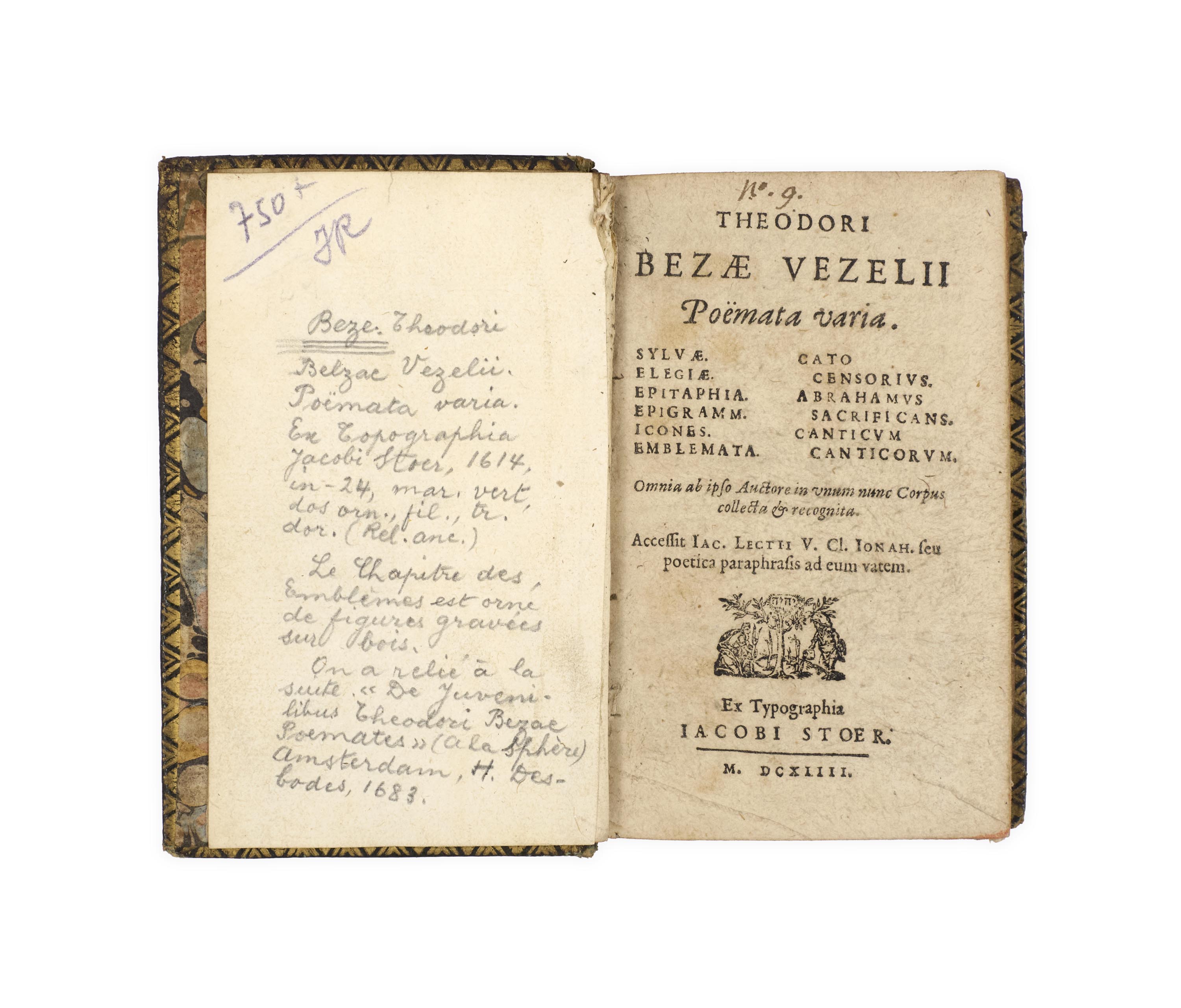
Poemata varia: Sylvae, Elegiae, Epitaphia, Epigramm., Icones, Emblemata, Cato censorius, Abrahamus sacrificans, Canticum canticorum … Geneva, Jacques Stoer, 1614.
[bound with:]
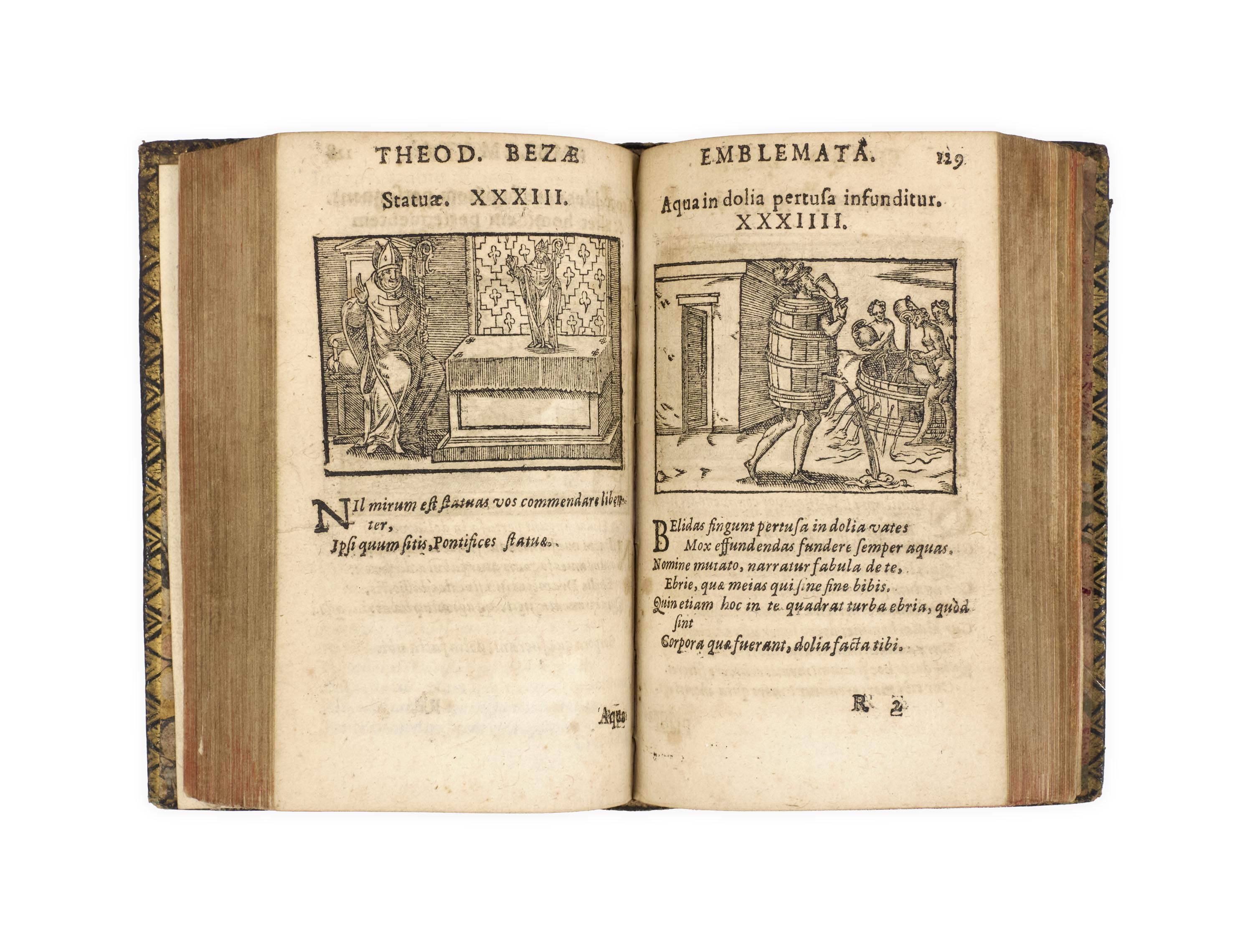
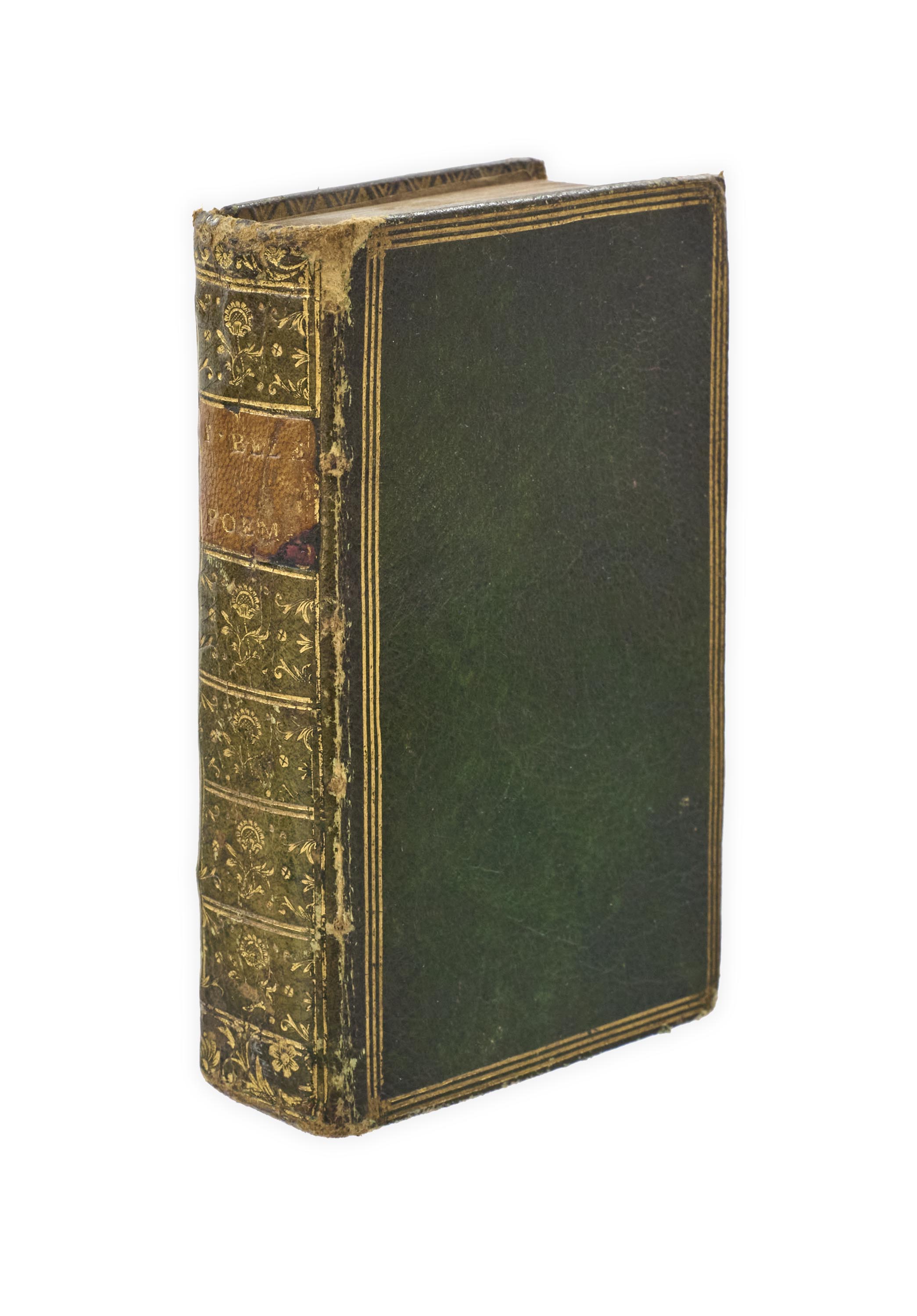
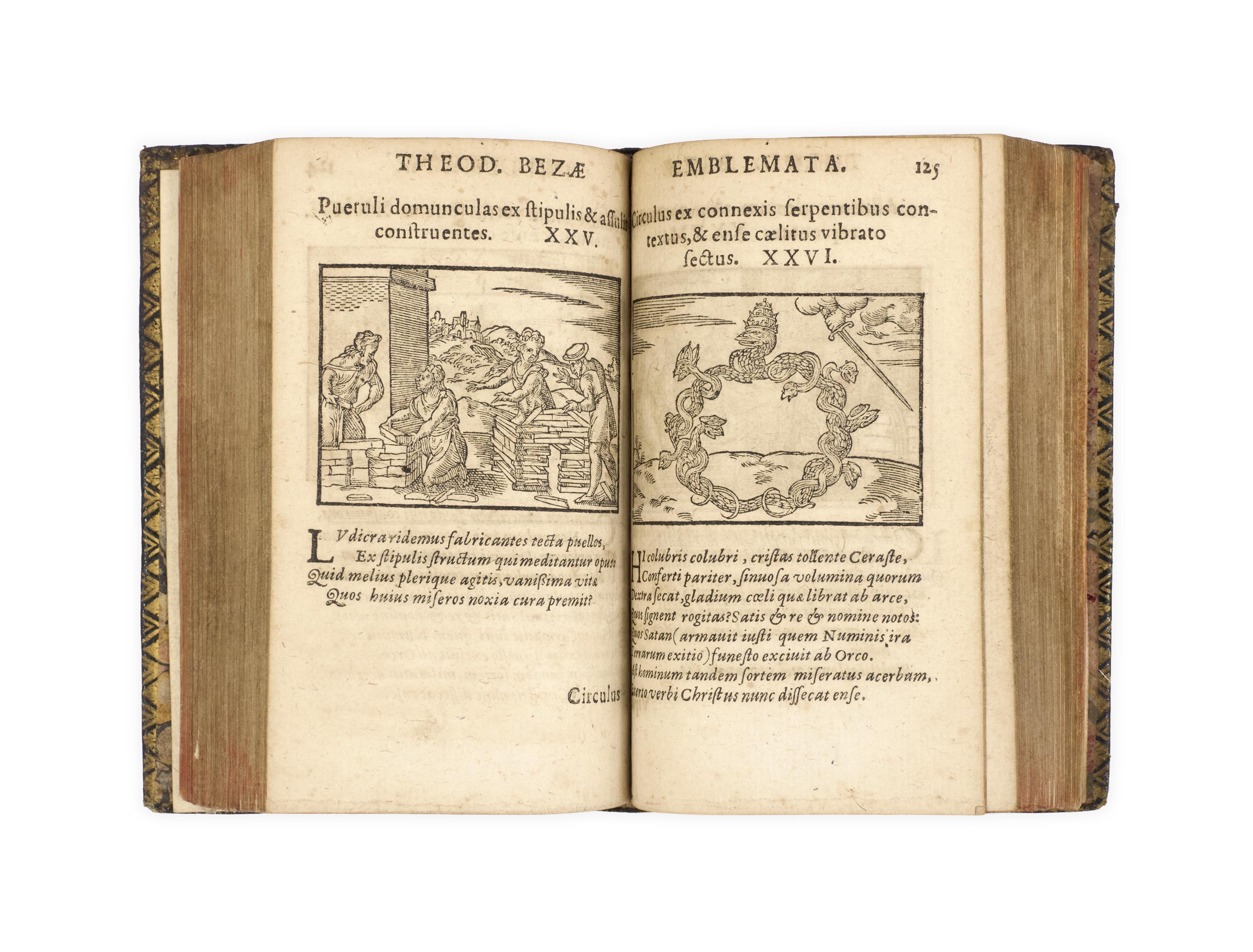
[GRAVEROL, Jean, attributed.] De juvenilibus Theodori Bezae poematis epistola ad N.C. qua Maimburgius aliique Bezae nominis obtrectatores accurate confutantur … Amsterdam, Henri Desbordes, 1683.Two works in one vol., 16mo, Bèze: ff. [10], VI, ‘206’ (recte 216); with 40 woodcut emblems in the text, a further 4 empty woodcut borders, and woodcut of author’s arms, divisional titles within woodcut borders, woodcut device to title, woodcut initials, woodcut head- and tailpieces; Graverol: pp. [iv], 64; woodcut Marteau device to title, woodcut headpiece; very occasional light foxing and toning, Graverol cut close at foot shaving a few catchwords and footnotes, but nonetheless very good copies; bound in eighteenth-century green morocco, spine gilt in compartments with gilt red morocco lettering-piece, edges gilt, marbled endpapers; a little rubbed at extremities, spine slightly sunned, small chip to lettering-piece; ‘Bibliotheca Heberiana’ ink stamp to front flyleaf, armorial bookplate of Charles James Stuart to front pastedown.
Added to your basket:
Poemata varia: Sylvae, Elegiae, Epitaphia, Epigramm., Icones, Emblemata, Cato censorius, Abrahamus sacrificans, Canticum canticorum …
One of the two ‘most complete’ (Gardy) editions of de Bèze’s verse, which includes the Icones and Emblemata, here bound with a copy of an anonymous defence of de Bèze’s poetry against his detractors; the Heber copy, in handsome gilt green morocco.
The great French theologian Théodore de Bèze (or Beza, 1519–1605) renounced Catholicism in 1548 and became professor of Greek at Lausanne, moving in 1558 to Geneva at Calvin’s invitation. On Calvin’s death in 1564 he became head of the Genevan Church and leader of the Calvinist movement in Europe. De Bèze’s activity and influence as a religious reformer, theologian, and scholar were extraordinary. Poetry, though, was the earliest of his endeavours – the mode which marked his output as a humanist. After the publication of his verse Juvenilia, his religious, theological and pastoral preoccupations became wholly dominant. It was only towards the end of his life that de Bèze took up his Poemata again, purged his youthful exuberance, and added much new content, published by Henri Estienne in 1597 but expanded and completed by Jacques Stoer in 1598, after Estienne’s death; Stoer’s sextodecimo edition (Geneva, 1599), which this edition follows, was considered the most complete.
The woodcut emblems first appeared at the end of the 1580 edition of de Bèze’s Icones, following his descriptions of famous men and women, and subsequently included (as here) in editions of his poetry.
Provenance:
1. Richard Heber (1773–1833); his first sale, Sotheby’s, 10 April–9 May 1834, lot 802 (‘blue morocco’).
2. Sir Charles James Stuart (1824-1901), 2nd baronet.
De Bèze: USTC 6702764; Adams, Rawles & Saunders F.108; Landwehr, Romanic 158; Gardy, Bibliographie … de Bèze 12/2. Graverol: STCN 844137596; USTC 1826481.