

Matriarchy Enforced by Extra-Terrestrials
[BOUDIER DE VILLEMERT, Pierre-Joseph.]
L’Andrometrie, ou examen philosophique de l’homme. Par Monsieur l’Abbé de Villemaire. Paris, chez Brunet, 1753.
[bound with:]
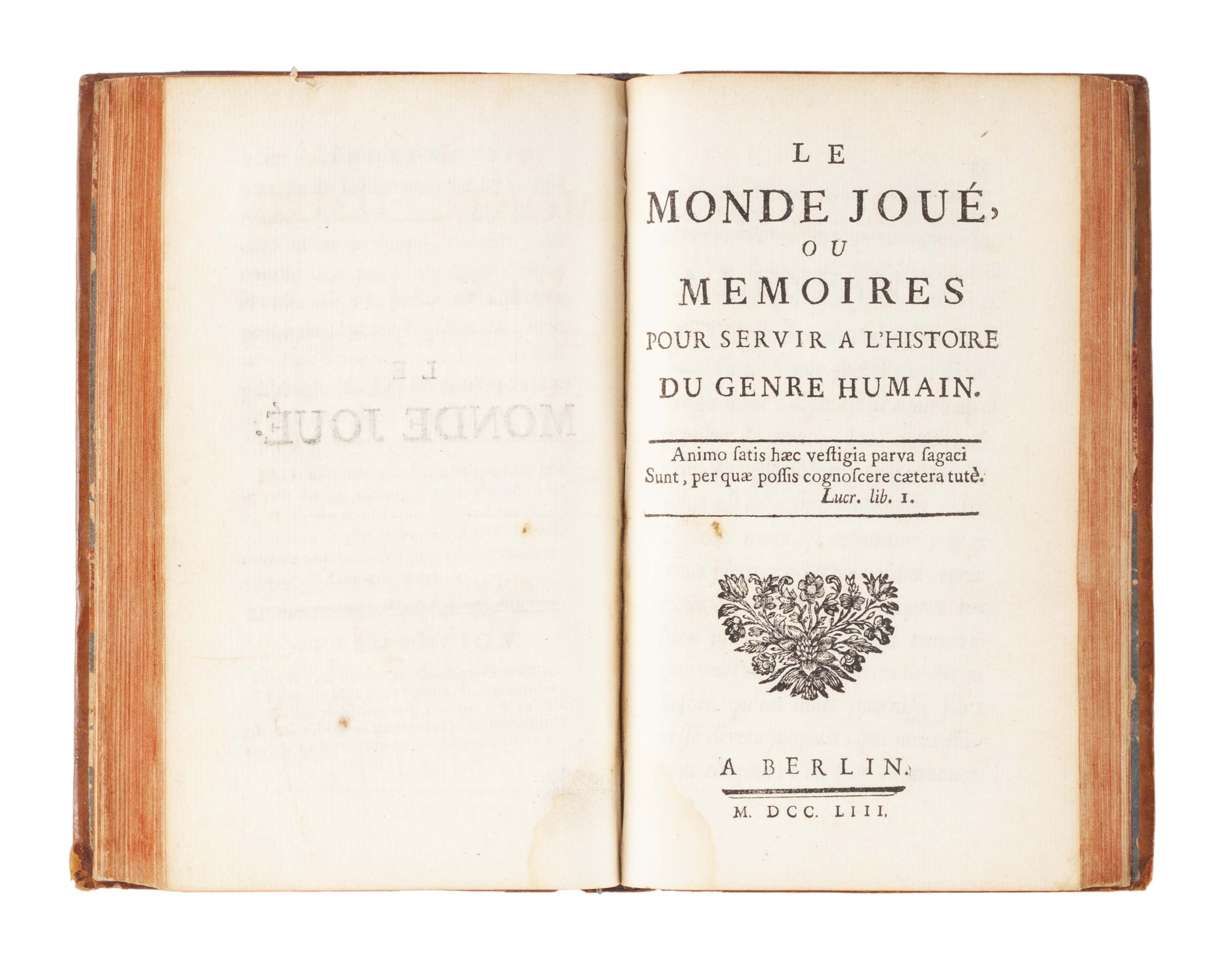
[‘POLYTHALASSE, Abel’, pseud. Pierre-Joseph BOUDIER DE VILLEMERT.]Le Monde joué, ou memoires pour servir a l’histoire du genre humain. ‘A Berlin’ [i.e. Paris, Bernard Brunet], 1753.
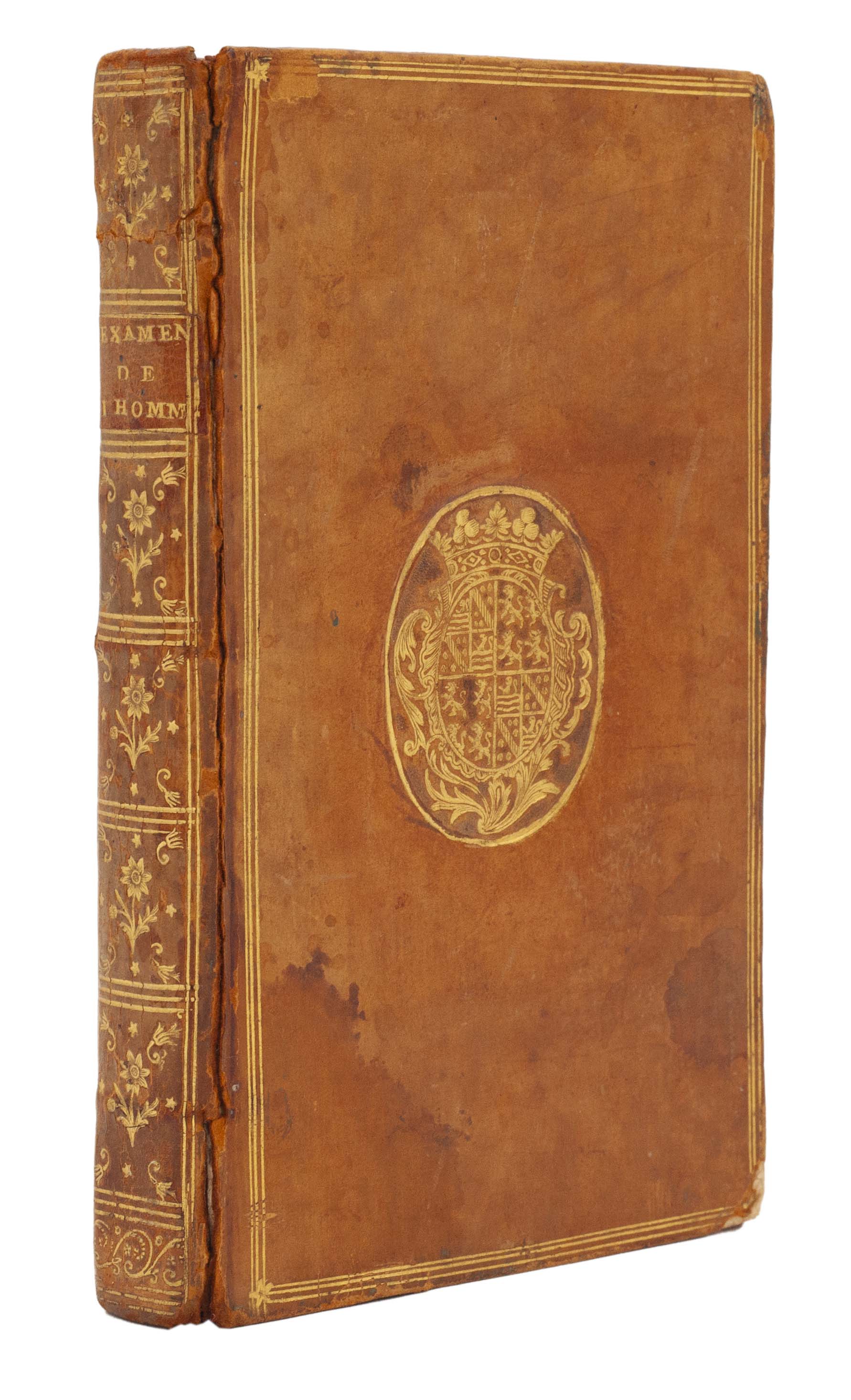
Two works in one vol., 12mo, pp. vi, 162; [2], vi, 108; woodcut initials, woodcut and typographic head- and tailpieces; a few small chips to fore-edge of first title, occasional very light marginal dampstaining, some loss to fore-edge of last leaf of second work (not touching text); overall very good copies bound together in contemporary calf, triple fillet border to covers, flat spine gilt in compartments with lettering-piece, red edges, marbled endpapers; upper joint split but holding firm, some wear to extremities and marks to boards; arms of the marquis d’Attilly stamped in gilt to covers, remains of bookplate to front pastedown.
Added to your basket:
L’Andrometrie, ou examen philosophique de l’homme. Par Monsieur l’Abbé de Villemaire.
First editions of two scarce works by the philosopher, moralist, and Parisian avocat Boudier de Villemert (1716–1801), best known as the author of L’Ami des Femmes, Le monde joué involving visits from extra-terrestrials both in ancient times and in the eighteenth century.
Inspired by Rousseau, L’Andrometrie provides a most interesting ‘philosophical examination of mankind’. Boudier de Villemert’s portrait is far from pretty: man is driven by self-interest and worthless passion, is blind to his faults, arrogant, vain and lazy, is more prone to dreaming than reasoning, is forever seeking happiness in the wrong places (in riches, greatness, or pleasure), and his enormous published output only proves his mediocrity and ignorance. ‘Science, talent, riches, honours – grand words which signify little’, the author writes, ‘and by little I mean everything that by its nature makes man neither better nor happier’ (pp. 57–58, trans.).
There is an interesting chapter on arts and manufactures, considering products which are useful and those that merely please, criticising man’s taste for luxury, and another on the rationalism-versus-empiricism debate, the author advocating a union of reason and the senses as the best means to acquiring knowledge. A footnote on bibliomania (p. 59) points to its existence long before the invention of printing. A second edition of L’Andrometrie appeared in 1757, likewise scarce.
The second work, Le Monde joué, is a satire on human society and fashions. In the first part an extra-terrestrial called Zouzou visits Earth in ancient times and witnesses the development of trade, the arts, and literature, becoming bored, however, when mankind begins philosophising. In the second part he revisits our planet in the eighteenth century accompanied by his friend Zinzin, the pair of aliens amusing themselves in subjugating men to women and making men adopt female dress and fashion.
Provenance: with the arms of Claude-Louis de Bullion, marquis d’Attilly (1692–1755) (OHR 641).
L’Andrometrie: No copies traced in the UK or US. Le Monde joué: OCLC finds three copies in the US (Harvard, Maine, University of Pennsylvania), and two in the UK (Bodley, CUL).
VD18 10314407 (second work); Querard I, p. 443 (both works).