CHOUFFE, Jean-Baptiste-P.
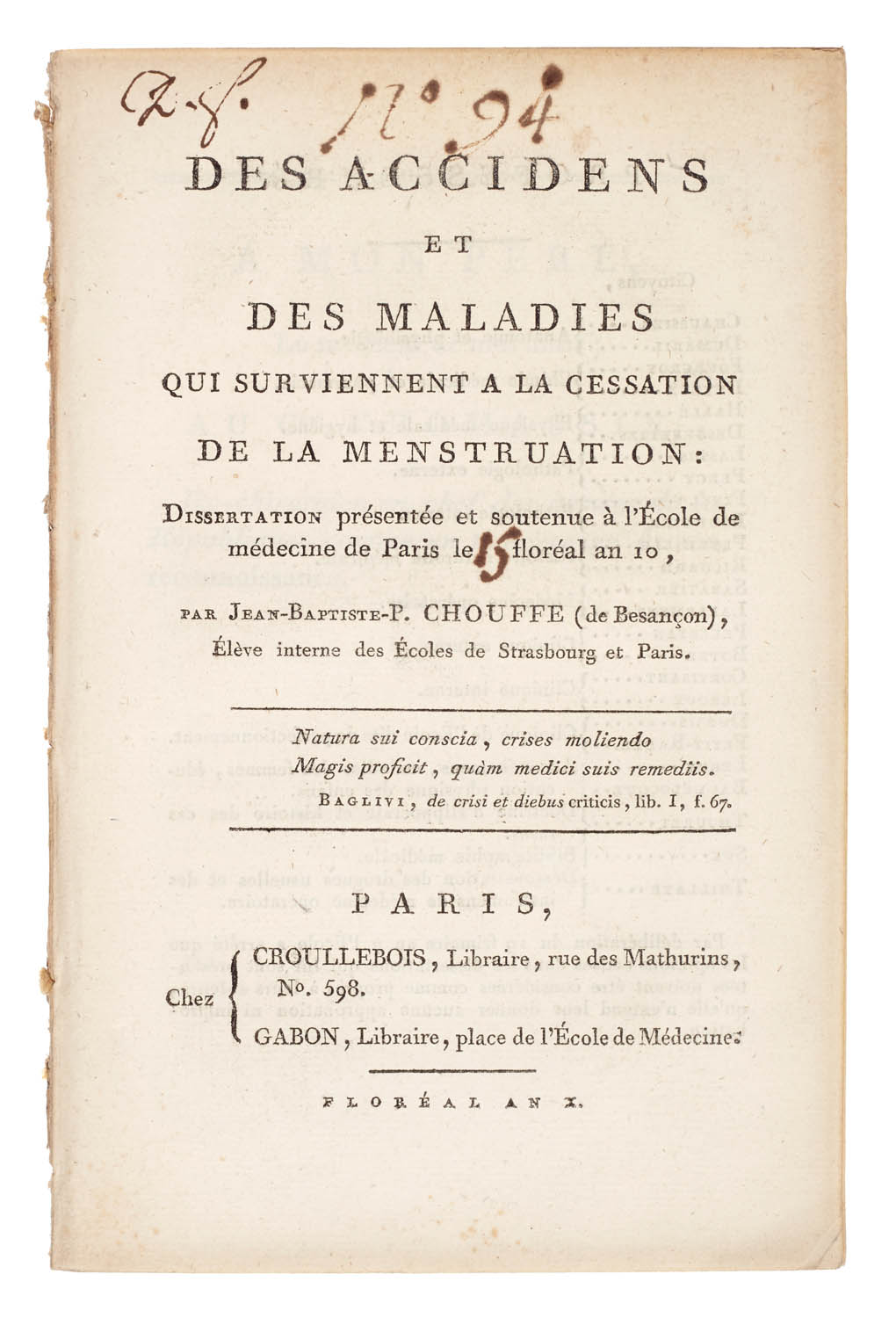
Des accidens et des maladies qui surviennent à la cessation de la menstruation. Paris: Croullebois et Gabon, Floréal an X [April-May 1802].
8vo, pp. [iv], 56; mild foxing and very mild browning, especially on first and last ll., very small loss from lower corner of first l.; disbound [and probably extracted from a Sammelband]; a very good copy, with broad margins; ‘[?]Diss. No 94’ (note in a contemporary hand on the title, for which vide infra; date ‘15’ inserted in a contemporary hand in the blank space before the letterpress text ‘floréal an 10’ on the title).
Added to your basket:
Des accidens et des maladies qui surviennent à la cessation de la menstruation.
First and only edition. This work discusses the cessation of menstruation and its causes, beginning with female bodies and the changes they undergo from puberty to old age. Chouffe, formerly a military doctor, then focuses on ten case studies of individual patients in whom the menses had ceased, aged ca. 36 to 54. These derive from extant medical literature rather than clinical experience, and Chouffe comments on the evidence presented in his selection of cases in his footnotes, so that the dissertation is evidence of the academic study upon which the Paris medical course was built – a type of knowledge which would increasingly be supplemented with the practical experience of midwives on maternity wards in the following years. The list of academics on the verso of the title includes prominent exponents of the two contrasting approaches to women’s health (midwifery pioneer Jean-Louis Baudelocque (1745-1810), the most eminent obstetrician of his time; and his adversary, traditionalist Alphonse-Louis Leroy (1742-1816)). The case studies are followed by general observations on the presentation and causes of menopause and a discussion of hygiene measures to control the same. This prophylactic part, Chouffe’s original contribution to the subject, includes details on lifestyle and diet. The benefits of exercise and air as opposed to medication offered by charlatans, and patients’ enthusiasm for the latter, make for particularly interesting insights into the medical marketplace of Paris at the turn of the nineteenth century.
Des accidens et des maladies enjoyed an international and diverse reception. It was listed in French obstetrics text books very soon after its publication, and appeared in French medical dictionaries under the heading of menstruation. It was also included in a German biographical dictionary of ‘living medical authors’ (A.C.P. Callisen, Medicinisches Schriftsteller-Lexicon, 1830-45), and helped his contemporaries to better understand diseases of ‘oxigenation’. Most interestingly, it was both part of the Astor Library (apparently thanks to the gift and bequest of the son of the founder, William B. Astor, from 1860 onwards, see catalogue of 1886) and in the Library of the Surgeon General's Office, United States Army (1873).
This work is very rare: OCLC/WorldCat only records copies at the British Library and McGill University, and two in French medical institutions; very scarce in commerce.