No Fun: a Catholic Review of the Moral Status of Games and Recreation
[GAMES AND RECREATION.]
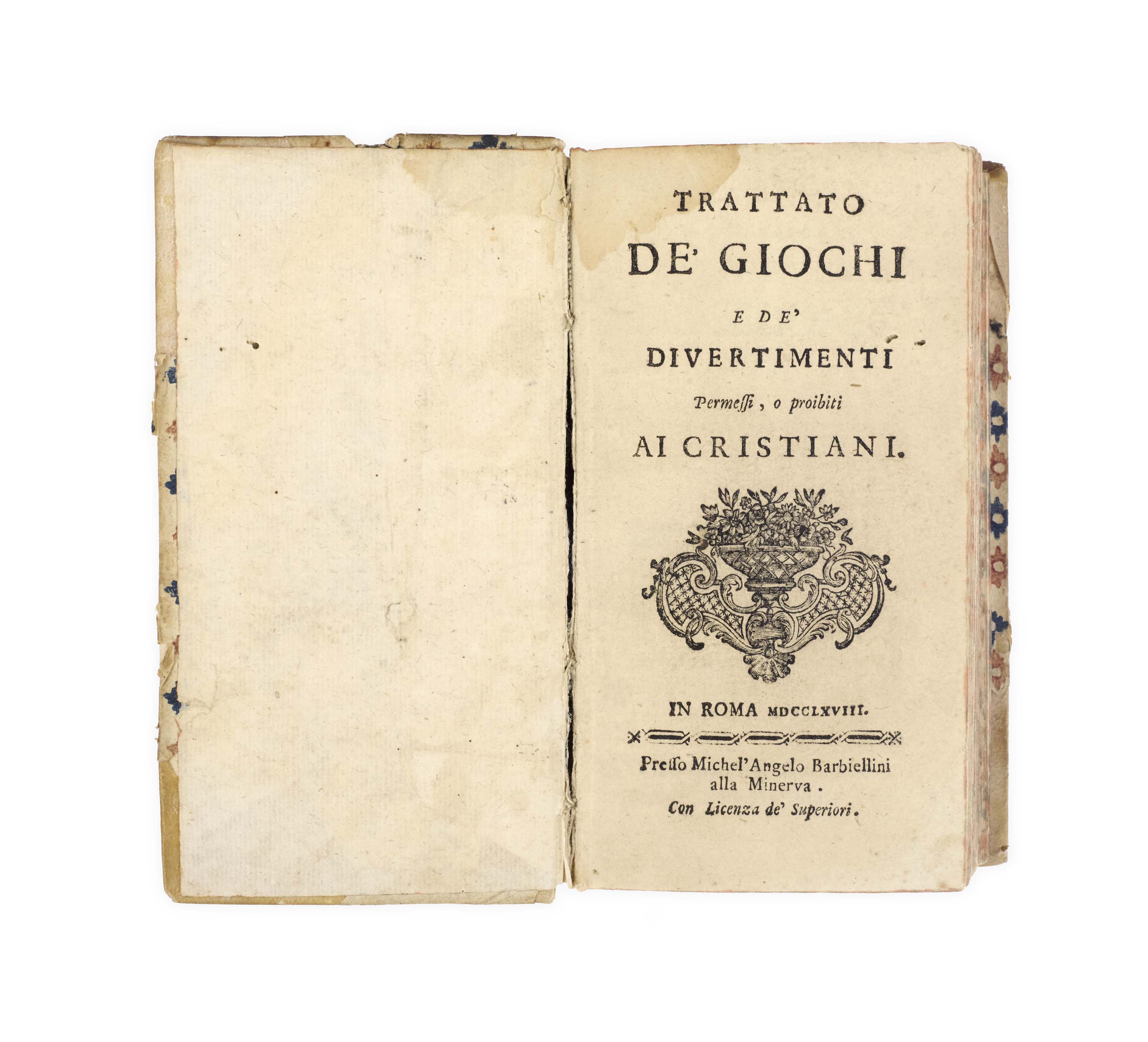
Trattato de’ giochi e de’ divertimenti permessi, o proibiti ai Cristiani. Rome, Michel'Angelo Barbiellini, 1768.
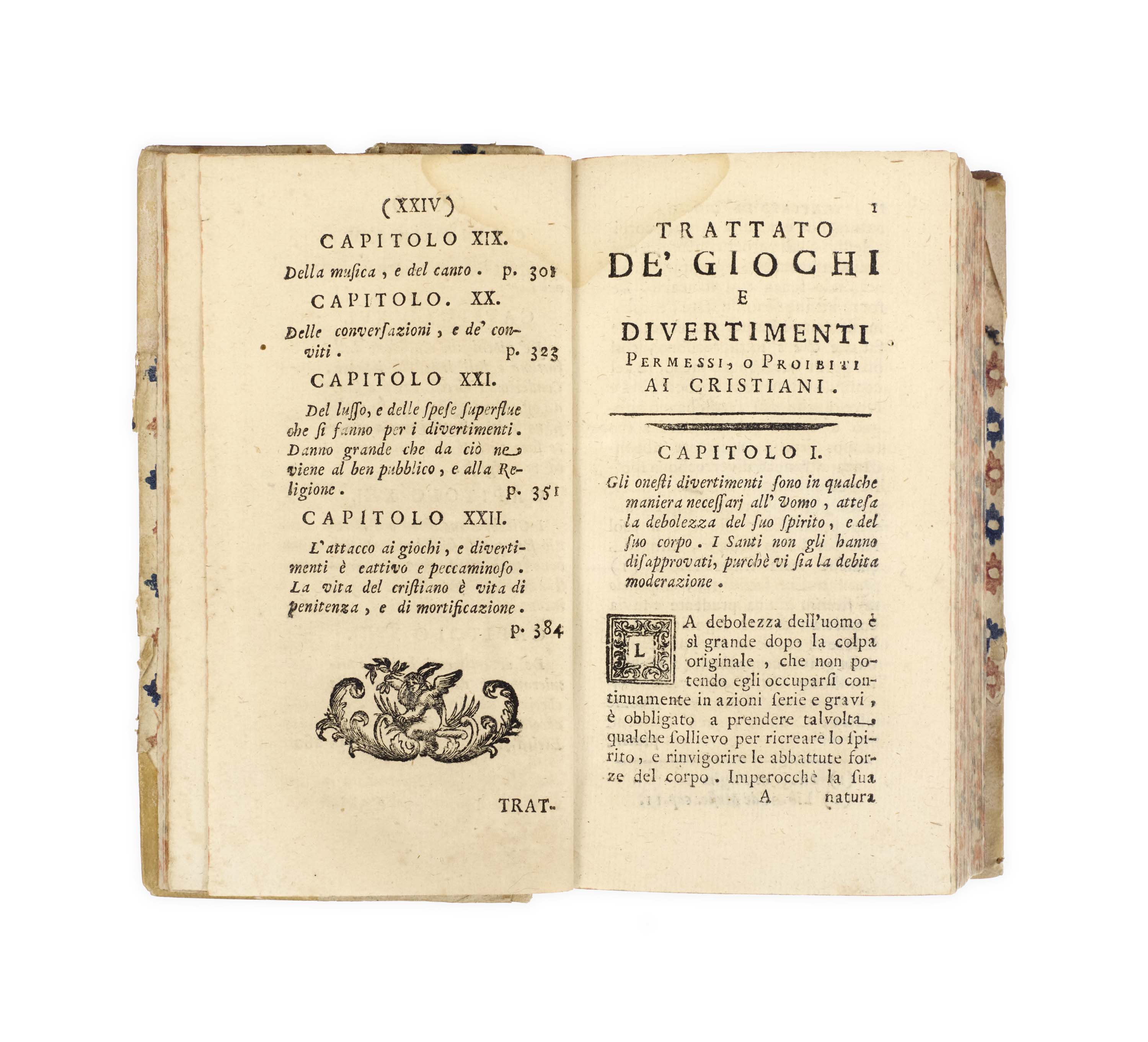
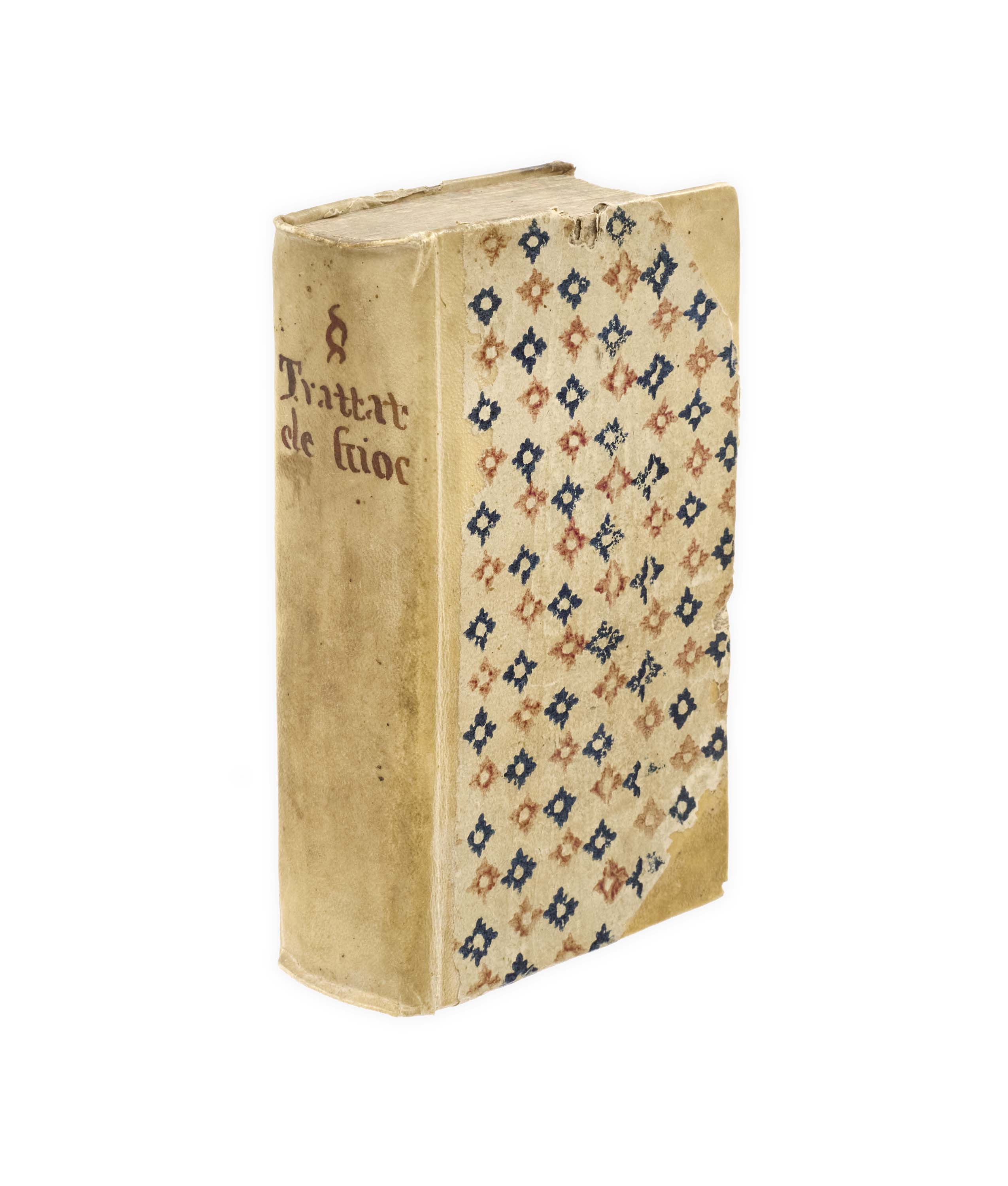
12mo, pp. xxiv, ‘396’ (recte 408), [1, imprimatur], [1, blank]; wormtrack to outer margin of first quires (up to F2)occasionally touching a couple of characters in a few leaves, a few marginal paper flaws, light waterstain to upper inner corner throughout, occasional very light spotting or browning, but a very good copy; bound in contemporary half vellum with printed patterned paper sides, title in manuscript to spine, spine lined with printed waste, edges speckled red and green; small chip in the upper edge of the front board, some rubbing to extremities.
Added to your basket:
Trattato de’ giochi e de’ divertimenti permessi, o proibiti ai Cristiani.
First edition of a treatise on games and recreation compiled in Rome by the publisher Barbiellini, with the purpose of providing a comprehensive ethical evaluation of all manner of diversions.
The treatise opens with a wide review of past literature on the subject – which the editor laments as fragmentary. At the time attitudes towards private recreation ranged from the austere, with games regarded as sinful or frivolous, to the more liberal, in which the potential for moral and physical development was recognised; our author is more in the former camp. Word games and choice of readings must be kept immune from profane or impious propositions, or even playful occurrence of saintly names. Games of chance are resoundingly condemned, but a qualification strikes the modern reader as important: the prohibition of card games extends only to the clergy, implying that underneath the lofty disregard for all manners of entertainment there lies an acceptance of certain social mores as deeply rooted in society. Sports fare much better, with due caution.
Theatre and music are severely reviewed, and at length: the former as, potentially, an outlet for vulgarity, the latter as a pleasure that must be pursued within strict confines of decorum. Reference is made to Pope Benedict XIV’s encyclical Annus qui nunc (1749), which, in line with the Council of Trent, aimed at purifying sacred music from indulgent ‘immoderate elements’ that had been introduced over time. Thus, this treatise reasserts the pre-eminence of chant and permits polyphony, so long as it should maintain the integrity and intelligibility of the texts. Fishing, hunting, private music, and conversation are then subjected to scrutiny, and finally luxury: in obvious contrast with the new ‘economists’ who argued that luxury stimulated trade and fostered innovation, our editor sides, unsurprisingly, with those who warned about consequences of moral decay and political instability.
Uncommon outside Europe: OCLC records three copies in the US (Getty, UCLA, Vanderbilt), two in the UK (BL, Oxford) and one in Australia (Catholic Institute of Sidney). Not in Melzi.