Pedantic Poetry
GAROFANI, Antonio Maria.
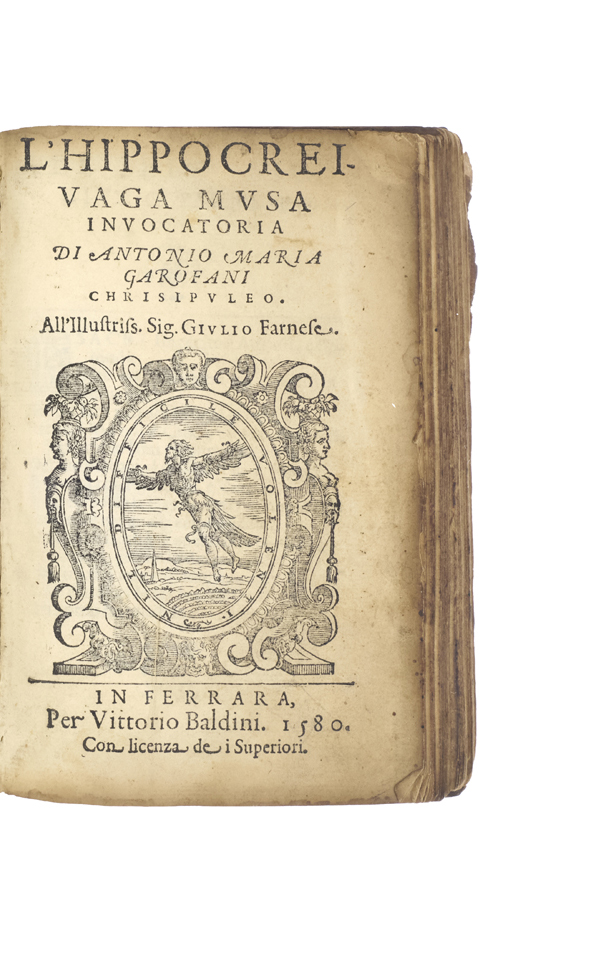
L’Hippocreivaga musa invocatoria. Ferrara, Vittorio Baldini, 1580 [(colophon:) 1581].
[bound with:]
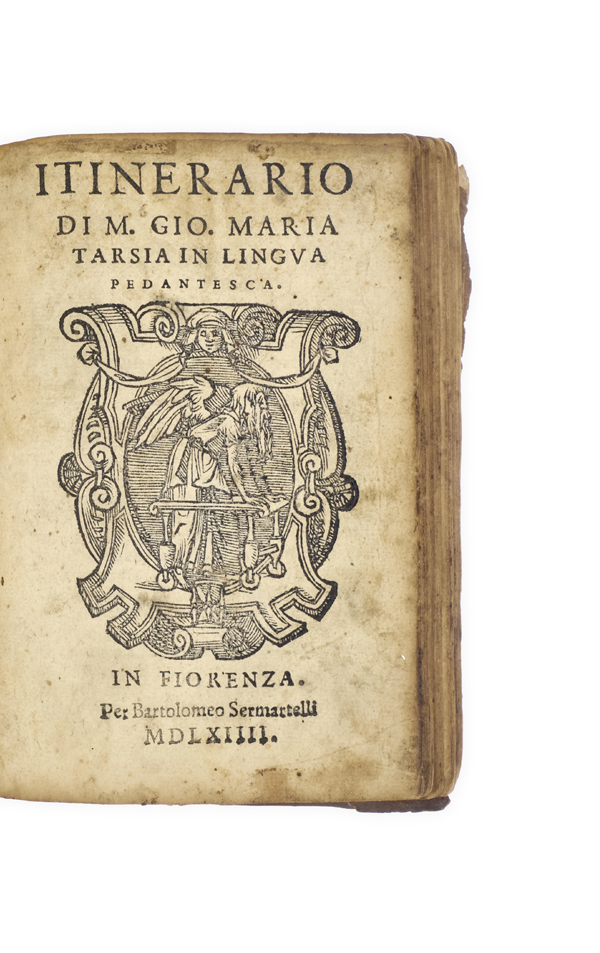
TARSIA, Giovanni Maria. Itinerario di M. Gio. Maria Tarsia in lingua pedantesca. Florence, Bartolomeo Sermartelli, 1564.[and:]
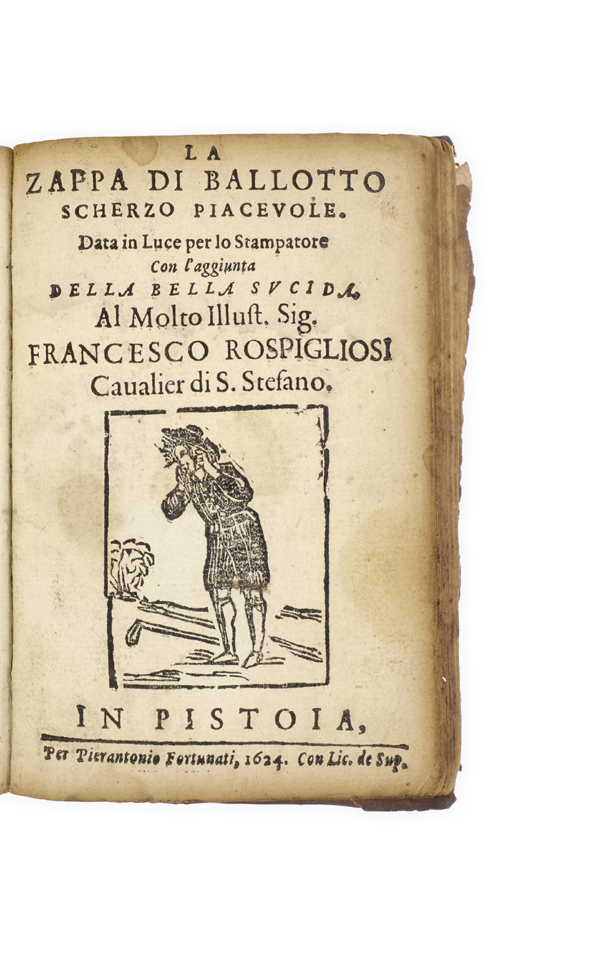
[COMANDI, Vincenzo.] La zappa di Ballotto scherzo piacevole. Data in luce per il stampatore con l’aggiunta della bella sucida. Pistoia, Pierantonio Fortunati, 1624.Three works in one vol., 8vo, I: ff. 35, [1 (blank)]; woodcut Baldini device depicting Daedalus to title and his device of Hercules killing the Hydra above colophon, woodcut initials, typographic ornaments; final blank slightly torn with small ink stain; II: ff. [34, last leaf blank]; woodcut printer’s device to title-page, woodcut initial; slightly soiled and browned; III: pp. 45, [3 (blank)]; woodcut illustration to title-page, woodcut initials, typographic cartouches and ornaments; lightly browned; good copies bound in seventeenth-century vellum over pasteboard, spine with ink lettering ‘Rime’ and inventory number 24, manuscript fragments used as spine lining; binding darkened, lower cover defective at foredge, head of spine and head of upper cover slightly defective, front flyleaf removed.
First editions of three poetical works printed in Ferrara, Florence, and Pistoia, the first two rare examples of poesia fidenziana, a genre of Italian satirical poetry particular to the mid-sixteenth century, and the third work a seemingly unrecorded piece of poesia bernesca and one of the earliest Pistoia imprints.
Antonio Maria Garofani was a cleric at the Pallavicino court in Soragna, and the Florentine Giovanni Maria Tarsia (fl. 1564–1607) is better known for his funeral oration on Michelangelo. Garofani’s Hippocreivaga musa, a poem in 187 verses of ottava rima, is a mad compilation of myths and fables; Tarsia’s Itinerario in lingua pedantesca is a long account in terza rima of a pedant’s journey, ending in Pisa where he is mocked by scholars. These two works are both written in poesia fidenziana, named for Camillo Scroffa’s Cantici di Fidenzio (1562) which ridiculed this excessive use of Latinisms. An earlier example of Italian written with such Latinisms is the Hypnerotomachia Poliphili (1499), though it later became used, as here, as a means of ridicule.
The third publication is a piece of humorous ‘Bernesque’ poetry in ottava rima. La zappa di Ballotto was attributed by Capponi (in his Biografia pistoiese, 1878) to Vincenzo Comandi of Pistoia (born 1585), a cleric who also wrote religious theatrical works; other unpublished verses of his, some of an anti-Jesuitical tendency, are in the Biblioteca comunale Forteguerriana of Pistoia. Pierantonio Fortunati was active as a printer from around 1622 to 1668, in Pistoia and Florence, specialising in chapbooks; this is one of his earliest productions. In his preface, addressed to Francesco Rospigliosi, he confesses that he is printing these juvenile verses without the author’s permission, which is why they are anonymous. The earliest Pistoia imprint dates to 1614.
Rare. We have located three copies of Garofani and Tarsia in the US and UK combined (both are in the British Library and Yale, the former is in the Folger, and the latter in the Bodleian). We have not been able to locate any copies of this or any other edition of La zappa di Ballotto.
Garofani and Tarsia: EDIT16 CNCE 20437 & 33632; USTC 831865 & 858094.