With Rare and Unrecorded Variants
GOFFE, Thomas.
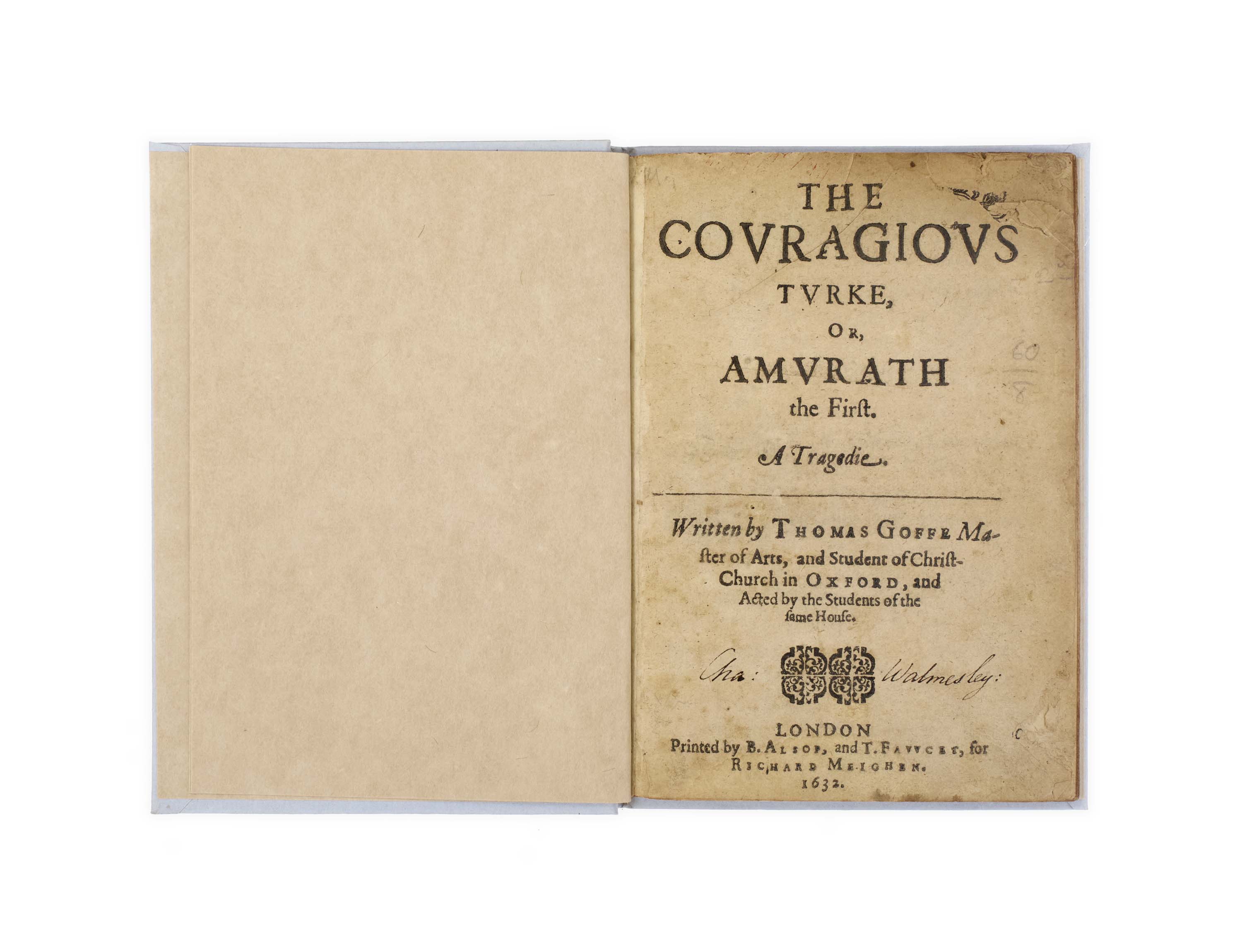
The Couragious Turke, or, Amurath the First. A Tragedie. London, Bernard Alsop and Thomas Fawcett for Richard Meighen, 1632.
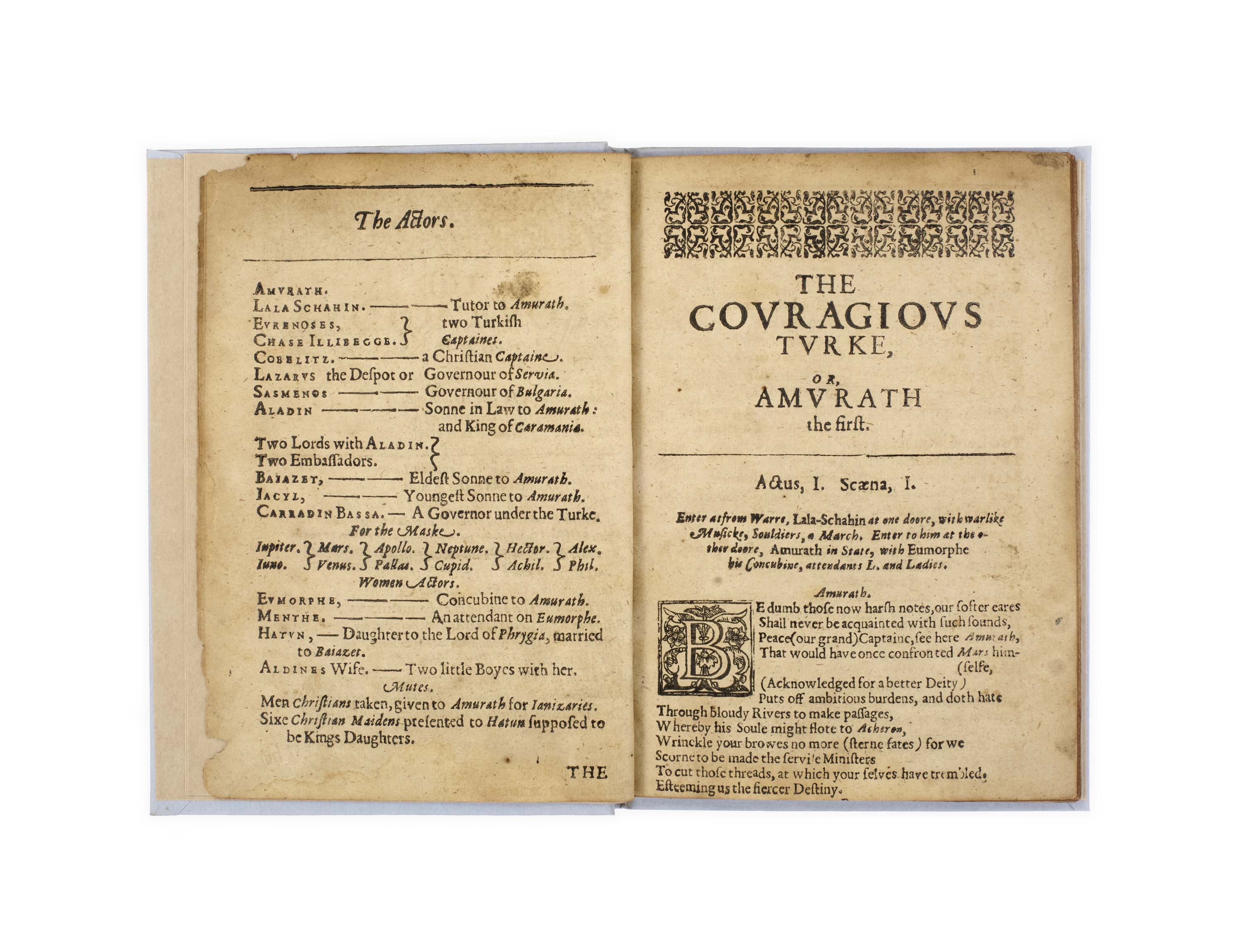
Small 4to, pp. [64]; woodcut initials, headpieces, and factotum initial at beginning; title-leaf and four leaves following gnawed at outer corners with loss to one word on A2, worming to outer head of first 14 ff. touching one word of title, tear to fore-edge of E2 affecting a handful of words, a few side-notes and direction lines cut into, text shaved but intact at tail on B1v, a few minor spots, browning to edges throughout; in recent light blue paper over boards; ownership inscription of Charles Walmesley to title.
First edition of this violent Near Eastern tragedy influenced by Marlowe and Shakespeare, this copy with rare and unrecorded issue points.
Written and first performed at Christ Church, Oxford in 1618, the play was based on Richard Knolles’s Generall Historie of the Turkes (1603), one of the first discussions of Turkey in English. It was a sequel of sorts to Goffe’s earlier and similarly bloody work The Raging Turke, based likewise on Knolles but considerably cruder.
The Couragious Turke is set in the reign of Murad I (1362–89), Sultan of the Ottoman Empire, here called Amurath the Turk. The role, reminiscent of Marlowe’s Tamburlaine ‘with its mixture of eloquence and cruelty’ (ODNB), was apparently played at the premiere by Goffe himself. The play opens with Amurath’s campaign in Greece, which he conquers but where he also finds distraction in the form of Eumorphe, a Greek concubine, whom he marries. Their relationship marks ‘the earliest dramatic treatment of the Mahomet–Irene story’ involving a sultan tempted by an ill-fated Greek mistress, a trope later put to use in Samuel Johnson’s Irene (Bentley IV, p. 506).
Amurath is torn between military duty and his newfound love. In an effort to sway him, the sultan’s tutor Lala-Schahin visits their wedding bed dressed as the ghost of Amurath’s father, rebuking the sultan for his neglect of the empire. In a clear echo of Othello, Amurath beheads his sleeping wife and turns back to his conquest of Europe. The rest of the play concerns his campaigns, largely successful, against a divided Christendom. These culminate in the Battle of Kosovo – an event of lasting resonance in the modern-day Balkans – in which Amurath is victorious but, ignoring a portent, gives mercy to a Christian general by whom he is then stabbed. The play ends with the accession of Amurath’s son, Bajazeth (Bayezid I), who strangles his brother to stave off rebellion.
Recent scholarship finds the play nuanced and often sympathetic in its portrayal of the Ottomans. Though violent, The Couragious Turke does not depict its Turkish characters as naturally and wantonly bloodthirsty – in marked contrast to Knolles. ‘It is certainly difficult to read this play’s protagonist as a one-dimensional stock Turk’, and its frequent classical allusions would have likely caused the Oxford men in Goffe’s audience to be ‘drawn to Amurath’s court as a place with which they shared cultural reference’. Ultimately Goffe ‘challenges them to see his raging and courageous medieval Turks as in many ways men like them’ (Dutton, pp. 181, 186).
Both of Goffe’s Turkish plays were printed posthumously – in quick succession, to be ‘neerer allyed, even as Twins in this their second birth’ (epistle dedicatory to this edition) – and were sold by Richard Meighen, involved at the time in the publication of the Second Folio of Shakespeare (1632). Though manuscripts survive (one of them in Goffe’s hand), David Carnegie chose the present edition of The Couragious Turke as the copy text for his Malone Society edition, collating ‘[a]ll known extant copies’ (though not ours) and finding a host of variants, sometimes in three states. Our copy preserves a number of uncorrected, first-state readings, namely for all of gathering E, the inner forme of G (known to Carnegie in only five copies), and all of B save the catchword of B3v – this last a combination unrecorded by Carnegie. Ours is also only the third known copy with the catchword of H2r intact, the first being at Folger and the second, unknown to Carnegie, sold by Quaritch in 1996.
Provenance: Charles Walmesley, likely the English Benedictine, mathematician, and natural philosopher (1722–1797), regarded for his consecration of the first Bishop of Baltimore as ‘the father of the Roman Catholic hierarchy in the United States’ (ODNB).
ESTC S122361; Greg 458(a); STC 11977. See Dutton, ‘“Looking after them, reading in Homer”: Thomas Goffe’s Turk Plays in Oxford’, in European medieval Drama 22 (2018).