Annotated Armorial
GUILLIM, John.
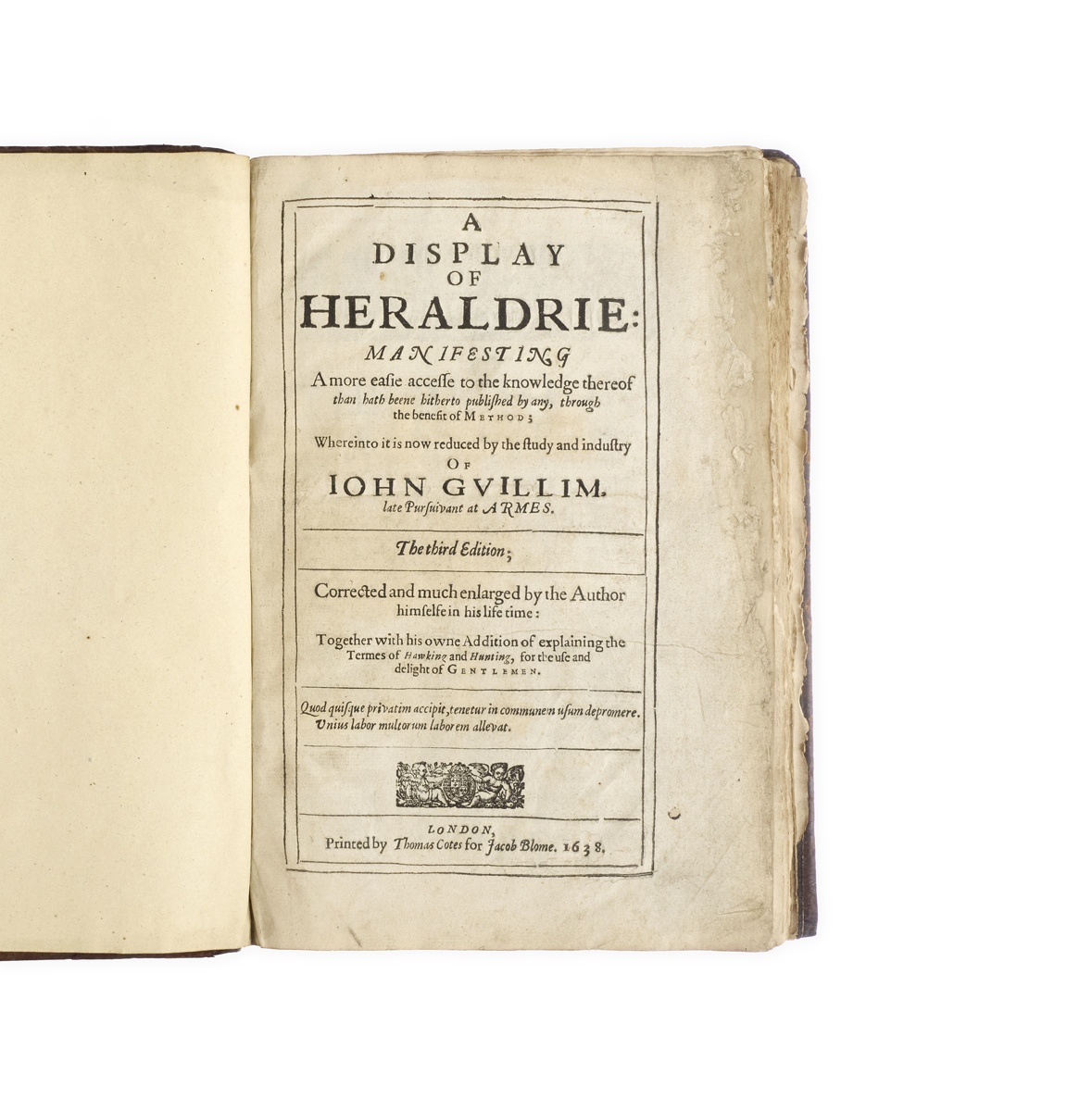
A Display of Heraldrie: manifesting a more easie Accesse to the Knowledge thereof than hath beene hitherto published by any, through the Benefit of Method … corrected and much enlarged by the Author himselfe in his Life Time: together with his owne Addition of Explaining the Terms of Hawking and Hunting, for the Use and Delight of Gentlemen. London, Thomas Cotes for Jacob Blome, 1638.
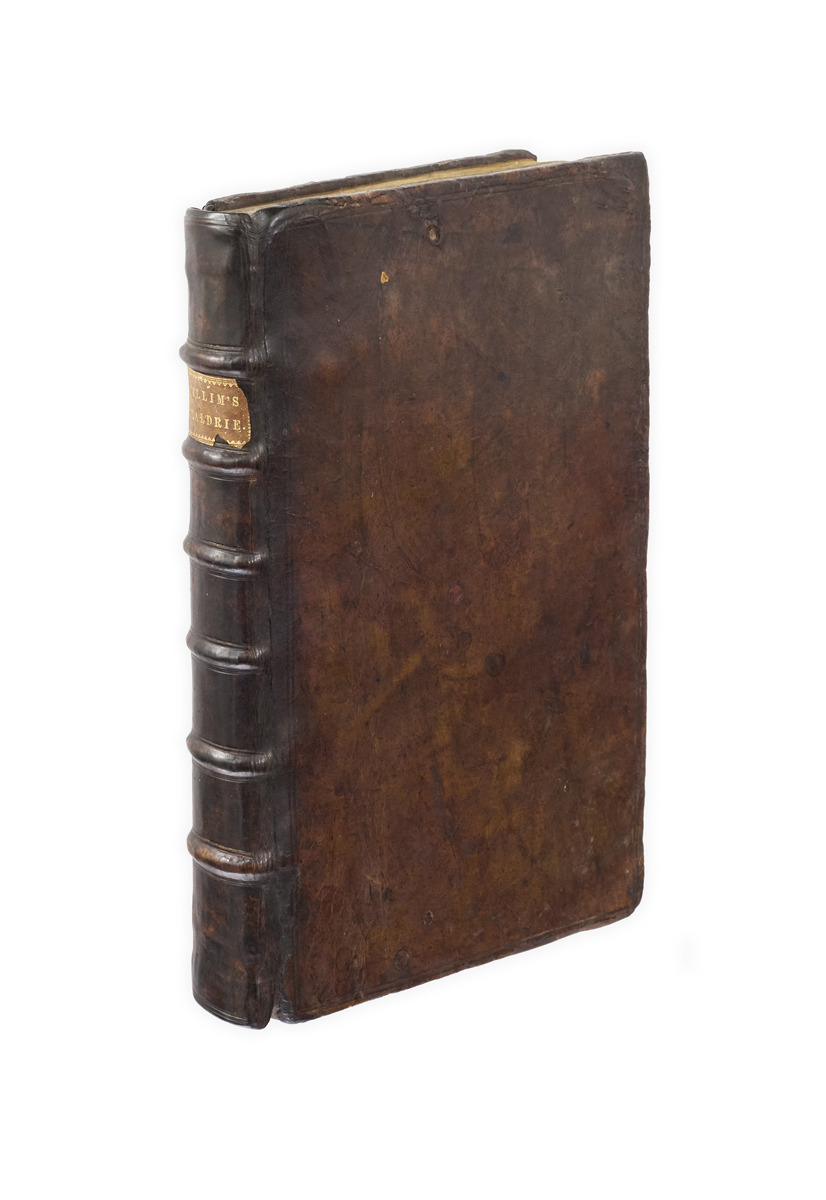
Folio in 4s, pp. [xvi], 167, 170–430 (of 433); wanting Hhh5–6 (‘Additions to be inserted and Amendments …’); woodcut initials, head-, and tailpieces, and illustrations (chiefly coats of arms) throughout, with 9 large woodcut achievements; minor stains, soiling, and browning throughout, some fore-edges frayed, title crudely repaired at fore-edge, occasional minor worming to margins, a few tears, final quires a little loose, Bb4 and Hhh1 partly detached; else a good copy in contemporary calf, covers tooled in blind with a double-fillet border; rebacked with old gilt title-piece laid down, a few scuffs; nineteenth-century armorial bookplate of Edward Francis Witts to front pastedown, manuscript annotations throughout in a (near-)contemporary and an eighteenth-century hand (see below).
Added to your basket:
A Display of Heraldrie: manifesting a more easie Accesse to the Knowledge thereof than hath beene hitherto published by any, through the Benefit of Method … corrected and much enlarged by the Author himselfe in his Life Time: together with his owne Addition of Explaining the Terms of Hawking and Hunting, for the Use and Delight of Gentlemen.
Third edition, corrected and enlarged, of this cornerstone of English heraldry; this copy annotated throughout in two hands, each showing close engagement with the blazon expounded by the text.
Compiled by the herald John Guillim (1550–1621), Portsmouth Pursuivant-Extraordinary and later Rouge Croix Pursuivant at the College of Arms, the Display of Heraldrie was the first attempt in English to methodise the science of heraldry. ‘The Display, which quotes earlier English and continental writers, is divided into six sections of which the first commences with the origins of heraldry, the second contains the basic divisions of the shield, the third and largest describes natural as compared to man-made charges, which are in the fourth section, the fifth has patterned coats without a predominant tincture, and the sixth deals with marshalling of arms. … [It] was to remain the standard textbook on English heraldry until the second half of the eighteenth century, and it is still regularly used by working heralds in the twenty-first century’ (ODNB).
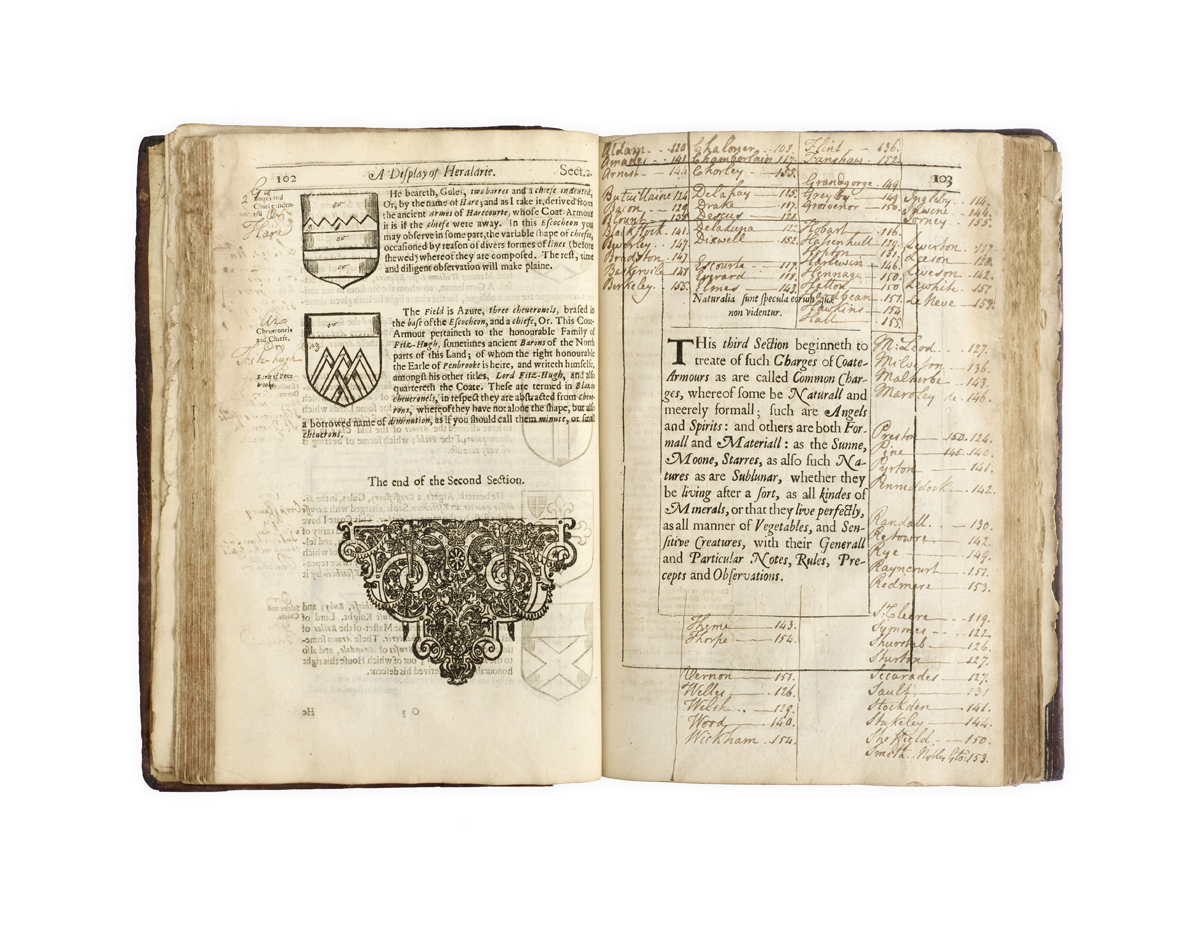
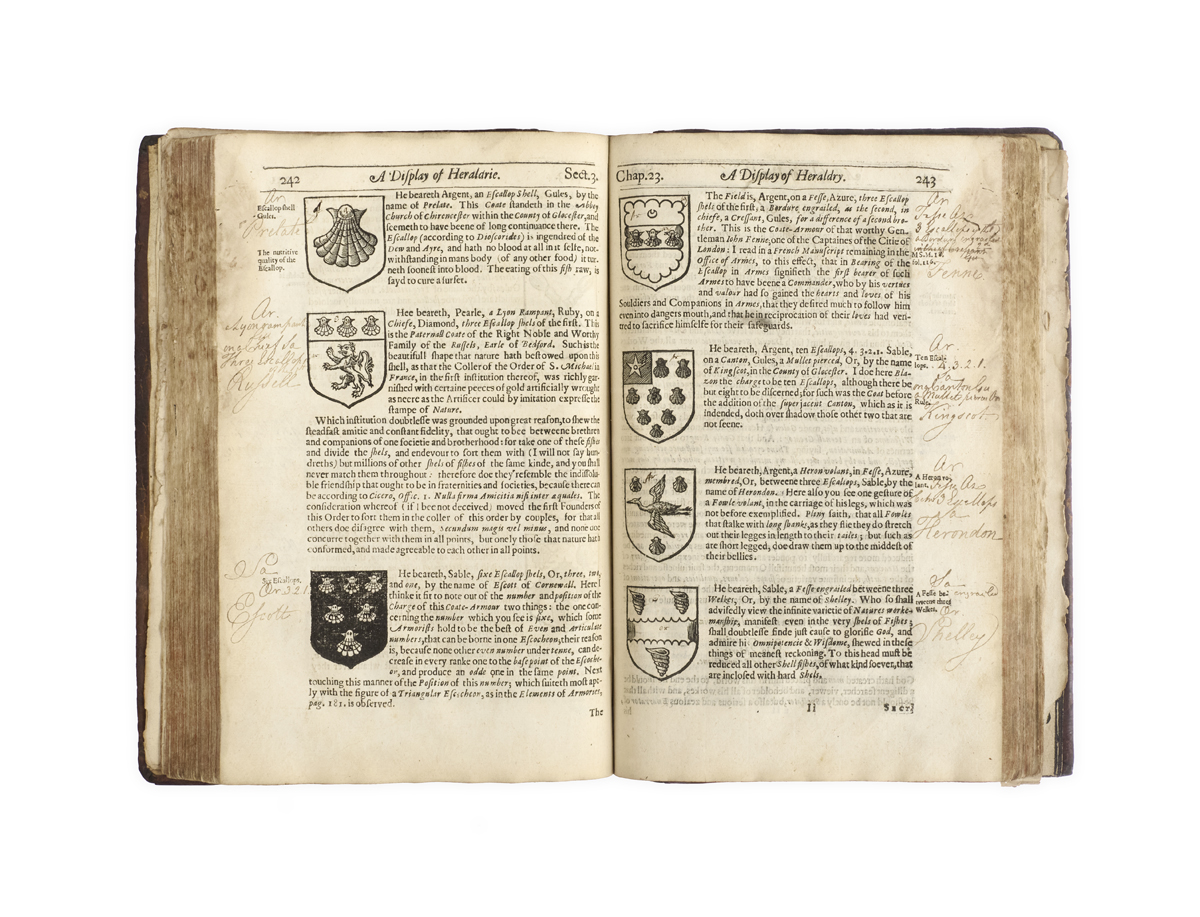
The present copy bears the manuscript additions of at least two attentive readers of the seventeenth and eighteenth centuries. The earlier of these owners, writing in a roughly contemporary secretary hand, has annotated virtually every coat of arms (of which there are often three or four to a page) with abbreviated tinctures, e.g. ‘az’ for azure’ and ‘g’ for ‘gules’. This was likely the same assiduous reader who corrected ‘Glocester-shire’ to Wiltshire on p. 284 and added a rhyming Latin proverb about chance to a section about the canting arms of the Ambesace (i.e. ames-ace) family (‘Or, three Dice, Sable, each charged with an Ace, Argent’), in which Guillim also condemns dice-playing as ‘a Spurre to wickednesse, and the roadway to desperation’.
Our later, eighteenth-century owner has supplemented these by summarising each entry with the blazon and name of the family in question and by adding four comprehensive family indices.
Provenance:
With the bookplate of Edward Francis Witts (1813–1886), son of the clergyman and diarist Francis Edward Witts (1783–1854) and his successor as rector of Upper Slaughter, Gloucestershire.
ESTC S120342; Moule, Bibliotheca heraldica CXLIV; STC 12503.