Induced Innovation
HICKS, J. R.
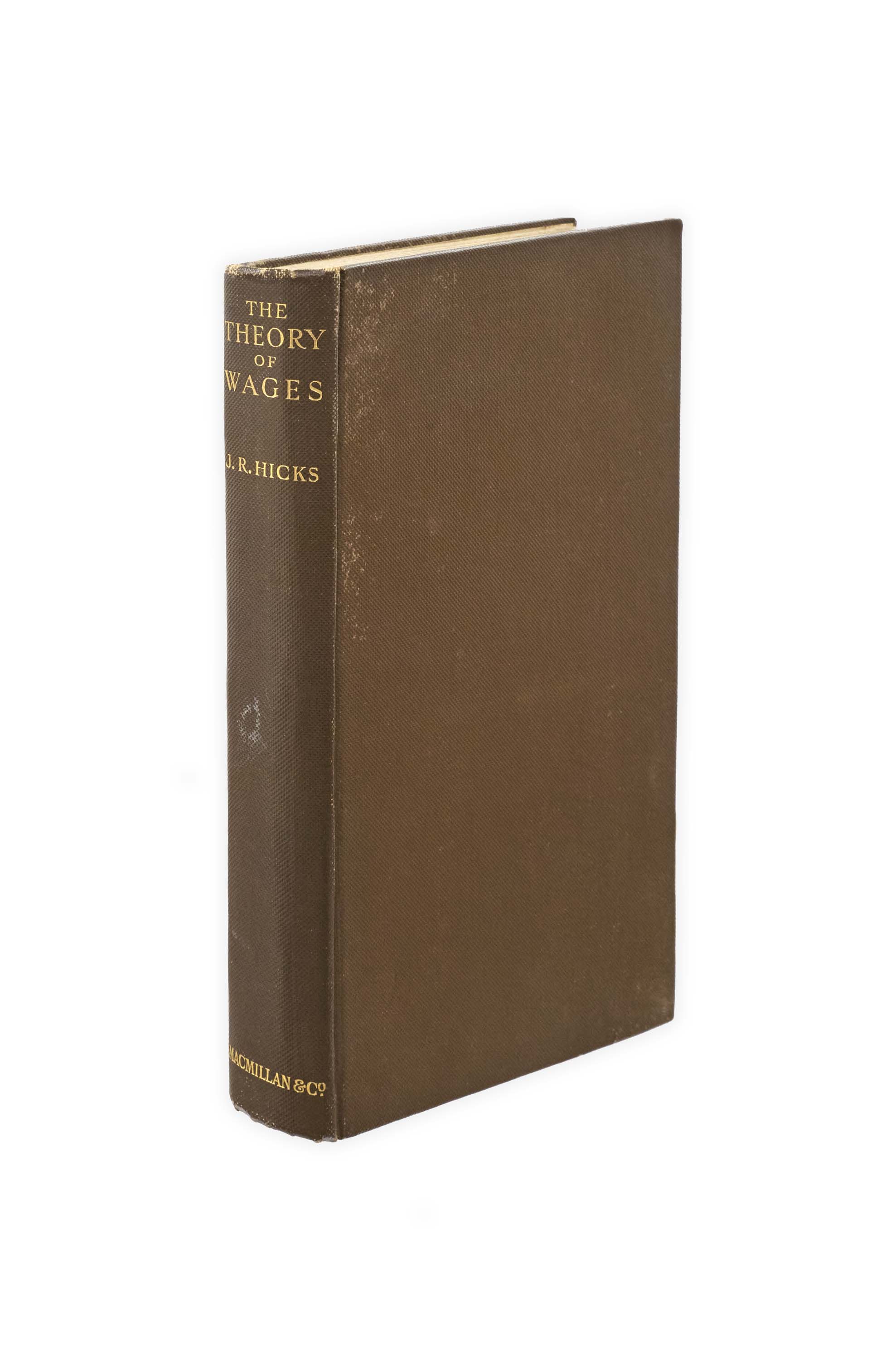
The Theory of Wages. London, MacMillan and Co, 1932.
8vo, pp. xiv, 247, [1, blank]; a very good, clean copy in the original publisher’s brown cloth, gilt lettering to spine; without dust jacket; corners and spine ends a little rubbed; school library stamp to title (Welwyn Garden City Grammar School); ownership inscription of Roger Carter, St John’s College, Cambridge, to the front free endpaper.
First edition, scarce on the market, of a classic microeconomic analysis of wage determination in competitive markets.
Hicks’s first book, it examines the forces of supply and demand that govern the general level of wages; after a reformulation of the marginal productivity theory of wages, it offers a full exploration of the regulated labour markets. Among the pioneering concepts and methodologies introduced in this work is the first appearance of the hypothesis of ‘induced innovation’, which Hicks formulates thus: ‘a change in the relative prices of the factors of production is itself a spur to invention, and to invention of a particular kind—directed to economizing the use of a factor which has become relatively expensive’. This hypothesis is now aiding the modelling of policies seeking to perfect strategies on climate change globally. Hicks went on to be awarded the Nobel Prize in Economic Sciences in 1972.
Blaug, Great Economists since Keynes, pp. 105 ff.