Creating the Perfect Wife: Kidnapping, Pistols, and Illegal Adoption
[KEIR, James.]
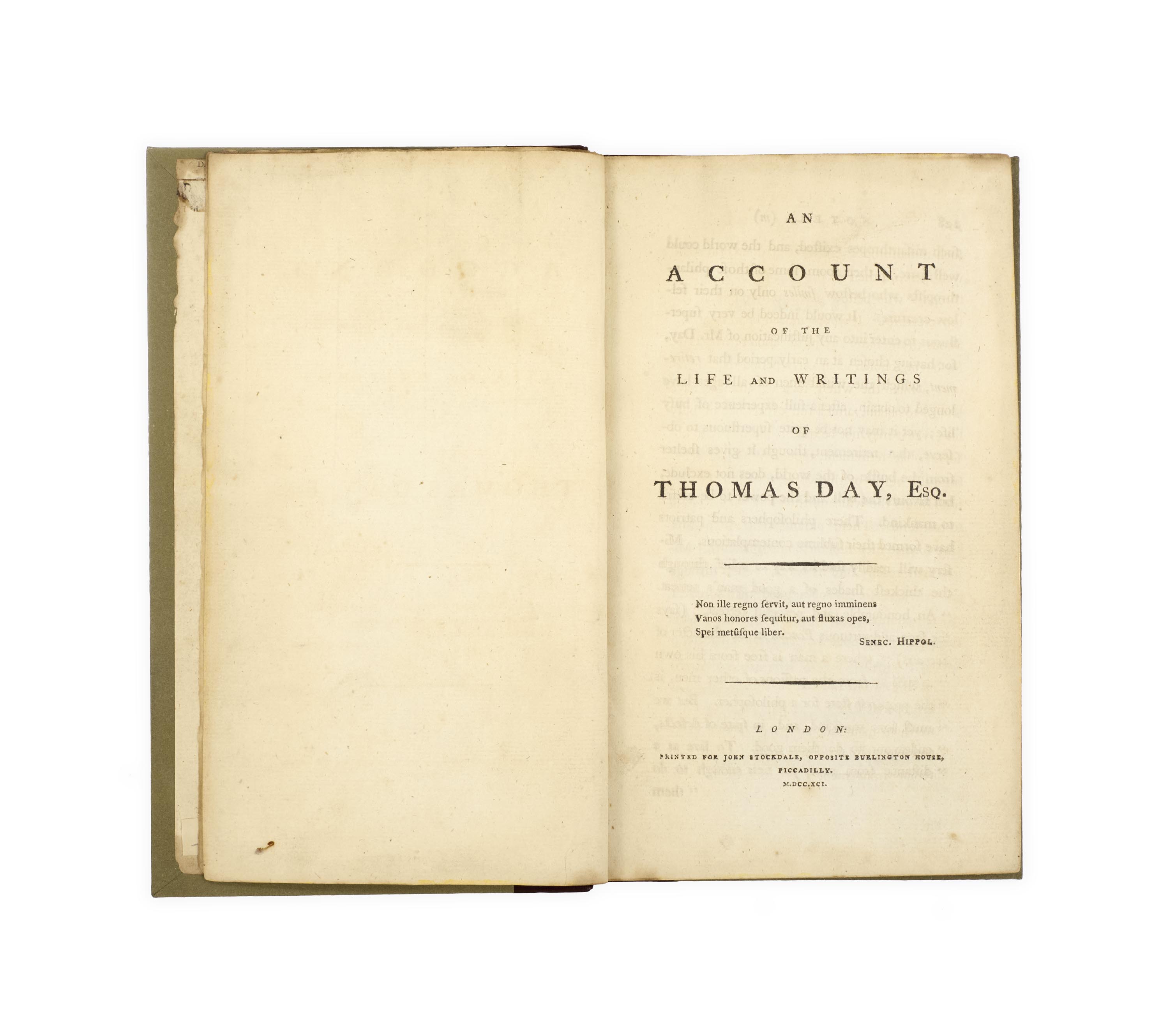
An Account of the Life and Writings of Thomas Day, Esq. London, printed for John Stockdale, 1791.
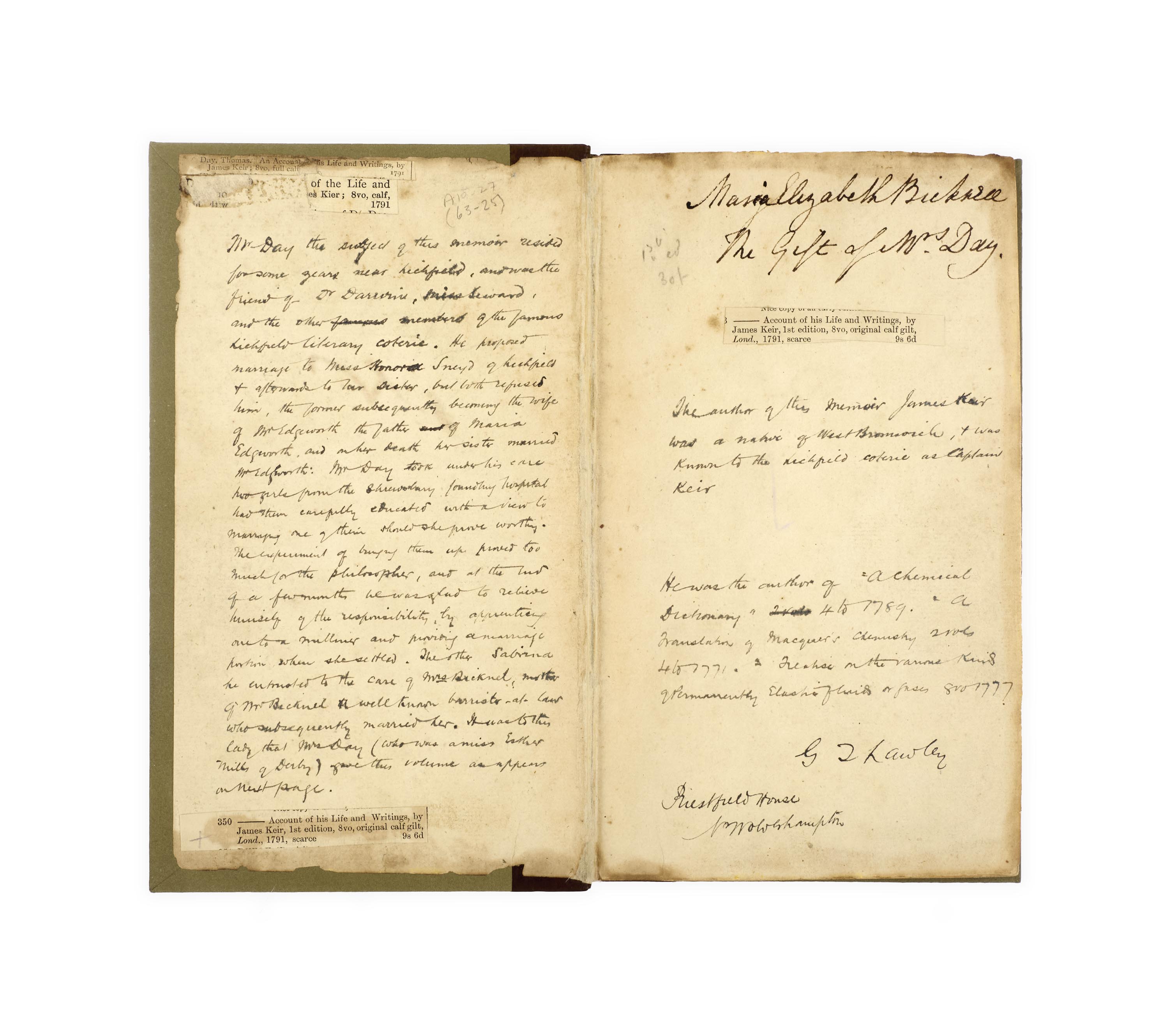
8vo, pp. iii, [1, blank], 144; uniformly toned, else a good copy; bound in modern calf-backed boards with green paper sides, spine lettered directly in gilt; contemporary inscription ‘Maria Elizabeth Bicknell | The Gift of Mrs Day.’ to front free endpaper (see below), later ink notes by G.T. Lawley to front pastedown and his ownership inscription to front free endpaper; manuscript authorial corrections to pp. 3, 24, 25, and 59.
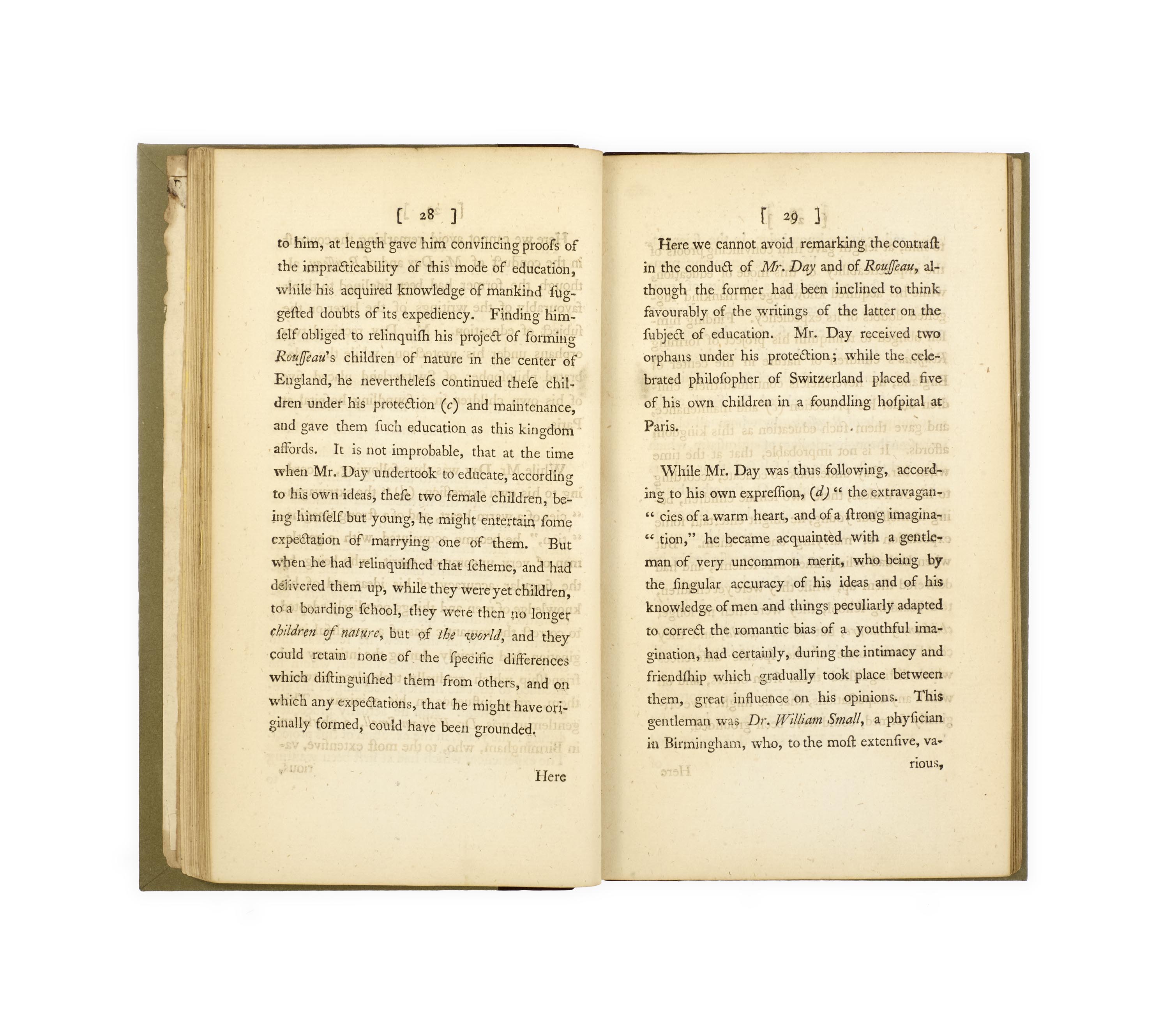
First edition of this biography of Thomas Day – notorious for his unsuccessful experiment in which he adopted two foundling girls, aged eleven and twelve, educating them in isolation in France according to Rousseau’s methods in the hopes of shaping the ideal wife and marrying the more successful of the two – a remarkable association copy, presented by Day’s widow Esther, the dedicatee, to her friend Maria Elizabeth Bicknell, mother-in-law of John Constable and sister-in-law of Sabrina Sidney, the subject of Day’s experiment.
Thomas Day, advocate for the abolition of slavery and for American independence and author of the celebrated didactic children’s novel The History of Sandford and Merton (1783–1789), was a friend of Richard Edgeworth and a member of the Lichfield Lunar Society (led by Erasmus Darwin and counting Josiah Wedgwood, Joseph Priestley, and the author of the present work amongst its members). After visiting Rousseau with Edgeworth and helping his friend to educate his son in the manner of Rousseau’s Emile, Day – then aged twenty-one – decided to replicate the experiment with two orphaned girls as subjects in the hope of shaping one of them into the ideal wife, having recently been rejected both by the writer Honora Sneyd and her sister. In 1769, using Edgeworth’s name, Day adopted two orphaned girls under the pretence of taking them on as housemaids, becoming a member of the governing board of the Foundling Hospital after making a fifty-pound donation.
After changing their names to Lucretia and Sabrina, he swiftly kidnapped both girls to France, where he stripped them of contact with the outside world, refused to teach them French, and employed only French-speaking staff (Keir adds a note on Day using a pistol to threaten an officer who had attempted to speak to the girls, p. 110). After deeming Lucretia ‘invincibly stupid’, he sent her to work for a milliner and continued the experiment with Sabrina, by this time thirteen years old, sequestering her at his home in Lichfield and ‘conducting some extraordinary experiments to test her hardiness, which included dropping hot sealing wax on her arm and firing a pistol at her skirts’ (ODNB).
Sabrina briefly lodged with the mother of Day’s friend, the barrister John Bicknell, and Edgeworth persuaded Day to send Sabrina to boarding school shortly thereafter; upon her return at the age of seventeen, Day proposed marriage, although their engagement was broken off when he flew into a rage over the style of one of her dresses. Despite having helped hand-pick Sabrina from the Foundling Hospital with Day, Bicknell revealed to her the motives behind Day’s experiment, and they married in 1784; following Bicknell’s death, Sidney worked as a housekeeper for the historian Charles Burney. Day had by this time married the poet and heiress Esther Milnes, whom he forced to ‘surrender her poetry, harpsichord, and friends to comply with [Day’s] demands’ (ODNB).
As well as an account of Day’s experiment (here portraying Day rather favourably), Keir’s biography also features a list of Day’s publications, anecdotes about Day’s childhood, several of his poems, and extracts from his letters.
Provenance:
1. Presented by Milnes to Maria Elizabeth Bicknell, brother of John Bicknell and sister-in-law of Sabrina Sidney. Maria Elizabeth Bicknell was the mother of Maria Bicknell and mother-in-law of the painter John Constable.
2. With the ownership inscription and manuscript notes of antiquarian bookseller George T. Lawley of Wolverhampton, notable for having acquired the personal library and papers of William Hone.
ESTC T18802.